
Floating Dock Anchoring Made Easy (Even If You're Not Handy)

First Things First: Why Proper Anchoring is Non-Negotiable
If you own a waterfront property on Long Island, knowing how to anchor floating dock systems effectively is absolutely vital.
Why is floating dock anchoring crucial for your property?
- Stability & Safety: A properly anchored dock stays put, preventing dangerous drifting and ensuring a secure platform for everyone.
- Investment Protection: It safeguards your significant investment in the dock itself, and any boats or personal watercraft moored to it.
- Weather Resilience: Anchoring allows your dock to adapt to changing water levels, strong winds, and powerful currents.
- Damage Prevention: It protects your dock from potential harm caused by boat wakes, shifting ice, severe storms, and floating debris.
Poorly anchored docks can quickly become a problem. They can drift, suffer damage, or even pose a hazard to navigation. A well-secured floating dock, however, provides peace of mind and proves its worth, especially when the weather turns. In fact, properly anchored floating docks can help protect boats during hurricanes, unlike stationary ones.
This guide will walk Long Island homeowners and commercial property owners through the essential steps to secure their waterfront investments with confidence.
Quick anchor floating dock definitions:
Choosing Your Anchoring Strategy: Key Factors to Consider
Before you dive into the specifics of how to anchor floating dock systems, let's talk about something crucial: there's no magic, one-size-fits-all solution. The best anchoring strategy for your floating dock depends entirely on your unique waterfront environment. Think of it like choosing the right foundation for a marine structure – what works in calm waters might not work in dynamic coastal conditions!

When we assess a waterfront property in Nassau or Suffolk County, we start by understanding your water body type. Is your dock going on a peaceful pond, a busy river with strong currents, or Long Island's dynamic coastline with tides and waves? The bigger and more exposed your water body, the more challenging the conditions – and the stronger your anchoring system needs to be.
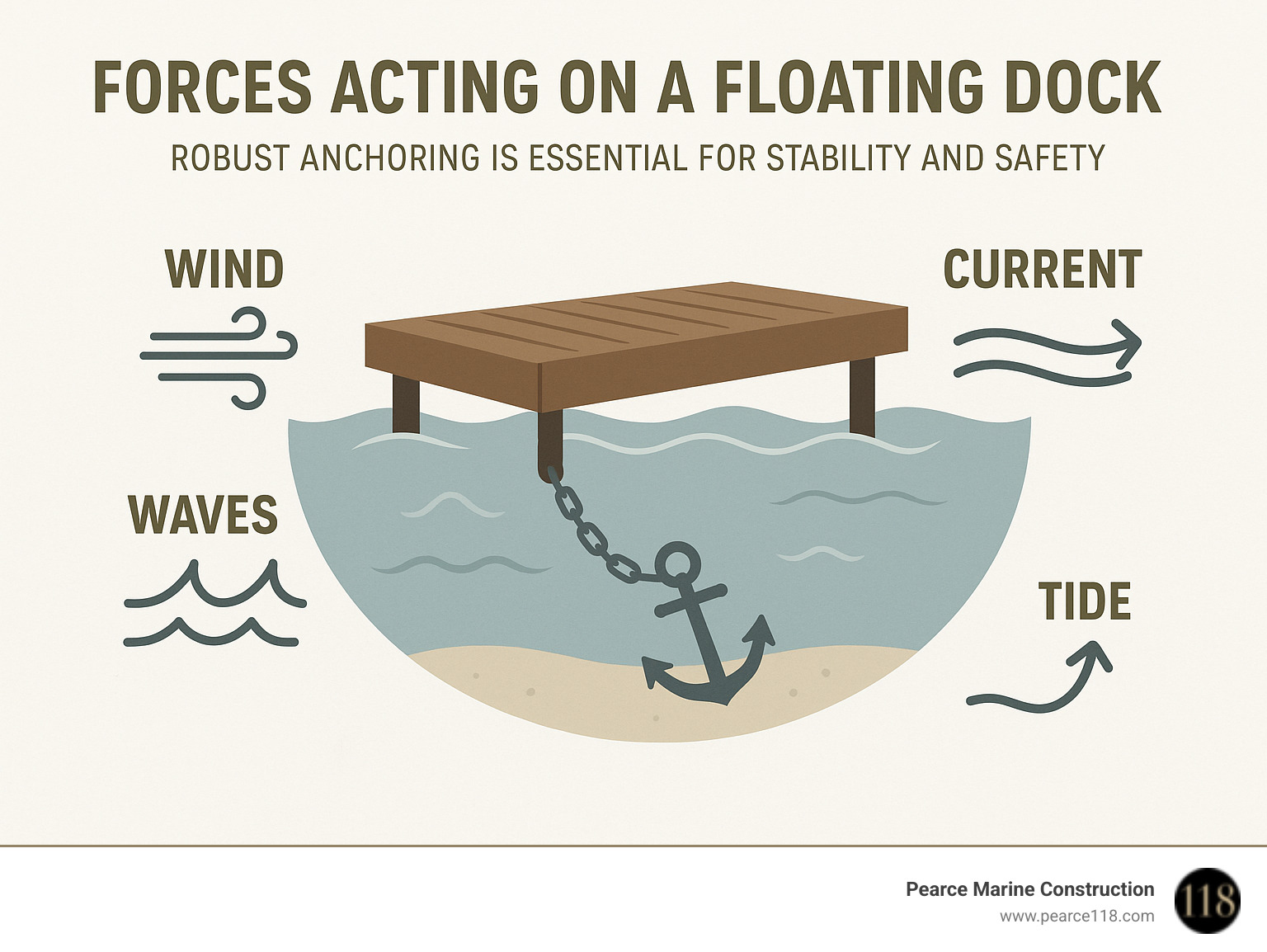
Water depth and how much it changes throughout the day, season, or year plays a huge role too. While floating docks are designed to rise and fall with water levels, your anchors need to stay effective whether the water is at its highest or lowest point. Tides and currents add another layer of complexity, constantly pushing and pulling on your dock with surprising force.
The wave action your dock will face varies dramatically depending on your location. A dock in a protected cove faces gentle ripples, while one on the open water might battle significant waves during storms. Seabed composition matters just as much – soft mud, hard sand, rocky bottom, or clay all require different anchor types to get a solid grip.
Don't forget about your dock size and weight and how you plan to use it. A small dock for launching kayaks needs far less anchoring power than a large platform designed for multiple boats. Your intended use – whether it's quiet family time or busy commercial activity – directly impacts how stable your dock needs to be.
Here on Long Island, we know local weather conditions can be unpredictable. Summer thunderstorms, powerful nor'easters, and even the occasional hurricane all test your anchoring system. We've seen what happens when docks aren't properly secured for our unique coastal conditions – it's not pretty!
Understanding these factors is the foundation of a successful floating dock installation. It helps us determine exactly which anchoring method and materials will keep your investment secure for years to come. For more detailed guidance on these considerations, you can find more info about floating dock anchoring in our resources.
The Ultimate Guide to Floating Dock Anchoring Systems
Once we understand your unique waterfront environment, we can explore the different types of anchoring systems available. Each has its strengths and ideal applications, designed to keep your floating dock stable and secure.

The four primary methods to anchor floating dock systems are stiff arm anchoring, cable anchoring, pile anchoring, and pole & sleeve anchoring. Each serves different waterfront conditions and requirements. You can learn more about specific Floating Dock Anchoring Systems in our detailed guide.
Stiff Arm Anchoring
Think of stiff arm anchoring as giving your dock a direct, rigid connection to shore \u00113 like a sturdy bridge that flexes just enough to handle water level changes. Heavy-duty galvanized steel arms hinge at both ends, so the dock rises and falls but cannot drift.
Ideal for protected coves with minimal depth change, stiff arms deliver best lateral stability\u00112 perfect for loading heavy gear or accommodating frequent foot traffic.
Cable Anchoring
Cable anchoring is our go-to for deep water or large water-level swings. Heavy galvanized chains run from dock corners to substantial concrete deadweights on the bottom.

A crisscross layout spreads forces, while optional winches let you fine-tune tension. The system flexes with waves and tide yet holds firm against current and boat wakes, making it a favorite throughout Long Island.
Pile Anchoring
Need maximum security? Drive wood, steel, or concrete piles deep into the seabed, then attach adjustable pile brackets so the dock rides up and down but cannot wander. Pile anchoring withstands big tides, ice, and commercial loads \u00112 the ultimate long-term solution for demanding sites.
Pole & Sleeve Anchoring
Pole & sleeve systems strike a balance between simplicity and strength. Smaller diameter poles are driven into the bottom; the dock slides on sleeves around each pole. It works well in moderate depths (up to roughly 15 ft of fluctuation) and high-wind areas where a little give helps absorb wave energy.
How to Anchor a Floating Dock: A Step-by-Step Guide
Once you've chosen the right anchoring method for your Long Island waterfront, it's time to get down to the practical steps of installation. While each method has its nuances, there are general principles we follow to ensure a secure and lasting installation. Proper site assessment and safety precautions are paramount throughout this process. You can find our comprehensive guide on How to Anchor a Floating Dock for more details.

Gathering Your Tools and Materials
Having the right marine-grade tools and materials is critical for a successful and durable anchoring system. Don't cut corners here; the harsh marine environment of Long Island demands the best!
We recommend:
- Concrete Anchors (Deadweights): These are the most commonly used anchors. For most floating docks, a minimum of 600 lbs of anchoring weight is recommended at each corner at the very end of the dock. For docks closer to shore, 450 lbs of anchoring weight is recommended on each side. A 150 lbs anchor weighs roughly half when submerged in water due to Archimedes’ Principle. This means a 600 lb underwater anchor would require about 1,200 lbs of concrete above water.
- Galvanized Steel Chains: These are essential for connecting your anchors to the dock. Galvanized steel is crucial for preventing corrosion in saltwater environments.
- Shackles, Quick Links & Eyebolts: These are your connecting hardware. Use heavy-duty, marine-grade components to ensure secure and reliable connections that won't fail under stress.
- Winches (for Cable Systems): If you're using a cable anchoring system, a robust winch will be necessary for tensioning and adjusting the cables.
For more information on selecting the right components, check out our guide on Dock Anchors for a Floating Dock.
Calculating Anchor Weight and Holding Power
This is where the science comes in! The goal is to have enough holding power to resist all the forces (wind, waves, current, traffic) acting on your dock.
- Weight Recommendations: As mentioned, for most floating docks, we recommend a minimum of 600 lbs at the furthest corners. For traditional straight standing docks, a minimum of 450 lbs of anchoring weight is recommended at each corner. It's also recommended to anchor your dock every 24 to 30 feet for stabilization.
- Archimedes’ Principle: This principle reminds us that objects weigh less in water. A 150 lbs anchor weighs roughly half when submerged. So, if you need 600 lbs of effective holding power underwater, you'll need to use an anchor that weighs approximately 1200 lbs on land.
- Total Weight Rule: A good rule of thumb is that the total weight of the anchorage should be at least twice the weight of the structure being anchored, and ideally three times (or more in severe conditions).
- Boat Size Impact: The size and number of boats mooring at your dock will significantly affect how much weight you need. Mooring several dozen kayaks is far less weight than mooring one pontoon boat.
Understanding these calculations ensures your dock stays secure, even in the face of Long Island's unpredictable weather. Learn more about Weight reduction in water explained by Archimedes’ Principle.
Planning Your Anchor Layout
The layout of your anchors is just as important as their weight. A well-planned layout distributes forces evenly and maximizes stability.
- Crisscross Layout: For improved durability and resistance to movement, especially in dynamic environments, a crisscross chain layout can be highly effective. This involves running chains diagonally from the dock corners to anchors positioned outside the dock's footprint.
- Scope and Chain Length: The "scope" refers to the length of your anchor line or chain from the anchor to the dock. Anchors have the most holding power when the angle from the anchor to its attachment point is around 45 degrees. It's crucial not to cut anchor chains too short, as this can cause tension and stress. Leave extra chain length for slack or to allow the dock to rise and fall with water level changes. Tension cords can also be used to improve flexibility and stability.
- Symmetrical Placement: Aim for symmetrical placement of your anchors to distribute forces evenly across the dock and prevent tilting or uneven stress.
- Stabilization Spacing: For overall stabilization, implement an anchoring method every 24 to 30 feet along the dock's length.
Proper planning of your anchor layout will ensure your dock remains stable and secure. You can find more insights on How Do You Anchor a Floating Dock in our detailed guide.
The Installation Process
With your materials ready and your layout planned, it's time for installation. This is where meticulous execution pays off.

- Prepare the Anchors: If you're using concrete blocks, attach the galvanized chains to them using shackles or eyebolts. We suggest you put a thick cardboard or piece of wood under the blocks to protect your decking when placing them on the dock.
- Position the Dock: Gently maneuver your floating dock over the desired anchor areas.
- Lower the Anchors: Carefully tip the anchor blocks into the water, holding the end of the chain. Guide them to their planned positions on the seafloor.
- Connect and Adjust Chains: Attach the chains to the appropriate connection points (cleats or specialized brackets) on your floating dock. Ensure you leave enough slack for the dock to rise and fall with water levels. You may need to cut chains to the correct length, saving a couple of extra feet for potential in-season adjustments.
- Gangway Connection: If you're connecting your floating dock to the shore with a gangway, ensure it's securely attached with hinges that allow it to pivot freely with water level changes. For ADA compliance, gangways should aim for a 1:12 slope (1 foot of length for every inch of height difference).
For comprehensive instructions on connecting your dock to the shore, refer to our guide on How to Anchor a Floating Dock to Shore.
Keeping Your Dock Secure: Maintenance and Common Mistakes
Installing a solid anchoring system is only half the job. Long Island\u0019s constantly changing tides, storms, and saltwater demand routine care so your dock stays safe and functional.

Common Pitfalls to Avoid
- Under-sized gear – non-marine hardware or light chains corrode quickly and fail under storm load.
- Too-short chain – creates constant tension; too long lets the dock wander. Aim for roughly a 45\u00176 chain angle at normal water level.
- Skipping inspections – small cracks or rusty shackles only get worse. A five-minute monthly check beats a mid-storm emergency.
- Ignoring permits – local regulations in Nassau and Suffolk Counties spell out setbacks, pile spacing, and eel-grass protections. Follow them from the start to avoid fines or forced removal.
Simple Maintenance Routine
- Inspect chains, cables, shackles, and pile brackets every season and after major storms.
- Tighten hardware and replace any part showing thinning, pitting, or deformation.
- Brush off light rust and re-coat with a marine-grade protectant.
- Adjust chain scope each spring and fall to match seasonal water levels.
- Keep sleeves or rollers free of sand and debris so the dock can slide smoothly.
A few proactive hours each year will add many years of worry-free service to your anchor floating dock system.
Frequently Asked Questions about Floating Dock Anchoring
How do you stabilize a floating dock?
Pick the right anchoring method for your site, balance the weight on the dock, give chains the correct scope (about a 45\u00176 angle), and check connections regularly. A crisscross cable layout is an easy upgrade that resists motion from any direction.
How much weight is needed to anchor a floating dock?
For most recreational docks, start with 600 lb of concrete weight at the outboard corners and 450 lb closer to shore. Remember concrete loses about half its weight when submerged, so a 600-lb underwater hold requires roughly a 1,200-lb block on land. Heavier boats, stronger current, or an exposed location warrant additional weight.
What\u0019s the best anchoring method for a river with strong currents?
We usually recommend a cable system with heavy upstream deadweights, or pile anchoring if the riverbed allows. Both provide strong lateral resistance while letting the dock rise and fall with changing flow. Whichever you choose, inspect hardware often\u0011fast-moving water accelerates wear.
Conclusion: Anchor Your Dock with Confidence
Well, we've certainly covered a lot of ground, haven't we? From understanding the dynamic forces at play on your Long Island waterfront to exploring the ins and outs of different anchoring systems, you now have a much clearer picture of what it takes to truly anchor floating dock systems with confidence.
Securing your floating dock isn't just about putting something heavy in the water; it's a critical investment in its longevity, stability, and your peace of mind. We've seen how choosing the right method – be it stiff arm, cable, pile, or pole & sleeve anchoring – is paramount. And we can't stress enough the importance of meticulous installation and consistent maintenance. Each piece of the puzzle, from understanding your Long Island waterfront's unique dynamics to selecting the perfect marine-grade materials, plays a vital role in ensuring a secure and lasting outcome.
While some of you might feel confident tackling a simpler dock anchoring project yourselves, let's be honest: our Long Island waters can be tricky! Complex environments, significant water level fluctuations, or simply the desire for absolute maximum security often call for a seasoned professional hand.
That's where Pearce Marine Construction comes in. As a woman-owned marine construction company deeply rooted in Nassau and Suffolk County, we bring generations of expertise and meticulous craftsmanship to every single project. We specialize in building and securing marine infrastructure like sturdy bulkheads and beautiful floating docks, ensuring they are not just protected, but optimized for our unique Long Island environment.
When it comes to your marine construction project, and to ensure your anchor floating dock is installed with the precision and durability it truly deserves, we invite you to explore our Boat Docks and Floating Docks Services. We're here to help you anchor your dock with confidence, providing peace of mind for years to come.
%20(1).avif)

Bring Your Vision to Life
Whether you're planning a custom dock, seawall, or boat lift, our experienced team is ready to deliver high-quality marine construction tailored to your needs. Pearce Marine Construction brings craftsmanship, precision, and a deep understanding of Florida’s waterways to every project. Let us help you create a durable, beautiful solution that stands the test of time. Get in touch now for a personalized estimate!