
Don't Get Boxed In: Unpacking Bulkhead Installation Costs


Understanding Marine Bulkhead Construction Costs on Long Island
Bulkhead installation cost on Long Island typically ranges from $500 to $1,200 per linear foot, influenced by materials, site conditions, and project complexity.
Quick Cost Breakdown:
- Wood Bulkheads: $500 - $700 per linear foot (15-20 year lifespan)
- Vinyl Sheet Pile: $700 - $1,000 per linear foot (50+ year lifespan)
- Steel/Concrete: $800 - $1,200+ per linear foot (30-50 year lifespan)
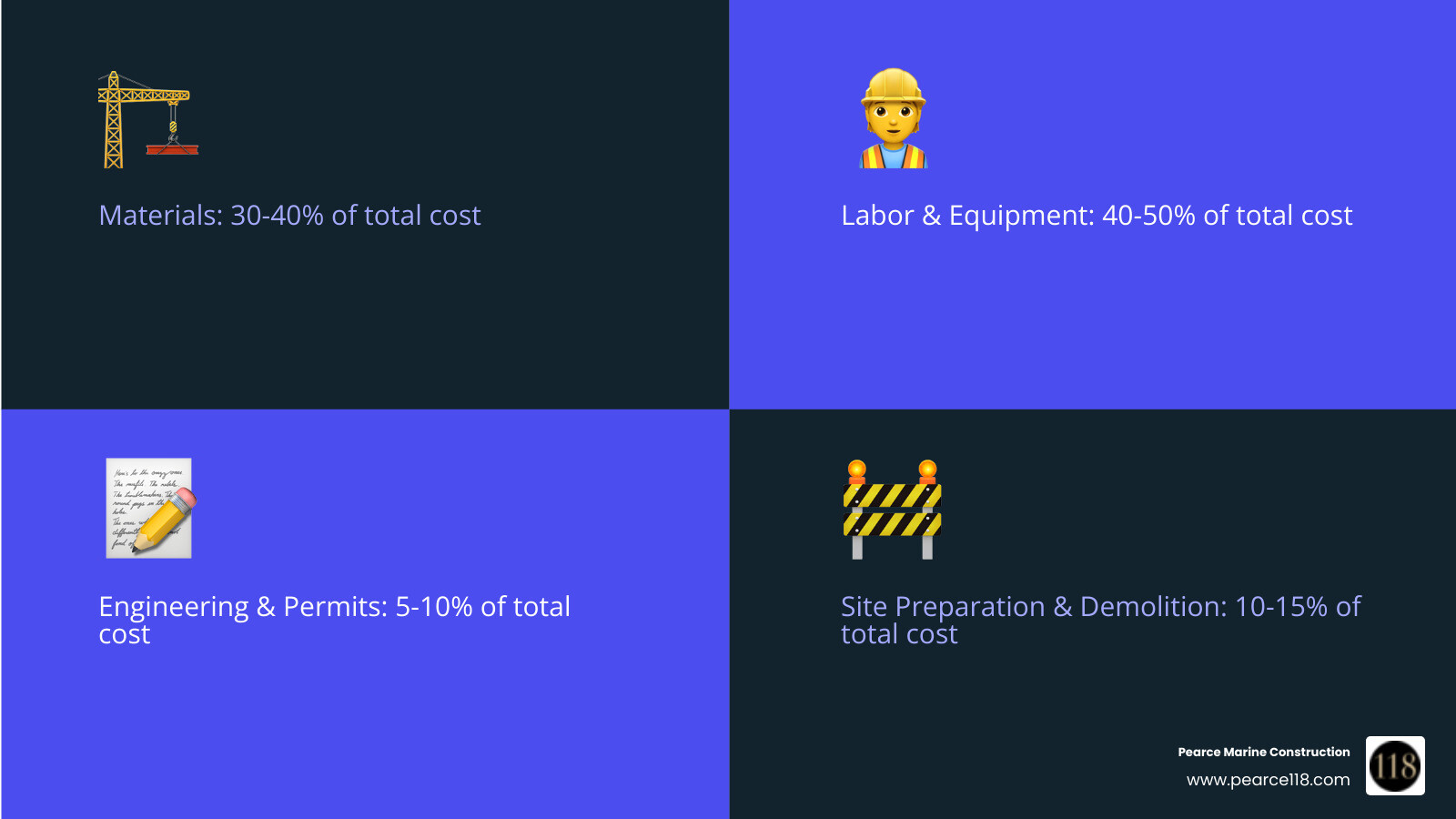
- Labor & Equipment: 40-50% of total project cost
- Engineering & Design: 5-10% of total project cost
For waterfront property owners on Long Island, a marine bulkhead is the primary defense against shoreline erosion. This vertical retaining wall protects your property from wave action and prevents soil loss. However, bulkhead installation is not a one-size-fits-all project. Costs vary based on material choice, site accessibility, soil conditions, and the engineering required for Nassau and Suffolk County's coastal environments.
A marine bulkhead is a complex infrastructure project requiring specialized equipment like pile drivers and marine barges. It involves deep foundation work and precise engineering to withstand Long Island's tidal forces and weather patterns.
This guide breaks down every cost factor—from materials and labor to site preparation—so you can budget accurately for your waterfront investment.
The Anatomy of a Bulkhead: A Complete Cost Breakdown
Planning a bulkhead for your Long Island property involves an investment of $500 to $1,200 per linear foot. This range reflects that every shoreline is unique. A bulkhead installation cost is not just for a wall; it's for an engineered system designed to withstand nor'easters, tidal surges, and saltwater exposure. The project scope, from a simple 50-foot wall to a complex 200-foot curved structure, significantly impacts the final price. For a deeper understanding of how these structures are engineered, see our guide on Marine Structures Design.

Material Costs
Materials account for 30% to 40% of your total bulkhead installation cost. Your choice between wood, vinyl, steel, and concrete defines the bulkhead's longevity and appearance. Wood offers a classic look at a lower upfront cost, while vinyl provides decades of low-maintenance protection. Steel and concrete deliver maximum strength for high-exposure sites. Shoreline conditions play a major role in this decision; what works on a calm canal may not suit open bay waters. Learn more about how these structures protect your property in our article on Bulkhead and Seawall.
Labor and Equipment
Accounting for 40% to 50% of the project cost, labor and equipment are where specialized marine construction expertise is critical. Our crews are marine specialists who understand tidal schedules and the challenges of building on water. The equipment is substantial, including specialized Pile Driving machinery, marine barges, cranes, and excavators. These have significant operating costs, and site accessibility is a key factor. Direct water and land access allows for efficiency, while a remote or tight lot requires more time and careful logistics, affecting the bottom line. We provide project-based pricing for upfront clarity, ensuring your bulkhead is engineered to last.
Design and Engineering
This crucial behind-the-scenes work typically runs 5% to 10% of your total bulkhead installation cost. Structural engineering plans provide the blueprint, calculating pile depths, sheathing thickness, and tie-back systems. Soil analysis determines the foundation approach, while hydrographic surveys map underwater terrain for planning. This detailed engineering ensures the structure is built to last.
Site Preparation and Demolition
Representing 10% to 15% of your total project cost, site preparation sets the stage for construction. If an old bulkhead exists, its removal must be done carefully to contain debris and prevent soil loss. Debris disposal costs typically run $50 to $150 per linear foot for demolition. Afterward, grading and excavation may be needed to reshape the shoreline and create a stable foundation. This phase is a critical investment in your new bulkhead's performance and longevity. If your current structure shows wear, explore our Bulkhead Repair services to understand your options.
Bulkhead Materials Compared: Cost vs. Lifespan
Your choice of material will define your initial bulkhead installation cost and future maintenance. Saltwater environments are demanding, accelerating corrosion and attracting marine organisms. That's why we consider your specific shoreline challenges before recommending a material. Our experience with Seawalls and Bulkheads confirms that the right choice today prevents costly replacements tomorrow. Let's compare your options.
Wood Bulkheads
Wood offers a traditional aesthetic that blends with Long Island's waterfront character. The bulkhead installation cost for pressure-treated timber is $500 to $700 per linear foot, making it the most budget-friendly option upfront. A well-built wood bulkhead can last 15 to 20 years. However, wood requires regular inspections for rot and damage from marine borers, especially at the waterline. For more details, see our Best Wooden Bulkhead Construction Guide.
Vinyl Sheet Pile Bulkheads
Vinyl sheet pile is a modern solution that addresses wood's weaknesses. The bulkhead installation cost is higher, at $700 to $1,000 per linear foot, but its lifespan of 50 years or more provides exceptional long-term value. Vinyl is rust-proof, impervious to marine borers, and will not rot, making it ideal for Long Island's saltwater conditions. Maintenance is minimal, and when you factor in total cost of ownership, vinyl is often the most economical choice. Our guide on Vinyl Seawall Construction offers more insight.
Steel and Concrete Bulkheads
For maximum strength in high-exposure areas or for commercial applications, steel and concrete are the top choices. The bulkhead installation cost for these heavy-duty options starts at $800 to $1,200+ per linear foot.
- Steel sheet pile offers excellent impact resistance and can last 15 to 20 years with proper protective coatings to combat saltwater corrosion.
- Concrete bulkheads are the pinnacle of durability, engineered to last 30 to 50 years with minimal maintenance. They are ideal for the tallest walls and most severe storm conditions.
The higher investment is justified when structural integrity is paramount. Our team has extensive experience with Concrete Bulkhead Installation for these demanding projects.

Comparing Bulkhead Materials
To help you see how these materials stack up against each other, here's a straightforward comparison:
| Material Type | Average Cost Per Linear Foot | Expected Lifespan | Maintenance Level | Best For |
|---|---|---|---|---|
| Wood | $500 - $700 | 15-20 Years | Moderate to High | Traditional aesthetic, freshwater, lower initial investment |
| Vinyl Sheet Pile | $700 - $1,000 | 50+ Years | Low | Saltwater, low maintenance, long-term value |
| Steel | $800 - $1,200+ | 15-20 Years | Moderate | High-impact areas, commercial, requires corrosion protection |
| Concrete | $800 - $1,200+ | 30-50 Years | Low | Maximum strength, large structures, high-exposure sites |
The right choice for your property depends on your budget, your shoreline conditions, and how you weigh upfront costs against long-term value. We're always happy to walk your property with you and discuss which material makes the most sense for your specific situation.
Key Factors That Influence Your Total Bulkhead Installation Cost
While the average bulkhead installation cost on Long Island is $500 to $1,200 per linear foot, your final investment depends on your property's unique traits. An accurate quote requires evaluating the real-world variables that affect construction. To understand the full scope, explore our guide on Bulkhead Construction.
Project Size and Design Complexity
The bulkhead's dimensions directly influence cost. Wall length is a primary factor, but wall height is also critical. A taller wall requires deeper pile driving and more robust materials to handle increased soil pressure. The shape also matters; straight walls are more efficient to build than curved designs, which require custom cuts and additional labor. Integrated features like steps or dock connections also add to the complexity and cost. For regional design insights, visit our article on Bulkhead Design Nassau.
Site Location and Accessibility
How easily our equipment can reach your property significantly impacts your bulkhead installation cost. Direct waterfront access for barges and equipment keeps costs down. Remote or tight locations with shallow water or limited land access may require smaller equipment or more manual labor, increasing project time and expense. Water depth also dictates which equipment and techniques can be used. These factors directly influence project efficiency. For more on waterfront projects, see our overview of Waterfront Construction Services.
Soil and Shoreline Conditions
What lies beneath your property is critical. Soil type affects the construction method. Sandy soil is common on Long Island and allows for straightforward pile driving, while rocky or hard clay soil can slow progress and increase costs. If your shoreline has severe erosion, we must first stabilize the area, which may involve extra excavation or foundation work. In some cases, dredging is needed to provide sufficient water depth for our equipment. A thorough site assessment is key to creating effective Shoreline Erosion Solutions for your property.
Hiring a Professional for Your Bulkhead Installation Cost
When considering the bulkhead installation cost, a DIY approach is extremely risky. A marine bulkhead is complex infrastructure. A failed project can lead to property loss and costs far exceeding a professional installation. Partnering with an experienced Marine Construction Contractor is essential.
Why Professional Installation is Essential
Your bulkhead installation cost covers the expertise and equipment needed to ensure your investment lasts. Here's what a professional brings:
- Specialized equipment: Barges, cranes, and pile drivers are required for proper marine construction and are operated by trained specialists.
- Engineering expertise: Professionals understand Long Island's unique coastal challenges, calculating precise pile depths and designing systems to withstand tidal forces and storm surges.
- Warranty: Reputable contractors provide warranties on materials and workmanship, protecting your investment.
- Long-term performance: Meticulous craftsmanship ensures your bulkhead performs reliably for decades. Our Full Service Marine Construction offerings cover all aspects of a quality build.
- Preventing costly failures: Professional installation avoids catastrophic failures and the high cost of remediation, which can be triple the original investment.
Questions to Ask Your Marine Contractor
Before you commit to any contractor for your bulkhead installation cost, take time to ask the right questions. A reputable marine construction company will welcome your due diligence and provide clear, detailed answers.
- Experience with local shoreline conditions: Long Island's waterfronts aren't all the same—Nassau County canal properties face different challenges than Suffolk County open bay locations. Your contractor should demonstrate intimate knowledge of your specific area's soil types and tidal patterns.
- Project portfolio: Request a detailed portfolio showing similar bulkhead installations they've completed. Photos and references from recent projects in your area demonstrate proven capability.
- Itemized quote: An itemized quote is essential for comparing contractors. The quote should break down material costs, labor, equipment, and engineering fees.
- Project timeline: Discuss the project timeline realistically. Marine construction depends on weather and tides. Ask how they handle delays and communicate schedule changes.
As a woman-owned marine construction company serving Nassau and Suffolk Counties, we're proud to answer all these questions transparently. Our generational expertise means we've seen every shoreline challenge Long Island can throw at us, and our meticulous craftsmanship ensures your bulkhead stands strong for generations.
Frequently Asked Questions about Bulkhead Costs
When it comes to bulkhead installation cost on Long Island, we hear the same questions time and again from waterfront property owners. These are smart questions—the kind that show you're thinking carefully about protecting your shoreline investment. Let's address the most common concerns.
What is the difference between a bulkhead and a seawall?
Though the terms are often used interchangeably, they serve different primary functions. A bulkhead is a retaining structure designed to hold back soil along calmer waters like canals and protected bays. Its main job is to prevent erosion. A seawall is a more robust defensive barrier built to withstand direct, heavy wave action from open water and storm surges. Seawalls typically require more advanced engineering and are more costly. Our Bulkhead vs Seawall Guide 2025 explains this in more detail.
How can I get an accurate estimate for my bulkhead installation cost?
An accurate estimate is impossible without a site visit. A qualified marine construction company must assess your property in person. We evaluate factors like site accessibility for barges, water depth, and soil conditions. We also take measurements and discuss your goals for materials and design. Following this comprehensive evaluation, we provide a detailed, itemized quote that clearly outlines all projected costs for materials, labor, and equipment. This transparent process ensures there are no surprises.
Is it cheaper to repair or replace a bulkhead?
This depends on the extent of the damage. Repair is a cost-effective solution for minor, localized issues like a small cap crack or a few worn boards. Addressing these problems early can save you thousands. However, for widespread structural failure—such as a leaning wall, significant soil loss, or rotted piles—replacement is the only safe and economical long-term solution. Patching a fundamentally failing structure leads to a cycle of costly repairs and risks catastrophic failure. A full bulkhead replacement has a higher upfront bulkhead installation cost, but it secures your property for decades. We can provide an honest assessment to help you decide the best path forward.
Protect Your Shoreline with Expert Bulkhead Construction
Understanding your bulkhead installation cost means recognizing it as a long-term commitment to protecting your waterfront property. The choice between wood, vinyl, or steel is an investment in decades of security against Long Island's harsh coastal conditions. Quality materials paired with meticulous craftsmanship will save you money and stress for years to come.
At Pearce Marine Construction, we've built our reputation on generational expertise and doing the job right the first time. As a woman-owned marine construction company serving Nassau and Suffolk Counties, we specialize in custom-engineered solutions for bulkheads, docks, and shoreline protection. We know what it takes to build a structure that not only stands but truly protects.
Don't wait for the next storm to expose your shoreline's weaknesses. Erosion is a constant threat, and delaying protection only increases future costs and risks. For a detailed property assessment and a transparent quote, explore our marine construction services. Let us bring our expertise to your waterfront and build a bulkhead that will stand strong for generations.
%20(1).avif)

Bring Your Vision to Life
Whether you're planning a custom dock, seawall, or boat lift, our experienced team is ready to deliver high-quality marine construction tailored to your needs. Pearce Marine Construction brings craftsmanship, precision, and a deep understanding of Florida’s waterways to every project. Let us help you create a durable, beautiful solution that stands the test of time. Get in touch now for a personalized estimate!