
Stone Seawalls: Your Guide to Durable Shoreline Defense


Why Stone Seawalls Protect Long Island Waterfront Properties

How to build a stone seawall requires professional marine construction expertise, specialized equipment, and an understanding of coastal engineering. For Long Island homeowners in Nassau and Suffolk Counties facing erosion, a properly constructed stone seawall provides decades of reliable shoreline protection.
Our Professional Construction Process
- Site Assessment - We analyze soil, wave patterns, and water levels to ensure structural integrity
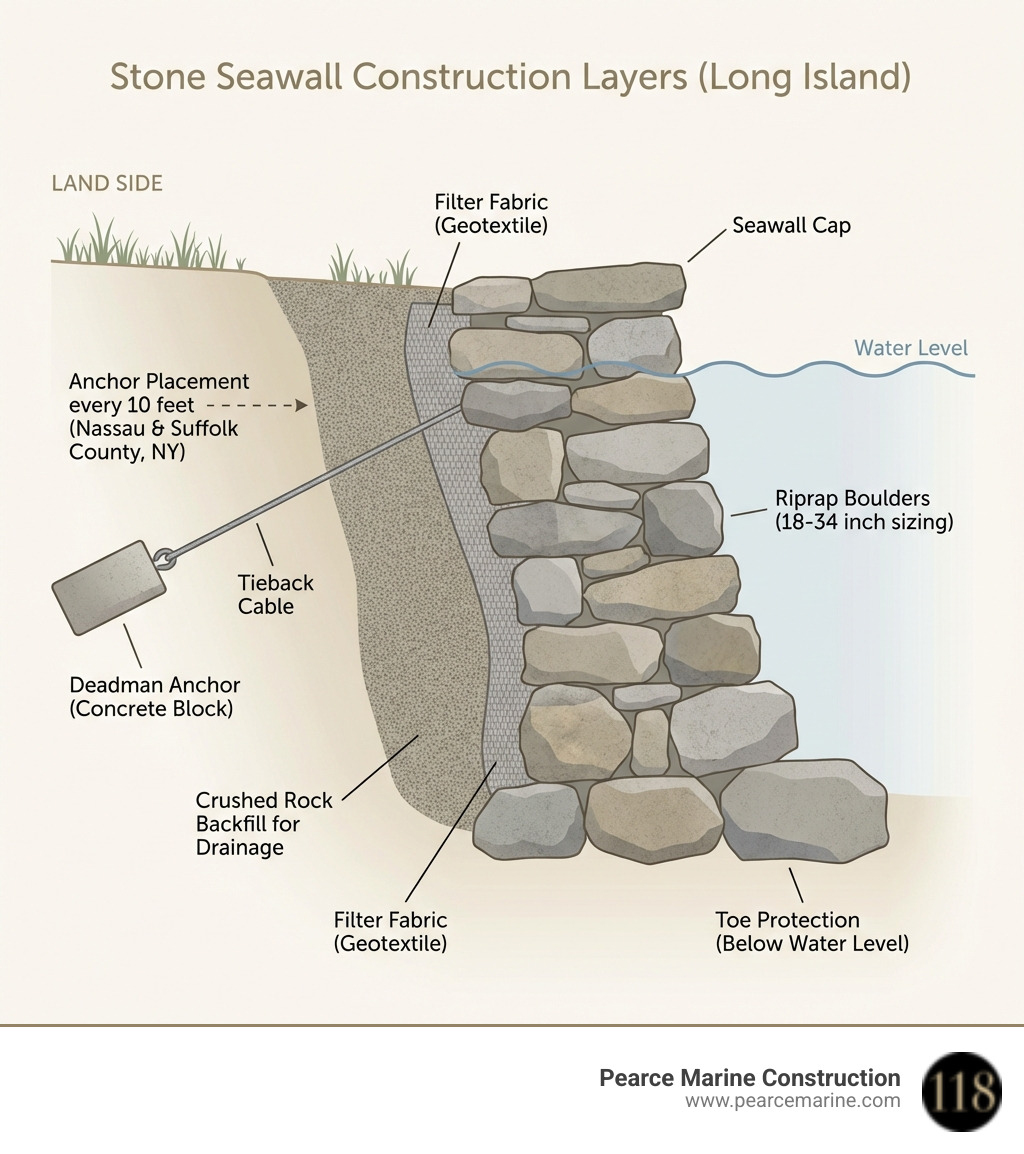
- Foundation Preparation - We excavate the shoreline and install heavy-duty filter fabric on compacted bedding stone
- Boulder Placement - We set large riprap (18"-34") using heavy machinery, staggering for interlocking stability
- Toe Protection - We place foundation stones deeply below water level to prevent undermining
- Drainage System - We install weep holes and crushed rock backfill to manage hydrostatic pressure
- Anchoring - We secure the structure with deadman anchors and tiebacks every 10 feet
- Final Grading - We complete backfill and grade the land-side area for optimal runoff
Waterfront properties in Southampton, West Islip, and West Hampton face constant threats from wave action and storm surge. Unlike vertical concrete walls that reflect wave energy, stone revetments absorb and dissipate energy through friction and turbulence between boulders. This natural approach to coastal defense has protected shorelines for centuries.
Building an effective stone seawall isn't a DIY project. It requires understanding soil mechanics, wave dynamics, and marine engineering standards specific to Long Island's coastal conditions. Improper foundation preparation or inadequate drainage can lead to structure failure and costly repairs.
This overview details the professional marine construction methods Pearce Marine Construction utilizes to protect waterfront property for 50+ years.
How to build a stone seawall definitions:
Professional Engineering: How to Build a Stone Seawall for Long-Term Stability
In Nassau and Suffolk Counties, shoreline structures must withstand relentless wave action and storm surges. Our approach to how to build a stone seawall is rooted in professional engineering, ensuring long-term stability against these dynamic elements.
A seawall composed of large boulders, or riprap, serves as an armored buffer. Instead of reflecting waves, which can lead to scour at the base, riprap allows water to filter through the rocks. This reduces the wave's force through friction and turbulence, minimizing destructive impact.
| Feature | Riprap Revetments (Stone Seawall) | Vertical Seawalls |
|---|---|---|
| Primary Function | Absorb and dissipate wave energy | Reflect wave energy |
| Structure Type | Sloping, strategically placed large rocks | Upright, vertical barrier |
| Wave Interaction | Water filters through rocks, reducing force | Waves hit directly, bouncing back with force |
| Scour Potential | Minimizes scour, promotes habitat creation | High scour potential at the base |
| Aesthetic | Natural, blends with environment | Stark, less natural |
| Environmental Impact | More eco-friendly, less beach erosion | Can cause significant beach scour |
| Ongoing Maintenance | Rocks may require repositioning after storms | Prone to undermining if scour is severe |
| Typical Lifespan | Decades, with proper design | Decades, but susceptible to foundation compromise |

Site Assessment and Foundation Preparation for a Stone Seawall
The first step in how to build a stone seawall is a thorough site assessment. For waterfront properties in Nassau and Suffolk Counties, we evaluate soil composition to prevent future settling. Soft or unstable soil is excavated until firm ground is reached, then replaced with compacted crushed rock and geogrid reinforcement. This prevents the seawall from shifting under the immense weight of the stone.
Following excavation, we install robust filter fabric at the base and behind the structure. This allows water to pass through, preventing hydrostatic pressure buildup, while stopping soil from migrating into the waterway. Next, we establish a bedding stone layer of smaller, angular stones (3”-8”) to provide a level surface for the larger riprap boulders.
For more detailed information on our services, explore our offerings: More info about seawall and bulkhead services.
Our Strategic Boulder Placement Process
Effective riprap seawalls in West Islip, Babylon, and Southampton rely on the correct selection and placement of boulders. We typically use Bank & Shore Riprap (18” – 34”), with custom extra-large boulders available for high-impact areas.
Our installation process involves:
- Setting Larger Boulders: Using heavy machinery, we precisely set the largest boulders into the foundation.
- Staggered Stacking: Boulders are stacked in a staggered pattern to create an interlocking matrix that resists displacement.
- Toe Protection: We place foundation stones deeply below the water level to prevent waves from scouring the base and undermining the structure.
Advanced Components: Drainage and Anchoring Systems
A stone seawall is an engineered system requiring advanced components for long-term stability.
Drainage Systems:
- Crushed Rock Backfill: We use crushed rock behind the seawall to allow free drainage, preventing hydrostatic pressure buildup.
- Weep Holes: Strategically placed openings allow trapped water to escape, further reducing pressure on the structure.
Anchoring Systems:
- Deadman Anchors and Tiebacks: We install concrete or steel anchors deep within the stable soil behind the seawall. These are connected to the structure by robust tiebacks every 10 feet, providing lateral support and preventing the wall from leaning under pressure.
To learn more about protecting your shoreline, contact us today: Protect your shoreline with expert seawall services.
Maintaining and Repairing Your Shoreline Defense
Even expertly constructed stone seawalls require maintenance to ensure continued effectiveness. For waterfront properties from Southampton to West Hampton, regular inspections are key. Powerful storms can lead to stone displacement, where rocks shift or settle. Addressing these minor issues promptly prevents more extensive repairs. We also monitor for sinkholes, ensuring that drainage systems and filter fabrics continue to mitigate soil loss and safeguard your investment in Nassau County marine construction.
Professional Construction Standards in Nassau and Suffolk Counties
At Pearce Marine Construction, our commitment to professional standards is the cornerstone of our service. When considering how to build a stone seawall, our generational expertise ensures precision and durability. We provide custom marine engineering custom to the specific conditions of your property in Brightwaters, Cold Spring Harbor, or Lloyd Harbor. Our skilled teams execute every phase with exacting standards, using high-quality materials built to withstand the harsh marine environment for decades.
Ensuring Longevity: How to Build a Stone Seawall to Last Decades
Achieving longevity against Long Island's weather patterns requires high-density materials and marine-grade engineering.
Material Selection: We select dense, durable stones resistant to erosion and freeze-thaw cycles. Bank & Shore Riprap (18” – 34”) is often chosen for its robust wave dissipation capabilities.
Marine-Grade Engineering:
- Proper Foundation: Prevents settling and undermining.
- Effective Drainage: Crushed rock backfill and weep holes manage hydrostatic pressure.
- Robust Anchoring: Deadman anchors and tiebacks resist outward pressure.
- Toe Protection: Placing the base below scour depth prevents undermining. Rock armor revetments are highly effective at dissipating energy.
Our Professional Standards for Durability:
- Staggered Placement: Creates a structurally sound, interlocking matrix.
- Filter Fabric: Prevents soil migration while allowing water passage.
- Regular Inspections: Essential for identifying rock displacement after major storms.
By adhering to these standards, we ensure that stone seawalls from Massapequa to Huntington are engineered to last. Our work is guided by resources like the coastal construction manual for shoreline structures, ensuring enduring quality.
For more information on our professional marine construction services, please visit: More info about professional marine construction.


Bring Your Vision to Life
Whether you're planning a custom dock, seawall, or boat lift, our experienced team is ready to deliver high-quality marine construction tailored to your needs. Pearce Marine Construction brings craftsmanship, precision, and a deep understanding of Florida’s waterways to every project. Let us help you create a durable, beautiful solution that stands the test of time. Get in touch now for a personalized estimate!