
A Beginner's Guide to Helical Pier Installation


What Is Helical Pier Installation and How Does It Work?
Helical pier installation is the process of driving steel screw-like anchors deep into the ground to support or stabilize marine structures like bulkheads, seawalls, and docks. Here's a quick overview of how it works:
- Site prep — Expose the bulkhead or marine structure footing and mark pier locations.
- Drive the pier — Use a hydraulic torque motor to screw the helical steel shaft into the ground.
- Monitor torque — Track resistance in real time to confirm the pier has reached load-bearing soil.
- Attach brackets — Connect heavy-duty steel brackets to transfer the marine structure's load onto the piers.
- Backfill and inspect — Restore the shoreline site and verify the installation meets engineering specs.
Helical piers typically reach depths of 10 to 30 feet — sometimes deeper — and can support tens of thousands of pounds of marine infrastructure when properly installed.
For Long Island property owners in Nassau and Suffolk Counties, this matters more than most places. Shorelines in areas like Southampton, West Islip, and West Hampton sit on sandy, shifting soils that can undermine docks, bulkheads, and marine structures over time. A failing marine foundation isn't just a structural problem — it's a safety risk and a costly one.
Unlike concrete piers that stop just a few feet below the surface, helical piers screw past weak upper soils and anchor into stable, load-bearing layers below. No curing time. No heavy excavation. Immediate structural support for waterfront bulkheads and docks.
This guide walks you through the full helical pier installation process — from site prep to final load transfer — so you know exactly what professional marine installation looks like and what to expect.

Key terms for helical pier installation:
The Step-by-Step Process of Professional Helical Pier Installation
Executing a professional helical pier installation requires a blend of heavy machinery, real-time mathematical calculations, and strict adherence to marine engineering standards. Because marine structures must withstand constant water movement, tidal shifts, and soil erosion, we do not treat this as a guessing game. Every pier must be installed to precise load-bearing specifications to guarantee long-term structural support for bulkheads, seawalls, and docks.
To understand how these deep foundation elements are integrated into a marine or coastal property, let's break down the process. For a deeper dive into the general engineering behind these systems, you can explore our Helical Pile Installation Complete Guide.
Preparing the Site for Helical Pier Installation
Before any steel touches the ground, our crew conducts a meticulous site assessment. Along the coastal communities of Nassau County and Suffolk County—from the canal-front properties of Massapequa and Merrick to the open bay shores of Babylon and Bayshore—site prep is key.
First, we mark and clear the area, paying close attention to local utility lines. We carefully excavate the soil around the existing bulkhead footing or dock support to expose the structure. For remedial repairs on failing bulkheads, this means digging access holes (typically 3x3 feet wide and up to 2 feet deep) directly adjacent to the marine foundation.
Once the footing is exposed, we prep the concrete or timber surface. If we are retrofitting an existing concrete bulkhead footing, our crew uses a demolition hammer to flatten the surface, ensuring a perfectly flush connection for the remedial brackets. Throughout this entire phase, we maintain strict safety protocols and ensure all work aligns with local Nassau and Suffolk County building codes.
Driving and Monitoring Torque During Helical Pier Installation
Once the site is prepped, the heavy-duty work begins. We position our compact excavator equipped with a high-torque hydraulic drive head directly over the marked pier location.
The lead section of the helical pier—which features the true helix plates (the spiral blades)—is driven into the ground at a smooth, continuous rate, typically between 5 and 20 revolutions per minute. As the pier penetrates the earth, we add steel extension shafts, coupling them together with high-strength structural bolts tightened to engineered specifications.
What makes helical pier installation incredibly reliable is our ability to measure torque in real time. As the pier goes deeper, the soil resistance increases, which raises the hydraulic pressure in the drive motor. We monitor this torque-to-capacity ratio (often referred to as the "K-factor" calculation) continuously. This mathematical relationship ensures that the final torque reading directly translates to the ultimate load capacity of the pier. For more technical details on torque ratings and shaft specifications, you can refer to the Vickars Helical Pier Installation Guide.
Securing the Foundation with Heavy-Duty Brackets
Once the pier reaches the target depth and achieves the required torque, we cut the steel shaft to the correct elevation. Now, it is time to link the pier to your marine structure.
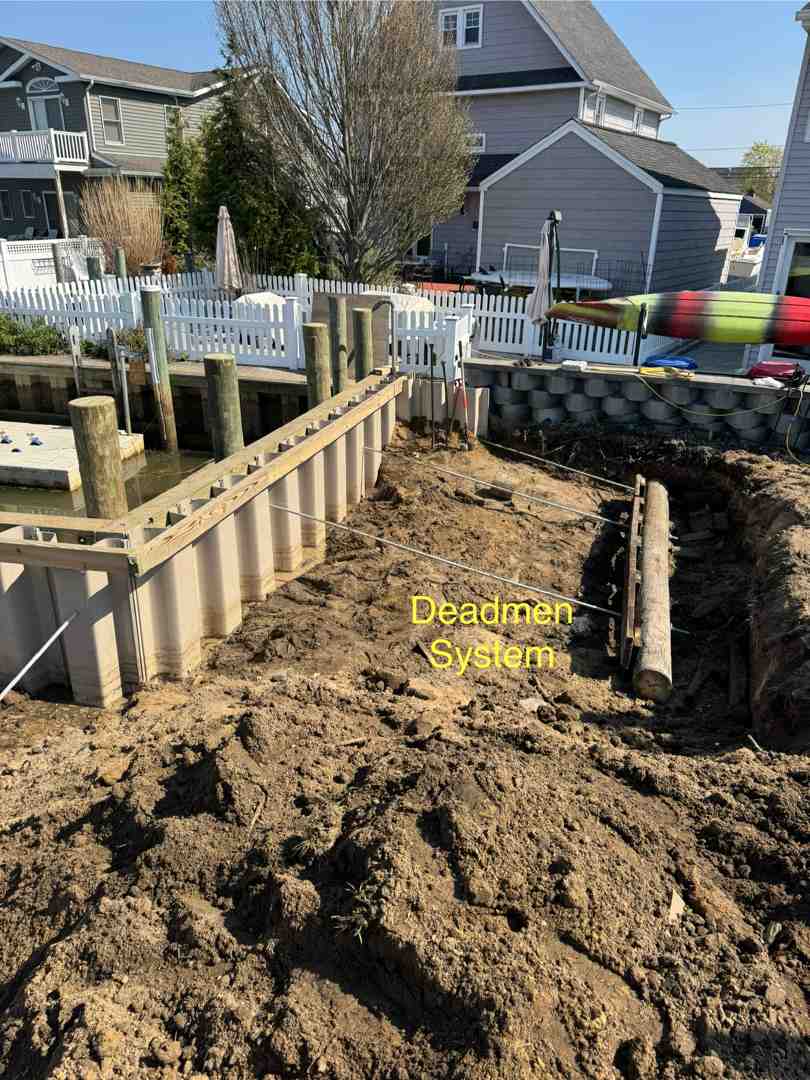
We install heavy-duty, hot-dipped galvanized steel remedial brackets directly onto the pier shaft and position them securely underneath the prepared bulkhead footing. Using high-strength structural bolts or anchor screws, we lock the bracket to the marine foundation.
Once the brackets are secure, we use hydraulic jacks to gently transfer the weight of the marine structure onto the newly installed helical piers. This provides immediate load-bearing capacity, stabilizing the bulkhead or dock permanently. To see the specific anchoring systems we use for different marine applications, visit our page on Services Helical Piles.
Why Helical Piers are Essential for Long Island Marine Structures
Long Island's waterfront properties are beautiful, but they present some of the most challenging building conditions in the country. From the high-velocity wind zones of West Hampton and Southampton to the tidal marshes of Bellmore and Wantagh, traditional shallow foundations simply cannot handle the environmental forces.
Comparing Helical Piers to Traditional Marine Piles
Historically, marine builders relied on timber piles or poured-in-place concrete footings. While those methods still have their place, helical piers offer massive advantages for modern shoreline protection.
| Feature | Helical Piers | Concrete Piles | Timber Piles |
|---|---|---|---|
| Curing Time | None (Immediate load-bearing) | 7 to 28 days | None |
| Installation Vibration | Vibration-free (Safe for adjacent docks) | High vibration (If driven) | High vibration |
| Lifespan | 75+ years (Hot-dipped galvanized steel) | Variable (Prone to cracking/spelling) | 20 to 30 years (Prone to marine borers) |
| Warranty | Typically 25-year transferable warranty | None | Limited |
| Environmental Impact | Minimal soil disturbance, no spoils | High soil displacement | Chemical treatments can leach |
Because our helical piers are hot-dipped galvanized steel, they offer unparalleled corrosion resistance in harsh saltwater environments, making them the superior choice for securing bulkheads, docks, and coastal boardwalks.
Soil Mechanics and Load Capacity in Nassau and Suffolk Counties
The soil profile of Long Island varies wildly. In North Shore areas like Lloyd Harbor, Huntington, and Cold Spring Harbor, we often run into dense glacial till and rocky soils. On the South Shore, in places like Brightwaters and West Islip, we deal with deep layers of saturated sand and organic silt.
These sandy, loose soils have very low load-bearing capacity near the surface. During storm surges or heavy tides, this top layer of soil can liquefy or wash away completely.
To combat this, we install helical piers to depths of 10 to 30 feet (and sometimes up to 100 feet in extreme coastal zones) to reach competent, highly compacted soil or bedrock. We typically space these piers every 6 to 9 feet for residential marine structures, ensuring that the total weight of your dock, deck, or bulkhead is evenly distributed. For an in-depth breakdown of budgeting for these depth and spacing requirements, check out our guide on the Cost to Install Helical Piers.
Choosing the Right Marine Contractor in Long Island
When it comes to protecting your waterfront investment, experience is everything. Pearce Marine Construction is a proud, woman-owned marine construction company serving residential, commercial, and public clients across Nassau and Suffolk Counties.
We combine generational marine expertise with meticulous craftsmanship to deliver deep foundation solutions that stand the test of time. We work side-by-side with certified engineers to custom-design and execute every single helical pier installation project to perfection.
If you want to ensure your shoreline infrastructure is anchored with absolute confidence, trust our certified team. Explore our full range of marine construction capabilities on our Pearce Marine Construction Services page, or contact us today to discuss your next project.



Bring Your Vision to Life
Whether you're planning a custom dock, seawall, or boat lift, our experienced team is ready to deliver high-quality marine construction tailored to your needs. Pearce Marine Construction brings craftsmanship, precision, and a deep understanding of Florida’s waterways to every project. Let us help you create a durable, beautiful solution that stands the test of time. Get in touch now for a personalized estimate!