
The Ultimate Guide to Marine Piling Repair: Techniques and Tips


Understanding Marine Piling Repair: What You Need to Know
Marine piling repair is the process of restoring damaged support structures for docks, piers, and bulkheads. For owners of waterfront property on Long Island, understanding how to repair pilings is key to saving money and preventing structural failure.
Pilings deteriorate from corrosion, marine borer attacks, physical impacts, and environmental stress. Common repair methods include jacketing, epoxy injection, concrete encasement, and splicing. Professional repairs typically cost $500-$5,000 per pile, depending on the material and extent of damage.
Key causes of piling damage include:
- Timber piles: Suffer from marine borers (shipworms, gribbles), fungal decay, and rot.
- Concrete piles: Experience rebar corrosion, spalling, and cracking from saltwater.
- Steel piles: Face corrosion, pitting, and section loss in marine environments.
Timely repairs cost far less than replacement. Corrosion causes up to 90% of steel pile failures, while marine borers can halve a timber pile's strength in just a few years. For Long Island property owners, the combination of tidal fluctuations, winter ice, and marine organisms creates a harsh environment. Regular inspection and prompt repair are essential for protecting your investment and ensuring safety.
Why Marine Pilings Fail: Common Causes and Damage Types
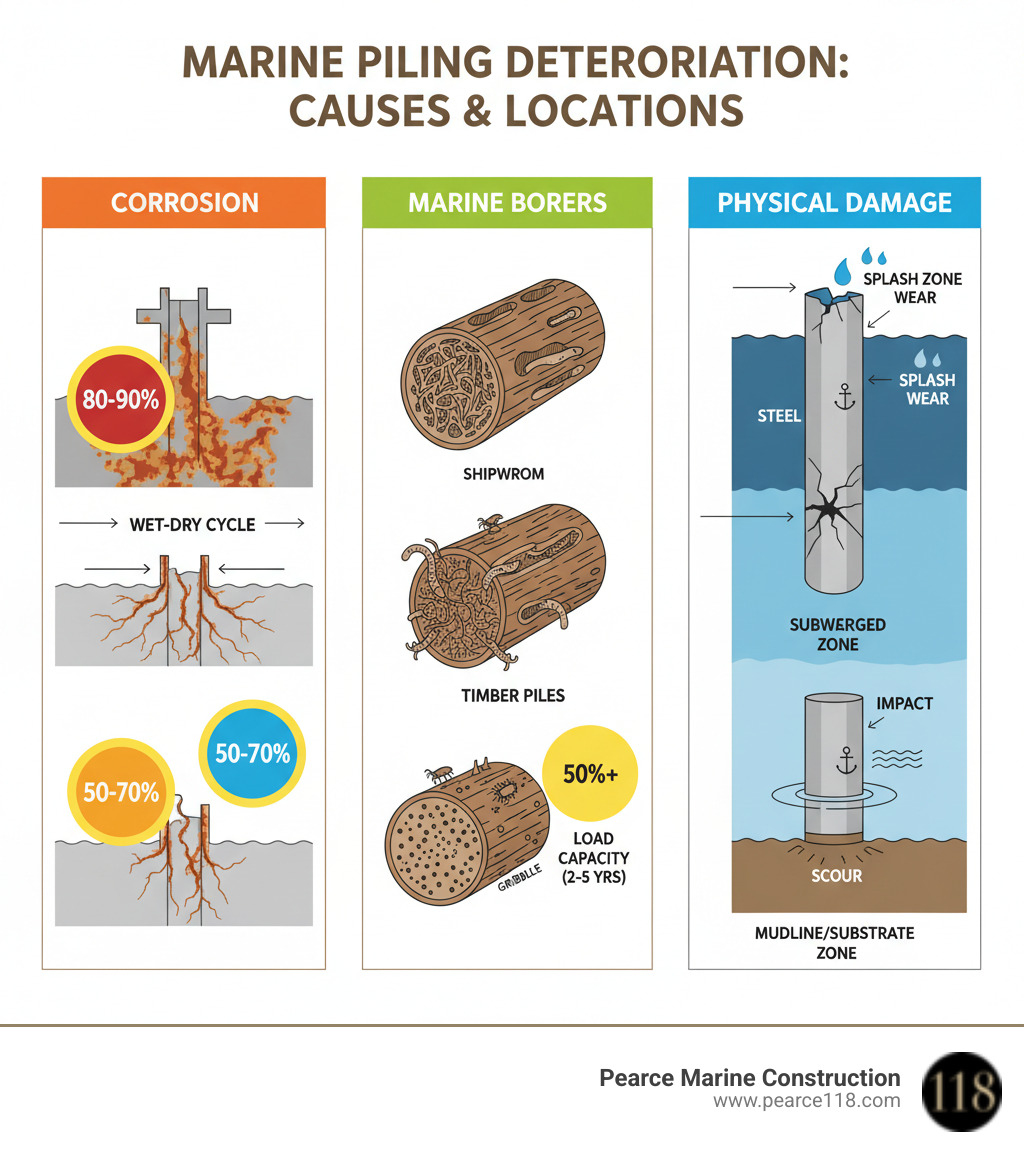
Beneath the surface, marine pilings face relentless attacks from saltwater corrosion, marine organisms, physical impacts, and tidal stress. Understanding these threats is the first step in protecting your waterfront investment and knowing when marine piling repair is necessary. For decades, we've seen how Long Island's environment, with its harsh winters and active marine life, takes a toll on all piling materials.

Corrosion is the primary enemy of steel and concrete pilings. Saltwater rusts steel and causes rebar inside concrete to expand, cracking the pile. This process, which accounts for 80-90% of steel pile failures, accelerates in the splash zone where oxygen-rich saltwater is abundant.
Marine borer attack is an equally serious threat to timber. Shipworms and gribbles burrow into wood, creating internal tunnels that compromise structural integrity. A pile can lose 50% of its strength in a few years. A study on Marine Boring Organisms details how these invaders work.
Physical damage from boat impacts, debris, or ice can cause abrasions or breakage, creating entry points for corrosion and borers.
Scour occurs when water currents erode soil from the pile base, reducing its embedment depth and weakening the foundation.
The splash zone, the area just above and below the waterline, is where deterioration is worst due to constant wet-dry cycles that accelerate all forms of damage.
Chemical damage from pollutants can also degrade pilings, and older treated timber may leach chemicals like creosote, an environmental concern modern repairs can address. For more on working in these conditions, see More info about Underwater Construction.
Timber Piling Vulnerabilities
Timber's organic nature makes it a target for biological attack. Shipworms (Teredo navalis) and gribbles (Limnoria tripunctata) bore into the wood, hollowing it out from the inside, often with no visible external signs until failure. Fungal decay and rot also break down wood fibers in the splash zone, turning solid timber into soft, crumbling material. Impact damage from boats can splinter the wood, creating cracks that invite further decay and lead to a reduced load-bearing capacity.
Concrete Piling Vulnerabilities
Rebar corrosion is the most serious issue for concrete piles. When saltwater penetrates cracks, it rusts the internal steel reinforcing bars, which expand and cause the concrete to crack and spall (break off). This process can reduce a pile's lifespan by 30-50%. Cracking also results from structural stress and temperature changes. Chloride ingress from saltwater accelerates rebar corrosion, while sulfate attack causes internal expansion and cracking. In Long Island's climate, freeze-thaw cycles are particularly damaging, as absorbed water freezes, expands, and breaks down the concrete over time.
Steel Piling Vulnerabilities
Steel is strong but highly reactive in saltwater. Uniform corrosion causes a general thinning of the steel, reducing its cross-sectional area and strength. Pitting corrosion is more dangerous, creating small, deep holes that concentrate stress and can lead to sudden failure. Galvanic corrosion occurs when dissimilar metals are in contact in saltwater. Fatigue develops from repeated stress cycles from waves or impacts, which can initiate cracks. All these issues result in section loss, directly decreasing the pile's load-bearing capacity.
An Overview of Effective Marine Piling Repair Methods
When pilings show signs of wear, modern marine piling repair techniques can restore structural integrity, often extending a pile's life beyond its original design. At Pearce Marine Construction, we have perfected these methods for Long Island's challenging marine environment.
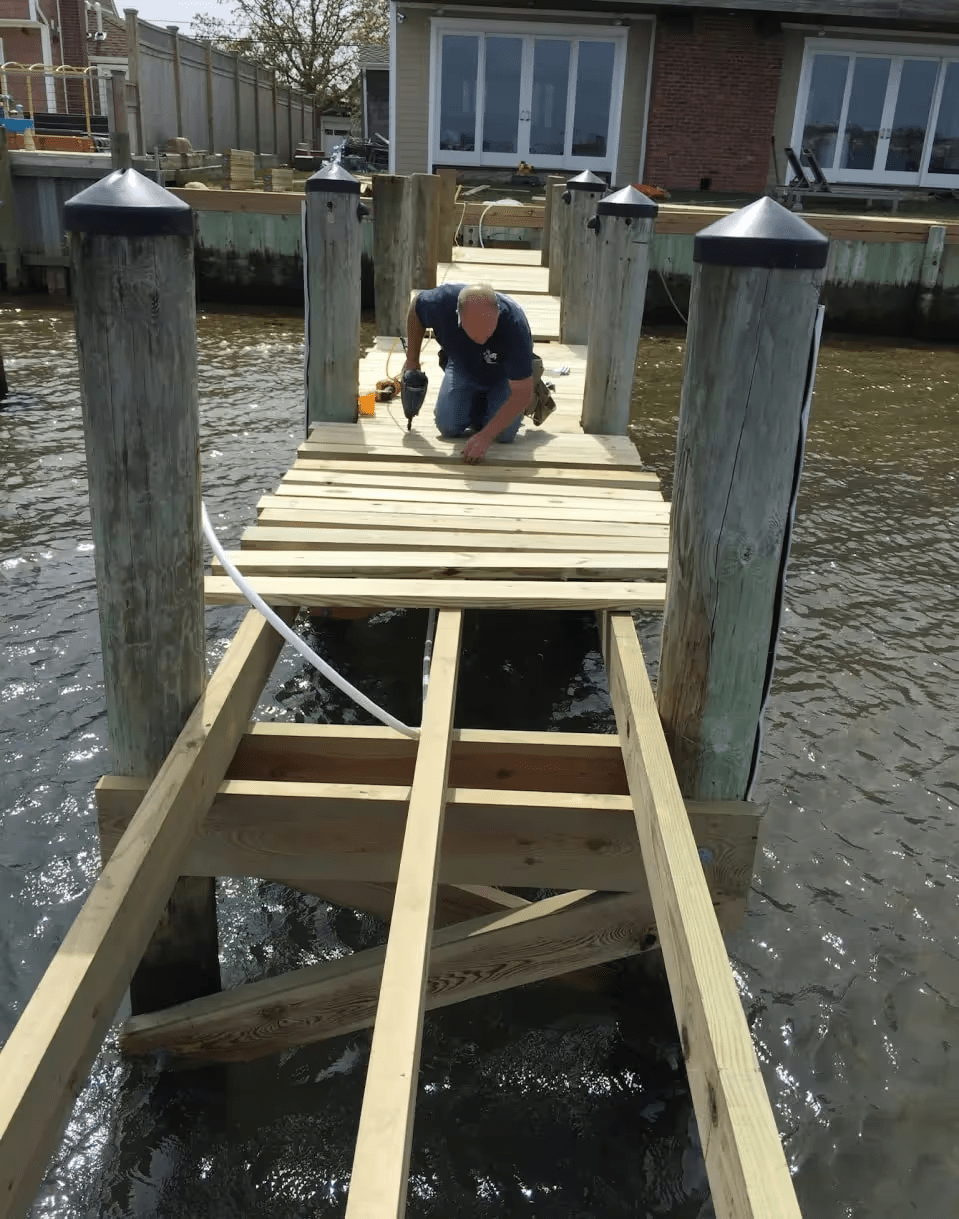
Every repair begins with thoroughly cleaning the pile to remove marine growth and reveal the true extent of the damage. After a damage assessment, which may include non-destructive testing, we proceed with structural reinforcement to restore lost strength. Finally, encapsulation creates a protective barrier to shield the repaired pile from future attacks. The specific method depends on the pile material. For more details, visit More info about Marine Structure Restoration.
Common Timber Marine Piling Repair
Timber pile repairs focus on stopping biological attack and restoring load-bearing capacity.
Pile jacketing is a primary solution. We encase the damaged section in a protective sleeve (e.g., UV-protected PVC) and fill the void with specialized grout or epoxy. This seals out oxygen, starving marine borers and halting rot. Properly installed jackets can extend pile life indefinitely. For smaller issues, epoxy fillers bond wood fibers and seal out moisture. For broken sections, splicing allows us to attach a new section, reinforcing the connection. Composite wraps (FRP) add significant strength, and in cases of extensive damage, post-and-beam reinforcement can be added to share the load.
Concrete Marine Piling Repair Solutions
Concrete repairs aim to stop rebar corrosion and restore the pile's protective concrete matrix.
For fine cracks, epoxy injection seals them to prevent water intrusion. For spall repair, we remove damaged concrete, clean or replace corroded rebar, and apply new repair mortar. Form-and-pump concrete encasement involves placing a form (often an FRP sleeve) around the pile and filling the gap with underwater concrete or epoxy mortar, restoring structural integrity at a fraction of replacement cost. Cathodic protection can be used to slow rebar corrosion electrochemically. For major strengthening, carbon fiber reinforcement (CFRP) sheets are bonded to the surface to improve the pile's flexural and shear strength, effectively restoring its axial capacity as detailed in A study on restoring Concrete Axial Strength.
Strategies for Steel Marine Piling Repair
Steel pile repairs focus on replacing lost material and preventing future corrosion.
For localized damage, welded plate repairs involve attaching new steel plates, though underwater welding is complex. Steel jacketing is an alternative where a new steel sleeve is placed around the pile and either welded or grouted in place. Cathodic protection systems, using sacrificial anodes, are essential for halting ongoing corrosion. Applying high-performance protective coatings to cleaned steel creates a physical barrier against saltwater. Finally, concrete encasement, often using modern FRP jackets, provides both structural reinforcement and an impervious shell that eliminates oxygen and stops corrosion.
The Rise of Advanced Materials and Innovations
Modern marine piling repair uses advanced materials and techniques that make repairs stronger, longer-lasting, and more environmentally responsible. At Pearce Marine Construction, we accept these innovations to deliver superior results for our Long Island clients.
Fiber-Reinforced Polymer (FRP) is a game-changer. These composites, made of carbon or glass fibers in an epoxy resin, create jackets and wraps that are stronger than steel. FRP reinforces the structure with materials that won't rust, rot, or deteriorate in saltwater.
PVC jackets offer reliable, long-term protection for timber and concrete piles. Engineered for marine environments, these UV-protected systems come with guarantees of at least 25 years and create an impermeable barrier that stops marine borers and halts deterioration.
High-strength underwater grouts and epoxies are formulated to cure while submerged, bonding the protective jacket to the original pile and restoring structural integrity.
Smart coatings represent the cutting edge, with some able to self-heal minor damage or incorporate sensors that monitor corrosion, allowing for proactive maintenance.
Advanced monitoring systems with embedded sensors provide real-time data on structural movement and corrosion rates, enabling data-driven maintenance decisions.
Crucially, modern repairs protect our marine environment. Older timber piles were often treated with creosote or CCA, which can leach into the water and harm aquatic life. By encapsulating these piles with impermeable PVC or FRP jackets, we create a watertight seal that stops harmful chemicals from seeping into the water. This strengthens the pile while making the surrounding ecosystem cleaner and healthier. These innovations align with our commitment to quality and environmental responsibility, protecting your investment and preserving Long Island's marine environment. For new marine structure foundations, we also offer advanced solutions like More info about Helical Piles.
Professional Repair vs. DIY: Making the Right Choice
When a piling is damaged, it's tempting to consider a DIY repair to save money. However, marine piling repair is a specialized task where professional expertise is critical. The marine environment is unforgiving, and a failed repair can lead to costlier problems.
We've often been called to fix well-intentioned DIY repairs that worsened the original issue. The challenges of saltwater, tides, and structural loads require specific knowledge and equipment.
| Factor | DIY Repair | Professional Repair |
|---|---|---|
| Cost | Lower initial material cost, high risk of re-repair | Higher initial cost, long-term savings through durability |
| Safety | Significant risks (underwater work, heavy materials) | Trained personnel, specialized equipment, safety protocols |
| Durability | Variable, dependent on skill and materials used | High, guaranteed quality, engineered solutions |
| Compliance | Risk of violating local codes and environmental regulations | Ensures adherence to all local and federal regulations |
Safety concerns are paramount. Marine repair often involves underwater work and handling heavy materials. Our crews are trained in marine safety and use proper equipment to manage these risks.
Durability is another key factor. Professional repairs use engineered solutions and materials designed for marine environments and often come with warranties. A repair costing $500-$5,000 is more economical than a full replacement, but only if done correctly the first time.
Permitting and regulations from agencies like the New York DEC and Army Corps of Engineers are complex. Professional contractors steer these requirements daily, ensuring your project is compliant and avoiding potential fines or removal orders.
Regular inspection and maintenance are your best defense against major costs. Annual visual inspections can catch deterioration early, leading to simpler, less expensive repairs. The cost-effectiveness of professional repair is clear long-term. An improper DIY fix often fails, leading to more extensive damage and higher costs later. For guidance on choosing a contractor, visit More info about hiring a Marine Construction Contractor.
Frequently Asked Questions about Marine Piling Repair
Over our years serving waterfront property owners across Long Island, we've answered countless questions about marine piling repair. Here are the most common ones, with answers based on our experience in Nassau and Suffolk County.
What is the typical cost of repairing a marine pile?
The cost of repairing a marine pile typically ranges from $500 to $5,000 per pile. The final price depends on several factors:
- The extent of damage: A small crack requiring epoxy injection is less costly than a pile with significant section loss.
- The pile material: Timber, concrete, and steel require different repair materials and techniques.
- The repair method: Simple epoxy fills are cheaper than comprehensive solutions like full jacketing with high-strength grouts.
- Accessibility: The need for divers or specialized barges can increase labor and equipment costs.
Even at the higher end, repair is almost always significantly less expensive than full pile replacement, which can cost tens of thousands of dollars.
How long does a pile repair last?
A professional pile repair using quality materials can last for decades. The durability depends on the repair method and material quality. Modern composite systems using fiber-reinforced polymer (FRP) and PVC jackets are engineered for harsh marine environments. For example, PVC jacketing systems come with guarantees of at least 25 years, and some research suggests they could last indefinitely.
These systems are designed to withstand Long Island's tidal fluctuations, winter ice, and marine borers. Proper maintenance, including regular inspections, further extends the lifespan of the repair, protecting your investment for the long haul.
Can a completely broken pile be repaired?
Yes, in many cases, even a completely broken pile can be repaired, which is often preferable to replacement. We start with a thorough structural assessment to determine if repair is feasible.
For broken piles, full encasement systems using FRP jackets and high-strength grouts are highly effective. The new reinforced shell can be engineered to carry the structural loads independently, even if the original pile has 100% section loss in one area. For timber piles, splicing can be used to attach a new section before the entire assembly is reinforced with a jacket.
The goal is to restore load capacity, and modern techniques can often make the repaired pile stronger than the original. However, replacement is sometimes necessary if the pile is too deteriorated to serve as a base for repair. We will always provide an honest assessment of the best approach for your situation. Repairing a pile avoids the high cost of replacement, especially if a structure is built on top of it. If replacement is the only option, we are also experienced in pile driving services.
Conclusion
Your waterfront property is a significant investment, and the pilings supporting your docks and bulkheads are its foundation. When these structures show signs of wear, timely marine piling repair is essential to protect that investment.
We've covered the primary threats to pilings, from marine borers in timber to corrosion in steel and concrete, all accelerated by the harsh splash zone environment. The good news is that modern repair methods, like pile jacketing and fiber-reinforced polymer wraps, can restore structures to better-than-original condition with a lifespan of 25 years or more. These techniques also offer environmental benefits by encapsulating older, chemically treated piles.
While a DIY approach may seem tempting, the safety risks, complex permitting, and specialized knowledge required for marine construction make professional expertise invaluable. A professional repair is a durable, cost-effective solution compared to premature failure or full replacement.
Proactive maintenance is the key to longevity. Regular inspections catch small issues before they become expensive problems. A simple crack today could require a full encasement next year if ignored.
At Pearce Marine Construction, we bring generational expertise and meticulous craftsmanship to every marine piling repair project in Nassau and Suffolk County. As a woman-owned firm, we are committed to delivering solutions that protect our clients' waterfront investments. Whether for a residential dock or public infrastructure, we approach each project with a dedication to quality and durability.
Your pilings are the unsung heroes of your waterfront property. Give them the professional care they deserve, and they will support your structures for decades to come.


Bring Your Vision to Life
Whether you're planning a custom dock, seawall, or boat lift, our experienced team is ready to deliver high-quality marine construction tailored to your needs. Pearce Marine Construction brings craftsmanship, precision, and a deep understanding of Florida’s waterways to every project. Let us help you create a durable, beautiful solution that stands the test of time. Get in touch now for a personalized estimate!