
How to Fix Damaged Boat Dock Floats: 3 Methods that Guarantee Results

Warning Signs That Your Dock Floats Need Repair
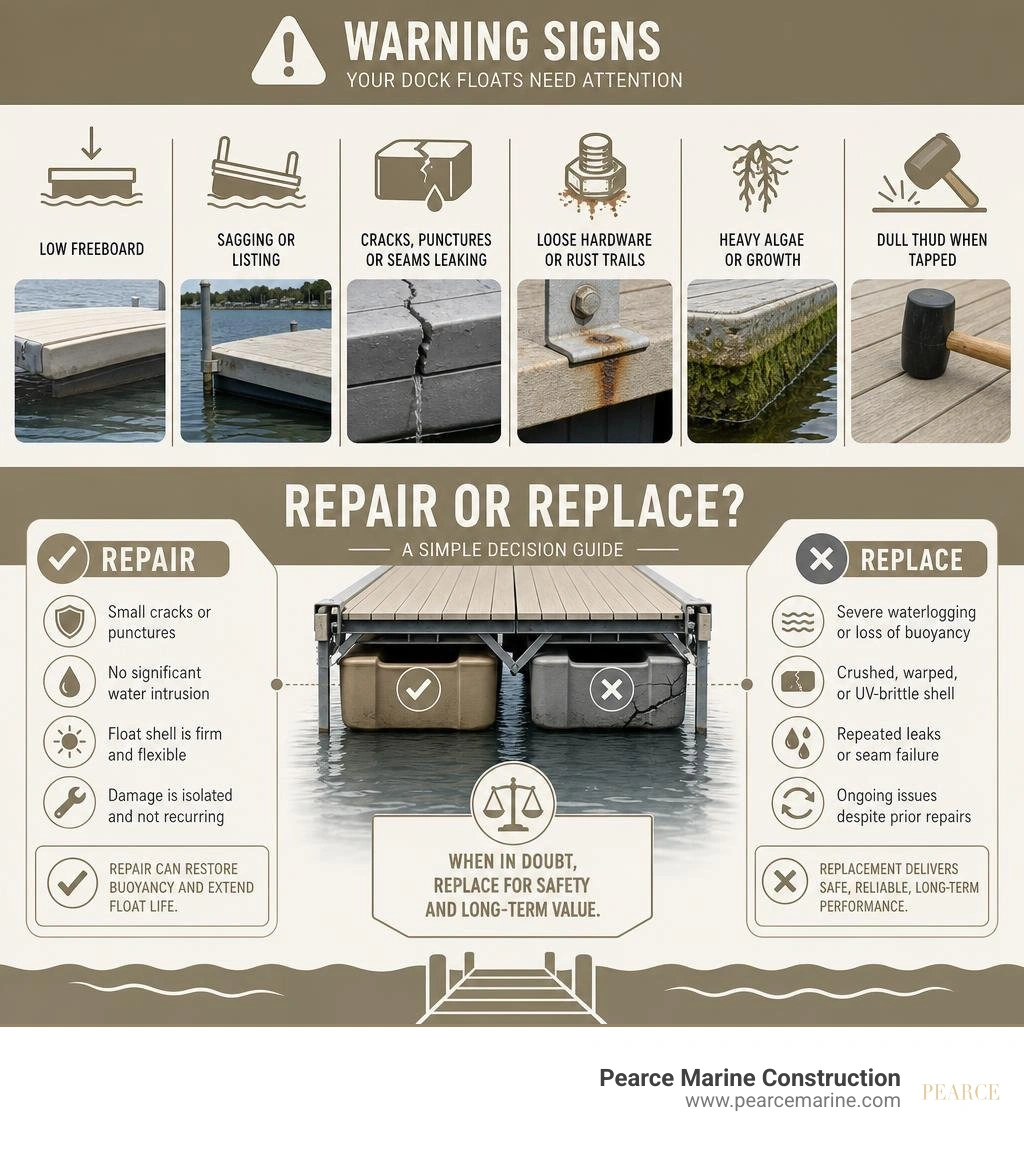
Boat dock float repair should begin as soon as a dock section sits lower, lists to one side, or feels less stable than usual. Small cracks in a polyethylene float may be repairable with professional thermal fusion. But a float that is badly waterlogged, UV-brittle, crushed, or repeatedly leaking usually needs replacement to restore safe, even buoyancy.
Watch for these early warning signs:
- Reduced freeboard, meaning less dock surface is above the waterline
- A sagging corner, uneven deck, or persistent side-to-side list
- Visible cracks, punctures, warped float shells, or water weeping from seams
- Excessive wobble, loose mounting hardware, or rust trails around fasteners
- Heavy algae or marine growth that adds weight and hides damage
- A dull thud instead of a hollow sound when a suspected hollow float is tapped
On Nassau and Suffolk County waterfronts, salt exposure, boat wakes, tides, storms, and winter ice can turn a minor buoyancy issue into frame damage fast. Pearce Marine Construction evaluates the float, mounting system, and dock load together, performing precision boat dock repair and comprehensive floating dock repair using commercial-grade boat dock repair parts to restore structural integrity.
3 Engineered Methods for Commercial Dock Float Restoration
High-salinity marine environments across Long Island subject floating dock systems to relentless hydrodynamic wear. Between continuous tidal shifts in Great South Bay and heavy wakes churning through Shinnecock Inlet, dock floats absorb massive dynamic loads. When a float suffers puncture damage or structural fatigue, the loss of buoyancy places severe torsional stress across the framing timber, stringers, and hinge connections.
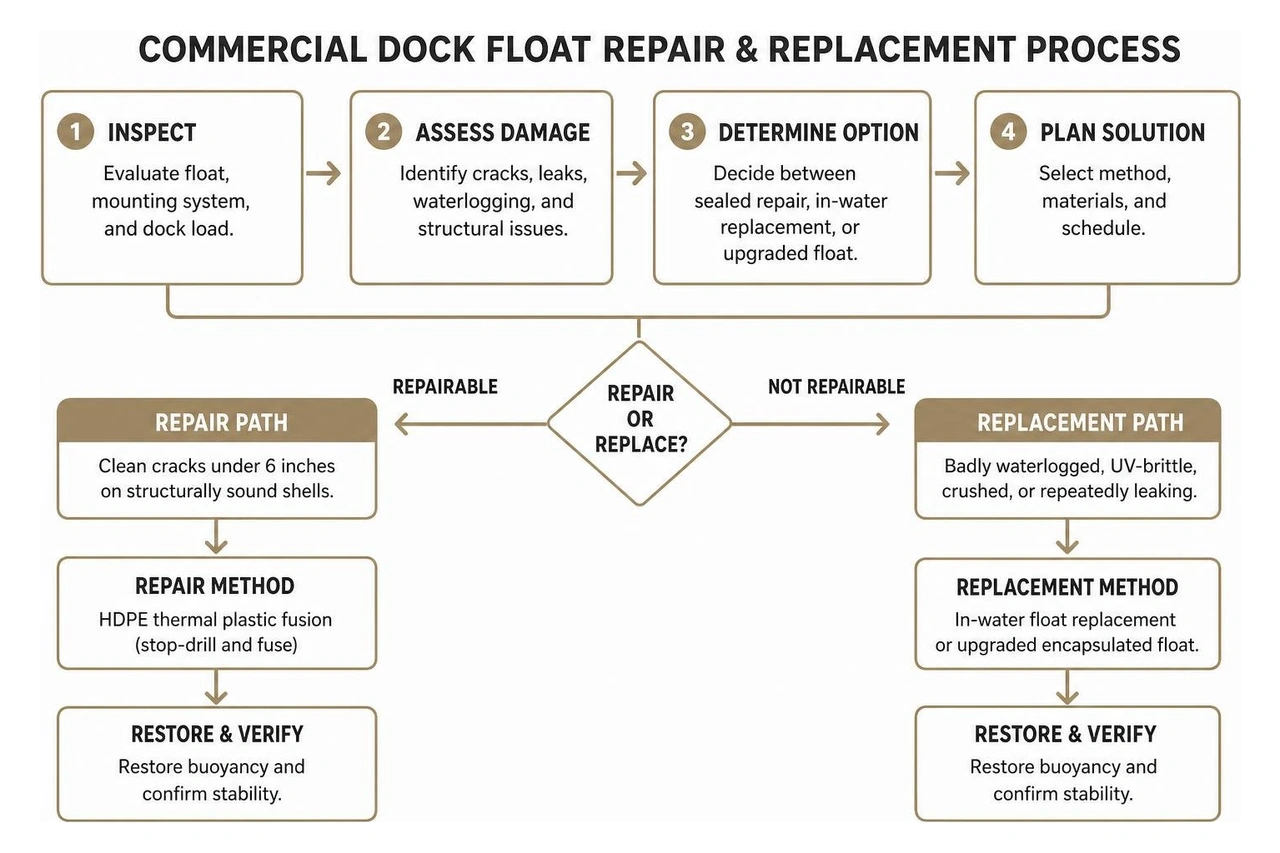
To protect the structural integrity of the overall system, professional marine contractors utilize three precision engineering methods to restore buoyancy, align load profiles, and secure framing hardware.
| Restoration Method | Best Application | Expected Service Life | Key Structural Hardware |
|---|---|---|---|
| HDPE Thermal Plastic Fusion | Clean cracks under 6 inches on structurally sound shells | 5–8 Years | Stop-drill points, high-density polyethylene filler rod |
| In-Water Pneumatic Airbag Elevation | Complete drum swaps for crushed or saturated floats | 10–15 Years | Hot-dipped galvanized mounting brackets, 316 stainless lag bolts |
| Closed-Cell Foam Stabilization | Punctured drums needing unsinkable internal core | 10–15+ Years | Two-part 2lb/cu.ft. closed-cell polyurethane foam, pressure vent plugs |
Thermal Plastic Fusion and Structural Boat Dock Float Repair
For heavy-duty rotationally molded High-Density Polyethylene (HDPE) floats exhibiting localized stress fractures under six inches, thermal plastic fusion offers a permanent molecular seal. Unlike superficial topical adhesives that peel under marine wave action, plastic welding fuses virgin material directly into the float shell.
Our marine technicians execute this repair through a precise sequence:
- Stress-Relief Stop-Drilling: Technicians drill a 3mm hole at the terminal ends of the stress fracture to prevent the crack from propagating across the polymer shell under hydraulic pressure.
- Rotary V-Groove Channeling: A precision rotary tool cuts a uniform V-shaped bevel along the crack seam, clearing away oxidized plastic and establishing optimal surface area for filler bonding.
- Surface Flame Oxidation: A controlled flame pass temporarily alters the low surface energy of the polyethylene, allowing maximum molecular cross-linking.
- Extrusion Thermal Welding: Utilizing an industrial HDPE welding unit, matching high-density polyethylene rod is melted simultaneously with the parent float shell, creating a homogeneous, airtight structural seal.
This technique is detailed further in our comprehensive Floating Dock Repair Complete Guide, providing an airtight repair that preserves structural buoyancy without requiring complete dock disassembly.
In-Water Airbag Elevation and Heavy-Duty Boat Dock Float Repair
When a float drum has suffered catastrophic crushing or widespread internal waterlogging, in-situ float replacement using commercial pneumatic salvage airbags is the most efficient and non-invasive engineering solution. Hauling a complete dock out of the water requires extensive rigging and crane mobilization; in-water elevation isolates the damaged section directly at your shoreline.
Commercial salvage airbags rated for 2,000 to 4,000 pounds of lift are positioned beneath the dock stringers and inflated using regulated pneumatic lines. This elevates the framing section 12 to 24 inches clear of the waterline, neutralizing buoyant upward resistance.
Technicians unbolt the compromised drum, inspect the sub-framing for hidden rot or bracket corrosion, and install heavy-duty rotationally molded floats. The assembly is secured using hot-dipped galvanized or 316 stainless steel mounting hardware, ensuring balanced load distribution across every structural joist. For deeper insights on hardware selection, explore our Boat Dock Repair Parts Guide 2026.

Closed-Cell Foam Stabilization and Encapsulated Drum Upgrades
Older dock systems often rely on hollow unencapsulated floats or low-density expanded polystyrene (EPS) billets that slowly degrade, absorb saltwater, and become waterlogged. When a float becomes waterlogged, surface patches cannot restore lost buoyancy.
The engineered solution involves upgrading to commercial-grade encapsulated dock floats featuring heavy-duty, UV-stabilized virgin polyethylene outer shells surrounding a solid core of steam-expanded, closed-cell polystyrene. Alternatively, salvageable hollow drums are reinforced via controlled injection of two-part 2lb closed-cell polyurethane foam:
- Internal Core Expansion: The two-part liquid polyurethane expands up to 30 times its volume, creating a dense network of closed cells that will not absorb water even if the exterior shell sustains future puncture damage.
- Pressure Vent Calibration: Precision vent ports are installed during injection to release off-gas pressures, preventing polymer shell distortion while ensuring void-free structural fill.
- Freeze-Thaw Resistance: Encapsulated foam cores withstand severe coastal Long Island winter ice pinching without cracking or taking on moisture.
Investing in high-grade encapsulated floatation forms the backbone of reliable Boat Dock Repair, preventing sudden listing and keeping deck surfaces perfectly level season after season.
Long-Term Waterfront Investment and Contractor Selection
Floating docks are substantial marine assets. While high-quality commercial dock floats deliver a reliable service life of 10 to 15 years, sustained exposure to saltwater, ice shifts, and continuous storm cycles demands professional oversight. Minor float issues that go unaddressed allow water to settle inside drums, placing uneven torsional loads across the entire frame and causing expensive stringer fractures.
Cost Analysis and Repair vs. Replacement Standards
Minor thermal welding or hardware re-securing projects generally range from $250 to $800, whereas full commercial float replacements typically cost between $300 and $1,000 per float unit depending on volume, dimensions, and buoyancy capacity.
When evaluating whether to repair or replace dock components, commercial marine construction relies on the industry-standard 50 Percent Rule:
- Evaluate Repair Thresholds: If cumulative structural repairs, hardware upgrades, and float swaps exceed 50% of the replacement value of a new floating dock system, complete system reconstruction delivers superior 5-year Total Cost of Ownership (TCO).
- Assess Frame Fatigue: If stringers exhibit rot, split fastener holes, or sagging frame joints alongside float failure, patching floats is only a temporary band-aid.
- Prevent Catastrophic Failure: A $500 maintenance intervention catches localized water intrusion before it escalates into a $15,000 frame rebuild following a coastal storm surge.
For an extensive breakdown of regional marine construction pricing and structural lifespan benchmarks, consult our Marine Dock Repair Guide 2026.
Turnkey Marine Engineering in Nassau and Suffolk Counties
Maintaining waterfront structures across Nassau County and Suffolk County requires specialized coastal knowledge. From the protected canals of Massapequa, Merrick, Wantagh, and Bellmore to the tidal expanses of Babylon, West Islip, Brightwaters, and Bayshore, every shoreline features distinct marine conditions. Further east in Southampton, Westhampton, Cold Spring Harbor, Huntington, and Lloyd Harbor, fluctuating tides and heavy ice loads demand structural engineering built to commercial standards.
Pearce Marine Construction is a woman-owned marine construction firm providing generational marine craftsmanship to residential, commercial, and public clients across Long Island. While regional contractors such as Bayview Dockbuilders and Kevel offer basic marine services, Pearce Marine Construction stands apart through superior structural engineering, heavy-duty marine-grade materials, and unmatched local expertise across Long Island's demanding waterways.
Whether your waterfront property requires precision pile guide realignments, custom heavy-duty dock framing, or comprehensive buoyancy restoration, our marine specialists deliver turnkey solutions that endure. Protect your shoreline investment—schedule expert waterfront repairs and maintenance services with Pearce Marine Construction today.



Bring Your Vision to Life
Whether you're planning a custom dock, seawall, or boat lift, our experienced team is ready to deliver high-quality marine construction tailored to your needs. Pearce Marine Construction brings craftsmanship, precision, and a deep understanding of Florida’s waterways to every project. Let us help you create a durable, beautiful solution that stands the test of time. Get in touch now for a personalized estimate!