
Building Stronger Shores: The Art and Science of Coastal Engineering

Why Long Island Waterfront Properties Need Coastal Engineering Solutions
Coastal engineering solutions are specialized construction techniques and structures designed to protect shorelines from erosion, storm surge, and rising sea levels. For Long Island property owners in Nassau and Suffolk Counties, these solutions include building seawalls, bulkheads, revetments, living shorelines, and hybrid systems that combine structural defenses with natural elements.
Common Coastal Engineering Solutions for Long Island:
- Seawalls & Bulkheads - Vertical barriers that prevent shoreline erosion and protect upland property
- Rock Revetments - Sloped armor stone installations that absorb wave energy
- Living Shorelines - Vegetated approaches using marsh grasses, sand, and stabilization structures
- Hybrid Systems - Combined structural and natural solutions for maximum resilience
- Beach Nourishment - Strategic sand placement to rebuild eroded shorelines
- Marine Pile Driving - Foundation systems for docks, piers, and support structures
Long Island's waterfront communities face mounting challenges. Sea levels are rising. Storm intensity is increasing. Every nor'easter and tropical system tests the strength of our shorelines.
For communities like Southampton, West Islip, and West Hampton across Nassau and Suffolk Counties, this means your property is more vulnerable than ever.
Modern coastal engineering combines proven methods with innovative approaches. Whether you need a robust bulkhead, a protective seawall, or a nature-based solution, the right construction techniques can safeguard your waterfront investment.
The key is understanding which solution fits your specific site conditions—and ensuring it's built with the meticulous craftsmanship and expertise your Long Island property deserves.
A Deep Dive into Coastal Engineering Solutions
Here on Long Island, we pride ourselves on building solutions that stand the test of time and tide. The art of coastal engineering solutions lies in understanding the dynamic forces at play—the relentless push of waves, the shifting sands, and the rising waters—and crafting structures that can endure. We assess each unique Long Island shoreline, from the tranquil bays of Massapequa to the exposed oceanfronts of West Hampton, to design and construct the most effective defenses.
Our approach integrates principles from geology, oceanography, and civil engineering to develop strategies that improve shoreline stability, manage erosion, and safeguard against flooding. From the initial site analysis to the final construction, we focus on delivering resilient and sustainable outcomes for our clients across Nassau and Suffolk Counties.
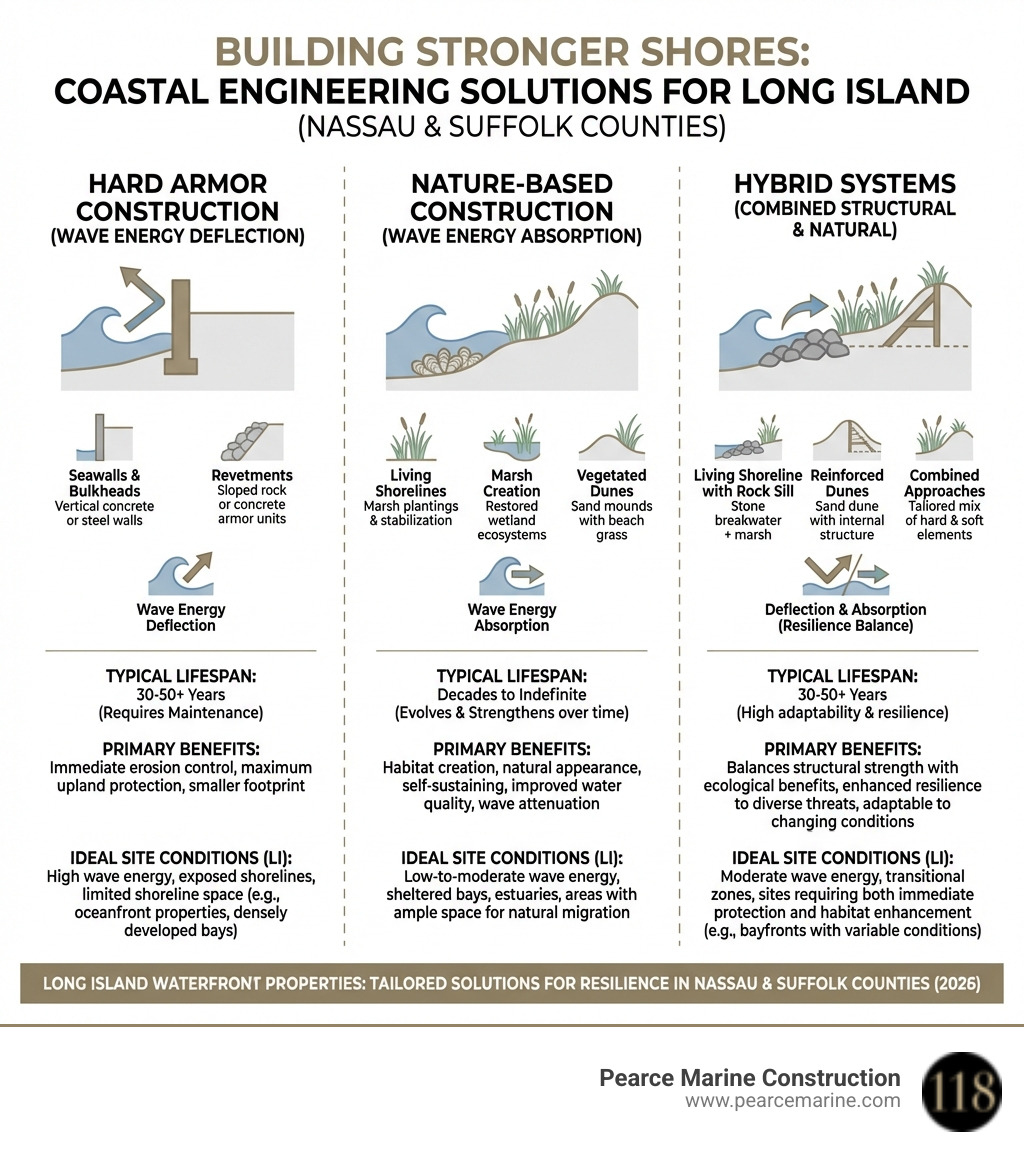
Hard Armor Construction: Your Strongest Defense
Sometimes, the most direct and formidable defense is a necessity. Hard armor construction involves building robust, engineered structures designed to withstand the full force of wave action and prevent erosion. These solutions are often chosen for properties facing high wave energy, significant erosion rates, or where valuable infrastructure is at immediate risk.
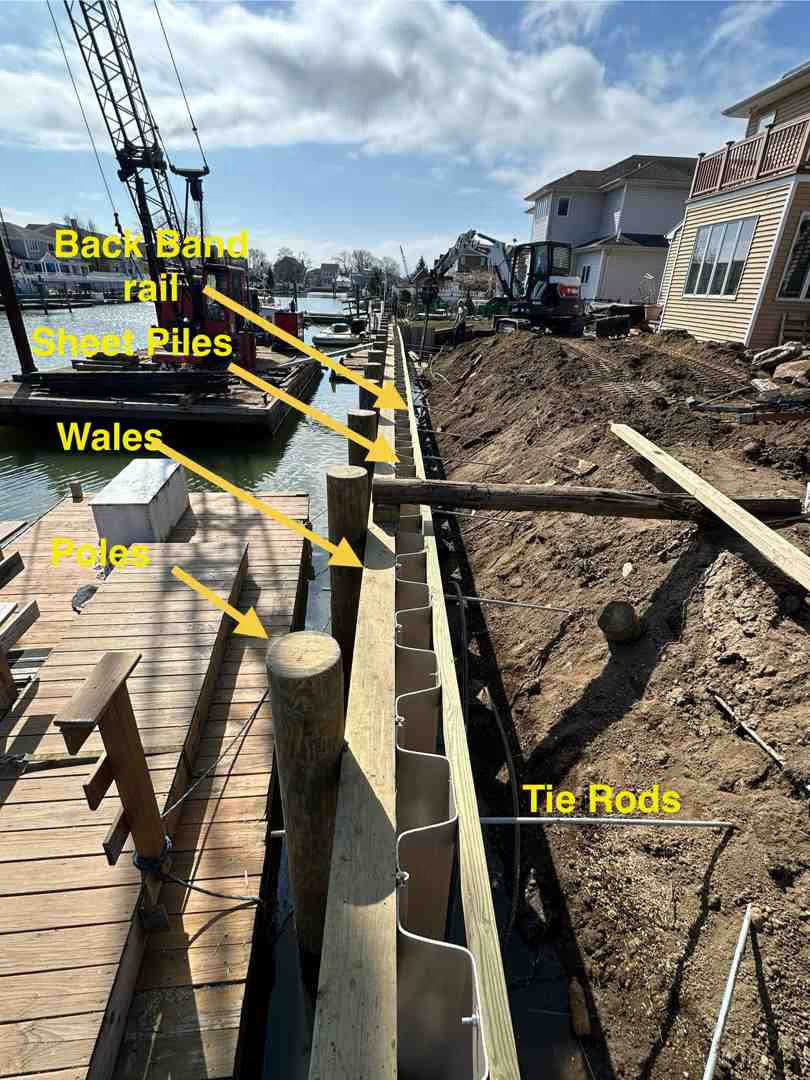
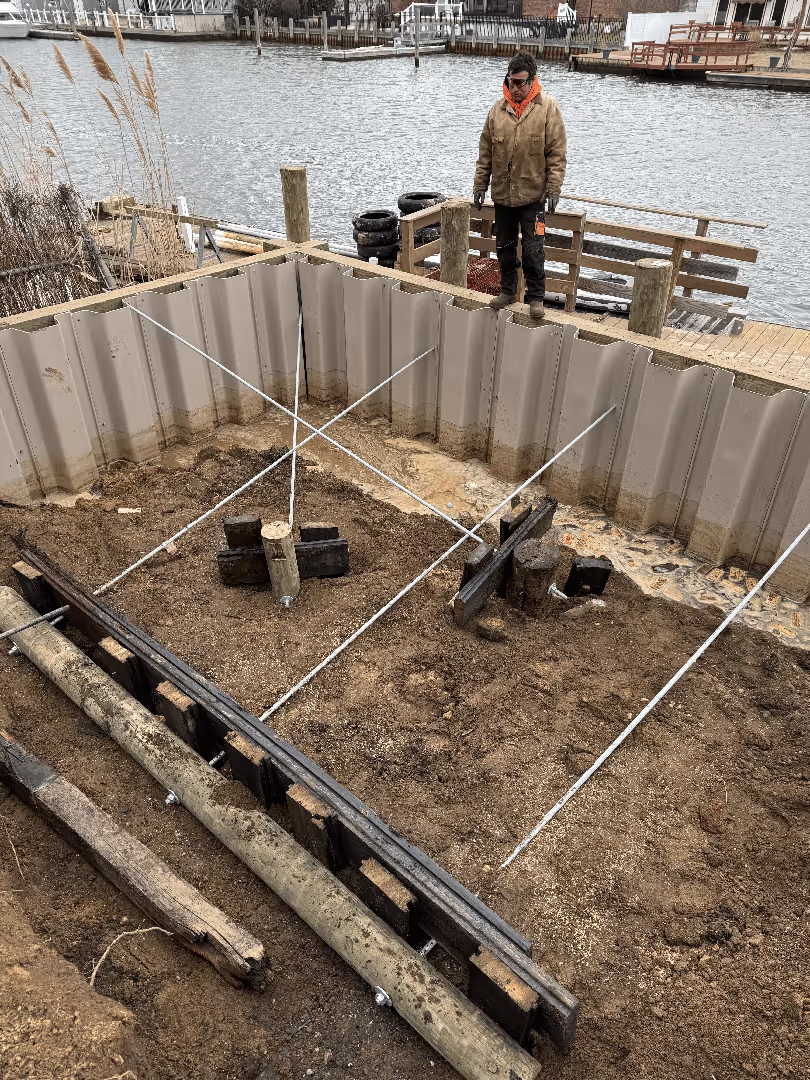
One of our most requested coastal engineering solutions is the construction of seawalls and bulkheads. These vertical barriers are constructed parallel to the shoreline to act as a solid shield against the sea. We specialize in both bulkhead construction and seawall installation, using high-quality materials to ensure longevity. For bulkheads, we carefully select timbers with the highest CCA treatment allowable or tropical hardwoods like green heart or purple heart to combat marine borers prevalent in our waters. Our vinyl sheet pilings can offer a lifespan of up to forty years, while steel-coated sheet pilings can last up to fifty years, though these figures depend on factors like local tides, salinity, and water cleanliness. For concrete seawalls, we typically use 4,000 PSI to 5,000 PSI marine application monolithic pours, ensuring a robust and durable structure.
Another powerful hard armor solution is the rock revetment. These sloped installations of armor stone absorb and dissipate wave energy more effectively than vertical walls, reducing wave reflection and scour at the base. We carefully select and place trap rock, granite, or cut stone, sizing it appropriately for the site-specific wave energy, to create a stable, long-lasting protective layer. Revetments can be particularly effective in areas where a more natural, yet still highly protective, aesthetic is desired.
Integral to many hard armor and even soft engineering projects is marine pile installation. Piles serve as the deep foundation for structures like bulkheads, docks, and piers, transferring loads to stable subsoil strata. We employ various pile types, including timber, steel, and helical piles, utilizing advanced pile driving techniques to ensure maximum stability and durability. For piers, we often use a three and four pile bent design to provide extra structural support and defy ice extraction, a crucial consideration for Long Island's colder months.
When comparing a bulkhead versus a seawall, the choice often comes down to the specific site conditions, desired level of protection, and aesthetic preferences. Bulkheads are typically built to retain soil, while seawalls are designed to withstand greater wave energy. Our structural design expertise ensures that whether we're building a new seawall in West Hampton or installing a bulkhead in Brightwaters, it’s engineered for optimal performance and longevity.
Nature-Based & Soft Engineering Construction
While hard armor provides formidable protection, sometimes working with nature offers equally effective and often more environmentally integrated coastal engineering solutions. Nature-based and soft engineering approaches harness natural processes and materials to stabilize shorelines, absorb wave energy, and even improve local ecosystems.
One of the most promising nature-based coastal engineering solutions is the construction of living shorelines. These solutions use natural components such as marsh grasses, sand, and strategically placed sills to minimize coastal flooding and erosion. By absorbing incoming wave energy, they stabilize the shoreline, provide increased flood storage, and can be a cost-effective alternative to traditional gray infrastructure.
Beach nourishment involves strategically adding sand to beaches or coastal areas where sand has been lost due to erosion. This process rebuilds eroded shorelines to a stable configuration and replenishes sand lost during storms, providing both shore protection and recreational benefits. We ensure that the quality of the beach material used is comparable to or coarser than the native sand for long-term effectiveness.
Dune restoration, often paired with beach nourishment, involves planting appropriate dune grasses and using sand fencing to help stabilize these natural barriers. Vegetated dunes act as crucial buffers, absorbing storm surge and preventing inland flooding, while also creating valuable habitat.
Sills are semicontinuous structures, often made of stone or treated wood, built offshore to reduce wave action and preserve or create marsh grass fringes. They are designed to trip waves before they reach the marsh, protecting the delicate vegetation and enhancing the shoreline's natural resilience. Geotextile tubes, filled with sand, can also be used as a soft and flexible alternative to traditional hard structures, providing erosion control and acting as a foundation for vegetated living shorelines.
The Modern Approach: Hybrid Coastal Engineering Solutions
The future of coastal engineering solutions lies in smart, integrated design. This is where hybrid coastal engineering truly shines for Long Island properties. Instead of choosing strictly between hard armor or nature-based solutions, we often find the most effective and sustainable approach is to combine them. This "green-gray infrastructure" leverages the strengths of both worlds, creating systems that offer robust protection while also enhancing ecological value.
A hybrid approach might involve constructing a rock revetment at the toe of an eroding bank to absorb direct wave impact, then planting native vegetation and establishing a marsh fringe landward of the revetment. This combination provides structural stability from the revetment while the vegetation further dissipates wave energy, traps sediment, and creates habitat. Similarly, sills can be constructed offshore to reduce wave energy, protecting a newly planted marsh or a nourished beach. This allows the softer, natural elements to thrive and provide their ecosystem services, while the engineered structure ensures the necessary baseline protection.
This integrated design philosophy leads to improved resilience. By incorporating multiple layers of defense—both structural and natural—our shorelines become more adaptable to changing conditions, including sea-level rise and increased storm intensity. We're not just building barriers; we're building dynamic systems that can evolve. Our shoreline stabilization services often involve these sophisticated hybrid designs, ensuring that our construction is both effective and environmentally conscious.
The goal of sustainable marine construction is at the heart of our hybrid solutions. We consider the long-term environmental impact, the lifecycle costs, and the aesthetic integration with Long Island's unique coastal landscapes. This approach allows us to deliver coastal engineering solutions that are not only effective in protecting your property but also contribute positively to the health and beauty of our local ecosystems.
Building for Resilience in Nassau and Suffolk County
Long Island's coastline is a precious resource, but it's also highly vulnerable. Our communities in Nassau and Suffolk Counties face unique challenges due to our exposure to the Atlantic Ocean, numerous bays, and tidal estuaries. This is why our focus is always on building for resilience—creating structures that can withstand current threats and adapt to future changes.
Designing for Long Island's Unique Coastal Conditions
Every Long Island shoreline is distinct, and a one-size-fits-all approach simply won't work. When we design coastal engineering solutions, we begin with a thorough site assessment, carefully analyzing the specific conditions of your property. This includes evaluating factors like fetch (the distance over which wind can blow unimpeded across water, directly influencing wave size), bathymetry (the depth of water), tidal range, and the historical storm vulnerability of the area. For instance, a property in West Hampton facing the open ocean will require a very different engineering solution than one on a sheltered bay in Massapequa.
Our expertise in shoreline protection for Long Island means we understand the nuances of these local conditions. We identify all coastal processes affecting shore protection structures and account for these during the design and construction process. This meticulous planning allows us to determine the ideal materials, structural design, and construction methods that will offer long-term durability and protection. Whether it's selecting specific types of timber for a bulkhead in Bellmore or designing a concrete seawall for a Southampton estate, our material selection is always geared towards maximizing resilience against the local environment.
The design storm is a critical concept here. Structures are typically designed to withstand a specific intensity of a storm, considering its return frequency. For example, a 25-year design condition has a 64 percent chance of occurring during a 25-year project lifetime. We carefully assess these probabilities to ensure the level of protection we build aligns with your property's needs and the long-term risks.
The Future of Shoreline Construction
The field of coastal engineering solutions is constantly evolving, driven by the urgent need to adapt to climate change and protect our valuable coastlines. For Long Island, this means embracing advanced materials, innovative design, and adaptive management strategies.
We are seeing advancements in materials that offer superior strength, corrosion resistance, and environmental compatibility. Think high-performance concretes, specialized composites, and even bio-engineered materials that integrate seamlessly with natural systems. These innovations allow us to build structures that are not only stronger but also require less maintenance over their lifespan.
Innovative design approaches, often supported by advanced modeling techniques, enable us to predict how our structures will interact with dynamic coastal processes. This allows for more precise and efficient construction, ensuring that every component serves its purpose optimally. Adaptive management is also key; recognizing that coastal environments are constantly changing, our solutions are designed to be flexible, allowing for future modifications or improvements as conditions evolve.
These forward-thinking approaches are vital for flood mitigation and ensuring robust coastal flood protection for Long Island. We focus on long-term planning, anticipating future sea-level rise and extreme weather events, to construct coastal engineering solutions that will safeguard your property for generations.
Partnering with a Master Marine Contractor
Choosing the right partner for your coastal engineering solutions on Long Island is paramount. Our team at Pearce Marine Construction brings generational expertise and meticulous craftsmanship to every project in Nassau and Suffolk Counties. We understand that your waterfront property is a significant investment, and we are committed to protecting it with the highest standards of quality and professionalism.
From the initial project planning stages to comprehensive construction oversight, we manage every detail. Public safety and risk management are at the core of our operations. We design and build structures that not only protect your property but also ensure the safety and integrity of the waterfront area. Our commitment extends to delivering solutions that minimize environmental impact while maximizing long-term resilience.
For example, when constructing bulkheads and seawalls, we factor in coastal environmental impacts such as wave and ice forces, corrosion, and high structural foundation loads. Our engineering staff has extensive experience in marine structures, including piers, wharves, fender systems, mooring systems, jetties, rock revetments, and various foundation types. This deep knowledge ensures that your project is built right the first time.
If you're considering coastal engineering solutions for your Long Island property, trust the experts who combine time-honored skill with cutting-edge techniques. We are dedicated to building stronger, more resilient shores for our communities.
Ready to safeguard your waterfront property with expertly crafted coastal engineering solutions? Request a consultation for your shoreline project today and let us help you build a more secure future for your Long Island property.



Bring Your Vision to Life
Whether you're planning a custom dock, seawall, or boat lift, our experienced team is ready to deliver high-quality marine construction tailored to your needs. Pearce Marine Construction brings craftsmanship, precision, and a deep understanding of Florida’s waterways to every project. Let us help you create a durable, beautiful solution that stands the test of time. Get in touch now for a personalized estimate!