
Unscrewing the Mystery: What is a Helical Pile Foundation?

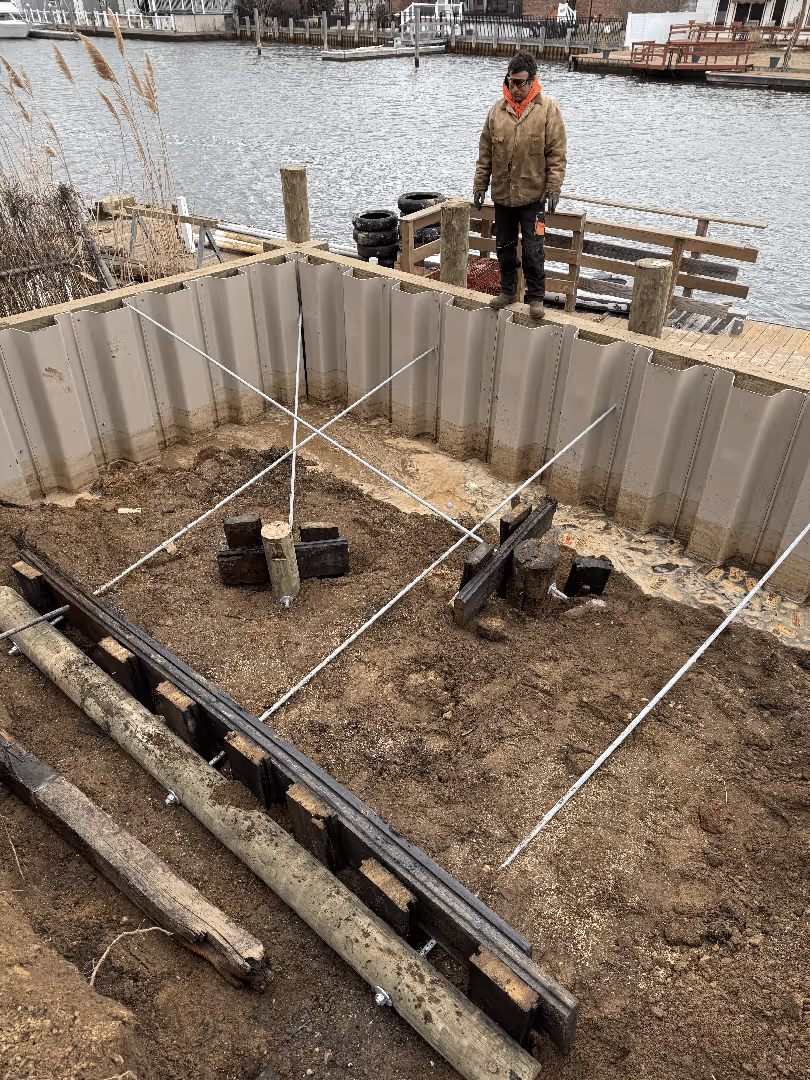
The Modern Anchor for Long Island's Shoreline
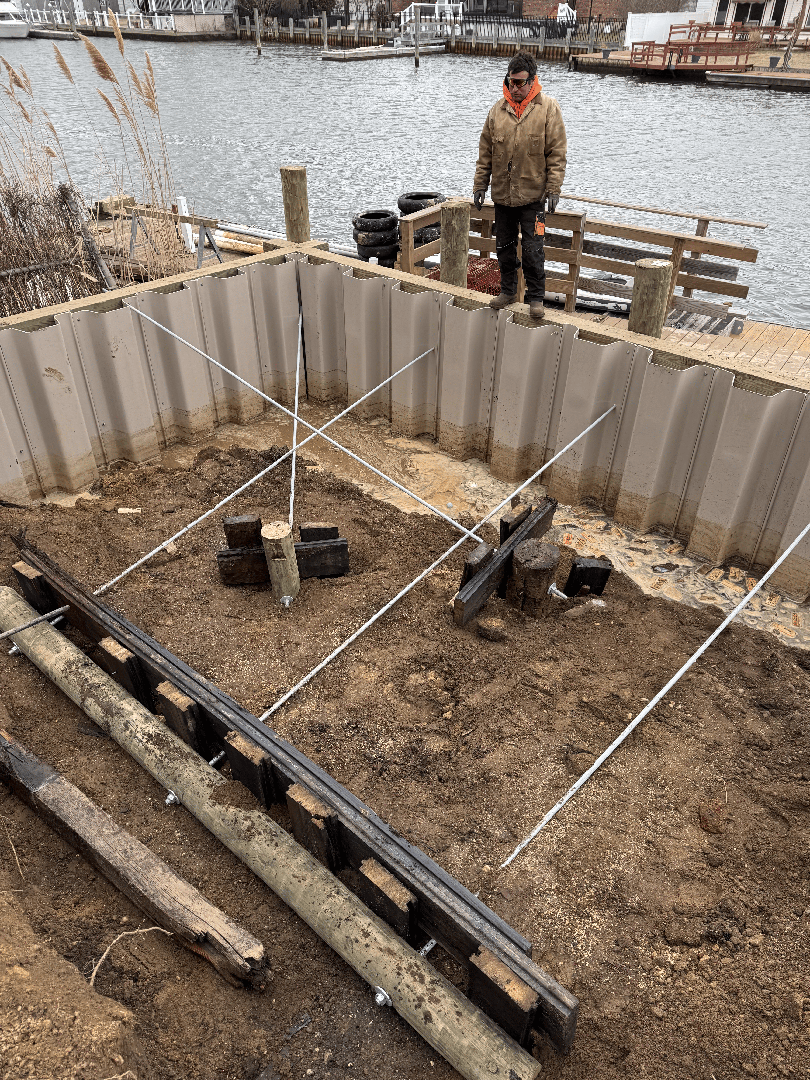
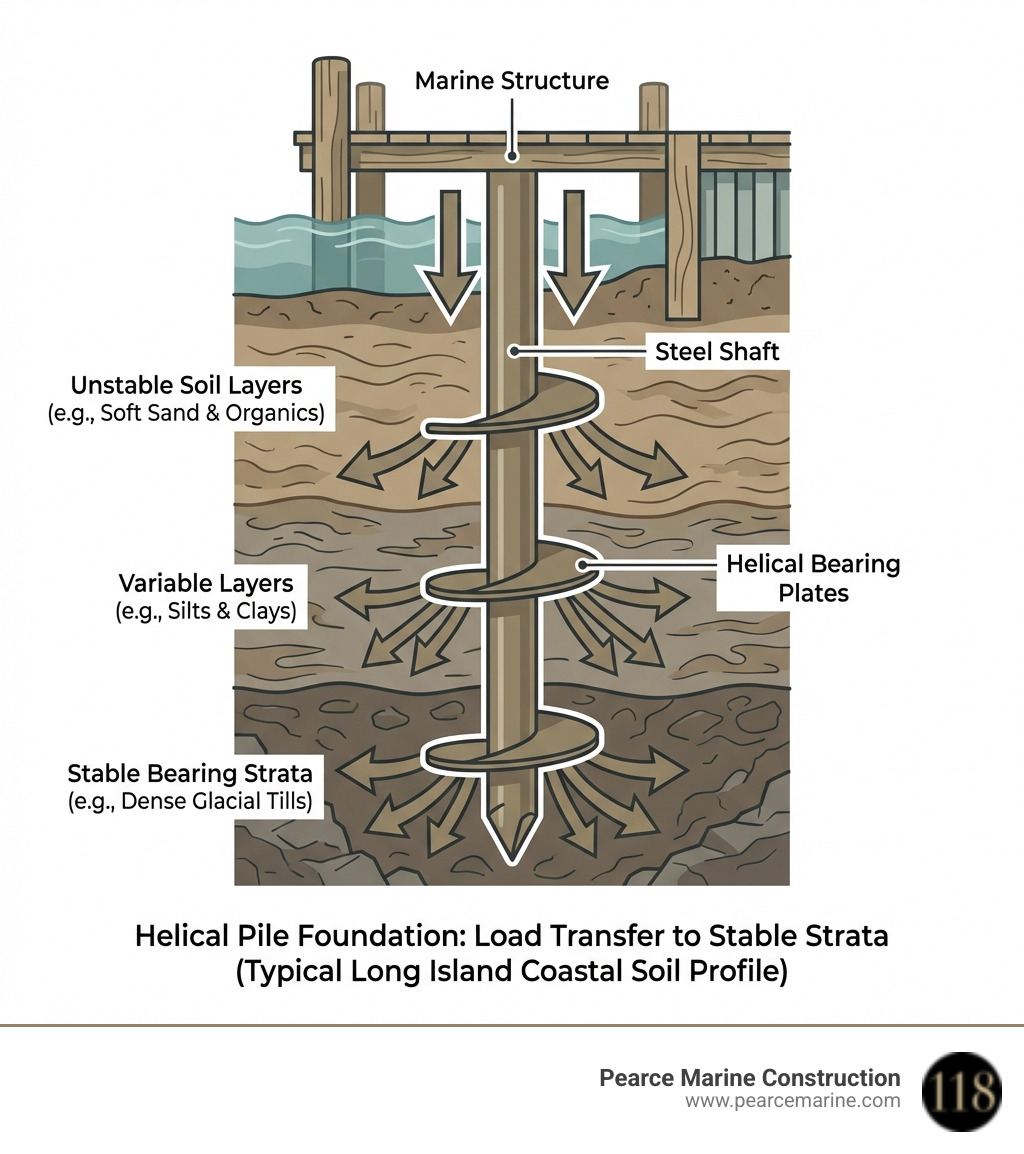
A helical pile foundation is a deep foundation system that uses steel shafts with welded spiral blades (helices) to anchor structures into stable soil layers. It provides immediate load-bearing capacity for docks, bulkheads, seawalls, and other marine structures without the need for concrete curing time or extensive excavation.
Key Facts About Helical Pile Foundations:
- What it is: Steel shaft with helical (screw-like) bearing plates
- How it works: Screwed into ground using hydraulic equipment until reaching load-bearing soil
- Installation time: Often 4 hours or less; up to 20 piles in a single day
- Load capacity: Supports from 225 lbs to over 1 million lbs per pile
- Lifespan: 150+ years in typical soil conditions when properly galvanized
- Immediate use: Ready to bear loads instantly after installation
If you own waterfront property in Nassau or Suffolk County, you've likely heard about foundation challenges along Long Island's shoreline. The soil conditions here—ranging from soft sand in Southampton to variable layers in West Islip and West Hampton—demand foundation solutions that can reach stable bearing strata without the disruption of traditional concrete footings.
Helical pile foundations solve this problem neatly. Unlike driven piles that create noise and vibration, or concrete footings that require excavation and curing time, helical piles screw quietly into the ground until they reach the torque levels that indicate proper load capacity. For marine construction projects where access is tight and time matters, this technology has become the standard for building durable docks, piers, and bulkheads.
The installation process is surprisingly straightforward: a hydraulic drive head rotates the pile into the soil while monitoring torque. When the torque reaches the engineered specification, you know the pile has reached stable soil and can support your structure. No guesswork. No waiting. No mess.
For Long Island property owners protecting valuable waterfront investments, understanding helical pile foundations isn't just technical knowledge—it's the key to choosing construction methods that will protect your shoreline for generations.
Handy helical pile foundation terms:
The Complete Guide to Helical Pile Foundation Systems
At Pearce Marine Construction, we understand that building durable and stable marine structures along the shores of Nassau and Suffolk County requires a deep understanding of both local conditions and advanced engineering solutions. This section will explore the technical aspects, advantages, and applications of helical piles, providing a comprehensive understanding for property owners in our service areas of Long Island. From Massapequa to Southampton, we've seen how the right foundation makes all the difference.
How Helical Piles are Installed on Your Property

The installation of a helical pile foundation is a precise, efficient process that minimizes disruption to your property, a huge advantage for waterfront locations in Long Island. Our process typically involves a few key steps:
Site Assessment and Design: Before any work begins, we conduct a thorough site assessment. This includes analyzing soil conditions, understanding the specific load requirements of your marine structure (be it a bulkhead, dock, or seawall), and reviewing project specifications. A professional engineer's input is crucial here to determine the optimal pile configuration, including shaft and helix dimensions, and the required embedment depth and torque. This ensures the helical pile foundation is perfectly suited for your project and the unique soil characteristics of areas like West Islip or Brightwaters.
Equipment Mobilization: One of the greatest benefits of helical piles is the compact and specialized hydraulic equipment we use for installation. Unlike traditional methods that might require heavy, cumbersome machinery, our specialized hydraulic drive heads can attach to skid steers, excavators, or even mini-excavators. This allows us to steer tight access areas common along the Long Island shoreline, from busy marinas in Babylon to serene residential properties in Cold Spring Harbor, with minimal logistical complexity. This equipment is designed exclusively for helical pile foundation installation, making the process efficient and less disruptive to the surrounding environment.
Pile Placement and Installation: The actual installation begins with placing the lead section of the helical pile. Using the hydraulic drive head, we mechanically screw the pile into the ground. The rate of rotation is typically between 5 to 25 RPMs, with sufficient downward pressure (crowd) applied to advance the pile approximately one helix pitch per revolution. This gentle, rotational motion ensures minimal soil disturbance and virtually no vibration or noise, a stark contrast to conventionally driven piles. This is particularly appreciated in residential areas like Merrick or Wantagh.
Torque Monitoring and Depth Verification: As the pile advances, we continuously monitor the installation torque. This is a critical step, as installation torque provides a direct, empirical relationship to the soil's strength and the pile's axial capacity. When the torque reaches the engineered specification, it indicates that the pile has reached stable, load-bearing soil. If we encounter an obstruction or the required torque isn't met, we can easily add extension sections to reach deeper, more competent soil layers. This real-time verification ensures the helical pile foundation meets specific engineering requirements, often reaching depths of 10 to 25 feet, or even deeper if necessary.
Termination and Connection: Once the designated depth and load-bearing capacity are reached, the pile installation is terminated. The pile is then trimmed to the appropriate length, and a load transfer device (pile cap or bracket) is professionally attached to the top. This cap serves as the connection point for your marine structure, whether it's a new dock in Southampton or a robust bulkhead in Huntington.
Minimal Disturbance and Immediate Use: The entire process is remarkably clean. Helical piles displace very little soil, meaning there are no excavation spoils to remove. This minimal impact on the landscape is a huge plus for maintaining the aesthetics of your waterfront property. Furthermore, because there's no concrete curing time, the helical pile foundation is ready to accept its full design load immediately after installation. We can often install up to 20 piles in a single day, meaning your construction project can move forward without delay.
For more detailed information on our installation process, you can visit our dedicated page: More info about Helical Piles Installation.
Key Advantages Over Traditional Concrete Foundations
When it comes to building or repairing marine structures along Long Island's beautiful but challenging coastline, the advantages of a helical pile foundation over traditional concrete footings are significant. We've seen these benefits play out across countless projects in Nassau and Suffolk County. Let's break down why we often recommend this modern solution:
| Feature | Helical Pile Foundation | Traditional Concrete Footings |
|---|---|---|
| Installation Speed | Helical piles can often be installed in less than four hours, with up to 20 piles installed in a single day. This rapid installation minimizes disruption to your project timeline, crucial for marine construction that often faces tight deadlines due to tides and weather. | Concrete footings require excavation, formwork, rebar placement, and concrete delivery, followed by curing time. This can extend the schedule by days or weeks, especially in damp or cold coastal conditions. |
| Immediate Load Capacity | One of the most compelling advantages of a helical pile foundation is its immediate load-bearing capacity. Unlike concrete, which requires significant curing time, helical piles are ready to support your structure the moment installation is complete. This means your marine construction project in Long Island can progress faster and more efficiently. | Concrete must cure to reach design strength, often requiring 7–28 days before full loads can be applied, delaying dock, bulkhead, or seawall construction. |
| Access & Equipment | Installed with compact hydraulic equipment that can maneuver in tight waterfront yards, along existing bulkheads, and between neighboring properties in communities like Bellmore or Lloyd Harbor. | Often requires larger excavation equipment, concrete trucks, and more staging space, which can be difficult to coordinate in narrow waterfront lots. |
| Soil Disturbance | Helical piles screw into the ground, displacing minimal soil and generating virtually no spoils. This keeps your site cleaner and reduces the need for soil removal from sensitive shoreline areas. | Excavation for footings generates substantial spoils that must be handled and removed, increasing cost, site disruption, and potential impact to the shoreline. |
| Noise & Vibration | Low-noise, low-vibration installation that is neighbor-friendly and ideal near existing homes and structures along Nassau and Suffolk waterfronts. | Formwork and excavation can be noisy and disruptive; in some cases, compaction or other activities may transmit vibration to nearby structures. |
| All-Weather Reliability | Can typically be installed in a wider range of weather conditions, since there is no curing process affected by temperature or moisture. | Concrete strength and finish quality are sensitive to cold temperatures, heavy rain, and freeze–thaw cycles during curing. |
| Performance in Poor Soils | Designed to extend through soft, loose, or variable coastal soils until they reach competent bearing layers, verified by torque readings during installation. Ideal for areas with deep sand or fill common across Nassau and Suffolk County. | Shallow concrete footings may not reach stable material in poor soils, increasing the risk of settlement, tilting, or cracking over time. |
| Adaptability & Repair | Additional piles or extensions can be added in the future if loads change or sections of a marine structure need reinforcement or repair. | Modifying or reinforcing existing concrete footings typically requires demolition and re-pouring, which is more invasive and time-consuming. |
| Environmental Footprint | Reduced excavation, minimal spoils, and no on-site concrete washout make helical piles an environmentally considerate choice for shoreline protection projects. | Larger excavation, concrete production, and washout management can increase the environmental impact near sensitive waterways. |
Common Applications for a Helical Pile Foundation
Along the shorelines of Nassau and Suffolk County, helical pile foundations are used anywhere a stable, deep foundation is needed for marine and shoreline structures. Pearce Marine Construction routinely installs helical systems for:
- Bulkheads and Seawalls: Providing deep anchoring and tie-back support so wall systems resist lateral loads from tides, waves, and backfill pressure.
- Docks and Piers: Supporting fixed dock sections, approach walks, and finger piers in areas with soft or variable soils.
- Lifted Decks and Waterfront Platforms: Elevating structural decks and work platforms above grade to protect framing from splash zones and tidal movement.
- Retaining Walls and Shoreline Stabilization Systems: Anchoring retaining structures that hold back soil along eroding waterfront slopes.
- Marine Access Walkways: Supporting framed walkways that connect upland yards to bulkheads or dockheads where soils are not suitable for shallow footings.
These applications ensure that the visible components of your project—whether a bulkhead face, pier framing, or liftd deck system—are anchored to a foundation engineered for long-term performance in Long Island’s coastal soils.
For a broader overview of helical pier uses and considerations, you can also review: More info about Helical Piers.
Design, Durability, and Engineering Considerations
Every helical pile foundation Pearce Marine Construction installs along the Long Island shoreline is engineered for the specific structure, soil profile, and environmental loading conditions.
Key design and durability factors include:
- Geotechnical Conditions: Coastal soils in Massapequa, Babylon, Bayshore, and West Hampton can vary from loose sand and organic layers to denser, more competent strata. Torque-correlated design allows the pile to advance until it reaches soils capable of carrying the required loads.
- Load Capacity: Shaft size, helix diameter, and helix spacing are selected to match the vertical and lateral loads from bulkheads, docks, seawalls, and retaining walls. Multiple piles can be grouped or battered to resist combined forces from waves, currents, and backfill.
- Galvanized Steel Protection: Helical piles are typically hot-dip galvanized to resist corrosion in the aggressive coastal environment, contributing to an expected service life that can exceed 150 years in typical soil conditions when properly specified.
- Round vs. Square Shaft: Round shafts may be selected for higher bending resistance where lateral loads are critical (such as exposed piles under docks or piers), while square shafts can be ideal for tension or compression in more protected conditions. The choice is based on engineering requirements, soil behavior, and the type of marine structure being supported.
- Connection Details: Pile caps, brackets, and structural connections are designed so loads transfer cleanly from framing members into the helical foundation. This detailing is especially important at bulkhead deadmen, dock bents, and retaining wall anchors.

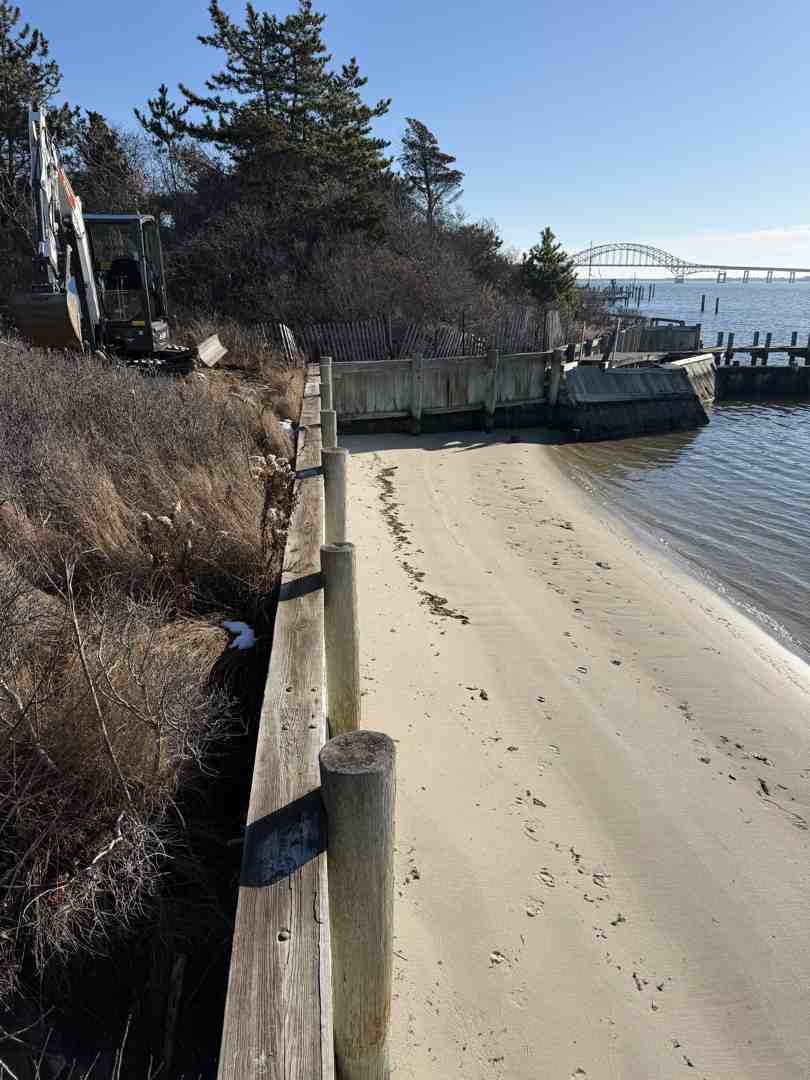

Bring Your Vision to Life
Whether you're planning a custom dock, seawall, or boat lift, our experienced team is ready to deliver high-quality marine construction tailored to your needs. Pearce Marine Construction brings craftsmanship, precision, and a deep understanding of Florida’s waterways to every project. Let us help you create a durable, beautiful solution that stands the test of time. Get in touch now for a personalized estimate!