
Steel Piers vs Concrete: Why Helical Piles are Winning


Why Waterfront Property Owners and Marine Contractors Choose Helical Piles for Shoreline Infrastructure
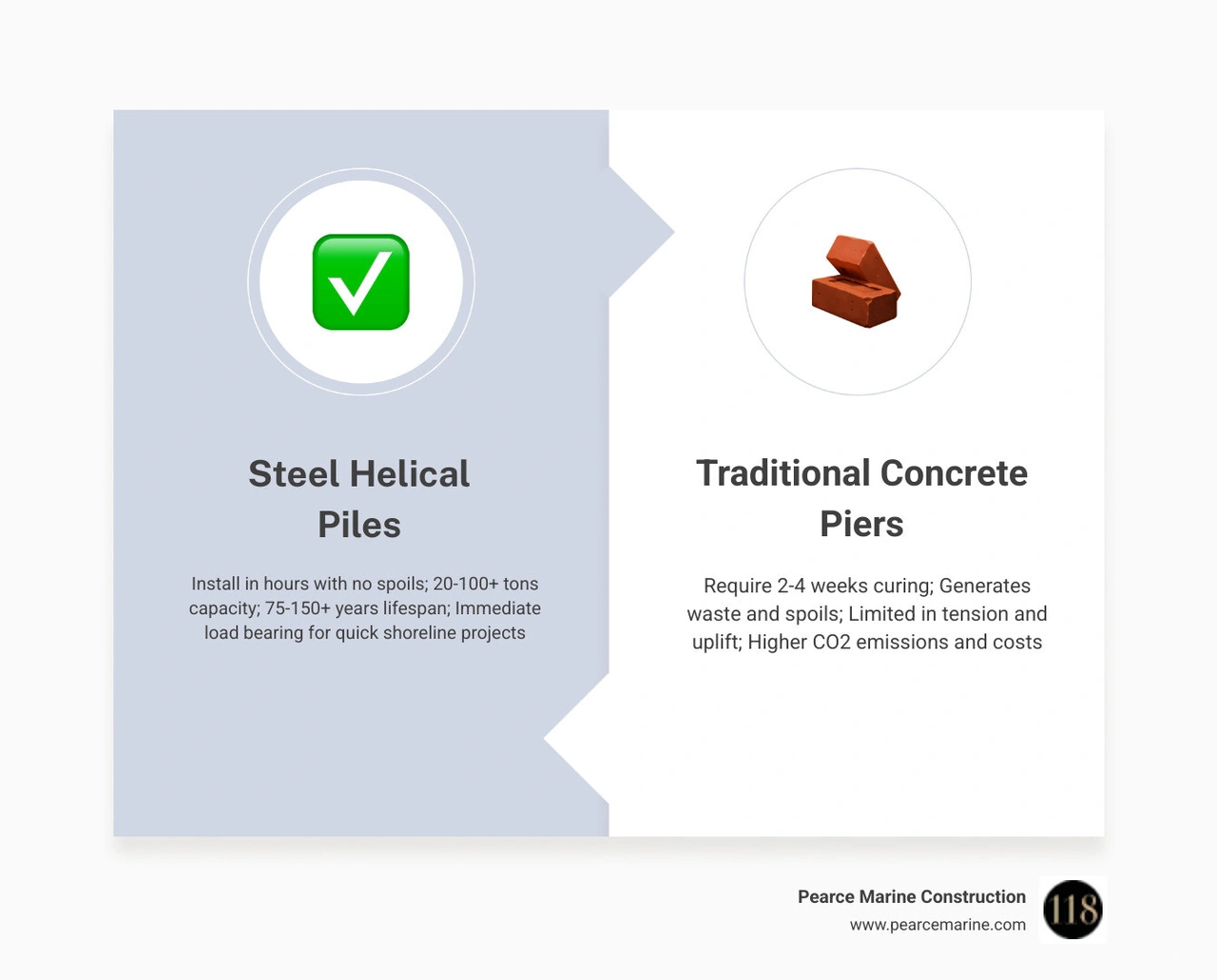
Helical piles are deep foundation elements made of steel shafts with helical plates welded along the shaft — essentially giant screws driven into the ground to support marine infrastructure like bulkheads and docks.
Here's a quick answer to what most people want to know:
| Question | Answer |
|---|---|
| What are helical piles? | Steel shafts with helical plates screwed into soil to support marine structures |
| How much can they hold? | 20–100+ tons per pile depending on size and soil conditions |
| How long do they last? | 75–150+ years with proper coating and design |
| How fast to install? | 1–2 days vs. 2–4 weeks for traditional concrete marine foundations |
| Do they work in sandy soil? | Yes — ideal for Long Island's sandy coastal soils |
| Can they handle marine environments? | Yes — galvanized steel resists corrosion in waterfront conditions |
For Long Island waterfront property owners, the foundation question isn't academic. It's the difference between a bulkhead or dock that holds through a Nor'easter — and one that doesn't.
Traditional concrete piers have long been the default. But on Nassau and Suffolk County shorelines — where sandy, shifting soils meet storm surge and tidal pressure — concrete has real limitations. It takes weeks to cure. It generates spoils. And once it's in, it's in.
Helical piles change that equation entirely.
They install in hours, bear load immediately, and outperform concrete in tension and uplift conditions — exactly the forces that challenge waterfront structures most. The North American helical pile market is projected to reach $392.6 million by 2030, and it's not hard to see why demand is surging in coastal construction markets like Long Island.
This guide breaks down why helical piles are replacing concrete as the foundation of choice for shoreline infrastructure — and what that means for your next marine project.
Simple helical piles glossary:
The Engineering Advantage of helical piles
The engineering behind helical piles is both simple and brilliant. Unlike traditional piles that rely solely on friction or end-bearing at the tip, a helical pile uses its screw-like blades (helices) to anchor into the soil. These flights are welded to a central steel shaft, which can be either a solid square shaft or a hollow round pipe depending on the marine project's needs.

When we install these, we aren't just pushing them into the mud. We use hydraulic torque motors to "thread" them into the ground. This process creates a direct relationship between the installation torque and the soil's bearing capacity. By monitoring the torque in real-time, we can verify exactly how much weight that pile can support before we even finish the job. This "torque-to-capacity" ratio provides a level of predictability that concrete simply cannot match.
Furthermore, helical piles displace soil rather than removing it. In traditional bored concrete piers, you have to deal with "spoils"—the dirt you dug out that now has to be hauled away. With helical systems, there is zero mess and zero excavation. If you want to dive deeper into the technical specs, check out our More info about helical piles services.
How helical piles Work in Sandy Long Island Soils
In Nassau County and Suffolk County, we deal with a lot of sandy strata. Sand is notorious for being "fickle" when it comes to marine foundations. Traditional concrete can settle or shift if the water table rises or if the sand isn't perfectly compacted.
Helical piles thrive here. Because the helices are spaced to act as independent bearing elements, they can reach deep into the stable, dense sand layers far below the surface. This makes them ideal for the "unsuitable" shoreline soil conditions often found in Massapequa or Merrick. For a deeper look at the mechanics, see our Helical Pile Foundation Complete Guide.
Comparing Load Capacities: Steel vs. Concrete
When it comes to raw strength, the numbers speak for themselves. While a standard marine concrete pier might handle a few tons, individual helical piles can restrain unfactored axial loads of up to 2000kN (roughly 450 kips). They are also powerhouses in resisting uplift and lateral loads—crucial for bulkheads facing heavy tides in Babylon or Bayshore.
| Feature | Steel Helical Piles | Concrete Piers |
|---|---|---|
| Axial Load Capacity | Up to 2000kN (450+ kips) | Varies, usually lower per unit |
| Uplift Resistance | Exceptional (anchored by helices) | Limited (relies on weight/friction) |
| Lateral Resistance | Up to 250kN+ | Moderate |
| Installation Speed | Minutes per pile | Days (including cure time) |
| Soil Displacement | Displaces soil (no spoils) | Excavates soil (high spoils) |
According to research from Helical Piles - Helical Technology, the ability to achieve these high capacities without the massive footprint of concrete is why they are becoming the standard for modern deep foundations in marine construction.
Installation and Application for Shoreline Infrastructure
The beauty of helical piles in marine construction is their versatility. Whether we are reinforcing a seawall in Southampton or building a custom dock in West Hampton, the equipment we use is compact and efficient.
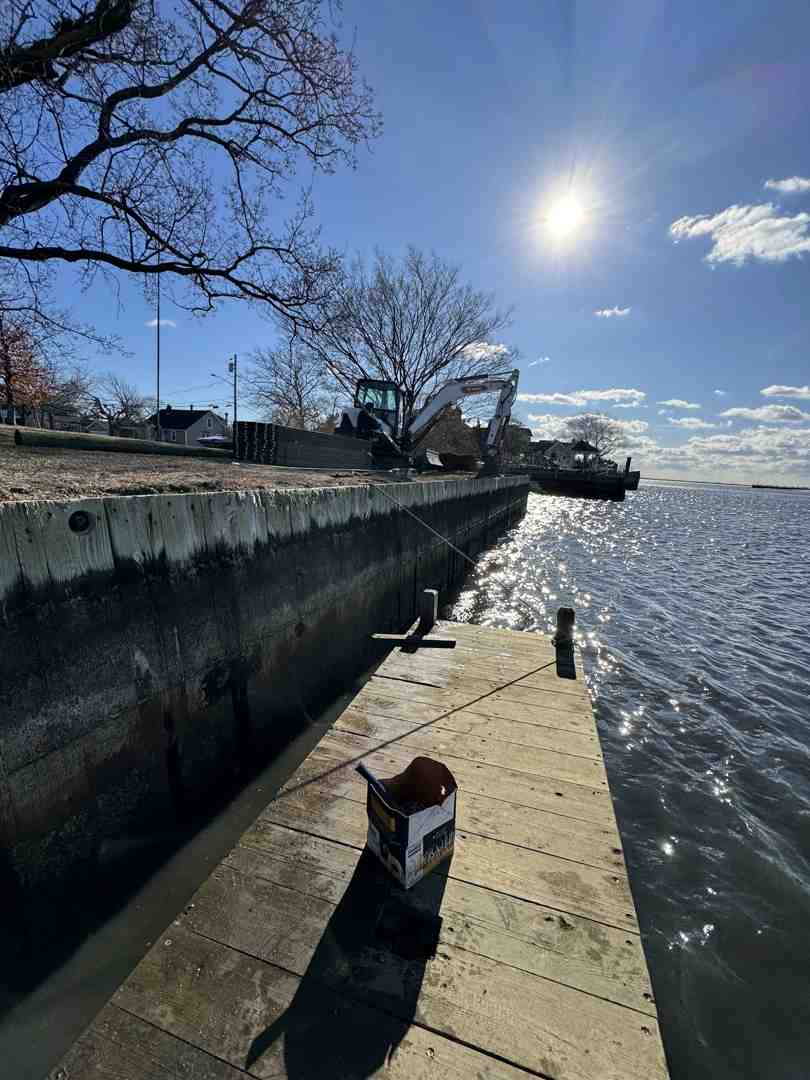
Because the installation equipment is smaller than a traditional pile driver, we can get into tight spots that would be impossible for other contractors. This is a game-changer for bulkhead repairs where we need to work close to existing waterfront structures without causing structural vibrations. You can learn more about the financial side of this efficiency in our guide on the Cost to Install Helical Piers.
The helical piles Installation Process
Our process is streamlined for speed and precision:
- Site Assessment: We analyze the soil and load requirements for the marine structure.
- Mobilization: We bring in compact hydraulic equipment (excavators or skid-steers).
- Driving the Lead: The first section with the helices is screwed into the earth.
- Extensions: We bolt on extensions until we hit the target depth or torque.
- Torque Monitoring: We record the peak torque every foot to ensure capacity.
- Termination: The pile is capped and immediately ready for the structure.
There is no "waiting for the concrete to dry." You can literally build on these piles the same hour they are installed. Read more about the Helical Piles Installation process here.
Marine Construction Applications in Nassau and Suffolk
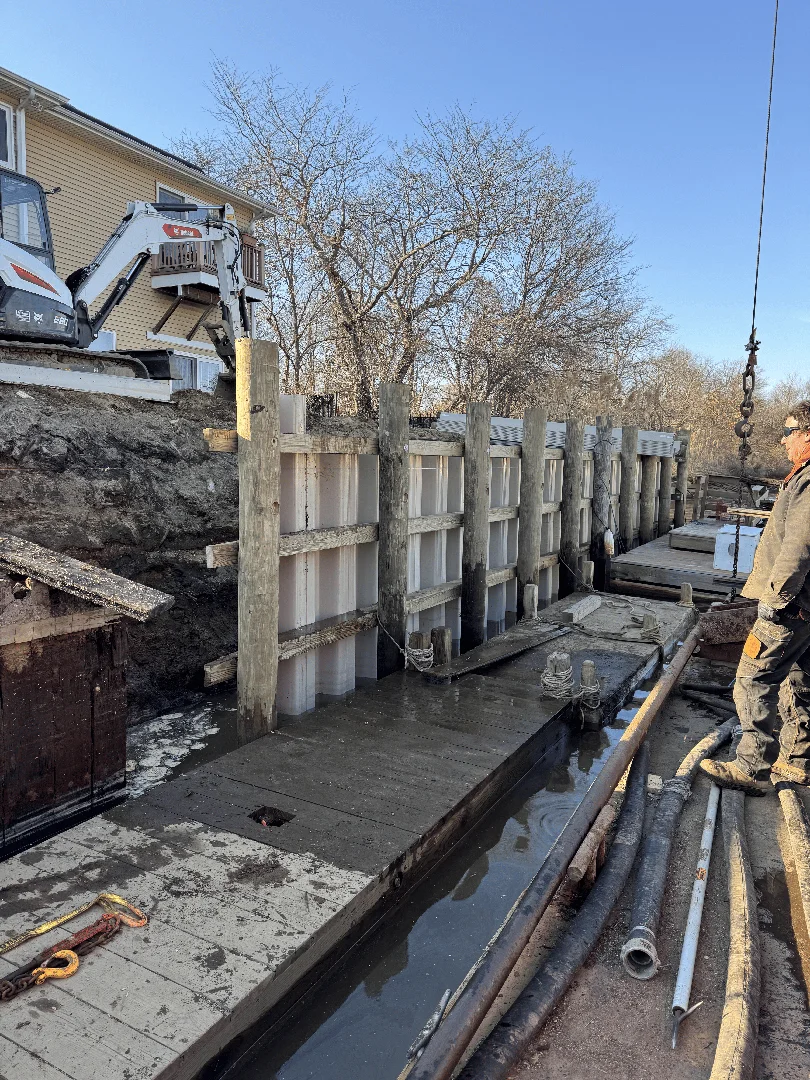
We use helical piles across a variety of high-stakes marine projects. In West Islip and Brightwaters, they are the preferred choice for anchoring bulkheads against the constant pressure of the Great South Bay. In the Hamptons, we use them to support massive piers and walkways that must withstand heavy storm surges.
Because they are made of hot-dipped galvanized steel, they are built for the salt air and brackish water of Long Island. For local residents, our Helical Piles Long Island Guide offers specific insights into how these systems perform in our local environment.
Environmental and Cost Benefits for Waterfront Projects
One of the most surprising facts about helical piles is their "green" footprint. They can reduce CO2 emissions by approximately 56% compared to bored concrete piles. This is largely because they use 50-70% less concrete and don't require the heavy transport of wet trades.

From a budget perspective, the savings are just as impressive. By reducing labor costs by 30-40% and cutting project timelines by up to 50%, waterfront property owners can see 40-60% total cost savings compared to traditional foundations. As noted by Helical Piles - Helical Drilling, the lack of "spoils" also means you aren't paying to haul dirt away from your property.
Why Pearce Marine Construction is the Local Authority
At Pearce Marine Construction, we don't just "install" piles; we provide engineered shoreline solutions. As a woman-owned business with generational expertise, we understand the unique challenges of Long Island's coast—from the rocky bluffs of Cold Spring Harbor to the sandy shores of Southampton.
We pride ourselves on meticulous craftsmanship. When you hire us, you aren't getting a "one-size-fits-all" foundation. You are getting a system designed specifically for your soil and your marine structure. We serve both Nassau and Suffolk Counties, including Wantagh, Bellmore, and Huntington, ensuring every dock, bulkhead, and seawall we build is anchored for a lifetime.
If you are ready to secure your shoreline with the most advanced foundation technology available, look for Certified Helical Pile Installers who know the Long Island landscape inside and out. We are here to make sure your waterfront investment stands strong for the next 100 years.


Bring Your Vision to Life
Whether you're planning a custom dock, seawall, or boat lift, our experienced team is ready to deliver high-quality marine construction tailored to your needs. Pearce Marine Construction brings craftsmanship, precision, and a deep understanding of Florida’s waterways to every project. Let us help you create a durable, beautiful solution that stands the test of time. Get in touch now for a personalized estimate!