
Repairing Seawalls: A Step-by-Step Guide to Shoreline Success


Why Repairing Seawalls Before They Fail Saves You Time, Money, and Shoreline
Repairing seawalls is the specialized process Pearce Marine Construction uses to restore deteriorating coastal barriers. For property owners in Nassau and Suffolk Counties, professional intervention is critical to prevent total shoreline loss.
Our professional repair process involves:
- Professional Inspection - Our team identifies cracks, rust stains, soil depressions, and leaning sections
- Root Cause Diagnosis - We analyze erosion, hydrostatic pressure, corrosion, and drainage issues
- Precision Engineering - We select the optimal method, such as epoxy injection, polyurethane grouting, or helical tiebacks
- Marine-Grade Materials - We use high-performance components specifically for Nassau and Suffolk saltwater environments
- Comprehensive Restoration - We stabilize soil and optimize drainage to ensure lasting protection
Seawalls take a beating every single day. Tidal cycles, wave action, storm surges, and the slow grind of saltwater on concrete or steel add up over years. For our clients on Long Island, the structures protecting their shorelines are under constant stress.
The challenge for property owners is that most damage starts invisibly. Water seeps through hairline cracks. Soil washes out behind the wall. Voids form underground. By the time you notice a sinkhole or a leaning panel, the repair job has already gotten significantly harder and more expensive.
Our approach ensures that we don't just seal a wall; we address the underlying issues like hydrostatic pressure to prevent accelerated failure.
This overview details the professional restoration process Pearce Marine Construction employs, from forensic assessment to selecting the right techniques for Long Island's unique saltwater environment.
Our specialized services include:
The Professional Process of Repairing Seawalls in Long Island
When we approach a project in West Islip or Southampton, we aren't just looking at a wall; we are looking at a complex engineering system. The professional process of repairing seawalls begins with a forensic-level assessment. We have to understand why the wall is moving or cracking before we can fix it.
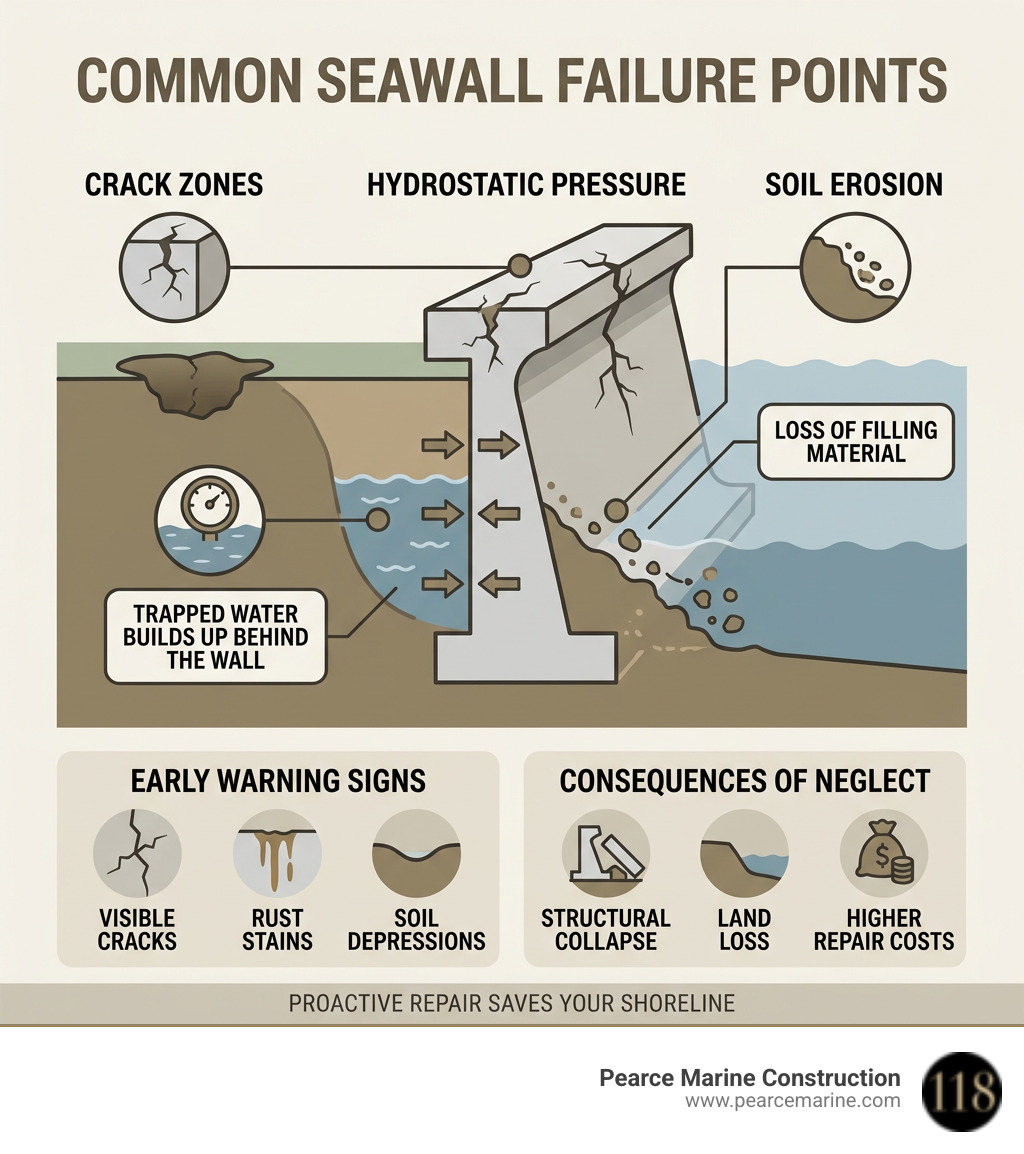
In Nassau and Suffolk Counties, the primary antagonist is often hydrostatic pressure. This occurs when water from rain or high tides gets trapped behind the wall and cannot escape. Because water is heavy, it exerts massive pressure against the structure. If the drainage isn't perfect, that water will find the path of least resistance—usually by forcing its way through joints or cracks, carrying your backyard's soil with it.
Our restoration process focuses on three pillars: sealing the leaks, stabilizing the soil, and relieving the pressure. By using advanced seawall repair services, we can often save a structure that looks destined for the scrap heap.
Professional Assessment: Identifying Signs for Repairing Seawalls Early
The key to protecting your property is having Pearce Marine Construction identify the "whispers" of failure before they become "screams." On Long Island, our freeze-thaw cycles and salt spray accelerate the degradation of even the toughest materials. According to scientific research on coastal erosion and seawall materials, the choice of material significantly impacts how damage manifests.
Our professional assessment focuses on these critical warning signs:
- Cracks and Spalling: Vertical or horizontal cracks in concrete are entry points for salt. Once saltwater hits the internal steel reinforcement, the steel rusts and expands, causing the concrete to flake off—a process known as spalling.
- Rust Stains: If you see orange streaks bleeding through the concrete, your internal rebar is corroding. This weakens the structural skeleton of the wall.
- Soil Depressions and Sinkholes: If you notice "potholes" forming in the grass or sand behind your bulkhead, soil is being sucked out through gaps in the wall during low tide.
- Seawall Movement: A wall that is bowing outward or leaning toward the water is a sign of tieback failure or excessive pressure from the landward side.
Our Advanced Techniques for Repairing Seawalls and Bulkheads
Modern marine engineering offers sophisticated solutions. At Pearce Marine Construction, we utilize techniques that address the structural physics of the shoreline.
- Polyurethane Injection: This is a game-changer for Long Island properties. We inject high-density, eco-friendly structural polymers into the soil behind the wall. This foam expands to fill massive underground voids, stabilizes the loose soil, and creates a watertight seal—all without heavy excavation.
- Epoxy Grouting: For structural cracks, we use low-viscosity epoxies that can penetrate openings as small as 0.002 inches. This bonds the concrete back together, making it stronger than it was originally.
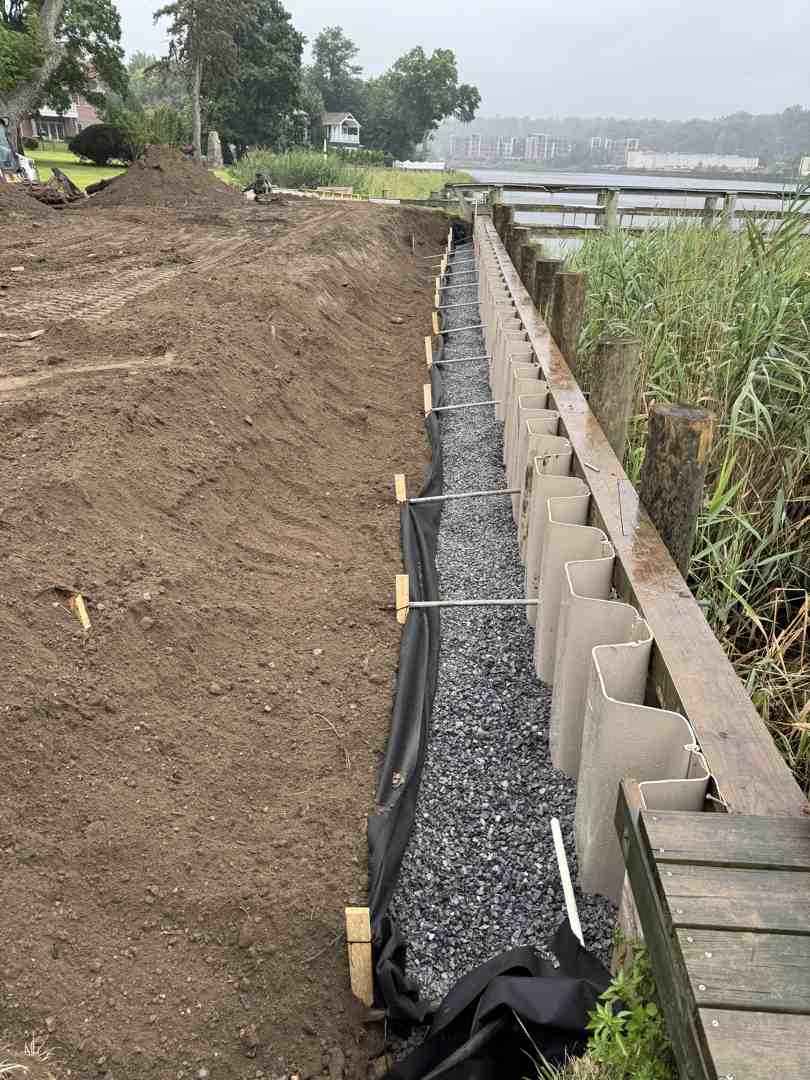
- Helical Tiebacks: If a wall is leaning in Massapequa or Babylon, we may install helical anchors. These are large steel screws drilled deep into stable load-bearing soil behind the wall, which are then tensioned to pull the wall back into alignment and lock it in place.
- Pressure Relief Systems: We often install specialized "weep holes" or hydrostatic pressure control systems. These allow water to flow out from behind the wall while keeping the soil in place, effectively "taking the weight off" the structure.
For a deeper dive into these methods, check out our Bulkhead Seawall Repair Guide.
Our Criteria: When to Choose Restoration Over Full Replacement
Many homeowners in West Hampton or South Hampton fear that a few cracks mean a total replacement is necessary. However, if the main "bones" of the wall are still sound, repairing seawalls is often the smarter financial move.
Our engineers typically recommend restoration over replacement if:
- The damage is localized (e.g., one or two panels).
- The wall is less than 20-30 years old.
- The structural tiebacks are still functional.
- The cost of repair is significantly lower than the $1,000+ per linear foot often required for new construction.
| Factor | Seawall Repair | Full Replacement |
|---|---|---|
| Typical Cost | 20% - 40% of replacement | 100% (High Investment) |
| Lifespan Extension | 10 - 20+ years | 30 - 50+ years |
| Disruption | Minimal (No excavation) | High (Heavy machinery) |
If you are dealing with seawall crack repair, acting now can prevent the need for a full demolition in five years.
Our Commitment to Long-Term Durability for Your Shoreline
Once Pearce Marine Construction completes the immediate repairs, our focus shifts to long-term durability. Long Island's North Shore (rocky, high energy) and South Shore (sandy, tidal) present different challenges, but the goal remains the same: durability.
We emphasize "over-engineering" repairs to handle the 100-year storms that seem to happen every decade now. This includes using marine-grade mortars, stainless steel hardware, and advanced drainage solutions. Proper drainage is the single most important factor in preventing future damage. Without it, even a brand-new wall will eventually succumb to the weight of the earth behind it.
Our Engineering for Saltwater and Tidal Exposure
The "splash zone"—the area between high and low tide—is where the most damage occurs. This constant wet-dry cycle accelerates chloride penetration into concrete and the rot of timber.
According to the ESP Brochure on synthetic marine materials, modern vinyl and composite materials have revolutionized how we think about the "splash zone." For concrete walls, we use specialized sealants and high-strength caps to prevent saltwater from reaching the reinforcement. In places like Bayshore or Wantagh, where the salt concentration is high, we ensure all repair materials are NSF-certified and specifically rated for high-chloride environments.
For more information on the latest standards, see our professional Seawall Repair Guide 2025.
Why Choose Pearce Marine Construction for Your Shoreline
Repairing seawalls is not a job for a general handyman or a driveway paver. Marine construction requires specialized equipment like pile drivers, barge-mounted cranes, and a deep understanding of Long Island's coastal geology.
Pearce Marine Construction is a woman-owned business with generational expertise serving Nassau and Suffolk Counties. From the calm canals of Merrick and Bellmore to the wave-battered shores of Lloyd Harbor and Cold Spring Harbor, we bring meticulous craftsmanship to every project. We understand the specific tidal challenges and coastal conditions of your neighborhood.
Don't let a small crack turn into a collapsed backyard. Contact our seawall and bulkhead experts today for a professional evaluation. You can also learn more about what to look for in our guide to Seawall Repair Contractors.
Whether you are in Brightwaters or Huntington, your seawall is the only thing standing between your property and the Atlantic. Treat it with the respect it deserves, and it will protect your home for decades to come.



Bring Your Vision to Life
Whether you're planning a custom dock, seawall, or boat lift, our experienced team is ready to deliver high-quality marine construction tailored to your needs. Pearce Marine Construction brings craftsmanship, precision, and a deep understanding of Florida’s waterways to every project. Let us help you create a durable, beautiful solution that stands the test of time. Get in touch now for a personalized estimate!