
Retaining Wall for Slope: Design Inspiration for Every Backyard

When Your Slope Needs to Hold: Retaining Wall Design for Waterfront Properties
A retaining wall for slope stabilization is one of the most critical investments a Long Island waterfront property owner can make. Whether you're dealing with a crumbling embankment in Southampton or active erosion along a Suffolk County shoreline, the right wall design can mean the difference between a stable property and a costly collapse.
Here are the most common retaining wall types used on slopes:
| Wall Type | Best For | Typical Lifespan |
|---|---|---|
| Interlocking block (segmental) | Moderate slopes, residential | 40-60 years |
| Steel or vinyl sheet pile | Waterfront, wave exposure | 30-50 years |
| Gabion / rock revetment | Coastal slopes, wave energy | 25-50 years |
| Geogrid reinforced slope | Steep embankments, large sites | Up to 120 years |
| Timber | Low walls, low wave exposure | 15-25 years |
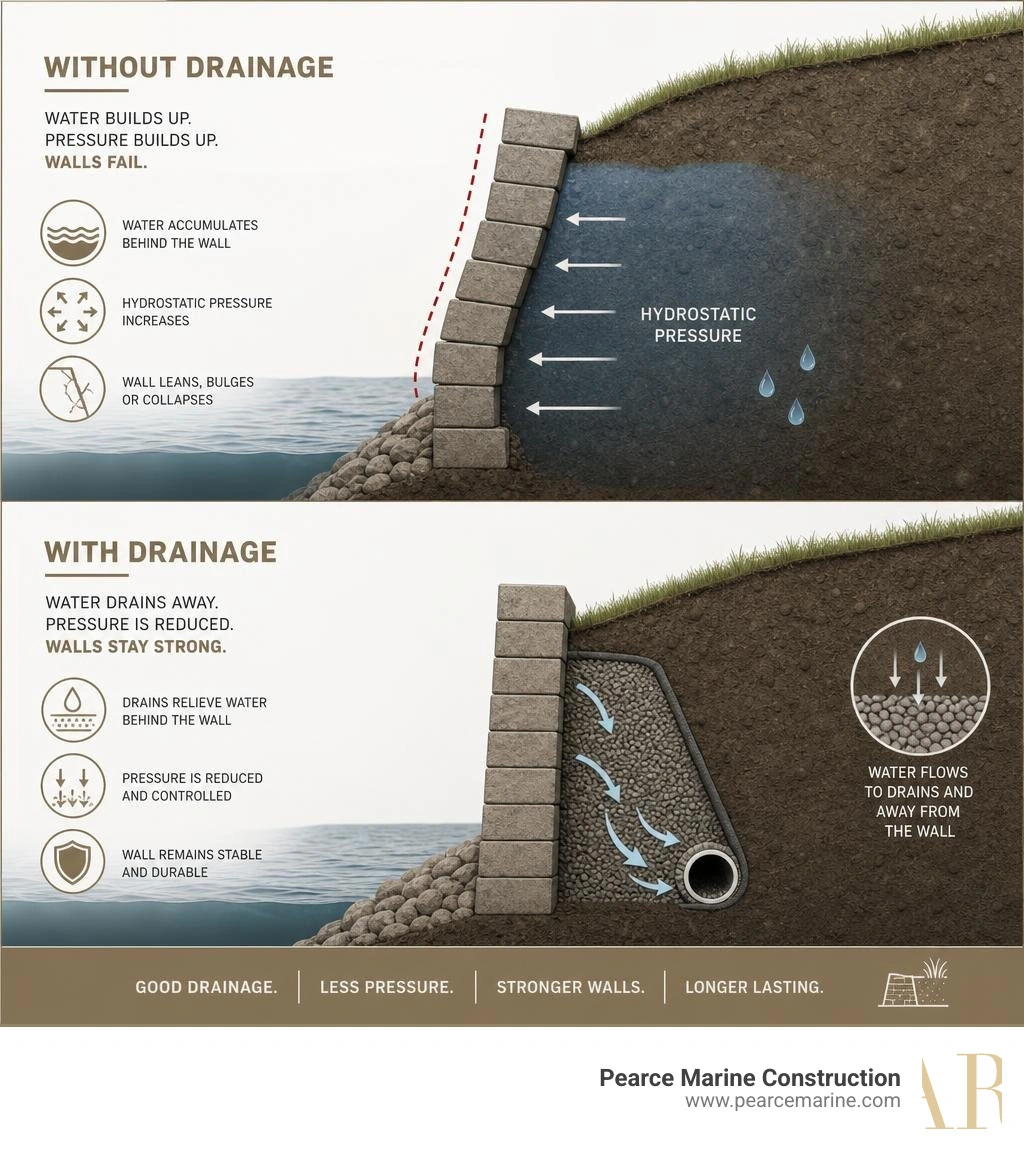
Poor drainage is the single biggest reason retaining walls fail. Water builds up behind the wall, creates hydrostatic pressure, and the wall leans, bulges, or collapses. Getting the design right from the start — materials, drainage, and foundation — is everything.
For waterfront properties in Nassau and Suffolk Counties, the challenge goes beyond a typical backyard slope. You're dealing with wave action, tidal fluctuation, saturated soils, and strict coastal engineering demands. That's where professional marine construction expertise matters most.
While some property owners search for cheap retaining wall ideas or general retaining wall ideas, waterfront slopes demand heavy-duty, engineered solutions. At Pearce Marine Construction, we specialize in building retaining walls designed specifically to withstand coastal forces and protect your shoreline property.
Heavy-Duty Retaining Wall for Slope Designs for Shoreline Properties
Stabilizing a steep embankment on a waterfront property requires an engineered approach that balances physical soil retention with active erosion control. On Long Island, our properties face unique geological conditions, from the sandy bluffs of Northport to the tidal marshlands of West Islip. Standard landscaping solutions simply will not cut it when waves and tidal flows start pulling soil away from your property's foundation.
Implementing a professional Long Island Retaining Walls system ensures your shoreline property remains secure against storm surges and heavy rainfall. Let's look at the heavy-duty designs engineered to handle severe sloped conditions.
Heavy-Duty Interlocking Block Retaining Wall for Slope Stabilization
Segmental retaining walls built with interlocking concrete blocks are highly favored for their durability and structural flexibility. Unlike poured concrete, which is prone to cracking as the ground shifts, segmental blocks can shift slightly with seasonal freeze-thaw cycles without losing their structural integrity.
To withstand the massive lateral pressures of a steep waterfront slope, we utilize advanced geogrid reinforcement systems like the TensarTech® TW3® Wall System | Tensar . High-strength geogrids are layered horizontally behind the interlocking blocks, anchoring the wall deep into the compacted backfill zone. This creates a unified, reinforced soil mass that behaves as a single heavy structure.
According to our Retaining Wall Construction Guide, proper soil compaction behind the blocks is critical. Standard block units must meet strict ASTM C1372 standards for compressive strength and water absorption to survive the harsh coastal winter conditions on Long Island, preventing premature cracking and degradation.
Steel and Vinyl Sheet Pile Retaining Wall for Slope Protection
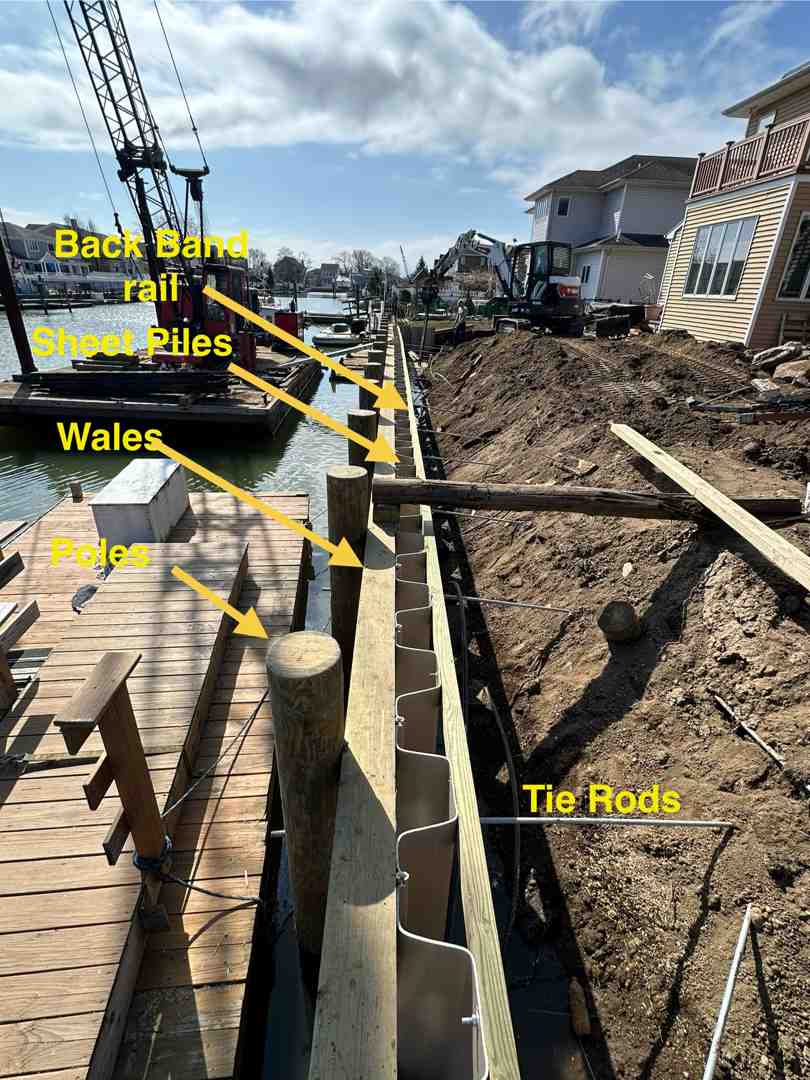
When a slope directly meets the water, wave action makes standard block walls impractical. In active tidal zones like Southampton, West Islip, and Bayshore, steel and vinyl sheet pile retaining walls provide the ultimate barrier.
Vinyl sheathing is highly resistant to saltwater corrosion and UV degradation, making it a premier material choice for modern marine bulkheads. These heavy-duty sheets are driven deep into the substrate using specialized pile-driving equipment. To support the weight of a steep slope pressing from behind, we install robust tieback anchoring systems. Steel tieback rods run from the face of the sheet pile wall deep into the bank, securing to heavy concrete or steel "deadmen" anchors buried in the stable soil zone.
For projects requiring the highest level of structural strength, our Retaining Walls Suffolk County Guide outlines how sheet piling stands up to severe wave impact and continuous soil saturation where other systems would wash away.
Gabion and Rock Revetment Systems for Coastal Slopes
For dynamic waterfront slopes that experience high-velocity wave energy, gabion baskets and rock revetments are exceptional solutions. Gabion walls consist of heavy-duty, corrosion-resistant wire baskets filled with durable granite or fieldstone. Systems like SierraScape® Wire Basket Retaining Walls, A Green System offer incredible flexibility, allowing the structure to settle and adjust naturally without losing strength.
In areas like West Hampton and Lloyd Harbor, we often combine these systems with stone revetments. A rock revetment is a sloped arrangement of heavy armor stone placed along the shoreline. Unlike solid walls that reflect wave energy (which can cause scour at the base of the wall), a sloped rock revetment absorbs and dissipates wave energy within the gaps between the rocks.
When our professional marine construction team is Building a Stone Retaining Wall on a Slope, precise stone placement and the integration of high-tensile filter fabrics underneath are vital to prevent the native soil from washing out through the rocks.
Structural Engineering and Drainage Solutions for Sloped Waterfronts
Building a retaining wall for slope environments requires a deep understanding of soil mechanics and structural engineering. Without proper drainage and a perfectly prepared foundation, even the thickest wall will eventually fail under the weight of saturated soil.
| Engineering Factor | Standard Requirement | Why It Matters |
|---|---|---|
| Backfill Material | Clean gravel / crushed stone (<10% fines) | Prevents water retention; allows rapid drainage |
| Minimum Safety Factor (Sliding) | 1.5 | Prevents the wall from pushing forward |
| Minimum Safety Factor (Overturning) | 2.0 | Prevents the wall from tipping over |
| Geogrid Vertical Spacing | Maximum 40 cm (two block courses) | Ensures uniform reinforcement of the soil mass |
Implementing these strict engineering standards is the core focus of our Retaining Walls Nassau County Tips, protecting your property from costly failures.
Hydrostatic Pressure and Subsurface Drainage Construction
Hydrostatic pressure is the single greatest threat to any retaining wall. When rain falls or tides rise, water saturates the soil behind the wall. Water is incredibly heavy; if it cannot escape, it exerts massive lateral pressure against the back of the structure, leading to leaning, bowing, and eventual structural collapse.
To manage this water, we install a comprehensive subsurface drainage system during construction:
- Filter Fabric (Geotextile): We line the excavated slope with heavy-duty geotextile fabric to prevent fine soil particles from clogging our drainage stone.
- Perforated Drain Pipes: A perforated pipe is placed at the very bottom of the wall's backfill zone to collect and channel water away.
- Gravel Backfill: We fill the space directly behind the wall with clean crushed stone, creating a high-permeability path for water to flow downward to the drain pipe.
- Weep Holes: For solid or block structures, weep holes are integrated through the face of the wall to allow trapped water to drain freely.
By adhering to the industry's Best Practices - Retaining wall design guidelines , we eliminate the risk of water buildup, keeping your sloped wall stable and dry.
Foundation Preparation and Stepping the Base on Steep Grades
A retaining wall is only as stable as the ground beneath it. When constructing on a steep grade, we cannot simply build a wall on flat ground. We must step the foundation up the slope.

Our construction crew begins the excavation process at the lowest point of the slope. We dig a level trench that is deep enough to accommodate a 4-to-6-inch compacted gravel leveling pad, plus at least one full block unit (or 10% of the wall's height) buried below grade. This buried "toe" of the wall prevents the base from sliding forward.
As we move up the sloped grade, we step the foundation trench up in vertical increments that match the exact height of our blocks. Each step must be perfectly level and thoroughly compacted to ensure the weight of the wall is distributed evenly into the load-bearing soil below.
When to Require Professional Marine Engineering for Sloped Walls
While low garden walls can sometimes be built without complex calculations, sloped waterfront walls almost always require professional marine engineering.
Engineering oversight is absolutely mandatory when:
- The wall height exceeds 4 feet.
- There is a steep slope above or below the wall structure.
- Surcharge loads (such as driveways, decks, or homes) sit within the failure wedge behind the wall.
- The soil is highly cohesive (such as clay) or extremely loose (such as fine beach sand).
At Pearce Marine Construction, we conduct comprehensive global stability analyses and soil bearing capacity tests for every sloped wall we build in Nassau and Suffolk Counties. Unlike general contractors who use cookie-cutter designs, we engineer custom solutions built specifically for the harsh coastal environments of Long Island.
When you want a shoreline structure built to stand the test of time, bypass the generalists. Contact Pearce Marine Construction for Professional Seawalls and Bulkheads and let our multi-generational expertise secure your waterfront property today.


%2520(1)_compressed.avif)

Bring Your Vision to Life
Whether you're planning a custom dock, seawall, or boat lift, our experienced team is ready to deliver high-quality marine construction tailored to your needs. Pearce Marine Construction brings craftsmanship, precision, and a deep understanding of Florida’s waterways to every project. Let us help you create a durable, beautiful solution that stands the test of time. Get in touch now for a personalized estimate!