
Everything You Need to Know About Steel Sheet Piling

What Is Steel Sheet Piling — and Why It Matters for Long Island Shorelines
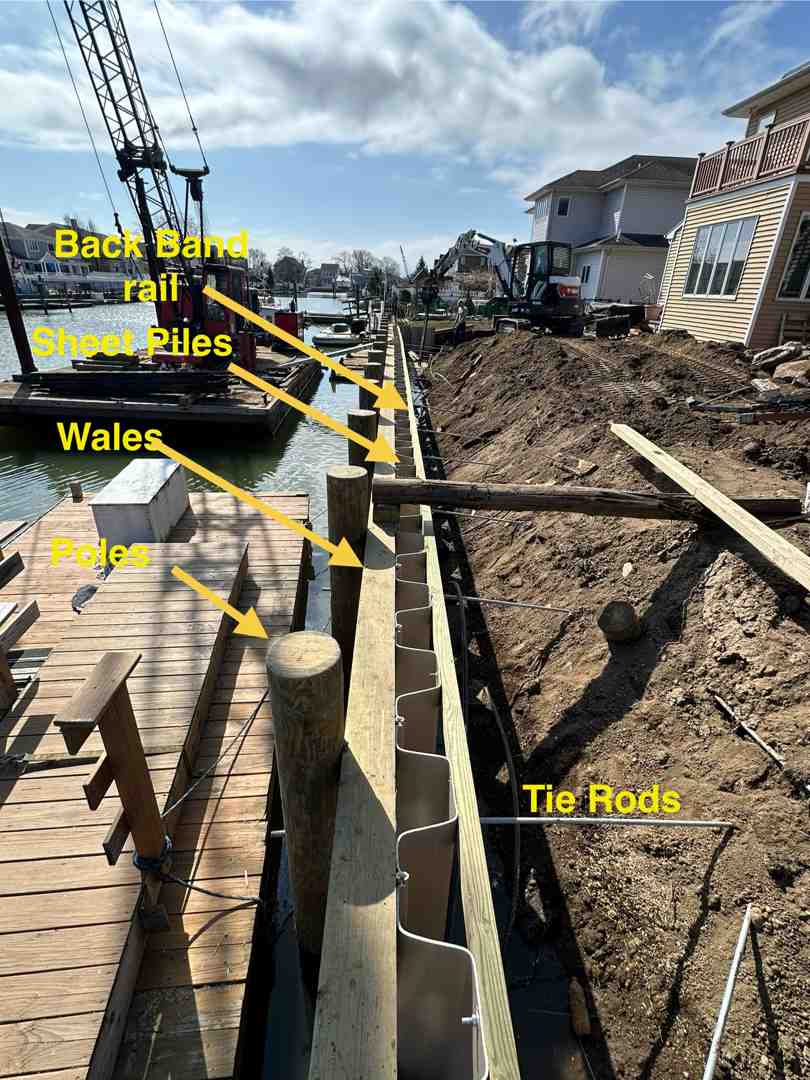
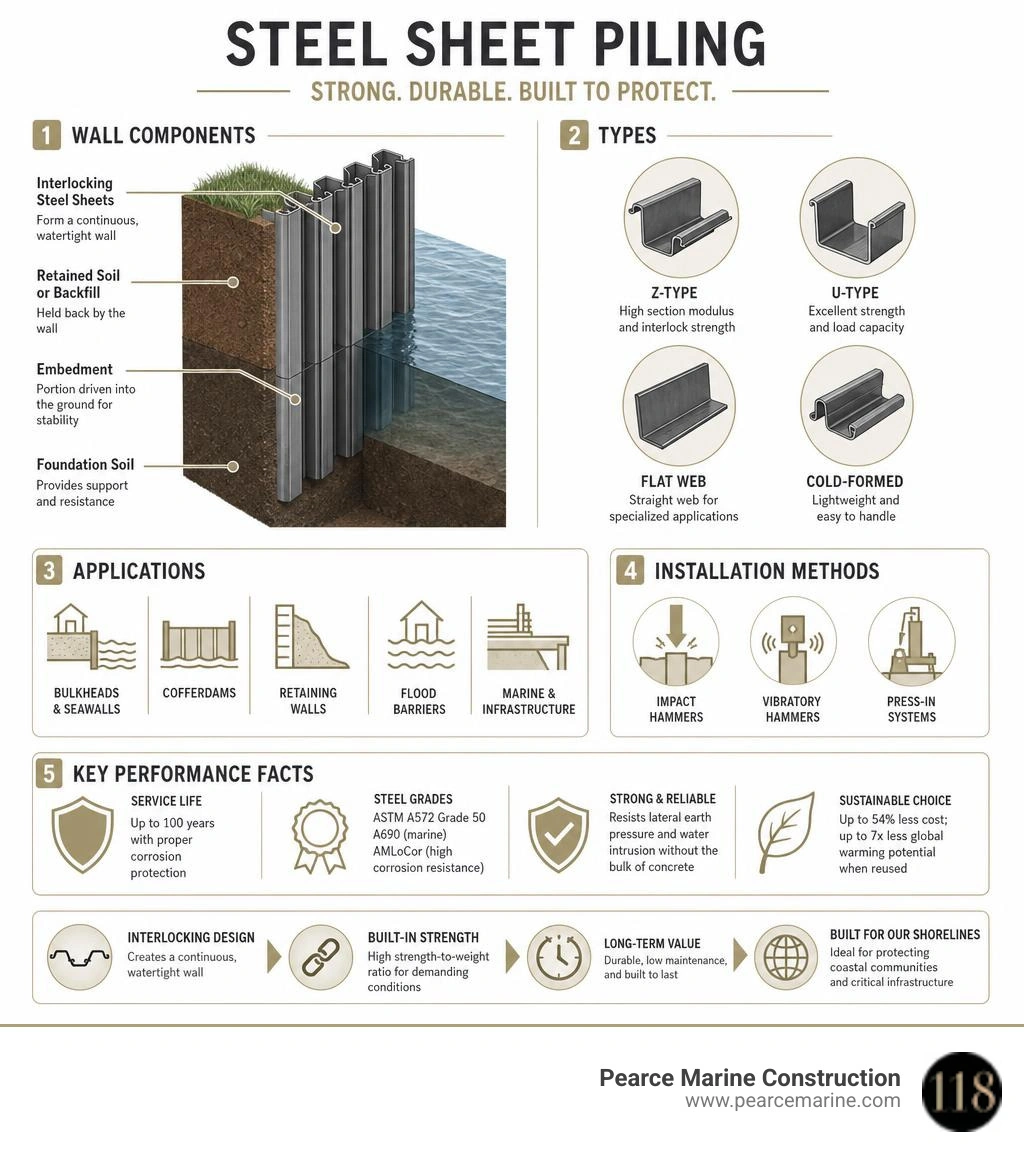
At Pearce Marine Construction, steel sheet piling is one of our most trusted marine construction methods, utilizing interlocking steel sections driven deep into the ground to form a continuous, high-strength wall that retains soil and resists water pressure.
Here's a quick overview of our professional steel sheet piling services:
| Topic | Key Facts |
|---|---|
| What it is | Interlocking steel sections driven into the ground to retain soil or water |
| Main types | Z-type, U-type, flat web, cold-formed |
| Common uses | Bulkheads, seawalls, cofferdams, retaining walls, flood barriers |
| Steel grades | ASTM A572 Grade 50, A690 (marine), AMLoCor (high corrosion resistance) |
| Installation methods | Impact hammers, vibratory hammers, press-in systems |
| Service life | Up to 100 years with proper corrosion protection |
| vs. Concrete walls | Up to 54% less cost; up to 7x less global warming potential when reused |
If you own waterfront property in Nassau or Suffolk County, your shoreline faces constant pressure — from wave action, tidal shifts, and soil erosion. Our professional steel sheet piling installation is the most reliable way to protect your investment.
We design and install these systems for everything from residential bulkheads in West Islip to large-scale commercial marine infrastructure in Southampton and West Hampton. The interlocking design creates a wall that resists lateral earth pressure and water intrusion without requiring the bulk of a poured concrete structure.
This guide covers the professional engineering, pile types, steel grades, and installation methods we use to deliver long-term durability for your next marine construction project.
Terms related to Steel sheet piling:
Engineering and Applications of Steel Sheet Piling
When we design marine structures on Long Island, we have to account for immense physical forces. The primary job of steel sheet piling is to resist lateral earth pressure—the force of the soil pushing outward—while simultaneously managing water levels and preventing shoreline erosion.
Unlike gravity retaining walls that rely on their sheer weight to stay upright, sheet pile walls act as structural beams. They derive their strength from their high bending resistance and how deep they are driven into the ground (known as embedment depth). Depending on the project requirements, we can supply these piles in single-piece lengths of up to 130 feet, which completely eliminates on-site joint splicing and speeds up construction.
Hot-Rolled vs. Cold-Formed Steel Sheet Piling
When selecting materials, the manufacturing process plays a massive role in how the wall performs. Steel sheet piles are produced using one of two methods: hot-rolled or cold-formed.
- Hot-Rolled Sheet Piles: These are manufactured by heating steel above its recrystallization temperature and rolling it into shape. This process creates tight, highly defined interlocking joints (often Larssen-style interlocks). These tight joints provide exceptional water tightness and high resistance to driving stresses, making them ideal for extremely hard driving conditions or walls requiring low permeability.
- Cold-Formed Sheet Piles: These are shaped at room temperature from flat steel coils. While they offer highly optimized shapes and are extremely cost-effective for smaller projects, their hook-and-grip interlocks are slightly looser. They are perfect for lighter-duty applications like bank protection, small excavations, and minor retaining walls.
To understand more about these options, you can Discover steel sheet piles | ArcelorMittal Sheet Piling or explore specialized Cold formed steel sheet piles for construction - Constructalia.
| Feature | Hot-Rolled Piles | Cold-Formed Piles |
|---|---|---|
| Manufacturing Temp | High temperature (recrystallized) | Room temperature |
| Interlock Tightness | Very tight, highly watertight | Moderate clearance, allows up to 10° deviation |
| Best Used For | Hard driving, high loads, low-permeability walls | Light-to-moderate loads, bank protection, cost-savings |
| Common Grade | ASTM A572 Grade 50 (50 ksi yield strength) | Variable, typically thinner sections (3–9 mm) |
Structural Profiles: Z-Type, U-Type, and Flat Web Piles
The shape of the sheet pile determines its structural efficiency and how it handles loads:
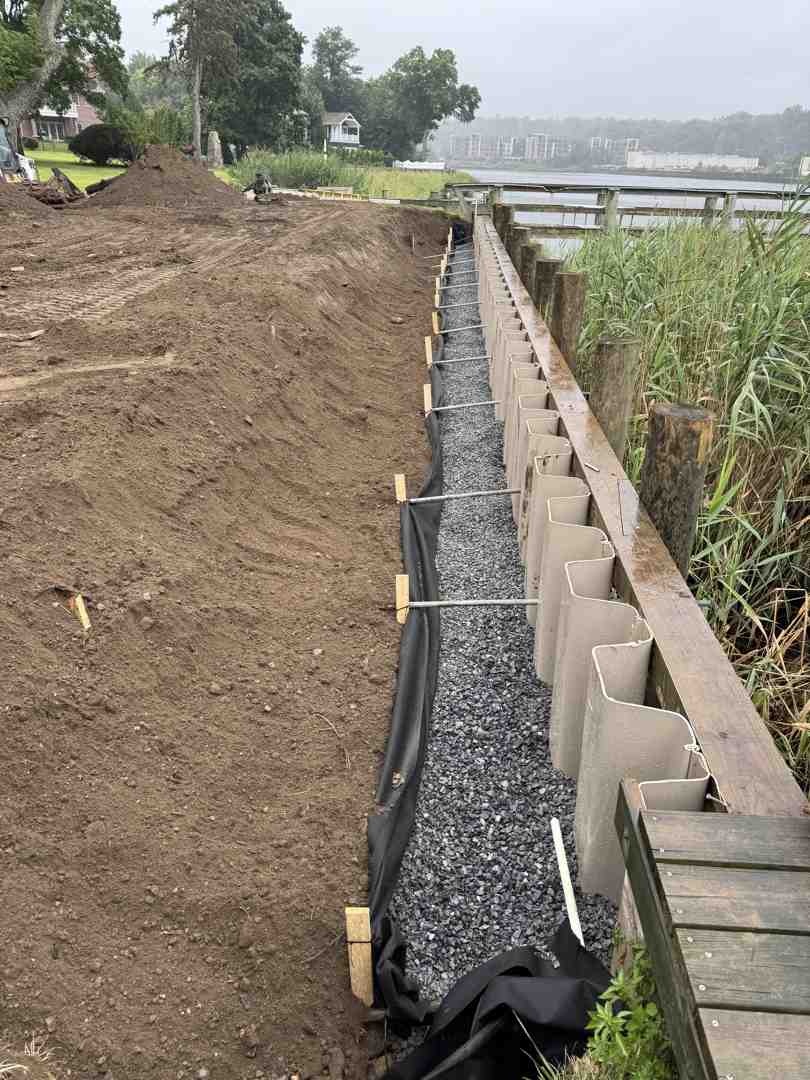
- Z-Type Piles: These are the most common sheet piles used in North American marine construction. The Z-shape is incredibly efficient because it positions the interlocking joints far from the neutral axis (the centerline of the wall where bending stress is lowest). This maximizes the section modulus and strength-to-weight ratio.
- U-Type Piles: A traditional shape that has been used in civil engineering for over a century. While they offer excellent drivability, their interlocks are located directly on the neutral axis, which means they require careful design to ensure proper shear force transfer.
- Flat Web Piles: Unlike Z or U piles, flat web piles are not designed to resist bending. Instead, they are engineered to resist high tensile forces within their interlocks. They are used to build circular, self-supporting gravity structures called cellular cofferdams. For deep-water applications, engineers often consult the AS 500 Straight Web Steel Sheet Piles manual to design gravity walls that don't require anchors.
Marine Bulkheads and Retaining Walls in Nassau and Suffolk Counties
On Long Island, our shorelines are constantly battered by storms, tides, and wakes. Whether we are building a heavy-duty commercial bulkhead in Southampton, stabilizing a residential shoreline in West Islip, or reinforcing a waterfront boundary in West Hampton, steel is often the gold standard.
Steel sheet pile walls cost up to 54% less than traditional cast-in-place concrete walls and install in a fraction of the time. They provide an immediate, secure barrier against shoreline erosion and soil loss. If you want to learn more about the differences between different shoreline protection systems, read our guides on Bulkhead Construction and Seawalls and Bulkheads.
Professional Installation and Durability in Long Island Marine Environments
Designing a great seawall is only half the battle; driving massive steel sheets into the coastal soils of Nassau and Suffolk Counties requires heavy machinery, local expertise, and meticulous craftsmanship. Unlike general contractors who might cut corners, we understand how Long Island's unique geology—ranging from soft marine clay to dense glacial till—impacts structural integrity.
Heavy Equipment and Methods for Driving Steel Sheet Piling
Driving steel sheet piles requires specialized pile-driving rigs and the right choice of hammer:
- Vibratory Hammers: This is our primary tool for most Long Island installations. Vibratory hammers use rapidly rotating eccentric weights to generate vertical vibrations. This liquefies the surrounding sandy soil, allowing the sheet pile to sink smoothly under its own weight and the weight of the hammer.
- Impact Hammers: When we encounter dense gravel, hardpan, or clay, we switch to impact hammers (diesel, hydraulic, or air-driven). These use a heavy ram to strike the top of the pile, forcing it through tough obstructions.
- Press-In Systems: In noise-sensitive residential areas—such as Brightwaters, Babylon, or Lloyd Harbor—where hammer vibrations could disturb nearby foundations, we utilize silent press-in systems. These use hydraulic rams to quietly push the piles into the ground.
During installation, we use a sequential installation method, interlocking the sheets in pairs or panels to ensure they remain perfectly plumb and aligned. To learn more about our professional pile-driving capabilities, check out our Marine Piling Installation Complete Guide and our dedicated Pile Driving service page.
Corrosion Mitigation and Long-Term Durability
The saltwater environment of Long Island is incredibly harsh on steel. Corrosion is most aggressive in the "splash zone"—the area just above the high-tide line that is constantly wet and exposed to oxygen.
To ensure our installations last up to 100 years, we utilize advanced metallurgy and protective systems:
- A690 Marine Steel: This high-strength, low-alloy steel is specifically formulated for marine applications. It has a corrosion resistance to seawater splashes that is two to three times greater than standard carbon steel.
- AMLoCor Steel: For ultimate durability, we offer AMLoCor steel grades, which are up to 5 times more corrosion-resistant than standard steel in marine environments, dramatically reducing the need for future repairs.
- Protective Coatings & Cathodic Protection: We often apply heavy-duty coal tar epoxy coatings or install sacrificial zinc anodes to protect the steel below the waterline.
If you have an older, rusting steel bulkhead that needs attention, our team provides expert Bulkhead Repair Services to stabilize your shoreline before structural failure occurs.
Why Choose Pearce Marine Construction?
When it comes to protecting your waterfront property, experience is everything. Other marine contractors simply cannot match the generational expertise and meticulous craftsmanship that Pearce Marine Construction brings to every single project.
As a premier, woman-owned marine construction company based right here on Long Island, we serve residential, commercial, and public clients across Nassau and Suffolk Counties—from Massapequa, Wantagh, and Bellmore to West Hampton, South Hampton, and Cold Spring Harbor.
We are committed to sustainability, too. By utilizing modern materials like EcoSheetPile™ Plus—which is produced using 100% recycled steel and renewable electricity to emit as little as 409 kg of CO2 per tonne—we minimize our environmental footprint. In fact, reusing steel sheet piles generates up to 7 times less global warming potential than constructing equivalent concrete retaining walls.
Don't leave your shoreline to chance. Protect your property with the best engineering, materials, and local craftsmanship available.
Ready to secure your shoreline? Contact Pearce Marine Construction today for professional pile driving and bulkhead installation.
_compressed.avif)

Bring Your Vision to Life
Whether you're planning a custom dock, seawall, or boat lift, our experienced team is ready to deliver high-quality marine construction tailored to your needs. Pearce Marine Construction brings craftsmanship, precision, and a deep understanding of Florida’s waterways to every project. Let us help you create a durable, beautiful solution that stands the test of time. Get in touch now for a personalized estimate!