
Ultimate Checklist for Storm Damage Marine Repair Services

_compressed.webp)
Why Storm Damage Marine Repair Demands Immediate Expert Attention
Storm damage marine repair is a critical service for protecting your waterfront property after severe weather. When storms hit Long Island, they can compromise docks, bulkheads, and seawalls in ways that aren't always visible. Acting quickly with the right expertise is the key to preventing a simple repair from becoming a catastrophic structural failure.
After a storm, you need:
- An immediate professional assessment of all marine structures.
- Thorough documentation for insurance claims.
- A licensed marine contractor with local Nassau/Suffolk County experience.
- A structural inspection to identify both visible and hidden damage.
- Priority repairs to prevent further property loss.
Storm damage extends deeper than what you can see. A dock that looks slightly damaged may have compromised pilings below the waterline, and a seawall with a small crack could be concealing extensive soil erosion behind it. With repair costs potentially running from a few thousand dollars to over $50,000 for a full replacement, a prompt and professional response is essential.
This checklist will guide you through every step—from initial assessment and insurance documentation to choosing the right contractor and deciding between repair and replacement.
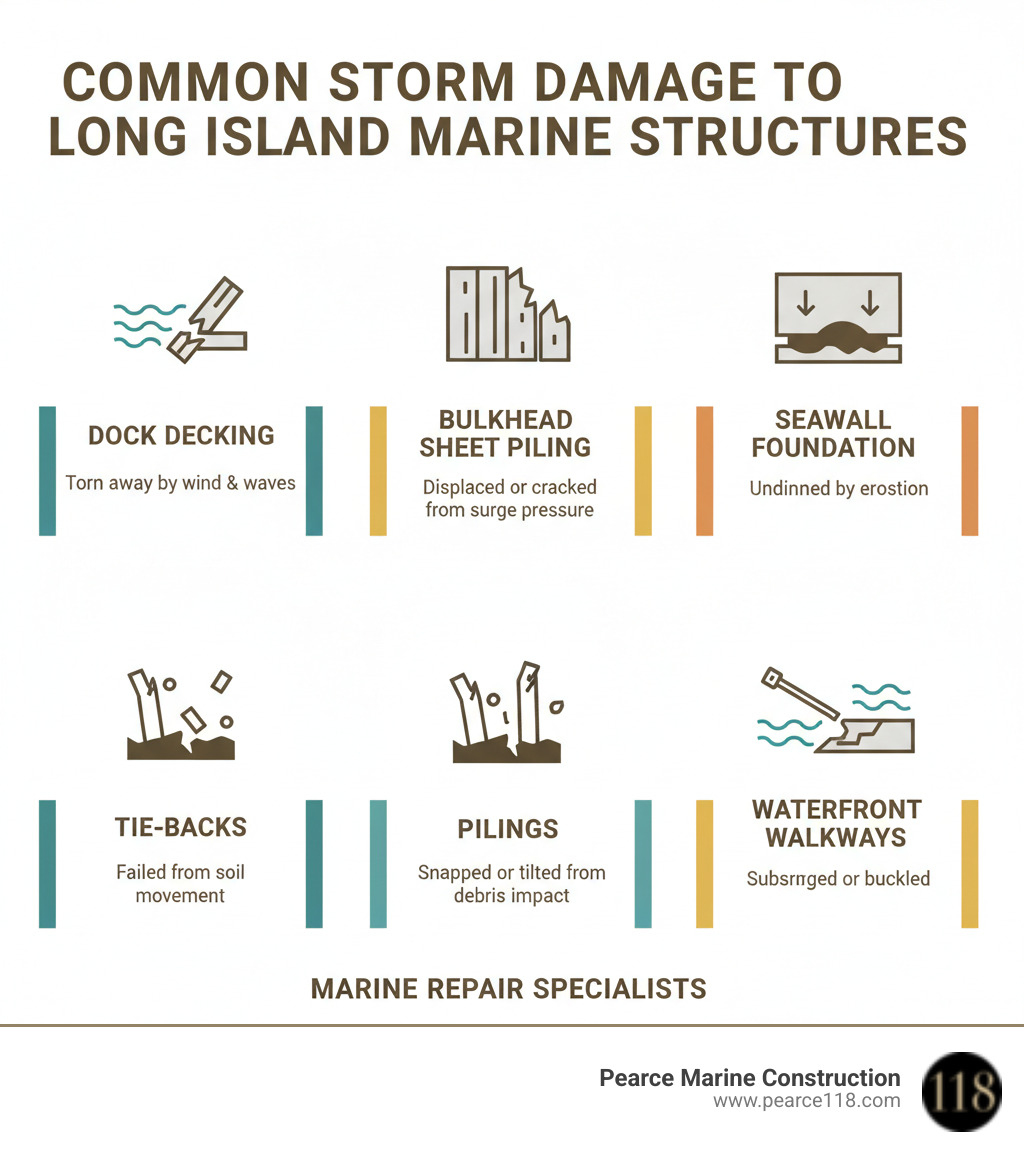
First Response: Your Post-Storm Assessment Checklist
The storm has passed, and it's time to assess your waterfront property. Your immediate priorities are to stay safe, document everything, and understand the damage. These first steps are crucial for a smooth recovery.

Prioritizing Safety and Documenting Everything
Before approaching your dock or bulkhead, assess the area for safety hazards. Downed power lines, hidden debris in floodwaters, and unstable structures pose serious risks. If anything looks unsafe, keep your distance and wait for professionals.
Once it's safe, document the damage thoroughly. Use your phone to take wide shots for context and close-ups of specific issues like cracked pilings or missing deck boards. Date and time-stamp your photos and take detailed notes. This evidence is vital for your insurance claim.
Insurance companies expect you to take reasonable steps to prevent further damage. This means documenting and reporting the damage promptly, not performing risky repairs yourself. Insurance industry best practices emphasize that the principles of immediate documentation and reasonable action are key.
Contact your insurance agent within 24 hours. The sooner you report the claim, the sooner an adjuster can be scheduled, which is critical when they are handling a high volume of claims after a storm.
Identifying Critical Damage to Docks, Bulkheads, and Seawalls
Understanding the warning signs of serious damage will help you communicate effectively with contractors. Long Island storms bring wind, waves, and surge, each causing unique problems.
- Loose deck boards may signal failed underlying joists.
- Cracked pilings are a serious foundation issue that can lead to collapse.
- Leaning or sagging sections of a dock or bulkhead indicate significant structural failure.
- Seawall cracks suggest immense pressure and can lead to a breach.
- Sinkholes or gaps behind a bulkhead are classic signs of washout, where soil has been eroded away, threatening the entire structure. This is why Bulkhead Washout Repair requires immediate, specialized attention.
Much of the most severe damage occurs below the waterline or behind structures, hidden from view. A professional assessment is necessary to identify these issues before they become catastrophic. Whether it's Dock Repair or a complex bulkhead issue, our team has the equipment to evaluate what's happening beneath the surface.
Navigating Insurance Claims and Legal Obligations
Dealing with insurance can be stressful, but understanding the basics is key. Most marine policies cover storm damage, but details matter. Review your policy for coverage limits, your deductible, and any specific requirements.
Remember your obligation to prevent further loss. You can take temporary protective measures, like covering exposed areas, but do not make permanent repairs before the adjuster's inspection. Document any temporary fixes with photos and receipts.
Provide your adjuster with your thorough documentation and professional repair estimates. Adjusters may not be marine construction experts and can miss hidden damage. We provide detailed assessments that accurately capture the full scope of damage, which is especially important for complex Seawall Repair Services where hidden erosion is common.
Your claim may involve the concept of "constructive total loss," where repair costs exceed the structure's insured value. In such cases, replacement may be the most logical option. Professional estimates for both repair and replacement will help you steer this decision and ensure a fair settlement.
The Critical Decision: Professional Repair vs. DIY
After documenting the damage, you'll face a choice: handle repairs yourself or hire professionals? While the DIY approach is tempting, storm damage marine repair involves critical infrastructure protecting your property from erosion. A failed bulkhead or dock can lead to severe and expensive consequences.
Marine construction requires specialized knowledge of tidal patterns, soil mechanics, and marine-grade materials, along with heavy equipment like pile drivers and barges. It's a field where inexperience can be dangerous and costly.
When to Call a Professional for Storm Damage Marine Repair
Certain situations clearly demand professional intervention. Attempting to fix these issues yourself can be hazardous and may worsen the problem.
- Structural Damage: Cracked, broken, or leaning pilings are a major red flag. Likewise, a sagging dock or a bowing bulkhead indicates a significant structural failure that needs immediate professional attention.
- Submerged Components: You can't properly assess or repair what you can't see. Damage below the waterline requires diving equipment and specialized expertise.
- Foundation Issues: Problems with seawall and bulkhead foundations, such as washout or undermining, can lead to catastrophic failure. Addressing these issues involves soil mechanics and proper backfill techniques, which are central to our Bulkhead Repair services.
- Extensive Erosion: If the ground around your structures is washing away, it's a sign that your protective systems are compromised and require a comprehensive solution.
If you lack the equipment, materials, or knowledge of marine engineering and local regulations, DIY repairs can end up costing more in the long run. Our team at Pearce Marine Construction has the generational expertise to identify hidden damage and provide long-term solutions, not just quick fixes.
Choosing the Right Marine Construction Contractor
Selecting the right contractor is crucial for safeguarding your waterfront investment. Here’s what to look for:
- Licensing and Insurance: Always verify that your contractor is fully licensed and insured. This protects you from liability and ensures they operate legally.
- Local Long Island Experience: A contractor familiar with Nassau and Suffolk Counties will understand our unique coastal conditions, building codes, and complex permitting processes. Our team has served Long Island for generations, giving us deep-rooted local knowledge.
- Proven Experience: In marine construction, there's no substitute for hands-on experience. Our team's generational expertise means we've honed our skills over decades on countless local projects.
- Portfolio and References: Ask to see a portfolio of completed work, especially storm damage repairs. A reputable contractor will be proud to share their projects and connect you with past clients.
- Knowledge of Regulations: Permitting on Long Island can be a maze. An experienced Marine Construction Contractor will guide you through the process, ensuring all work is compliant.
As a woman-owned business, we bring a detail-oriented approach to every project. We specialize in building and repairing the bulkheads, docks, and decks most vulnerable to storm damage. When you work with us, you're partnering with a team as invested in protecting your waterfront as you are.
The Ultimate Guide to Storm Damage Marine Repair and Rebuilding
Engaging professionals for your storm damage marine repair is an opportunity to not only restore what was lost but to build back stronger and more resilient. Understanding the process and materials will help you make decisions that protect your waterfront investment for years to come.

Repair vs. Replacement: A Cost and Durability Analysis
Should you repair or replace your damaged structure? The decision depends on the extent of damage, the structure's age, and a comparison of short-term costs versus long-term value. While repairs are often cheaper upfront, replacement can be wiser for older, extensively damaged structures, offering a chance to upgrade with modern, resilient materials.
A full replacement is a larger investment, as detailed in our guide to the Cost of a Seawall. However, incorporating modern elements like those discussed in our Cost to Install Helical Piers guide can prevent future catastrophic failures, offering better long-term value and peace of mind.
| Feature | Repair | Replacement |
|---|---|---|
| Extent of Damage | Best for minor, localized damage like a few loose boards or small cracks | Necessary for severe structural damage including compromised pilings, extensive seawall breaches, or widespread rot |
| Age of Structure | Makes sense for newer structures with long remaining lifespan | Often preferred for older structures requiring frequent repairs and nearing end-of-life |
| Upfront Cost | Generally lower initially, especially for cosmetic or localized fixes | Higher upfront investment due to new materials and comprehensive construction |
| Long-Term Value | May offer diminishing returns if underlying issues persist | Improved durability, lower long-term maintenance, and increased property value |
| Durability | Restores to pre-damage condition but doesn't improve overall resilience | Opportunity to upgrade to more resilient materials and modern construction techniques |
Best Materials for Resilient Marine Structures on Long Island
Choosing the right materials is critical for longevity in Long Island's harsh saltwater environment. Our experience has shown which materials stand the test of time.
- Pressure-Treated Wood: A time-tested and economical choice for docks and bulkheads, offering excellent value when installed correctly per our Best Wooden Bulkhead Construction Guide.
- Composite Decking: An excellent investment for dock surfaces, this material resists fading, staining, and rot. It won't splinter and requires minimal maintenance.
- Vinyl Sheet Piling: A superior material for bulkheads and seawalls. It's impervious to saltwater corrosion and marine borers, offering exceptional longevity with virtually no maintenance. Our expertise in Vinyl Seawall Construction ensures a lasting installation.
- Concrete: Provides maximum strength for heavy-duty seawalls and foundations, capable of withstanding enormous forces when properly mixed and reinforced for a marine environment.
- Marine-Grade Stainless Steel Fasteners: Critical for structural integrity. We use 316-grade stainless steel to prevent corrosion, which is a common point of failure in saltwater.
- Helical Piles: These screw-like foundations provide exceptional stability in Long Island's challenging soil conditions, resisting uplift and settlement during storms.
Building for the Future: Prevention and Long-Term Maintenance
The best time to prepare for the next storm is right after you've finished repairs from the last one. Proactive measures are essential for protecting your waterfront investment on Long Island.
At Pearce Marine Construction, we don't just fix what's broken; we build structures designed to stand strong against future storms, drawing on our generational expertise in smart design and quality construction.
Proactive Strategies to Mitigate Future Storm Damage
Treating storm damage marine repair as an opportunity to build back stronger can dramatically improve your property's resilience.
- Reinforce Structures: We identify and strengthen weak points by adding pilings, upgrading hardware, or reinforcing framing.
- Improve Design: Proper Marine Structures Design accounts for local wave patterns and storm surge heights, a nuance we've learned over generations of work in Nassau and Suffolk counties.
- Improve Foundation Stability: Helical Piles Installation creates a deep, stable foundation that resists the uplift and lateral forces of a storm.
- Upgrade Materials: Replacing a failed wooden bulkhead with modern vinyl sheet piling eliminates worries about rot and corrosion. Our Vinyl Seawall Construction is a proven, long-term solution.
- Implement Erosion Control: Effective Shoreline Erosion Solutions, such as riprap revetments, work with your bulkheads and seawalls to provide comprehensive protection.
- Plan for Storm Surge: We design bulkheads and seawalls with appropriate height and strength to deflect storm surge, often building beyond minimum requirements for added security.
Long-Term Maintenance for Waterfront Resilience
Even the strongest structure needs regular care. Consistent maintenance is a small investment that prevents catastrophic costs later.
- Conduct Semi-Annual Inspections: In spring and fall, walk your property to look for small signs of trouble like loose boards, new cracks, or slight sagging.
- Check Fasteners and Connections: Test bolts and look for corrosion. Tighten loose hardware and replace any failing components with marine-grade stainless steel.
- Clean Regularly: Power wash your structures to remove marine growth and debris that can hide damage and accelerate deterioration.
- Address Minor Issues Immediately: A small, inexpensive fix today can prevent a massive, costly emergency repair tomorrow. Don't wait.
- Reapply Protective Coatings: For wooden structures, reapplying marine-grade sealants every few years protects against UV damage and moisture.
- Monitor for Washout: Look for depressions or sinkholes behind your bulkhead or seawall. Catching washout early is critical to preventing structural failure.
Our Marine Structure Restoration services are designed to partner with you in this ongoing care, ensuring your waterfront investment remains protected for generations.
Frequently Asked Questions about Marine Structure Repair
How much does it cost to repair a storm-damaged dock?
The cost varies widely, from a few hundred dollars for minor fixes to tens of thousands for major reconstruction. Key factors include:
- Damage Severity: Replacing a few boards is much cheaper than rebuilding a collapsed section with new pilings.
- Materials: Pressure-treated wood is more economical than high-end composite decking.
- Labor & Equipment: Complex repairs requiring specialized equipment like barges will increase labor costs.
Because of these variables, a professional on-site assessment is necessary for an accurate quote. For inquiries about Long Island Dock Repair, our team can provide a thorough evaluation and transparent estimate.
Do I need a permit for storm damage repairs in Nassau or Suffolk County?
Yes, most storm damage marine repair projects on Long Island require permits. The process can be complex, often involving:
- Local Town/Village and County codes
- New York State Department of Environmental Conservation (NYSDEC) for work near wetlands or below the high water line.
- U.S. Army Corps of Engineers for work in navigable waters.
While minor, in-kind repairs may sometimes be exempt, any structural work typically requires a permit. A knowledgeable local contractor like Pearce Marine Construction is invaluable for navigating this process and ensuring your project is fully compliant.
How long does a typical bulkhead or seawall repair take?
The timeline is highly variable and depends on several factors:
- Permitting: This phase alone can take weeks or even months, depending on regulatory backlogs.
- Scope of Work: Minor washout repairs are much faster than extensive structural reconstruction.
- Material Availability: Demand for materials can surge after a major storm, leading to delays.
- Weather: Marine construction is weather-dependent, and conditions can postpone work.
A significant Bulkhead Repair Suffolk County project could range from a few weeks to several months. We prioritize efficient project management and clear communication about timelines.
Conclusion
Recovering from storm damage to your waterfront property is a challenge, but you don't have to face it alone. The key to a successful recovery lies in a prompt, professional response. This begins with a safe assessment and thorough documentation for your insurance claim, followed by an expert evaluation to uncover any hidden structural damage.
While DIY repairs may seem cost-effective, marine construction demands specialized knowledge and equipment. Investing in quality repairs with durable materials like pressure-treated wood, composite decking, and vinyl sheet piling is not just about fixing current damage—it's about building resilience for future storms. This investment is protected through regular maintenance and proactive care.
At Pearce Marine Construction, we've served waterfront property owners throughout Nassau and Suffolk Counties for generations. As a woman-owned marine construction company, we bring deep expertise and meticulous craftsmanship to every project. We understand Long Island's coastal environment and know which construction techniques stand the test of time.
Storms are a certainty on Long Island. The peace of mind that comes from knowing your dock, bulkhead, or seawall was repaired by experienced professionals is invaluable. Don't wait for minor damage to become a major failure.
Contact us for professional repairs and maintenance and let our generational expertise protect your waterfront investment.
%2520(1)_compressed.avif)


Bring Your Vision to Life
Whether you're planning a custom dock, seawall, or boat lift, our experienced team is ready to deliver high-quality marine construction tailored to your needs. Pearce Marine Construction brings craftsmanship, precision, and a deep understanding of Florida’s waterways to every project. Let us help you create a durable, beautiful solution that stands the test of time. Get in touch now for a personalized estimate!