
The Real Cost of Protecting Your Shoreline

_compressed.avif)
How Much Does a Concrete Seawall Cost on Long Island?
_compressed.webp?alt=media&token=ef6f525d-931c-4c23-8c8a-c092785346c4 "concrete seawall installation Long Island NY - how much does a concrete seawall cost")
How much does a concrete seawall cost is one of the first questions Long Island property owners ask when shoreline erosion starts threatening their investment. Here's a quick answer:
| Project Size | Estimated Cost Range |
|---|---|
| 50 linear feet | $10,000 – $50,000 |
| 100 linear feet | $20,000 – $80,000 |
| 150 linear feet | $30,000 – $120,000 |
| 300 linear feet | $60,000 – $240,000 |
Per linear foot, concrete seawalls typically cost between $200 and $800 for standard residential projects. High-erosion coastal zones — like exposed oceanfront properties in Southampton or West Hampton — can push that figure to $700–$2,000 per linear foot.
The wide range isn't arbitrary. Concrete seawalls are complex marine structures. Their cost depends on wall height, how deep the wall must be embedded, soil conditions, site accessibility, and local permitting requirements. On Long Island, saltwater environments and strict NYSDEC regulations add layers of complexity that directly affect the final price.
This guide breaks down every major cost factor so you can budget accurately and make a confident decision about protecting your waterfront property in Nassau or Suffolk County.

Know your how much does a concrete seawall cost terms:
Factors Determining How Much Does a Concrete Seawall Cost
When we sit down with a homeowner in Merrick or Bayshore, the first thing we look at isn't just the length of the shoreline. While linear footage is the primary baseline for any quote, several "invisible" factors can swing the price significantly.
The standard how much does a concrete seawall cost range of $200 to $800 per linear foot covers the majority of residential builds, but why the $600 gap? It usually comes down to the physical environment of your backyard.
Accessibility and Equipment Logistics
If we can drive our heavy machinery directly onto your shoreline from the street, your costs stay on the lower end of the spectrum. However, many Long Island properties—especially in areas like Cold Spring Harbor or Lloyd Harbor—have steep bluffs or narrow side yards that make land-side access impossible.
In these cases, we must perform a barge-based installation. Operating from the water requires specialized marine equipment, tug services, and careful coordination with the tides. Bringing in a barge and crane can increase labor and mobilization costs by 30% to 40%. It’s more complex, but for many properties, it is the only way to ensure a structurally sound installation without destroying existing landscaping or pool decks.
Soil Density and Site Conditions
What’s beneath the surface matters as much as the wall itself. If your property has loose, sandy soil common in parts of the Great South Bay, we may need to drive piles deeper or use more robust anchoring systems to prevent the wall from shifting. Conversely, hitting rocky terrain or "hardpan" clay can slow down the pile-driving process, increasing the hourly labor rate.
We also have to consider the current state of your shoreline. If there is an old, failing timber bulkhead that needs to be removed and disposed of, you should budget an additional $50 to $150 per linear foot for demolition and site preparation.
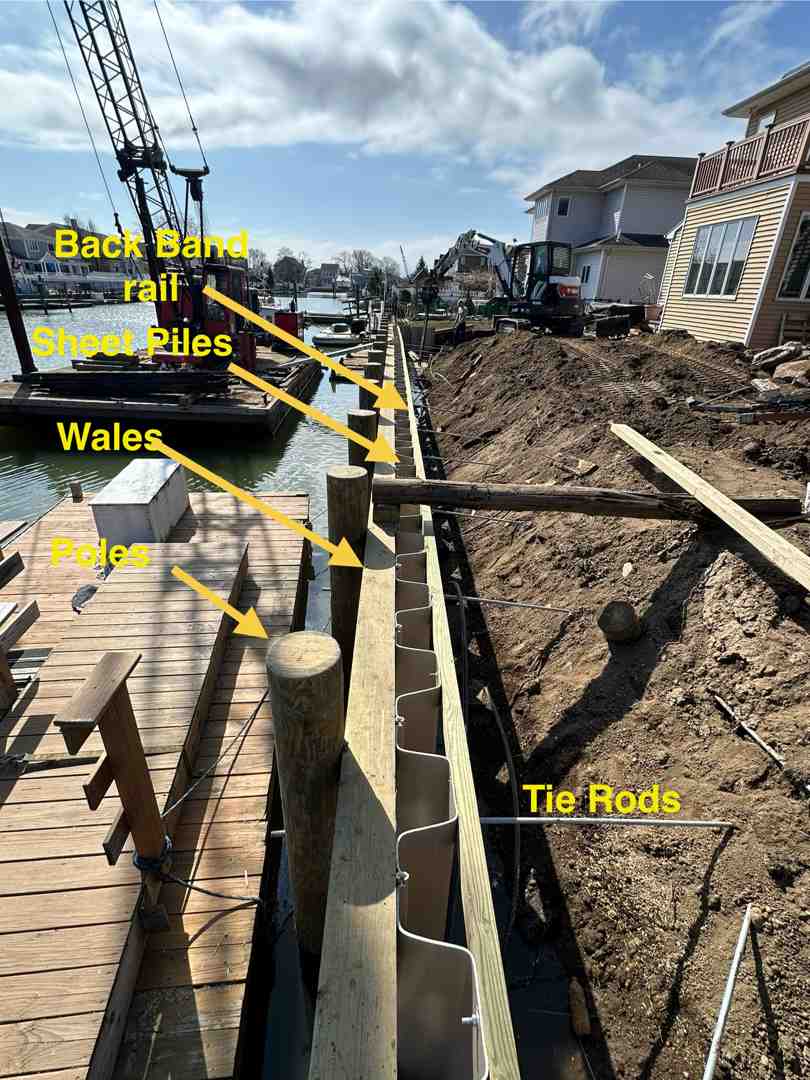
Material Comparison Table
To give you a better idea of where concrete stands, here is how it compares to other common materials we use on Long Island:
| Material | Cost Per Linear Foot | Expected Lifespan | Best Use Case |
|---|---|---|---|
| Concrete | $200 – $800 | 30 – 60 Years | High wave energy, heavy-duty protection |
| Vinyl | $150 – $600 | 50 – 80 Years | Calmer bays, canals, corrosion resistance |
| Steel | $250 – $700 | 25 – 40 Years | Extremely deep water, heavy industrial use |
| Wood (Timber) | $150 – $500 | 10 – 25 Years | Freshwater or very low-energy environments |
| Riprap (Stone) | $50 – $200 | 25 – 100+ Years | Natural erosion control, supplemental protection |
Material Comparisons and Long Island Site Conditions
Choosing the right material isn't just about the upfront price; it's about the "Total Cost of Ownership." For example, while wood might seem like a bargain, the harsh saltwater environment of the Atlantic or the Long Island Sound is home to marine borers—tiny organisms like gribbles and shipworms that eat through timber in record time. On Long Island, a wooden wall might only last 15 years, whereas a concrete wall can easily double or triple that lifespan.
Concrete is often the gold standard for properties facing significant wave action. If you live in Southampton or West Hampton, your wall has to stand up to the relentless pounding of the ocean. Concrete provides the mass and structural rigidity needed to deflect that energy.
For those in calmer waters, like a canal in Massapequa or a bay-front lot in West Islip, you might consider our Vinyl Seawall Cost Complete Guide. Vinyl is popular because it won't corrode in saltwater, but it has height limitations. If your project requires a wall taller than 6 or 7 feet to handle storm surges, concrete or steel-reinforced systems are usually the safer bet. You can find more info about seawall construction here to see which fits your specific topography.
Engineering and Permitting for How Much Does a Concrete Seawall Cost
You can’t just start pouring concrete into the water—well, you can, but the fines from the NYSDEC would be astronomical. Permitting and engineering are non-negotiable costs that property owners must budget for early on.
Engineering Fees: For a concrete seawall to be safe and legal, it must be designed by a licensed structural engineer. They calculate the "loads"—the pressure from the soil behind the wall and the water in front of it. On Long Island, engineering fees typically range from $2,000 to $5,000. This ensures your wall is designed to withstand the specific storm surge levels for your zone.
Permitting Costs:Navigating the regulatory waters of Long Island requires patience. Depending on your location, you may need approvals from:
- The New York State Department of Environmental Conservation (NYSDEC)
- The U.S. Army Corps of Engineers
- Nassau or Suffolk County offices
- Local township boards (e.g., Town of Hempstead or Town of Babylon)
Permit fees themselves usually fall between $150 and $2,500, but the real "cost" is time. The process can take anywhere from 90 days to several months. At Pearce Marine Construction, we handle the heavy lifting of the permitting process to ensure everything is compliant with the FEMA Coastal Construction Manual and local codes.
The Role of Wall Height and Water Depth
The taller the wall, the more it costs—but it’s not a linear increase. As the height of a seawall increases, the amount of hydrostatic pressure (water and soil pressure) pushing against it grows exponentially.
To combat this, a taller wall requires:
- Thicker Concrete: More cubic yards of marine-grade concrete.
- Heavier Reinforcement: More epoxy-coated or galvanized steel rebar to prevent internal corrosion.
- Stronger Tiebacks: The "anchors" that hold the wall to the land must be placed deeper and more frequently.
In West Hampton, where storm surges can be significant, we often utilize Concrete Sea Wall Construction techniques like monolithic pours. This involves pouring the wall as one continuous piece of concrete to eliminate "cold joints" where leaks or cracks could start. We use high-PSI marine-grade concrete (often 4,000 to 5,000 PSI) specifically formulated to resist the chemical attack of salt ions.
Water depth also plays a role. If the water at the base of your wall is deep, we have to use longer pilings and more complex underwater construction techniques, which naturally drives up the how much does a concrete seawall cost estimate.
Long-Term Maintenance and Structural Longevity
One of the reasons concrete is a favorite in Nassau and Suffolk Counties is its longevity. A well-built concrete seawall has a lifespan of 30 to 60 years. However, that lifespan is directly tied to how well you maintain it.
Think of your seawall like your car; you wouldn't drive it for 50,000 miles without an oil change. We recommend annual visual inspections to catch minor issues before they become $50,000 disasters.
Key Maintenance Tasks:
- Weep Hole Clearing: These small holes allow water to drain from behind the wall. If they get clogged, pressure builds up and can cause the wall to lean or "blow out."
- Crack Sealing: Small hairline cracks are common due to the freeze-thaw cycles on Long Island. Sealing them early prevents saltwater from reaching the steel reinforcement inside.
- Cap Inspection: The top of the wall (the cap) takes the brunt of foot traffic and sun exposure. Keeping the cap in good repair prevents water from seeping into the core of the structure.
For a deeper dive into preserving your wall, check out our Seawall Repair Services Ultimate Guide.
Embedment Depth and How Much Does a Concrete Seawall Cost
A seawall is like an iceberg—a huge portion of the structure is hidden underground. This is known as "embedment depth." To remain stable, a concrete seawall must be driven or poured deep into the seabed—usually 8 to 20 feet deep, depending on the height of the wall and the force of the waves.
Why so deep? Two words: Toe Scour.When waves hit a seawall, the energy is deflected downward. This downward force can wash away the sand and soil at the base (the "toe") of the wall. If the wall isn't embedded deep enough, this scour will eventually undermine the foundation, causing the wall to collapse forward into the water.
Deeper embedment requires longer piles and more powerful pile-driving equipment, which is a major factor in the how much does a concrete seawall cost per foot. According to seawall reference data, proper embedment is the single most important factor in preventing catastrophic failure during a storm.
Repairing vs. Replacing Coastal Infrastructure
If your current wall is showing its age, you might be wondering if you can get away with a repair or if you need a full replacement. We generally follow the "50% Rule": If the cost of repairs exceeds 50% of the cost of a brand-new wall, it’s usually a better long-term investment to replace it.
Common Repair Costs:
- Minor Crack Injection: $1,000 – $5,000
- Tieback Replacement: $200 – $600 per linear foot
- Cap Restoration: $150 – $300 per linear foot
Repairs can extend the life of a wall by 10 to 15 years, but they don't reset the clock entirely. If the structural integrity of the concrete panels is compromised (a condition known as "spalling" where chunks of concrete fall off), a replacement is likely necessary. You can see the technical details of these fixes in our Concrete Bulkhead Repair Ultimate Guide.
Choosing a Local Expert in Nassau and Suffolk Counties
At Pearce Marine Construction, we don't believe in "cookie-cutter" seawalls. Every property from Massapequa to Montauk has a unique fingerprint—different tides, different soil, and different exposure to the elements.
As a woman-owned business with generational expertise, we pride ourselves on meticulous craftsmanship. We live and work in the same Nassau and Suffolk County communities we serve. We know exactly what the NYSDEC is looking for in a permit application and exactly what kind of reinforcement a wall needs to survive a Long Island winter.
We don't cut corners because we know that a seawall isn't just a wall; it's the only thing standing between your home and the sea. If you're ready to get an accurate, site-specific answer to how much does a concrete seawall cost for your property, we are here to help.
Contact us for a consultation on your Seawalls and Bulkheads project today and let's build a legacy of protection for your waterfront home.


Bring Your Vision to Life
Whether you're planning a custom dock, seawall, or boat lift, our experienced team is ready to deliver high-quality marine construction tailored to your needs. Pearce Marine Construction brings craftsmanship, precision, and a deep understanding of Florida’s waterways to every project. Let us help you create a durable, beautiful solution that stands the test of time. Get in touch now for a personalized estimate!