
Floating Dock Anchor Lines: What You Need to Know


Why Proper Anchor Lines Are Critical for Floating Dock Stability
Anchor lines floating dock systems are the invisible foundation securing your waterfront investment. These critical connections to the seabed determine whether your dock remains stable during storms or becomes a costly liability drifting through Long Island's waterways.
Key considerations for floating dock anchor lines:
- Primary types: Galvanized chain, nylon rope, and polyester lines serve specific conditions.
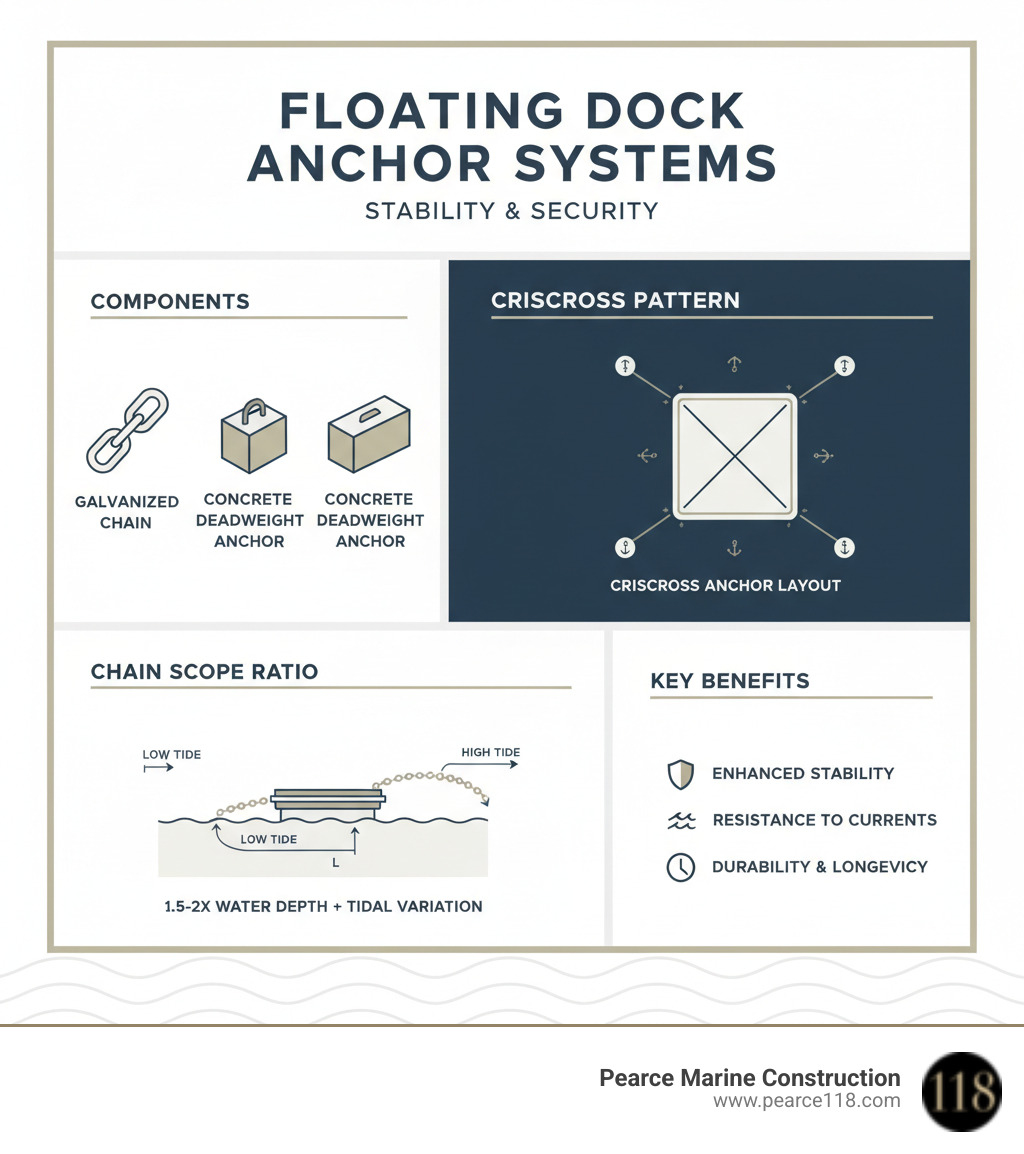
- Weight requirements: Minimum 600 lbs at dock corners, with total anchorage weight 2-3 times the dock's weight.
- Spacing: Anchoring points every 24-30 feet for optimal stability.
- Chain length: 1.5-2 times water depth, plus extra for tidal changes.
- Hardware: Marine-grade shackles, eyebolts, and quick links prevent corrosion.
The choice between cable, pile, or stiff arm systems depends on site conditions like water depth, bottom type, wave exposure, and tidal range.
As one Long Island homeowner learned: "We watched helplessly as an improperly anchored dock drifted away during a summer storm." This scenario is common when anchoring systems aren't designed for local conditions.
Professional marine contractors know that concrete loses about half its anchoring effectiveness underwater due to buoyancy. They also understand that Long Island's diverse waterways require customized solutions built to withstand nor'easters and hurricanes.
Anchor lines floating dock helpful reading:
Fundamentals: Understanding Anchoring Components and Forces
Effective anchor lines floating dock systems rely on understanding the physical forces at work. Archimedes' Principle is a key concept: an object underwater experiences an upward buoyant force, reducing its effective weight. This means a 1,200-pound concrete anchor only provides about 600 pounds of holding power once submerged, a critical factor in our weight calculations.
Proper angles and tension are also vital. An anchor line pulling at a 45-degree angle provides optimal holding power. The scope—the ratio of anchor line length to water depth—ensures the anchor digs in securely rather than dragging. Getting this balance right is essential for dock stability, and FEMA has even documented that properly anchored floating docks can protect boats during storms better than fixed structures.
Every installation considers Long Island's unique conditions, from protected coves to exposed bays. Our Floating Dock Anchoring Systems approach ensures your investment remains secure.

Primary Types of Anchor Lines for Floating Docks
- Galvanized chain is the workhorse, offering excellent abrasion resistance and durability. Its zinc coating fights corrosion, though marine-grade stainless steel is a recommended upgrade for saltwater.
- Nylon lines are elastic, absorbing shock from waves and wind to protect the dock and anchor from sudden stress. They also offer good UV resistance.
- Polyester lines provide high strength with minimal stretch, making them ideal for precise positioning. They are highly resistant to UV degradation and chemicals.
The best choice depends on your specific waterfront conditions, as a calm Massapequa cove requires a different solution than the waters off West Hampton.
Essential Anchoring Hardware
Reliable anchoring requires hardware that withstands constant water exposure and dynamic forces.
- Concrete anchors are a cost-effective deadweight solution for sandy or muddy bottoms. We account for buoyancy, using a 1,200-pound block to achieve 600 pounds of underwater holding power.
- Helical anchors screw into the seabed, providing exceptional grip in various soil types with minimal environmental impact. They are ideal for sites requiring extra security.
Connection hardware is critical. Shackles and quick links join components, eyebolts create secure attachment points on the dock, and thimbles prevent rope wear. For materials, galvanized steel offers good rust protection, but we recommend marine-grade stainless steel (316L) for Long Island's saltwater environments due to its superior corrosion resistance and longevity.
Our detailed approach to Dock Anchors for a Floating Dock ensures every component performs reliably.
Choosing the Right System: Anchoring Methods and Site Assessment
An effective anchor lines floating dock system is customized to its environment. A professional site assessment is the first step, evaluating factors that determine which anchoring method is best for your property.
- Water depth: A shallow cove in Oyster Bay requires a different approach than the deeper waters off Montauk. Depth influences the choice between cable, pile, or other systems.
- Substrate type: Sandy, muddy, or rocky bottoms each demand specific anchor types. Concrete blocks work well in sand, while helical anchors excel in mixed soils.
- Wind and wave exposure: A protected harbor in Cold Spring Harbor faces different forces than an exposed bay in the Hamptons. High-energy sites require heavier anchors and more robust hardware.
- Water level fluctuations: Long Island's tides and storm surges must be factored into the design to prevent stress on the dock.
Understanding these factors is key to creating an effective Marine Structures Design for Long Island's dynamic environment.
| Anchoring Method | Suitability for Water Depth | Water Level Fluctuation | Bottom Type | Stability | Notes |
|---|---|---|---|---|---|
| Cable / Deadweight | Deep to Moderate | High (with proper slack/scope) | Sand, Mud, Some Rocky | Good | Cost-effective, adaptable, requires significant anchor weight. |
| Pile | Moderate to Deep | High (dock slides on piles) | Firm Mud, Clay, Sand | Excellent | Restricts horizontal movement, ideal for heavy loads, requires pile driving. |
| Stiff Arm | Shallow to Moderate | Low to Moderate | Any (anchors to shore/piles) | Excellent | Best for near-shore, stable water levels; rigid connection. |
| Pole & Sleeve | Shallow to Moderate | High (dock slides on poles) | Firm Mud, Sand | Very Good | Good for windy areas with waves; poles driven into bottom. |
Cable and Deadweight Systems
Cable and deadweight systems are a versatile choice, especially in deeper water. They adapt well to changing water levels by using a crisscross (X-pattern) configuration. By crossing anchor lines diagonally, the system self-tightens and prevents the dock from moving sideways in currents or storms. We design these systems with carefully calculated anchor weights, accounting for buoyancy, and recommend a minimum of 600 pounds at the corners, with total anchorage weighing 2-3 times the dock's weight. Proper slack in the anchor lines floating dock connections allows the dock to rise and fall with tides. Learn more in our guide: How Do You Anchor a Floating Dock.
Pile and Stiff Arm Systems
For maximum stability in exposed waters or for high-traffic applications, pile and stiff arm systems are superior.
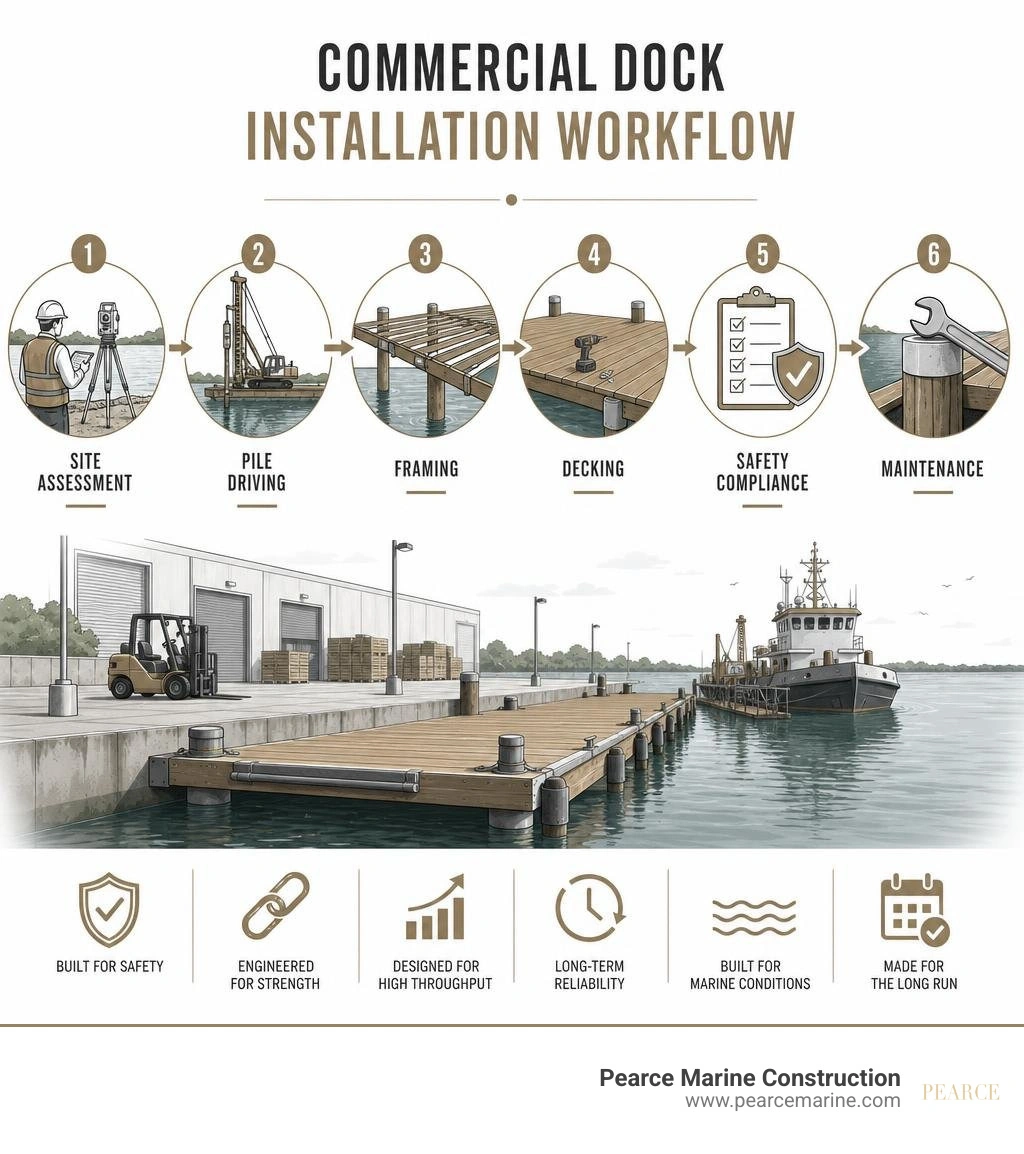
Pile anchoring involves driving vertical supports into the seabed and fitting the dock with sleeves that slide along these guides. This prevents horizontal drift while allowing vertical movement with tides. Piles offer excellent stability against wind and waves. Our expertise in Pile Driving ensures a solid foundation. For sensitive areas, Helical Piles provide exceptional holding power with minimal seabed disturbance.

Stiff arm systems use rigid connections between the dock and the shore or fixed pilings. This eliminates horizontal movement, creating rock-solid stability for near-shore installations with stable water levels. In tidal areas, we can integrate pile hoops to allow vertical movement while maintaining rigidity.
Installation and Maintenance of Anchor Lines for a Floating Dock
Proper installation and maintenance are what separate a dock that lasts for decades from one that fails prematurely. A successful anchor lines floating dock installation begins with precise calculations.
We determine anchor weight requirements (accounting for buoyancy), design an anchor layout with points spaced every 24-30 feet, and calculate chain length. The chain should be 1.5-2 times the maximum water depth, plus extra length to account for Long Island's tidal variations. For example, in 8 feet of water with an 8-foot tidal swing, the 16-foot depth range requires about 24 feet of chain, plus 2-3 feet of slack. This ensures proper anchoring technique. Learn more about What is the Proper Technique for Anchoring.
The Construction and Installation Process
The installation process follows a proven sequence for safety and longevity. After final site preparation, anchors are deployed according to the layout plan. We then install the lines in a crisscross pattern, connecting anchors to opposite corners of the dock to reduce side-to-side movement. All hardware, including shackles and thimbles, is secured, and shoreline connections are carefully installed. The final step is tension adjustment, creating enough slack (1-2 feet) for the dock to absorb wave action and adapt to water level changes without stress. Our guide on How to Anchor a Floating Dock to Shore provides more detail.
Long-Term Maintenance and Storm Preparedness
Ongoing maintenance and storm preparation are essential on Long Island to protect your investment.
- Regular Inspections: Conduct thorough checks in spring and fall, with monthly visual inspections during boating season. Look for fraying lines, rust, or loose chains.
- Check for Wear and Corrosion: Even marine-grade materials can deteriorate. Replace any hardware showing significant rust or wear before it fails.
- Seasonal Adjustments: Adjust chain tension to accommodate seasonal water level fluctuations. The dock should never feel overly tight or loose.
- Storm Preparedness: Before a storm, recheck all connections and remove loose items. Floating docks can ride out storm surges, but extreme weather may require moving the dock to a more sheltered location. Properly anchored floating docks are often safer than fixed structures, and considering hurricane holes for storm planning is a wise strategy.
Preventative maintenance is always more cost-effective than emergency repairs. If issues arise, our team provides comprehensive Long Island Dock Repair services.
Regulations, Challenges, and Professional Solutions
Installing a floating dock on Long Island involves more than just construction; it requires navigating local regulations and overcoming site-specific challenges. A successful anchor lines floating dock project needs meticulous planning to ensure compliance with all environmental and safety standards.
Every dock project requires permits from local (town/village), state (NYS DEC), and sometimes federal (U.S. Army Corps of Engineers) agencies. These bodies ensure projects protect navigation, water quality, and habitats. Common challenges include complex seabeds (rocky or soft mud), strong currents, heavy wave exposure, and significant tidal fluctuations. Environmental sensitivity, especially the protection of eelgrass beds, often requires modified designs and low-impact installation techniques. Partnering with an experienced Marine Construction Contractor is invaluable for navigating these issues.
Environmental and Regulatory Compliance on Long Island
Protecting Long Island's marine ecosystems is a key part of the construction process. The permitting process involves multiple agencies with specific requirements for drawings and environmental assessments. Setback requirements from property lines and navigation channels are strictly enforced. Often, the anchoring system must integrate with existing structures to provide complete shoreline protection, a specialty of our team of Shoreline Protection Contractors. We conduct thorough site surveys to map and avoid protected habitats like eelgrass beds, using creative anchor placement or helical anchors to minimize disturbance.
When to Hire a Professional Marine Contractor
While some projects may seem simple, professional expertise is crucial for safety, compliance, and reliability in many situations:
- Deep water installations (>8-10 ft) require specialized equipment for accurate anchor placement.
- Heavy wave exposure or strong currents demand engineered solutions, such as Helical Piles Installation.
- Complex seabed conditions (rock, soft mud) require specific anchor types and installation methods.
- Structural damage or significant wear on an existing system needs a professional assessment for safe and effective repairs.
- Navigating permits and regulations is complex; an experienced contractor can save you months of delays.
Our generational expertise ensures your investment is protected. Waterfront owners trust the Dock Builders Long Island relies on for professional marine construction.
Frequently Asked Questions about Anchor Lines for Floating Docks
How much weight is needed to anchor a floating dock?
Proper anchor lines floating dock calculations are based on engineering, not guesswork. A common starting point is a minimum of 600 lbs of anchor weight at the outer corners, but the final weight depends on dock size, use, and exposure to wind and waves. Crucially, concrete loses about half its effective weight underwater due to buoyancy. A 1,200-pound concrete block provides only 600 pounds of holding power. As a rule, the total anchorage weight should be 2-3 times the weight of the dock, with the higher ratio used for sites with strong currents or frequent storms.
How long should my anchor chains be?
Chain length, or scope, is critical for an effective system. The standard principle is a chain length of 1.5 to 2 times the maximum water depth. In Long Island's tidal areas, you must also add length to account for the full tidal swing, plus a few feet of slack to prevent stress. For example, with 10 feet of water at high tide and an 8-foot tidal range, the maximum depth is 18 feet. Using a 1.5 scope, you would need at least 27 feet of chain, plus 2-3 feet of slack. This allows the anchor to set properly instead of dragging.
Can I use the same anchoring system in saltwater and freshwater?
While anchoring principles are universal, the materials must be chosen based on the environment. Saltwater is highly corrosive and will rapidly deteriorate standard galvanized steel components suitable for freshwater. For Long Island's saltwater bays, we specify heavy-duty galvanized or marine-grade stainless steel hardware (like 316L) for all chains, shackles, and eyebolts. While stainless steel has a higher upfront cost, its superior corrosion resistance ensures the anchor lines floating dock system remains strong and reliable for decades.
Conclusion
Your floating dock's anchor lines floating dock system is the invisible foundation that protects your waterfront investment from becoming a liability during a storm. Effective anchoring is a science, requiring precise calculations for anchor weight, chain length, and material selection to withstand Long Island's tidal, saltwater environment.
From the versatility of cable and deadweight systems to the best stability of pile installations, the right choice depends on a professional site assessment. The installation process, tension adjustments, and navigation of complex environmental permits all demand expertise. A properly engineered system provides peace of mind, keeping your dock secure through nor'easters and seasonal changes.
At Pearce Marine Construction, our generational expertise in Long Island's waters ensures we design and build anchoring systems that last. We understand the unique challenges of every harbor and bay from Nassau County to the East End. When you're ready to protect your investment with a professionally designed system, our team delivers the precision and craftsmanship that comes from decades of experience.
To learn more about our comprehensive approach, explore our boat and floating dock services. Your dock deserves an anchoring system as solid as the craftsmanship that built it.
_compressed.webp)

Bring Your Vision to Life
Whether you're planning a custom dock, seawall, or boat lift, our experienced team is ready to deliver high-quality marine construction tailored to your needs. Pearce Marine Construction brings craftsmanship, precision, and a deep understanding of Florida’s waterways to every project. Let us help you create a durable, beautiful solution that stands the test of time. Get in touch now for a personalized estimate!