
Smart Boat Dock Piling Repair Solutions for Coastal Property Owners


Boat Dock Piling Repair: Know When to Reinforce or Replace
If a dock piling is soft, hollow, badly cracked, or leaning, arrange a professional marine construction inspection before the structure is loaded or expanded. A contractor can check the piling above and below the waterline to see whether it still supports the dock. If it does, a protective wrap or grout-filled jacket may stop further damage and add strength. If the piling cannot carry its load, replacement is the safer choice.
Damage is often worst where the water rises and falls, and much of it can be hidden below the surface. Pearce Marine Construction is a woman-owned marine construction company serving residential, commercial, and public clients in Nassau and Suffolk Counties on Long Island, NY. A careful assessment is the first step toward effective boat dock repair, whether you require structural pile reinforcement or comprehensive dock repair. Waterfront property owners searching for reliable marine dock repair can rely on engineered boat dock piling repair solutions built to withstand harsh coastal elements.

Professional Waterfront Foundation Assessment and Structural Warning Signs
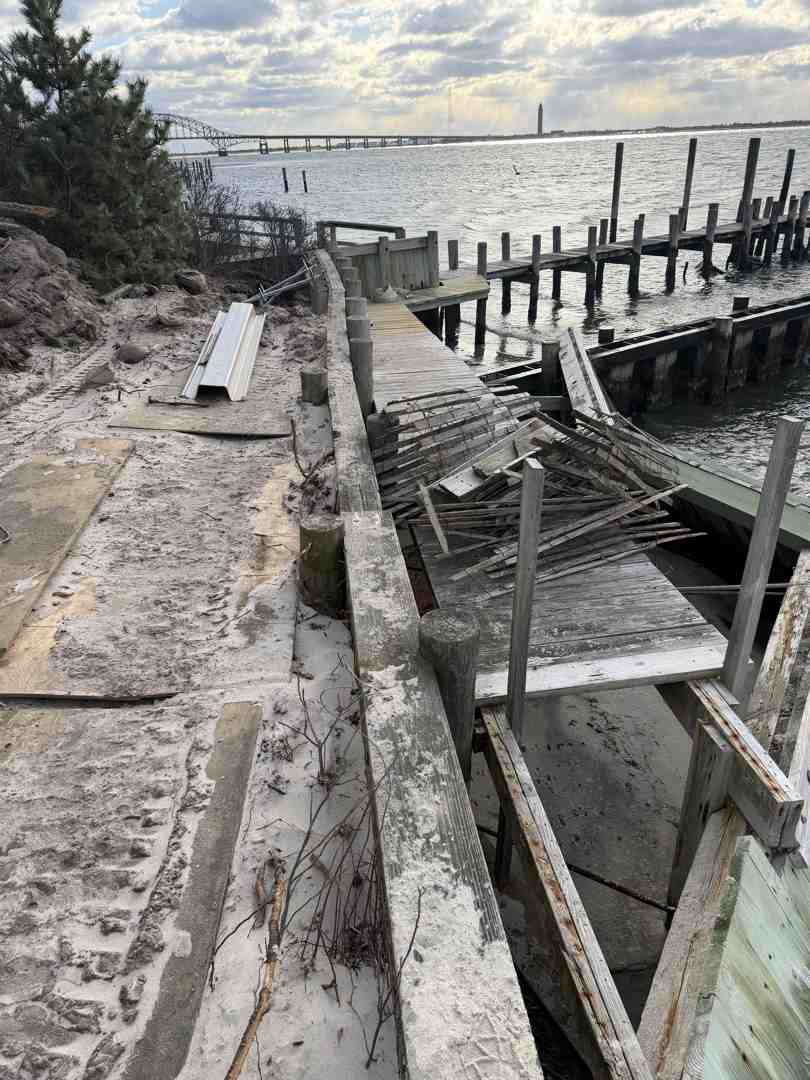
A dock's stability relies directly on its submerged foundation. The tidal environment across Long Island subjects structural timbers to relentless physical, biological, and chemical stress. Catching deterioration early makes the difference between cost-effective structural reinforcement and a catastrophic framing collapse. Scheduling contractor-led inspections and timely marine piling repair ensures your waterfront platform remains secure year-round.
When conducting physical assessments, marine contractors rely on calibrated sounding tests and manual probe tools like ice picks to determine internal structural density. Striking a healthy timber with a specialized brass hammer produces a sharp, high-pitched ring. If the timber resonates with a dull, hollow thud, it indicates internal decay or pest infestation.
When an ice pick sinks deeply into the core with little resistance, internal fungal rot or wood-boring pests have compromised the structural wood. Once a piling loses more than 20 percent of its effective cross-sectional area, its vertical and lateral load-bearing capacity drops exponentially.
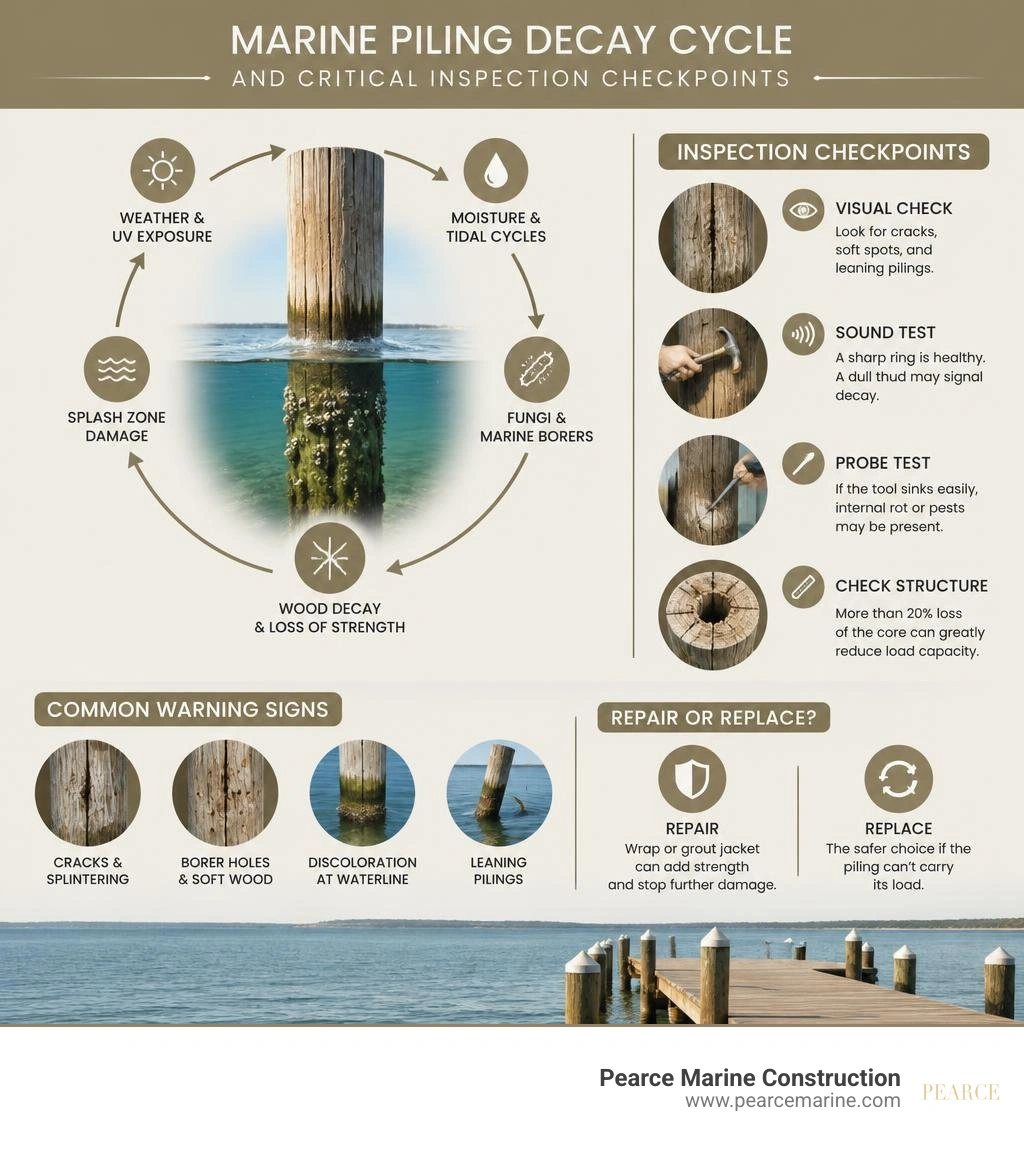
Most structural damage concentrates in the splash zone—the intertidal region between the low-tide mark and the high-tide line. Constantly cycling between wet and dry conditions creates the ideal moisture, heat, and oxygen levels for marine decay.
Common Indicators That Your Dock Pilings Need Immediate Contractor Attention
For service calls in Massapequa, Merrick, Wantagh, and Bellmore, Pearce Marine prioritizes dock piling inspections when these visible warning signs appear:
- Hourglass Necking: Noticeable tapering of the post diameter right at the mean water line, caused by continuous wave friction, suspended sand abrasion, and concentrated marine organism feeding.
- Surface Boreholes and Channels: Tiny entry holes on exterior wood surfaces signaling that wood-boring worms have hollowed out the core.
- Structural Settling or Deck Sagging: Visible dipping along stringers, framing joists, or decking boards, indicating an underlying foundation post has lost vertical support.
- Out-of-Plumb Posts: Foundation piles that lean outward or pull away from walers and cross braces due to lost structural integrity at the seabed line.
- Soft, Spongy Outer Layers: Timber fibers that peel away effortlessly by hand or flake off under light water pressure.
Because the most aggressive deterioration happens submerged beneath the low-tide mark, our team uses specialized underwater camera systems to inspect the entire column down to the mudline along Nassau County waterfronts.
Primary Causes of Marine Borer and Environmental Deterioration
Biological attack is the leading driver of coastal timber foundation failure on Long Island. Oxygen-rich, pristine coastal waters support aggressive marine boring species, as documented by Sea Grant research on marine borer damage to wood structures:
- Teredo Navalis (Shipworms): These destructive marine mollusks enter timber as microscopic larvae and bore extensive internal networks of tunnels. An untreated timber post can suffer up to 80 percent internal structural loss in just a few seasons, while leaving the outer shell looking deceptively intact.
- Limnoria (Gribbles): Tiny crustaceans that tunnel near the wood surface, creating shallow channels that weaken outer layers. Waves wash these fragile fibers away, accelerating the classic hourglass waistline near the splash zone.
- Tidal Currents and Storm Surge: Strong tidal surges through inlets in Brightwaters, Babylon, and Bayshore stress weakened timbers, turning minor biological decay into sudden structural cracks.
- Saltwater Corrosion of Marine Fasteners: Galvanic corrosion degrades structural bolts, threaded rods, and framing brackets, loosening connections and allowing timbers to twist under dynamic wave loads.
Without proactive mechanical intervention on Suffolk County shorelines, untreated or aging treated wood posts will rapidly degrade past the threshold of safe load capacity.
Modern Boat Dock Piling Repair Methods and Encapsulation Solutions
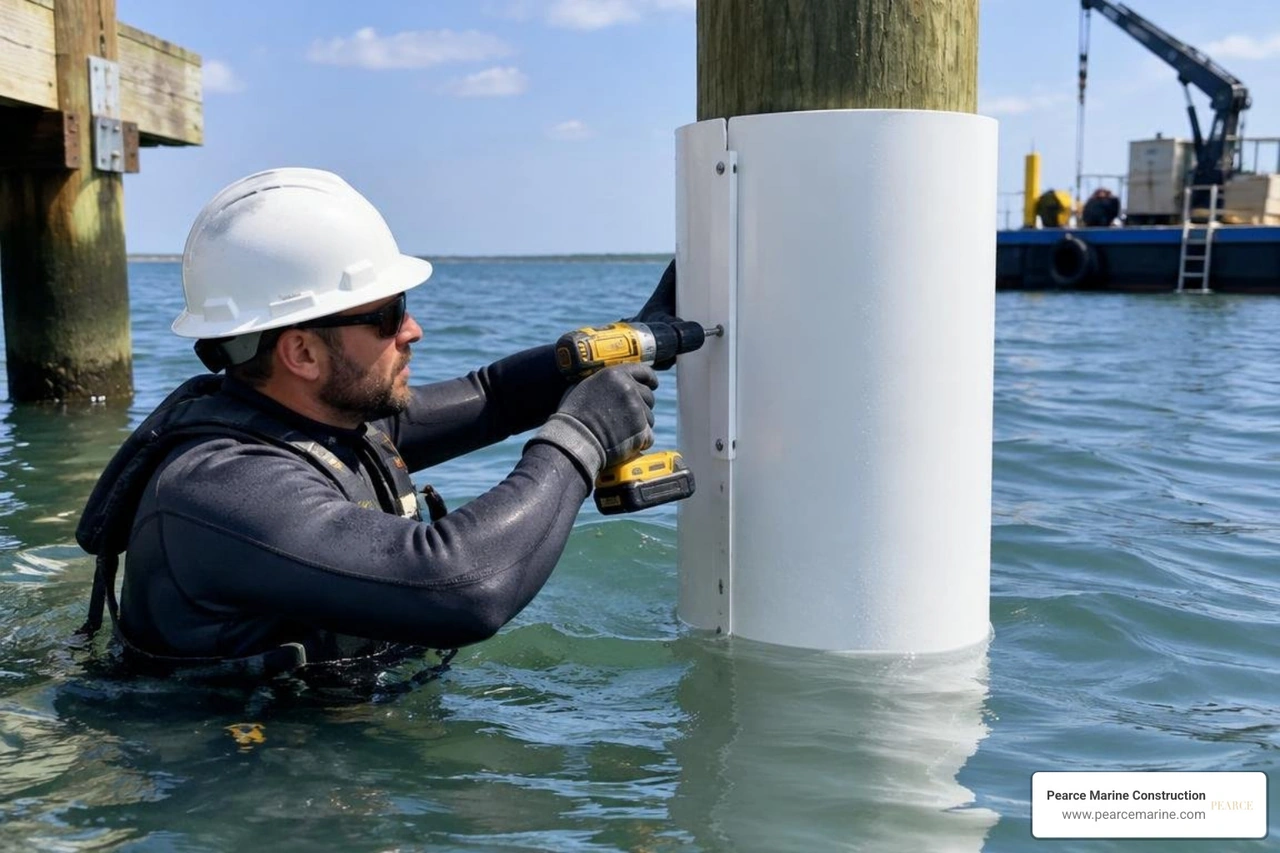
Replacing an entire foundation post used to require barge-mounted cranes, pile-driving rigs, and dismantling the dock overhead. Today, specialized structural encapsulation provides a robust, engineered repair that restores structural strength without disturbing your deck framing. Property owners seeking expert marine construction services can save time and money by reinforcing damaged timbers right where they stand.
Structural encapsulation encloses the deteriorated timber column in an engineered, heavy-duty barrier sleeve. The system centers the jacket using stand-off spacers, maintains a continuous annular void around the damaged zone, and fills the space with high-strength marine grout.
The grout core forms a new structural composite column that can carry the dock's full vertical and lateral loads, while the tough outer jacket creates a permanent mechanical barrier against marine life and water infiltration.
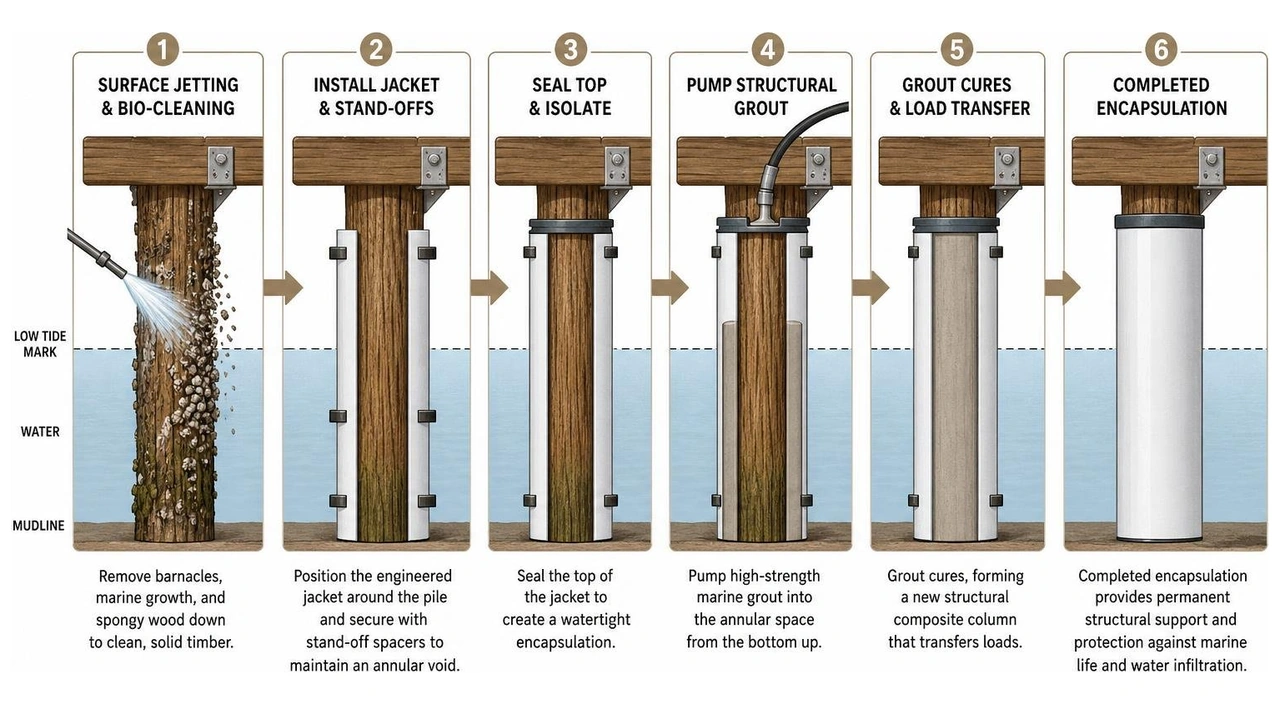
Step-by-Step Boat Dock Piling Repair and Concrete Encapsulation
Achieving maximum structural load transfer requires strict adherence to commercial marine engineering standards:
- Hydraulic Surface Jetting and Bio-Cleaning: Technicians use high-pressure hydraulic water jets and mechanical scraping tools to strip barnacles, oysters, biological growth, and spongy, rotted wood fibers down to clean, solid timber.
- Annular Spacer Calibration: Install heavy-duty composite stand-off spacers around the post to center the protective sleeve and guarantee an annular space of at least 1.5 to 2.0 inches for uniform grout encapsulation.
- Sealing the Sleeve: Technicians wrap a heavy-duty, UV-stabilized PVC or high-density polyethylene (HDPE) jacket around the column, lock the mechanical fasteners along the vertical seam, and set a marine-grade bottom sealing flange below the mudline.
- Bottom-Up Grout Pumping: Pump structural grout from the bottom flange upward using a specialized positive-displacement pump and flexible tremie lines. Pumping from the bottom displaces trapped seawater out the top, eliminating air voids, cold joints, and honeycombing.
- Curing and Oxygen Starvation: As the grout cures into a solid column, it seals off all oxygen and nutrients from the wood interior, instantly terminating any remaining marine borers inside.
Selecting Grout Materials: Epoxy vs. Cementitious Compounds
Choosing the right structural filler material depends on dynamic water exposure, tidal windows, and load demands:
| Performance Metric | Marine-Grade Cementitious Grout | High-Strength Marine Epoxy Grout |
|---|---|---|
| Initial Set Time | 2 to 4 hours | 45 to 90 minutes |
| Full Compressive Cure | 7 to 28 days (4,000–6,000 PSI) | 24 to 48 hours (8,000–12,000 PSI) |
| Underwater Adhesion | Mechanical bond via confinement | Superior chemical and mechanical bond |
| Chemical Resistance | Good saltwater resistance | Outstanding saltwater, fuel, and chemical barrier |
| Flexural / Tensile Strength | Standard structural rating | Superior tensile load and micro-crack resistance |
| Ideal Project Application | Large-scale residential and commercial dock posts | High-load pier supports and tight structural voids |
For high-stress installations like main pier supports and dock load zones in Cold Spring Harbor or Huntington, high-strength epoxy grouts deliver rapid load-bearing strength and excellent structural stability against heavy marine loads.
Repair vs. Replacement: Making the Right Structural Investment
Choosing whether to reinforce an existing foundation or drive an entirely new post depends on remaining structural cross-section, localized decay, and framing conditions. Property owners evaluating marine dock repair solutions can consult the diagnostic framework below to choose the most cost-effective path:

When an existing post retains at least 50 to 60 percent of sound, non-decayed timber along its core, encapsulation restores the foundation's original load rating. This approach avoids driving new posts, keeps deck framing intact, and extends service life by 15 to 25 years.
Cost and Longevity Breakdown of Boat Dock Piling Repair vs. Replacement
Driving new replacement posts in Nassau and Suffolk Counties is a major capital expense. Traditional replacement runs $500 to $1,500 or more per post once you factor in heavy barge staging, pile-driving hammer mobilization, stringer disassembly, and structural re-framing.
By comparison, modern structural encapsulation:
- Reduces project costs by 40 to 70 percent compared to full structural replacement.
- Eliminates the need to demolish dock frames or disconnect existing deck framing and anchoring hardware.
- Takes only one to two days for an average residential dock with 8 to 12 posts.
- Delivers a minimum 20 to 25-year structural service life, with high-grade UV-protected PVC shells backed by studies showing indefinite durability when undisturbed.
On protected canal fronts across West Islip and Westhampton, where shallow waters complicate heavy barge access, in-place reinforcement provides fast structural stabilization with zero marine traffic disruption.
Long-Term Environmental and Structural Benefits of Restoration
Repairing and encapsulating foundation posts also offers clear ecological advantages over traditional removal and replacement:
- Benthic Habitat Preservation: Keeping old posts in place avoids driving replacement piles that tear up underwater mudflats, disturb fragile root systems, and cloud the water column with suspended silt.
- Zero Toxic Preservative Leaching: Old marine wood often contains copper, chromium, and arsenic treatments. Sealing damaged timbers in watertight PVC and grout prevents chemical runoff into surrounding bays.
- Reduced Marine Waste: In-place repair saves large quantities of heavy, treated timber from being torn out and sent to regional landfills.
- Sediment Stability: Leaving the embedded post bases undisturbed preserves the established sub-surface friction that anchors your shoreline and dock foundation against storm surge.
Protect Your Waterfront Foundation with Long Island's Marine Experts
For residential, commercial, and municipal waterfront properties across Lloyd Harbor, Southampton, and West Hampton, partnering with an experienced marine contractor is critical for long-term structural integrity. Pearce Marine Construction delivers unmatched local expertise, superior craftsmanship, and dedicated heavy commercial equipment on every installation and restoration.
Our team specializes in structural marine pile assessment, customized PVC encapsulation systems, pile driving, custom decking, and structural bulkheads engineered specifically for coastal Long Island. Schedule professional dock maintenance and repairs with Pearce Marine Construction today to secure your waterfront foundation for decades to come.


Bring Your Vision to Life
Whether you're planning a custom dock, seawall, or boat lift, our experienced team is ready to deliver high-quality marine construction tailored to your needs. Pearce Marine Construction brings craftsmanship, precision, and a deep understanding of Long Island's waterways to every project. Let us help you create a durable, beautiful solution that stands the test of time. Get in touch now for a personalized estimate!