
Down to Earth: How Helical Piering and Screw Piling Keep Your Build Steady


Why Helical Anchors Are the Deep Foundation Standard for Marine Construction
Helical anchors are deep foundation elements made from a steel shaft with welded helical bearing plates — essentially a large, engineered screw driven into the ground to transfer structural loads down to stable soil. They resist both downward compression forces and upward tension (uplift) forces, making them uniquely suited for the demanding conditions of shoreline construction.
Here's what you need to know at a glance:
| Question | Quick Answer |
|---|---|
| What are helical anchors? | Steel shaft + helical plates screwed into bearing soil to support structures |
| What loads do they handle? | Both compression (downward) and tension (uplift/lateral) |
| How strong are they? | Up to 200,000 lbs per pile; 4-5x the holding strength of concrete blocks |
| How long do they last? | 75+ years with hot-dip galvanization to ASTM A123 |
| Why use them near water? | No curing time, minimal soil disturbance, proven in marine environments |
| Who installs them on Long Island? | Pearce Marine Construction serves Nassau and Suffolk Counties |
For Long Island property owners in places like Southampton, West Islip, and West Hampton, the stakes are high. Shoreline structures — bulkheads, seawalls, docks, and piers — face relentless lateral pressure from soil, water, and storm surge. A foundation that shifts, corrodes, or pulls out isn't just a repair bill. It's a safety risk.
Traditional methods like concrete deadman anchors and timber piles have real limits. A 6,000-lb cement block sitting on sand delivers only about 3,200 lbs of breakout force. A comparable helical anchor can exceed 20,000 lbs — from a unit weighing just over 100 lbs.
That's the core reason marine contractors and engineers are specifying helical anchors for coastal work. This guide breaks down exactly how they work, how they're installed, and why the right specification matters when your structure is sitting at the water's edge.
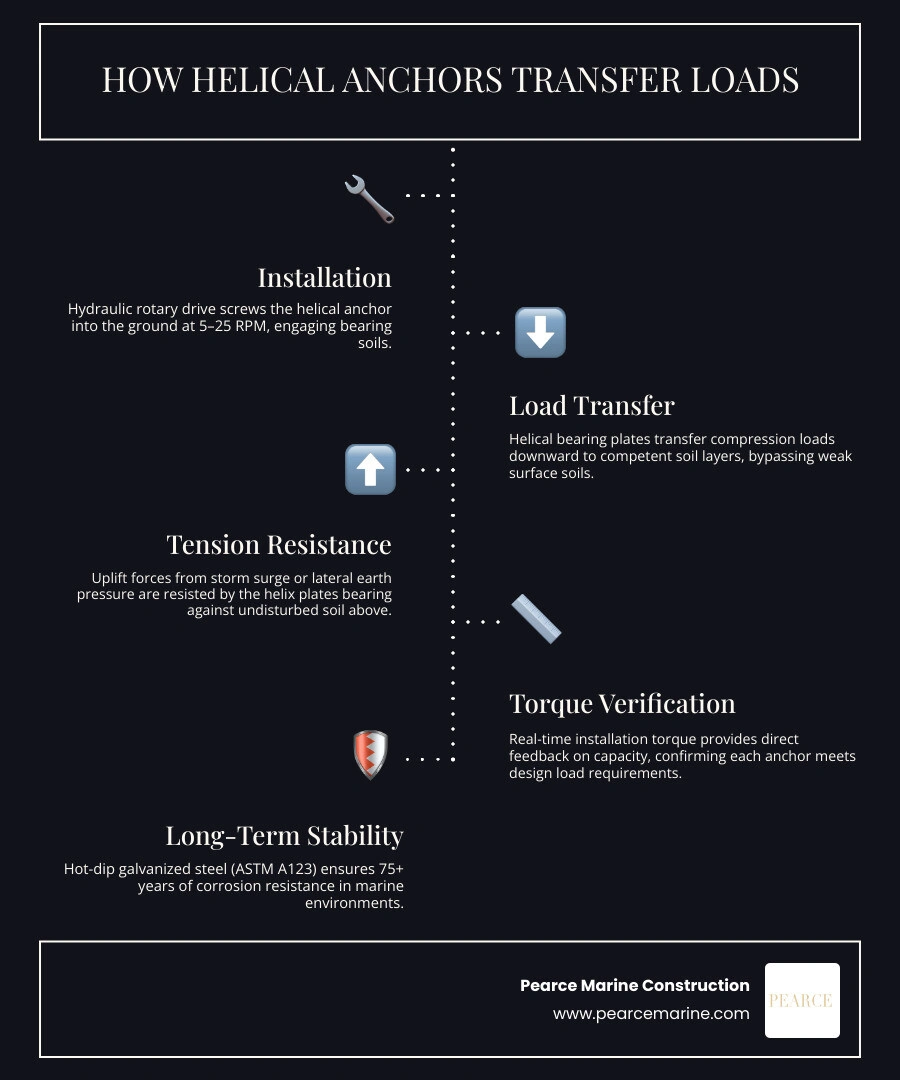
Simple helical anchors word guide:
The Engineering Behind Helical Anchors in Marine Construction
To build a shoreline structure that survives decades of shifting tides and heavy storms, you have to look past the surface. Standard foundations rely on the top layers of soil, which are often saturated, weak, or highly prone to erosion along the canals of Babylon and the bays of West Hampton. Helical anchors bypass these unstable layers entirely, providing robust deep foundation support.
By screwing deep into the earth, these anchors establish a reliable anchor point in dense, competent soils. This design allows them to resist massive tension resistance (uplift forces from wind or buoyancy) and heavy compression loads (downward forces from structural weight). For marine bulkheads and seawalls, which are constantly pushed outward by the weight of the wet soil behind them, these anchors act as the ultimate tieback system. If you want a deeper dive into how these systems support massive weights, explore our helical pile foundation complete guide.
How Helical Anchors Work to Stabilize Shoreline Infrastructure
The mechanical magic of a helical anchor lies in its simple yet highly engineered design. It consists of one or more circular helical bearing plates welded to a central steel shaft.
As the anchor is rotated into the ground, the helical plates act like a wood screw, pulling the shaft down without churning up the surrounding earth. Once the plates reach competent bearing soils, the load transfer occurs. The soil above and below the plates acts as a physical block, resisting movement.
In tension applications, such as securing a retaining wall against lateral earth pressures or anchoring a floating dock, the plates resist being pulled out by utilizing the weight of the soil column above them. This is crucial for resisting lateral earth pressures and uplift forces.
| Foundation Type | Tension Capacity | Installation Speed | Soil Disturbance | Lifespan in Saltwater |
|---|---|---|---|---|
| Helical Anchors | Extremely High (Up to 20,000+ lbs for a 100 lb anchor) | Very Fast (Hours, no curing time) | Minimal (Screws directly into soil) | 75+ Years (With ASTM A123 Galvanization) |
| Traditional Timber Piles | Moderate (Relies on skin friction) | Slow (Requires heavy pile driving) | High (Vibrations can disrupt shorelines) | Moderate (Prone to marine borers and rot) |
| Concrete Deadman Anchors | Low to Moderate (Relies on deadweight and suction) | Very Slow (Requires excavation and concrete curing) | Extremely High (Massive digging required) | Variable (Concrete can degrade or shift) |
To learn more about how we utilize these systems on residential and commercial waterlines, check out our dedicated page on helical piles.
Inertia Welding and Metallurgical Advantages of Modern Helical Anchors
Not all steel anchors are created equal. In the harsh, corrosive saltwater environments of Long Island’s South Shore, the physical joints of an anchor are its weakest points. Traditional manufacturing relies on hand-welded gussets to connect the helix plates to the shaft. This process creates a "heat-affected zone" where the steel becomes brittle and highly susceptible to cracking under high torque or shear loads.
Modern high-performance anchors utilize patented inertia weld technology. This is a solid-state welding process that spins the coupling against the shaft at high speeds under immense pressure. The friction heats the metal to a plastic state, literally fusing the two pieces of steel together without any filler material.
This process results in:
- The complete elimination of the heat-affected zone.
- A joint that delivers up to twice (2x) the shear strength of conventional gusset welds.
- A seamless connection that stands up to the toughest rotational forces during installation.
To handle the immense stresses of marine engineering, these anchors are manufactured using high-strength API 5CT N80 steel for the shafts and premium ASTM A572 steel for the helix plates. To protect against the aggressive, corrosive forces of saltwater and coastal soils, they undergo hot-dip galvanization conforming to ASTM A123 standards, ensuring a service life of 75+ years. For a comprehensive breakdown of these metallurgical standards, you can view The Strongest Anchors in the World .
Comparing Round Shaft Piles and Square Shaft Tension Anchors
When designing a deep foundation system, selecting the correct shaft geometry is critical. The two primary options are the Round Shaft (RS) series and the Square Shaft (SS) series.
- Round Shaft (RS) Series: These feature a hollow circular cross-section. Because of their geometry, round shafts have superior structural properties when it comes to resisting bending, buckling, and torsional forces. They are the ideal choice for compression-heavy applications, such as supporting heavy docks, piers, or building foundations.
- Square Shaft (SS) Series: These feature a solid square cross-section. While they have lower resistance to bending than round shafts, they boast incredible torsional strength during installation. This makes them highly efficient for deep penetration into hard soils. They are primarily used in pure tension applications, such as tieback anchors for bulkheads.
The coupling details also differ; round shafts typically use internal or external sleeve couplers bolted together, whereas square shafts slide into cast steel couplings. Understanding these differences ensures your shoreline structure is built to handle its specific load profile. For more information on choosing the right pier or piling for your project, read our guides on helical piers and screw pile footings.
Selecting and Installing Deep Foundation Systems on Long Island
From the sandy shores of Lloyd Harbor to the muddy wetlands of Southampton and Bayshore, Long Island’s coastal geology is incredibly diverse. Standard, one-size-fits-all construction methods simply do not work here. Installing helical anchors in Nassau County and Suffolk County requires local expertise to navigate high water tables, organic silts, and dense glacial tills. If you are planning a project in our area, our helical piles long island guide is an invaluable resource.
Marine Installation Methods and Real-Time Torque Verification
The installation of helical anchors is a highly controlled, scientific process. Rather than pounding a pile into the ground with brute force, a specialized hydraulic rotary drive head is used to screw the anchor into the soil.
During this process, two key variables are closely monitored:
- Rotational Speed: The anchor must be rotated slowly and steadily, typically between 5 to 25 RPM, to prevent the soil from churning or losing its natural strength.
- Crowd Pressure: This is the downward force applied by the machine to ensure the anchor advances at a rate equal to the pitch of the helix plate (usually 3 inches per revolution).
One of the greatest engineering benefits of this system is torque-to-capacity feedback. There is a direct, mathematically proven correlation between the rotational torque required to install an anchor and its ultimate holding capacity. By measuring the installation torque in real-time, our team can verify exactly when the anchor has reached a soil stratum capable of supporting the design load. For detailed engineering specifications on this process, refer to the 10FSI-010-Rev.1 Helical Anchor Model Specification and our helical pile installation complete guide.
Mitigating Failure Modes in Coastal Soil Environments
Designing a shoreline anchoring system requires careful analysis to prevent structural failure. Engineers must evaluate several potential failure modes:
- Pullout Failure: Occurs when the tension load exceeds the shear strength of the soil holding the helix plates down.
- Tensile Failure: Occurs if the physical steel shaft snaps under extreme tension.
- Stripping: Occurs when the soil around the helix plates shears completely, losing its grip.
- Shallow vs. Deep Failure: A shallow failure occurs when the anchor is not embedded deeply enough, causing a cone of soil to break away at the surface. Deep failure models (using cylindrical shear or individual bearing calculations) assume the plates are deep enough that the soil behaves as a confined mass, providing maximum resistance.
To prevent these failures, we calculate the Equivalent Projected Area (EPA) of the helix plates (the total area of the plate minus the area of the shaft) and ensure the spacing between plates is designed to be 2.4 to 3.6 times the helix diameter. If your existing shoreline system is showing signs of movement or distress, we can help with professional marine piling repair.
Pearce Marine Construction: Long Island's Premier Shoreline Stabilization Experts
At Pearce Marine Construction, we don't believe in cutting corners. As a premier, woman-owned marine contractor serving Nassau and Suffolk Counties, we bring generational expertise and meticulous craftsmanship to every single project. Whether we are securing a residential bulkhead in Massapequa, building a custom dock in Brightwaters, or stabilizing a seawall in Cold Spring Harbor, we provide engineered solutions that outperform standard local contractors.
Our comprehensive marine services include:
- Heavy-duty bulkhead construction and repair (steel, vinyl, and timber)
- Custom dock and pier building tailored to your waterfront
- Premium waterfront deck and boardwalk construction
- Precision pile driving and shoreline stabilization
- Custom-engineered anchoring systems for marine structures
We are proud to serve waterfront communities across Long Island, including Merrick, Wantagh, Bellmore, West Islip, Babylon, Westhampton, Southampton, Bayshore, Huntington, and Lloyd Harbor.
Ready to secure your shoreline with the strongest foundation systems available? Explore our professional marine construction services and let our family protect your property for generations to come.


Bring Your Vision to Life
Whether you're planning a custom dock, seawall, or boat lift, our experienced team is ready to deliver high-quality marine construction tailored to your needs. Pearce Marine Construction brings craftsmanship, precision, and a deep understanding of Florida’s waterways to every project. Let us help you create a durable, beautiful solution that stands the test of time. Get in touch now for a personalized estimate!