
Screw Piles or Concrete Footings for Your Next Deck Project


The Real Difference Between Helical Piles and Concrete Footings for Waterfront Decks
Helical piles for decks are a critical technology in modern marine construction, offering a superior alternative to traditional concrete footings for coastal structures. Engineered for rapid installation and high load capacity, these steel piles require no excavation and perform exceptionally well in the shifting, saturated soils found across Nassau and Suffolk Counties on Long Island.
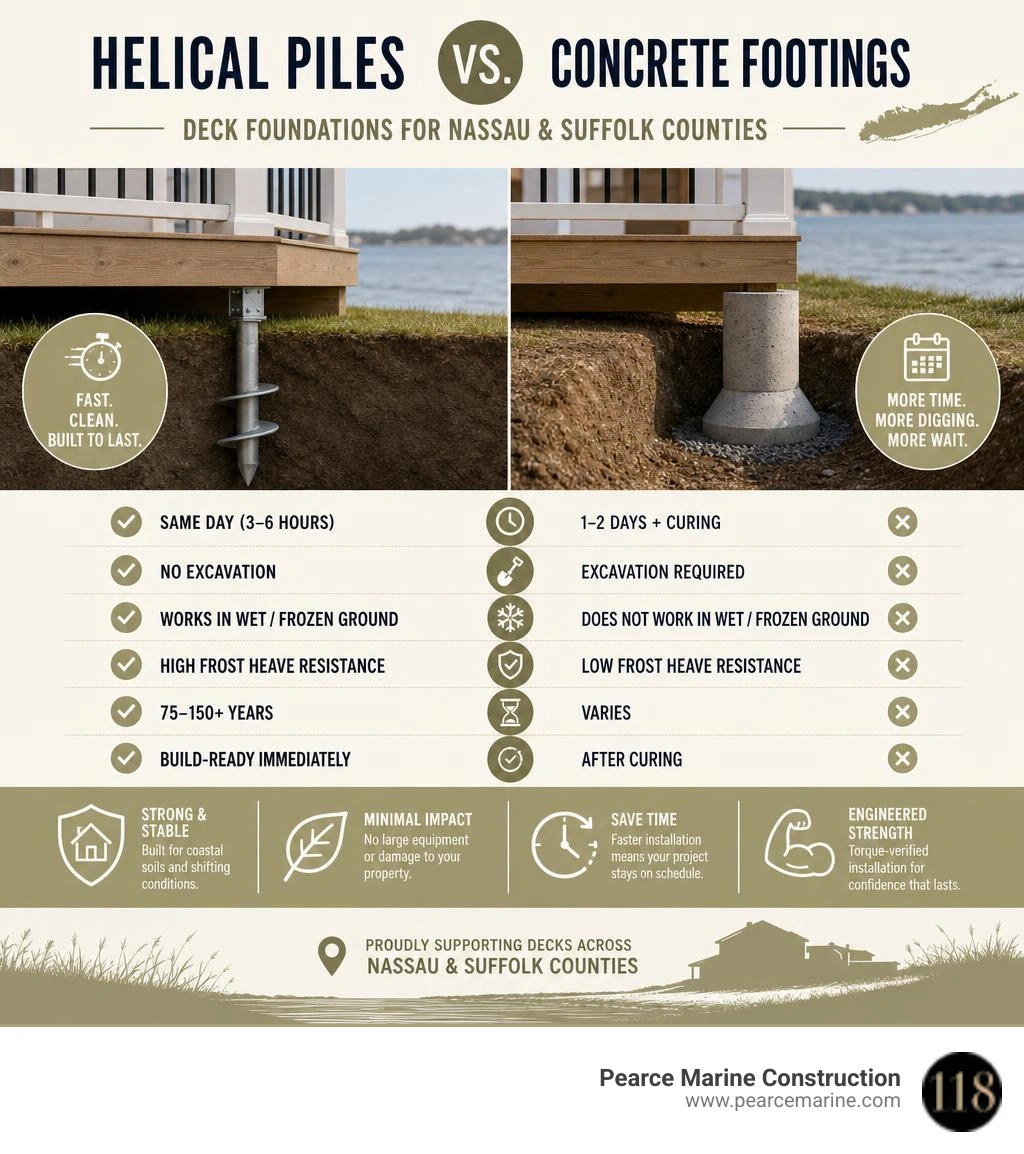
Quick comparison: Helical Piles vs. Concrete Footings for Marine Decks
| Feature | Helical Piles | Concrete Footings |
|---|---|---|
| Installation time | Same day (3-6 hours) | 1-2 days + curing |
| Excavation required | No | Yes |
| Works in wet/tidal zones | Yes | No |
| Frost heave resistance | High | Low |
| Lifespan | 75-150+ years | Varies |
| Build-ready after install | Immediately | After curing |
When executing a waterfront deck or boardwalk project along Long Island's coastlines, selecting the correct marine foundation is paramount. Traditional concrete footings are highly susceptible to failure in tidal zones, whereas helical piles provide a torque-verified, engineered foundation that eliminates the risk of settling.
For marine properties along Long Island's South Shore, where sandy soil shifts constantly with the tides and seasonal frost heave poses a structural threat, professional helical pile installation is the most reliable method to secure heavy waterfront structures.
Professional marine construction resources:
Why Helical Piles for Decks Outperform Concrete Footings in Marine Environments
When engineering a custom waterfront deck or boardwalk in coastal communities like Babylon, Merrick, or Huntington, the foundation is the single most critical structural element. Historically, poured concrete piers were used, but modern marine engineering has proven that helical piles for decks offer vastly superior performance in challenging coastal environments.
Traditional concrete footings require extensive excavation, which is highly problematic in high-water-table areas like Wantagh and Bellmore where open holes quickly fill with water. In contrast, marine-grade helical piles require zero excavation. They are mechanically screwed directly into the ground, causing minimal disturbance to the shoreline. To explore how this technology scales from residential waterfront decks to massive marine structures, check out our Helical Piles Complete Guide.
Furthermore, concrete installation is highly weather-dependent and cannot be poured in freezing temperatures or heavy rain without risking structural failure. Helical piles can be installed year-round in any weather condition. For a closer look at how these systems compare on waterfront properties, you can read about Helical Piles for Decks .
What Are Helical Piles for Decks and How Do They Work?
At their core, helical piles (also known as screw piles or helical piers) are heavy-duty, galvanized steel shafts with spiral blades (helices) welded to the shaft, designed specifically to anchor structures in unstable soils.
During installation, specialized hydraulic machinery rotates the pile, driving it deep into the ground. As the pile spins, the helical plates pull the shaft into the soil without displacing it. Instead of relying on the weight of a massive concrete block, helical piles transfer the structural load directly to deeper, highly stable load-bearing soil strata beneath the seabed or shoreline.
Once the pile reaches the engineered depth and torque requirements, a steel cap is fitted to the top, allowing marine framing to begin immediately. There is no waiting for concrete to cure, which means our marine construction crews can start building the deck frame the very same afternoon. To understand the underlying engineering of these systems, see our Helical Pile Foundation Complete Guide.
This immediate load transfer is a massive advantage for tight construction timelines on Long Island. For more technical details on how these plates distribute structural loads, read about Revolutionizing Deck Support with Helical Piles .
Comparing Load Capacity and Lifespan in Coastal Zones
When we build waterfront decks and boardwalks in places like West Hampton and Lloyd Harbor, we design them to withstand constant exposure to moisture, salt, and shifting ground.
- Load Capacity: Even a standard helical pile can easily support 5,000 to 10,000 pounds, while heavy-duty commercial marine piles can support over 50 tons each. This high capacity makes them ideal for supporting heavy waterfront structures, multi-level decks, and docks.
- Lifespan: Poured concrete is porous; over time, saltwater penetrates the concrete, causing internal rebar to rust and the footing to crack. Helical piles are made of heavy galvanized steel, which resists corrosion for decades. High-quality screw piles have an established service life of 75 to 150 years, even in highly corrosive marine soils.
By utilizing galvanized steel Helical Piles, we ensure your waterfront deck’s foundation will outlive the wood framing itself. For detailed case studies on long-term performance and load testing, refer to the technical paper on Helical Pile Deck Foundations .
Soil and Weather Adaptability in Coastal Environments
Long Island's coastal geography presents unique challenges. The South Shore—including Massapequa, Bayshore, and Brightwaters—is characterized by soft, sandy, and marshy soils that shift constantly with the tides. The North Shore, around Cold Spring Harbor and Huntington, often features rocky clay and steep slopes.
Traditional concrete footings struggle in these environments. In sandy soil, the sides of a dug hole will collapse before you can pour the concrete. In high-water-table areas, water fills the hole, diluting the concrete mix and weakening the foundation.
Helical piles bypass these issues entirely. They cut through soft, shifting surface sands to anchor deep into stable sublayers. They are also highly resistant to frost heave. During cold Long Island winters, the moisture in the upper soil freezes and expands, pushing upward. Because helical piles are anchored deep below the frost line and have a slim profile, the freezing topsoil simply slides up and down the steel shaft without shifting the pile.
For a localized look at how these piles perform across Nassau and Suffolk, see our Helical Piles Long Island Guide. To see how these systems perform in regional marine and residential applications, you can read more from Helical Pier Foundation Systems Long Island, NY - Helical Piles NY .
Professional Installation and Engineering on Long Island

Building a waterfront deck or marine structure on Long Island requires navigating strict local building codes, varying coastal soil conditions, and intense weather patterns. Whether we are working on a waterfront property in Southampton or a marine lot in West Islip, professional engineering and precise installation are non-negotiable.
To ensure structural integrity, every custom deck foundation we build is tailored to the specific wind loads, soil profiles, and local codes of the municipality. For details on how we manage these specialized coastal builds, check out our guide to Deck Installation Long Island.
Engineering Specifications: Depth, Spacing, and Torque
Installing helical piles is a highly scientific process. We do not simply drive them into the ground and hope for the best.
- Depth: To prevent shifting, the pile must be driven below the local frost line (typically 36 to 48 inches on Long Island) and continue until it reaches load-bearing soil. In soft coastal soils, this may require adding extension shafts to reach depths of 10 to 20 feet.
- Torque Monitoring: As the hydraulic drive head screws the pile down, we monitor the rotational torque (the resistance of the soil). There is a direct mathematical correlation between installation torque and soil-bearing capacity. By measuring the torque, we verify exactly when the pile has reached a layer of earth capable of supporting the deck's designed weight.
- Spacing: Pile spacing depends on the deck's layout and the size of the beams. Typically, piles are spaced 8 to 12 feet apart, but structural engineering calculations dictate the exact placement to prevent any sagging or bouncing.
To learn more about the technical steps we take during this process, read our overview of Helical Piles Installation. For additional structural engineering insights regarding pile spacing and load distribution, you can refer to Helical Piles for Decks | Premium Technical Services .
Why Professional Installation of Helical Piles for Decks is Critical
While some home improvement stores sell light-duty ground anchors, true structural helical piles for decks must be installed by certified professionals using hydraulic machinery.
As a woman-owned marine construction contractor with generational expertise, Pearce Marine Construction brings meticulous craftsmanship to every project. We understand the nuances of Long Island's geology. Using compact, low-impact hydraulic machinery, we can maneuver into tight backyards in Merrick or sloped properties in Cold Spring Harbor without destroying your landscaping.
Our certified operators monitor pressure and torque in real time, providing a stamped engineering report for each pile to satisfy local building departments in Nassau and Suffolk Counties. Working with a certified team avoids structural failures, sinking decks, and code violations. To find out why working with a credentialed team is so important, see our guide on Certified Helical Pile Installers. For a closer look at regional installation standards, check out Helical Pile Installer Long Island, NY .
Cost-Effectiveness and Long-Term Value
At first glance, the material cost of galvanized steel helical piles is higher than a bag of concrete mix and a cardboard Sonotube. However, when you look at the total project cost, helical piles are incredibly cost-effective.
- Labor Savings: A traditional concrete foundation requires a crew to dig holes, haul away dirt, mix concrete, pour, and return days later once it cures. Helical piles are installed by a small crew in a single day, drastically reducing labor hours.
- No Down Time: Because framing can begin immediately, the overall construction schedule is shortened, getting our crews off your property faster so you can enjoy your outdoor space.
- Zero Remediation: There is no heavy excavation, meaning you won't have to spend thousands of dollars repairing damaged lawns, sprinkler lines, or gardens.
In the long run, the durability of galvanized steel means you will never have to worry about your deck settling, tilting, or heaving. To compare the upfront and long-term costs of these systems, read our Helical Piles Cost Guide 2026. For a deeper breakdown of the machinery and labor involved, see the Cost to Install Helical Piers.
If you are ready to build a deck that stands the test of time, contact us today to learn more about our comprehensive Marine Construction Services and how we can secure your home's shoreline structures.

%20(1).avif)

Bring Your Vision to Life
Whether you're planning a custom dock, seawall, or boat lift, our experienced team is ready to deliver high-quality marine construction tailored to your needs. Pearce Marine Construction brings craftsmanship, precision, and a deep understanding of Florida’s waterways to every project. Let us help you create a durable, beautiful solution that stands the test of time. Get in touch now for a personalized estimate!