
How to Repair Tears and Stitching on a Boat Lift Canopy

Boat Lift Canopy Repair: Address Small Failures Before They Affect the Supporting Structure
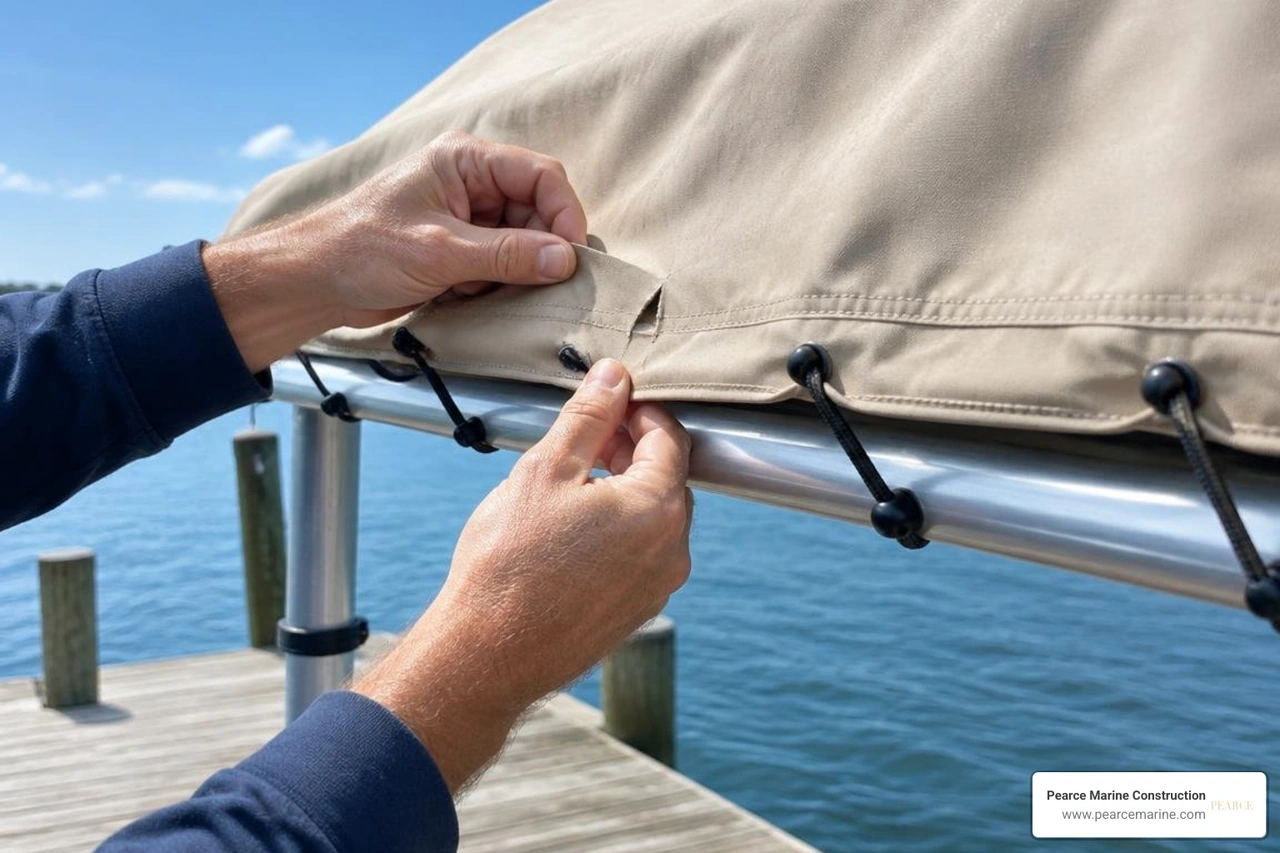
Most boat lift canopy damage begins as a localized failure, such as a split seam, a loose perimeter strap, a worn bungee, or a small tear around a fastener. Left exposed to salt spray, ultraviolet light, wind-driven rain, and repeated movement, that small defect can allow water to pool and can transfer uneven loads into the canopy frame, dock mounting points, and adjacent pile-supported structure.
For professional boat lift canopy repair, Pearce Marine Construction evaluates the full support system rather than treating the fabric as an isolated component. The assessment also considers regional storm exposure documented by the National Oceanic and Atmospheric Administration. It includes the cover material, stitched and heat-welded seams, tension straps, bungee assemblies, aluminum or galvanized frame members, fasteners, attachment tracks, and the structural connection between the lift canopy and nearby dock or pier construction. This approach helps determine whether a targeted repair can restore reliable performance or whether the canopy system needs broader restoration.
For Long Island waterfront properties, prompt evaluation is especially important after coastal storms. A professional marine contractor can assess whether the canopy experienced wind uplift, water loading, frame movement, or damage at its structural attachment points. Typical corrective work may include:
- Removing pooled water and restoring balanced canopy tension so the cover does not continue to load the frame unevenly.
- Repairing localized vinyl tears with marine-grade patch material, compatible adhesive systems, and reinforced backing where the surrounding fabric remains sound.
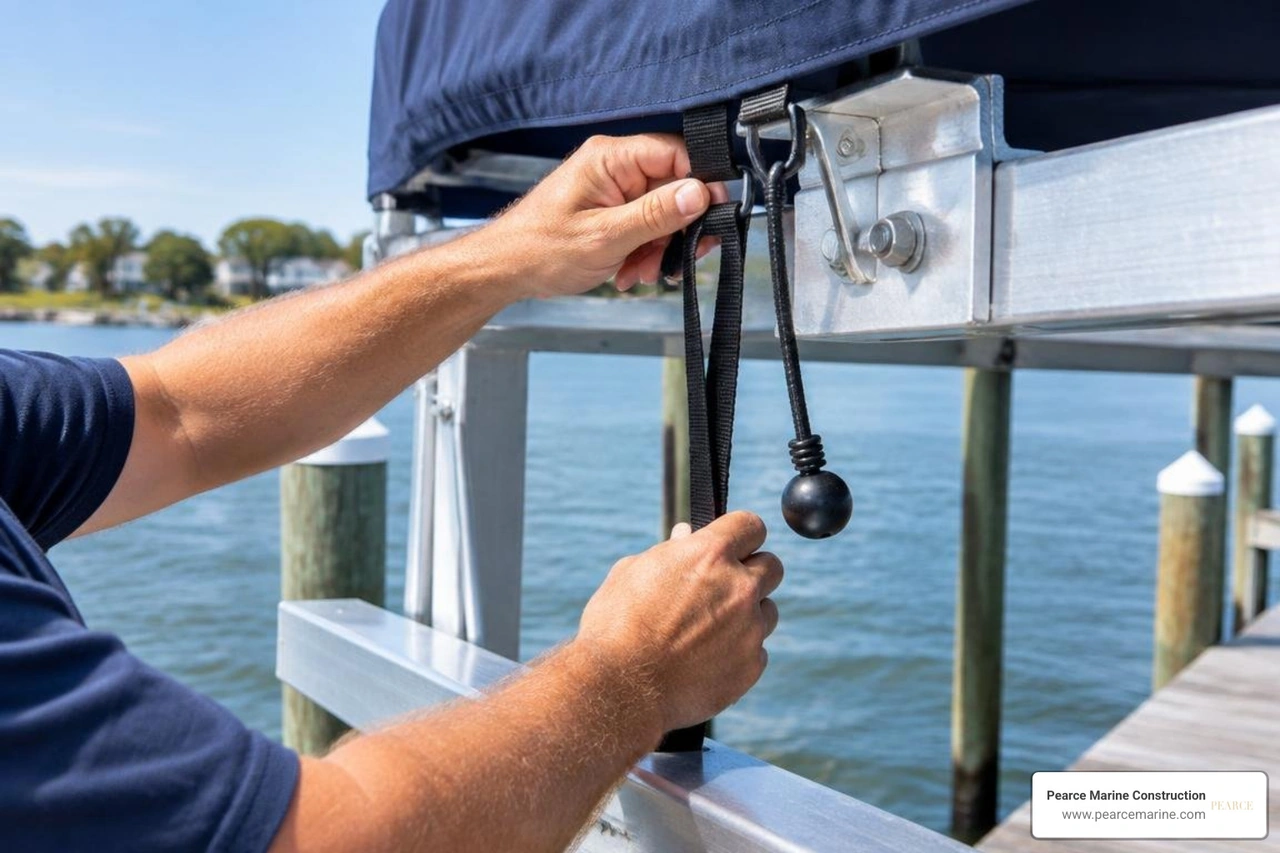
- Replacing degraded bungees, straps, fasteners, or track hardware that can no longer maintain consistent tension.
- Inspecting the overhead frame, dock connection points, and nearby pilings when wind movement, bent members, shifted anchors, or recurring leaks indicate a larger structural issue that may call for marine repair and maintenance services.
High ultraviolet exposure, wind gusts, and salt air can accelerate fabric wear and corrosion across Nassau and Suffolk County shorelines. Routine condition reviews help identify problems before a weakened canopy affects the boat lift, the dock framing, or the anchoring systems that support the broader waterfront installation. For related structural work, property owners can review marine repair and maintenance services, boat lift repair, and compatible boat hoist parts.
As a woman-owned Long Island marine construction company, Pearce Marine Construction serves residential, commercial, and public waterfront properties across Nassau and Suffolk Counties. Its team connects canopy evaluations with structural boat lift repair, properly specified boat hoist parts, dock and pier building, pile driving, and comprehensive boat dock repair, so related site conditions can be addressed as one coordinated scope.
Comprehensive Boat Lift Canopy Repair and Restoration Techniques
A canopy assembly performs reliably only when its fabric, tensioning components, overhead frame, and mounting hardware work together. Along South Shore bays and other exposed waterfronts in Nassau and Suffolk Counties, gusting winds can create repeated uplift and lateral movement. When the cover is loose or the perimeter hardware is failing, those forces can travel into frame members, dock mounting points, timber piers, and pile-supported structures.

A professional inspection considers both visible damage and the conditions that caused it. Contractors look for loosened fasteners, stretched straps, corroded hardware, distorted track systems, seam separation, fabric abrasion, and low points that collect rainwater. Correcting only the visible tear without addressing tension or frame alignment can leave the repaired area under the same concentrated load that caused the original failure. This broader approach supports sound boat lift repair decisions when canopy damage is connected to frame or dock-support conditions.
Professional Boat Lift Canopy Repair for Tears and Sagging
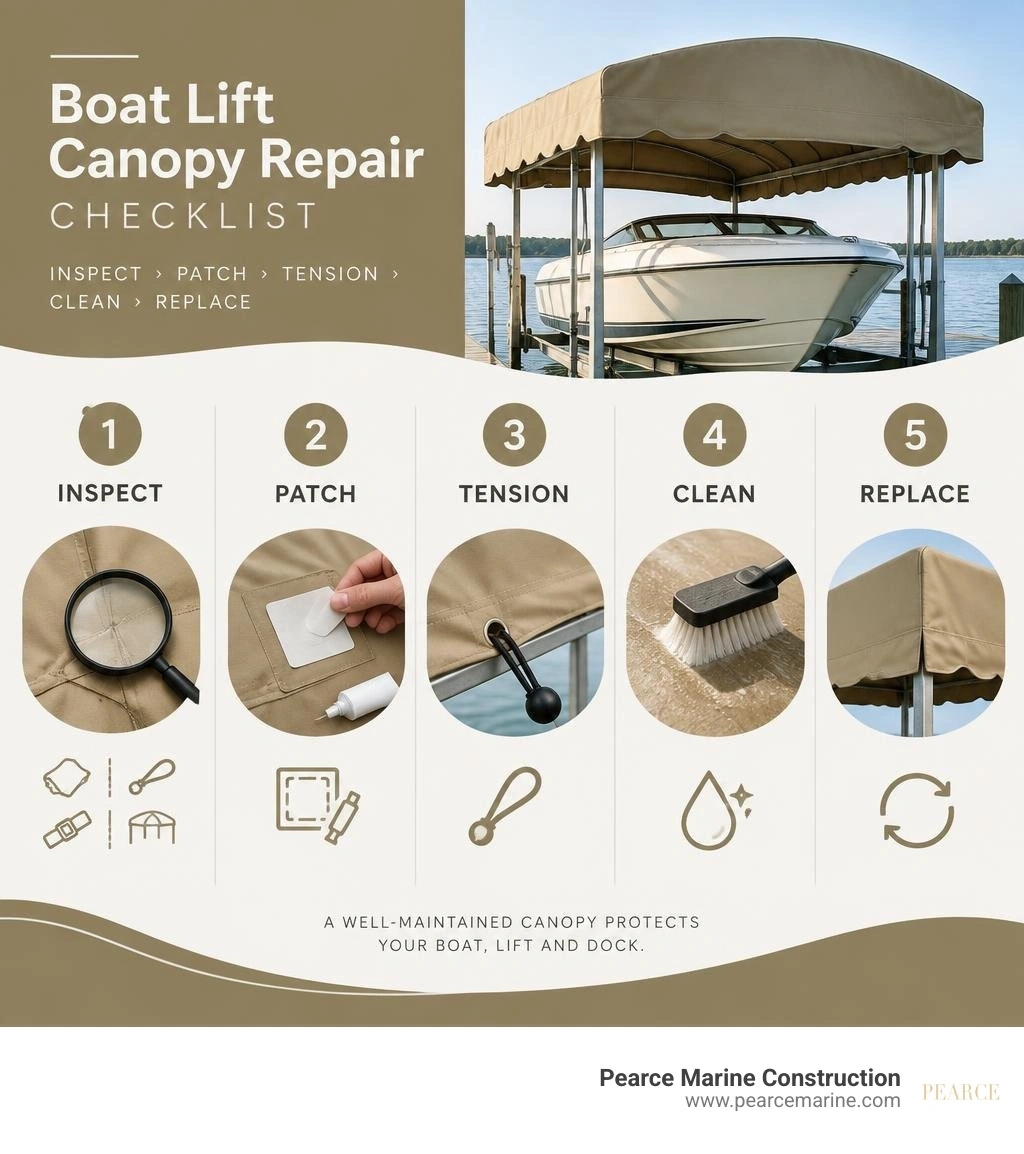
Localized fabric damage may be repairable when the surrounding material remains flexible, strong, and securely attached. The repair process is designed to rebuild the damaged area while maintaining balanced load distribution across the canopy:
- Surface preparation: Technicians remove salt residue, grime, and biological buildup, then prepare the repair area so patch material and adhesive can bond to a clean, stable surface.
- Reinforced patch installation: A marine-grade patch is shaped with rounded corners to reduce edge lifting, then bonded with compatible materials and reinforced where the tear or puncture is subject to tension.
- Seam and edge evaluation: Stitched or heat-welded seams are checked for separation, and perimeter edges are examined for stress around grommets, tracks, and attachment points.
- Tension restoration: Load straps and bungee assemblies are adjusted or replaced so the cover sheds water and does not place disproportionate force on one section of the frame.
- Hardware service: Fasteners, pins, tracks, and access components are inspected for corrosion, binding, or movement that could undermine the repair.
Frame Rust Removal, Mildew Cleaning, and Seasonal Care
Fabric performance depends on the condition of the supporting frame. Coastal moisture and airborne salt can lead to oxidation on metal components, while persistent dampness can encourage mildew on canopy material and adjacent dock surfaces. In communities such as Massapequa, Merrick, Wantagh, Bellmore, Brightwaters, and West Islip, seasonal inspection can help catch deterioration before it becomes a structural repair.

A thorough frame-restoration scope may include removal of surface oxidation, cleaning and degreasing of affected members, treatment with a marine-appropriate corrosion-control coating system, and inspection of fasteners and welded connections. The goal is not simply to improve appearance; it is to protect the structural components that hold the canopy in alignment and transfer forces into the dock or pier system.
During seasonal removal or maintenance, the cover should be fully dried and inspected for early seam separation, abrasion, or stress at attachment locations. Where a waterfront is particularly exposed, Pearce Marine can evaluate whether the canopy frame and nearby dock structure need added reinforcement, improved anchoring, or related boat hoist installation work to better manage site conditions.
Evaluating Replacement Options and Heavy-Duty Marine Fabrics
A repair is not always the best long-term solution. When canopy material is brittle, repeatedly leaking, extensively stretched, or failing at multiple seams and attachment points, continued patching can create recurring costs while leaving the supporting frame exposed to poor load distribution. A professional evaluation compares the condition of the cover with the structural requirements of the lift, dock, and waterfront exposure.
Evaluating Professional Boat Lift Canopy Repair vs Full Replacement
The decision between repair and replacement should consider the location, extent, and cause of the damage. An isolated tear in otherwise resilient vinyl may be a sound repair candidate. Widespread cracking, pervasive seam failure, recurring water pooling, or a distorted overhead frame usually calls for a broader restoration scope.
| Evaluation Metric | Repair Candidate | Replacement or Structural Restoration May Be Needed |
|---|---|---|
| Fabric condition | Isolated tear or puncture with flexible surrounding material | Brittle, chalking, cracked, stretched, or torn material in several areas |
| Seams and edges | One localized seam issue with stable adjacent stitching or welds | Repeated seam separation, edge failure, or tearing around attachment points |
| Water management | Minor low spot corrected through tension adjustment | Recurring ponding caused by stretched fabric, failed straps, or frame distortion |
| Frame condition | Frame remains aligned with limited surface corrosion | Bent members, cracked welds, loose mounts, or corroded connections affecting alignment |
| Repair history | First or infrequent localized repair | Multiple repairs in different areas with no durable improvement |
Replacement planning should address more than the cover itself. The contractor should confirm frame dimensions, connection points, hardware compatibility, canopy profile, drainage path, and whether the supporting dock or pier structure has shifted or deteriorated. Material selection and performance criteria can also be reviewed against relevant ASTM International standards where applicable. When wear affects the complete lift assembly, scheduling marine repair and maintenance services helps coordinate canopy work with the condition of the surrounding waterfront infrastructure. Property owners can also review the boat lift canopy installation guide for related installation considerations.
Heavy-Duty Marine Fabrics, Frame Measuring, and Long Island Waterfront Care
Replacement covers must match the existing frame accurately and be suited to the property’s wind, salt, sun, and water exposure. Before ordering or fabricating a replacement, a contractor documents the dimensions and structural details that affect fit and tension:
- Inside width: The clear distance between the inside faces of the load-bearing side frame members.
- Overall frame length: The exterior length of the canopy frame and the position of end supports.
- Peak and valance profile: The frame shape, ridge height, and side drop needed to shed water and protect the covered area.
- Attachment layout: The location and type of tracks, straps, bungees, fasteners, and tensioning hardware.
- Site exposure: The degree of wind, salt spray, sunlight, and storm-driven rain expected at the property.
| Fabric Type | Typical Characteristics | Key Strengths | Best Fit |
|---|---|---|---|
| Heavy-duty marine vinyl | Thick, coated material with reinforced seams | Strong water resistance, abrasion resistance, and dependable performance in exposed conditions | Open-water and high-wind waterfronts |
| Lighter marine vinyl | Reduced weight for easier handling | Practical protection where exposure is more moderate | Sheltered canals and protected inlets |
| Solution-dyed woven marine fabric | Breathable fabric with color stability | Useful where ventilation and appearance are priorities | Covered or lower-exposure waterfront settings where the frame and drainage plan are appropriate |
Shoreline conditions vary widely across Nassau and Suffolk Counties, from more protected North Shore harbors to exposed South Shore waterfronts. Pearce Marine Construction brings local knowledge of pile driving, dock and pier building, custom decking, bulkhead construction and repair, seawalls, and anchoring systems for marine structures to each evaluation. That broader structural perspective helps ensure canopy work supports, rather than compromises, the long-term stability of the waterfront installation. Explore Long Island boat lift solutions for related infrastructure planning.


Bring Your Vision to Life
Whether you're planning a custom dock, seawall, or boat lift, our experienced team is ready to deliver high-quality marine construction tailored to your needs. Pearce Marine Construction brings craftsmanship, precision, and a deep understanding of Florida’s waterways to every project. Let us help you create a durable, beautiful solution that stands the test of time. Get in touch now for a personalized estimate!