
The Complete Guide to Boat Lift and Dock Installation


Why Proper Boat Hoist Installation Protects Your Vessel and Your Dock
Boat hoist installation is one of the most structurally demanding projects a waterfront property owner can undertake — and getting it wrong can mean hull damage, dock failure, or a lift that won't last a single season.
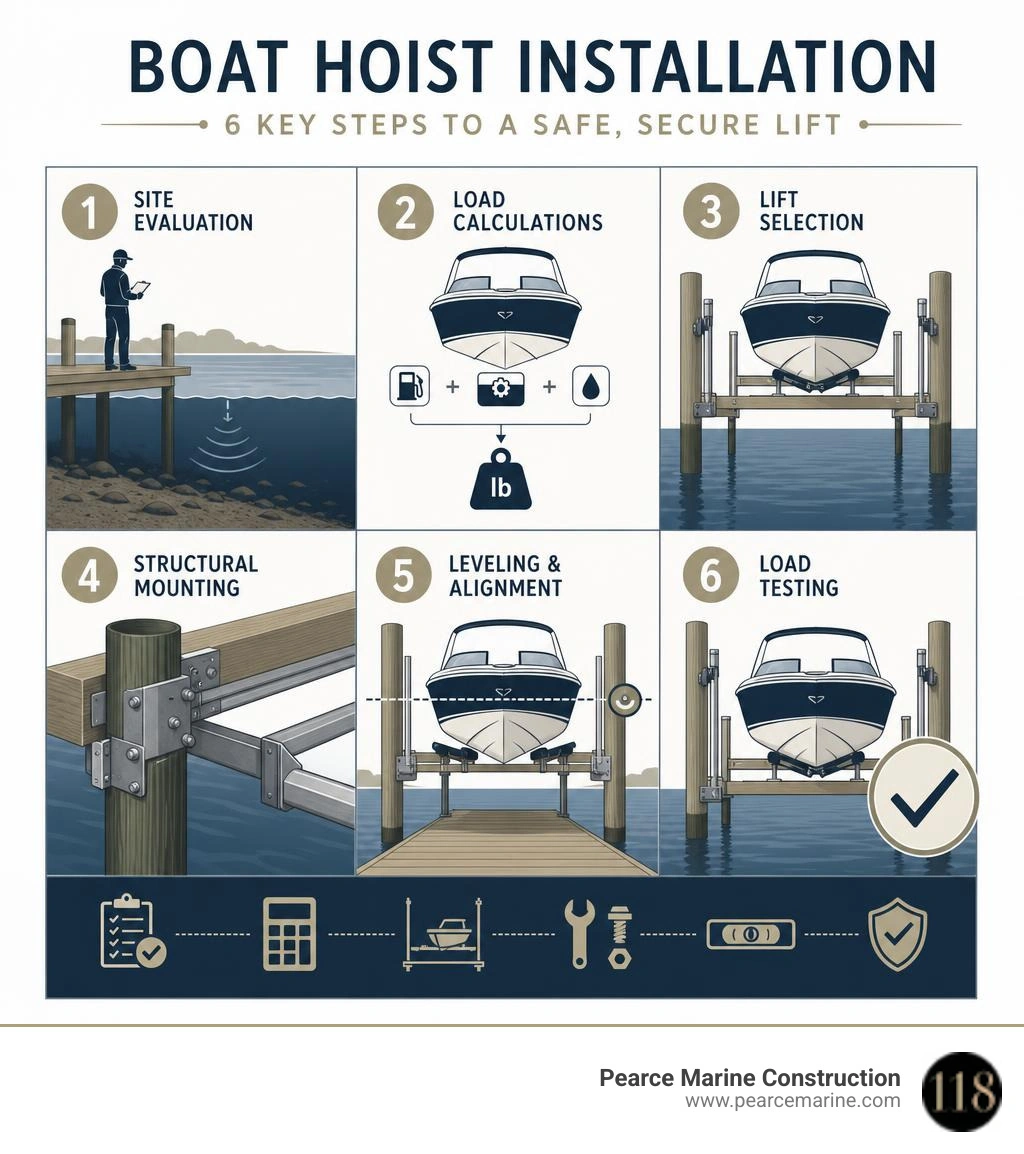
Our professional boat hoist installation process involves:
- Site evaluation — water depth, seabed type, tidal range, and slip dimensions
- Load calculations — total vessel weight including fuel, gear, and water
- Lift selection — matching lift type and capacity to your boat and dock configuration
- Structural integration — anchoring the lift to pilings or dock framing using marine-grade hardware
- Leveling and alignment — setting bunks, stabilizer arms, and control systems correctly
- Load testing — verifying safe, level operation before regular use
Every step depends on the one before it. A lift sized correctly but mounted to an undersized piling system will still fail. A well-anchored lift with poorly placed bunks can damage a hull over time.
Improper installation can cause premature mechanical wear, hull damage, and dangerous dock instability — which is why professional installation by an experienced marine contractor is strongly recommended, especially in the demanding tidal and weather conditions found across Nassau and Suffolk Counties on Long Island.
This overview details the professional installation process executed by Pearce Marine Construction — from site engineering and structural integration through final load testing — ensuring your marine infrastructure is built to last.
Boat hoist installation helpful reading:
Professional Boat Hoist Installation and Site Engineering
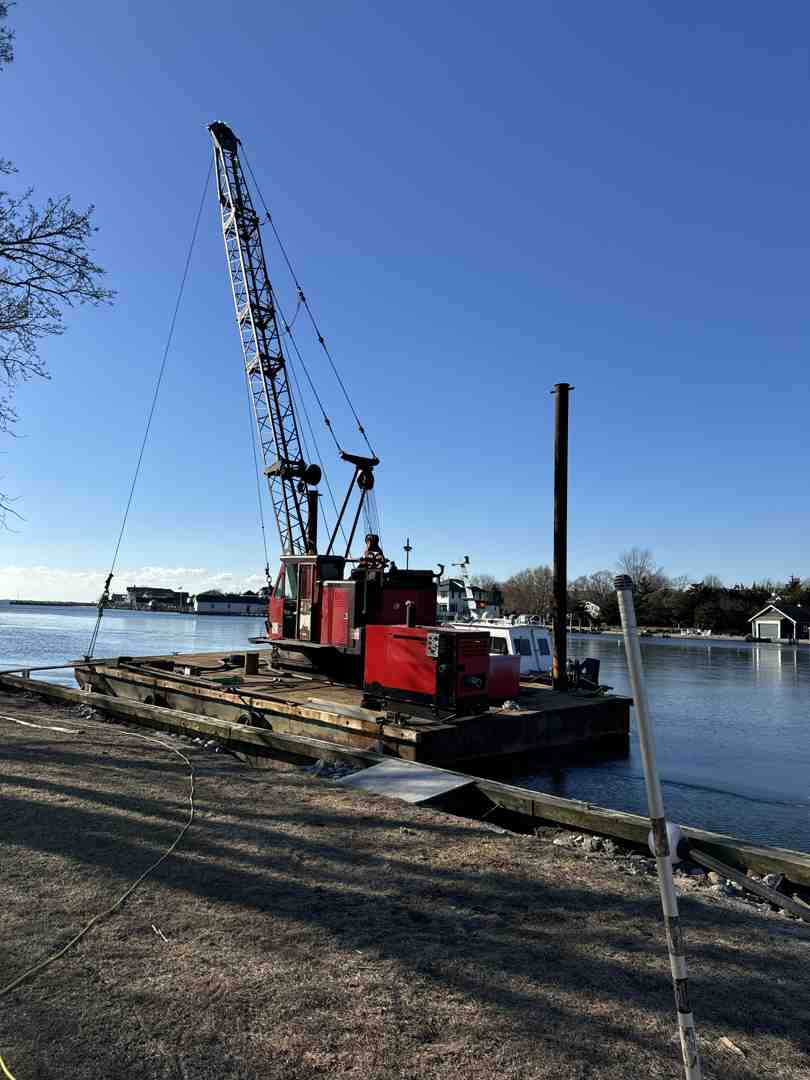
A boat lift is not a standalone appliance; it is an engineered extension of your shoreline infrastructure. When we execute a professional boat hoist installation, our team approaches the project with a focus on marine engineering and structural durability. This process begins long before any hardware is lowered into the water.
Our engineering team conducts a thorough site assessment and geotechnical evaluation. We analyze local wave action, prevailing wind loads, and the structural integrity of your existing dock. Because a lift concentrates thousands of pounds of vertical and lateral force into a highly localized area, we must ensure that the surrounding marine structures can handle these loads without settling or shifting. To explore how these systems tie into broader waterfront infrastructure, read More info about marine construction services.
Evaluating Marine Site Conditions in Nassau and Suffolk Counties
The marine environments of Long Island’s North and South Shores present vastly different engineering challenges. In South Shore communities like Massapequa, Wantagh, Bellmore, West Islip, and Babylon, we primarily contend with shallow canals, thick organic silt (muck) seabeds, and significant tidal fluctuations. Conversely, North Shore areas like Cold Spring Harbor, Huntington, and Lloyd Harbor feature rocky bottoms and steeper drop-offs.
Evaluating the seabed composition is critical. In soft mud or silt, standard gravity-based or shallow-water lifts can settle unevenly if not properly supported. For these shallow environments, we design and install systems engineered to operate within tight vertical tolerances. You can review the Scientific research on shallow water lift engineering to see how specialized low-profile tanks operate in as little as 21 inches of water plus hull draft.
To prevent seasonal shifting, the foundation must be anchored deep into the load-bearing strata of the seabed. To learn how we establish these deep foundations, Learn more about dock piling installation.
Selecting the Right Boat Hoist Installation Capacity and Configuration
Selecting the proper lift capacity requires precise mathematical calculations. A common and costly industry mistake is relying solely on a manufacturer's dry weight specification. When we calculate the total lifting load, we use the following formula:
$$\text{Total Lifting Load} = \text{Vessel Dry Weight} + \text{Fuel Weight} + \text{Freshwater/Waste Weight} + \text{Gear, Engines, and T-Tops} + \text{10\% Safety Margin}$$
To ensure accuracy, we calculate fuel weight at 6.6 lbs per gallon and water weight at 7.5 lbs per gallon. Additionally, we measure the vessel’s beam width (allowing a 4-to-10-inch cushion on each side for guidepost clearance) and the hull draft to ensure the lift can lower sufficiently in low-tide conditions.
| Boat Type | Typical Weight Range (Fully Loaded) | Recommended Lift Capacity | Minimum Water Depth Required |
|---|---|---|---|
| Center Console (21-25') | 5,000 – 8,500 lbs | 10,000 lbs | Draft + 24 Inches |
| Express Cruiser (28-32') | 10,000 – 14,000 lbs | 16,000 lbs | Draft + 32 Inches |
| Large Sportfisherman | 18,000 – 28,000 lbs | 30,000+ lbs (4-Piling / 8-Piling) | Draft + 38 Inches |
To understand how dock layouts are designed to accommodate these heavy-duty lift configurations, Read our complete guide to boat dock construction.
Structural Integration with Docks and Marine Piling Systems
For pile-mounted cable or hydraulic lifts, the lift mechanism is only as strong as the pilings supporting it. We calculate the required piling capacity based on the total weight of the lift and vessel, factoring in lateral loads from windage and currents. In heavy-exposure areas like West Hampton and Southampton, we drive heavy-use timber or steel pilings deep into the seabed using specialized pile-driving rigs to resist both compression and uplift forces.
The lift's structural brackets must distribute loads evenly across the piling cluster to prevent twisting or localized dock stress. We construct our structural frames using marine-grade 6061-T6 aluminum and secure all connections with 316 stainless steel fasteners to resist the highly corrosive saltwater environment of Long Island's bays. To understand the mechanics of deep-foundation anchoring, Discover professional pile driving services.
Construction Methodologies for Fixed and Floating Boat Lifts
Choosing between a fixed, pile-mounted lift and a floating pneumatic lift depends on your specific dock structure and waterfront exposure. Fixed lifts are ideal for high-traffic areas and deep-water slips where heavy-duty pilings can be driven. Floating lifts, which utilize heavy-duty polyethylene marine tanks, excel in deep-water marinas or areas with significant tidal swings because they rise and fall naturally with the water level. To see how these systems integrate with different dock types, Explore our boat docks and floating docks services.
Professional Installation Protocols for Standing and Hydraulic Systems
Our professional installation methodology for standing, pneumatic, and hydraulic systems follows strict engineering protocols to ensure absolute structural alignment:
- Substructure Pre-Assembly: We assemble the primary structural channels, end channels, and keel spanners on a flat, dry staging area. Fasteners are left hand-tight to allow for final squaring once the structure is in the water.
- Torque Application: Once the frame is squared, we torque all structural bolts to exact engineering specifications using calibrated click-style torque wrenches. For instance, standard 1/2-13 bolts are torqued to 39–40 ft-lbs, while heavy-duty 5/8-11 structural bolts are torqued to 83 ft-lbs to prevent loosening under dynamic wave action. For detailed engineering specifications on fastener torque and tank spacing, refer to this Technical guide on lift assembly and torque values.
- Stabilizer Arm and Torsion Bar Alignment: For pneumatic and hydraulic lifts, we install parallel stabilizer arms and torsion bars. The torsion bar clamps must be tightened to approximately 40 ft-lbs to ensure that the arms remain perfectly parallel, which prevents the lift from tipping or binding during operation.
- Bunk and Pad Positioning: We position the hull support pads or wood bunks to match the deadrise angle of the vessel's hull, ensuring they support the boat's weight along its structural stringers.
To read more about how our custom marine carpentry and structural framing align with these mechanical installations, Read our dock builder complete guide.
Rigging, Leveling, and Securing the Lift Structure
Once the pre-assembled frame is floated or craned into the slip, we secure it using heavy-duty, adjustable piling brackets or dock brackets. The lift must be perfectly level within a tolerance of 3 inches across all four corners when fully raised.
To prevent the lift from lowering beyond safe limits, we install heavy-duty, equal-length stainless steel catch chains. We position the marine-grade control box in an easily accessible location and route all hydraulic lines or air hoses through protective conduit to prevent chafing.
Electrical safety is paramount in saltwater construction. We route all 115V or 230V power lines through an integrated Ground Fault Circuit Interrupter (GFCI) device. Disabling or bypassing this safety system is a critical hazard that violates federal safety standards. To learn more about the structural and safety engineering behind these installations, Learn more about marine structures design.
Post-Installation Load Testing and Marine Construction Excellence
At Pearce Marine Construction, we do not consider a project complete when the last bolt is tightened. Serving waterfront communities across Nassau and Suffolk Counties—including Brightwaters, Bayshore, and Southampton—we deliver meticulous craftsmanship designed to outlast the harshest winter nor'easters. Unlike mass-volume operations, our woman-owned firm treats every boat hoist installation as a custom engineering project.
Before handing over the system, we perform rigorous post-installation testing:
- Dry Run Testing: We cycle the lift completely up and down without a load to verify there is no binding, hose pinching, or structural interference.
- Controlled Load Testing: We float the vessel onto the lift and perform a slow, staged lift to monitor bunk alignment, ensuring the hull makes contact evenly without shifting.
- Leveling Verification: We measure the frame's deflection under load to ensure it remains within the 3-inch leveling tolerance.
- Bunk and Guidepost Fine-Tuning: We make final underwater adjustments to the bunks to ensure the vessel's weight rests securely on its structural stringers.
If you are ready to secure your vessel with a structurally engineered, professionally installed boat lift, Contact a marine contractor near me to schedule a structural site assessment with our team.



Bring Your Vision to Life
Whether you're planning a custom dock, seawall, or boat lift, our experienced team is ready to deliver high-quality marine construction tailored to your needs. Pearce Marine Construction brings craftsmanship, precision, and a deep understanding of Florida’s waterways to every project. Let us help you create a durable, beautiful solution that stands the test of time. Get in touch now for a personalized estimate!