
Designing Marine Barriers to Withstand Coastal Tides and Heavy Waves

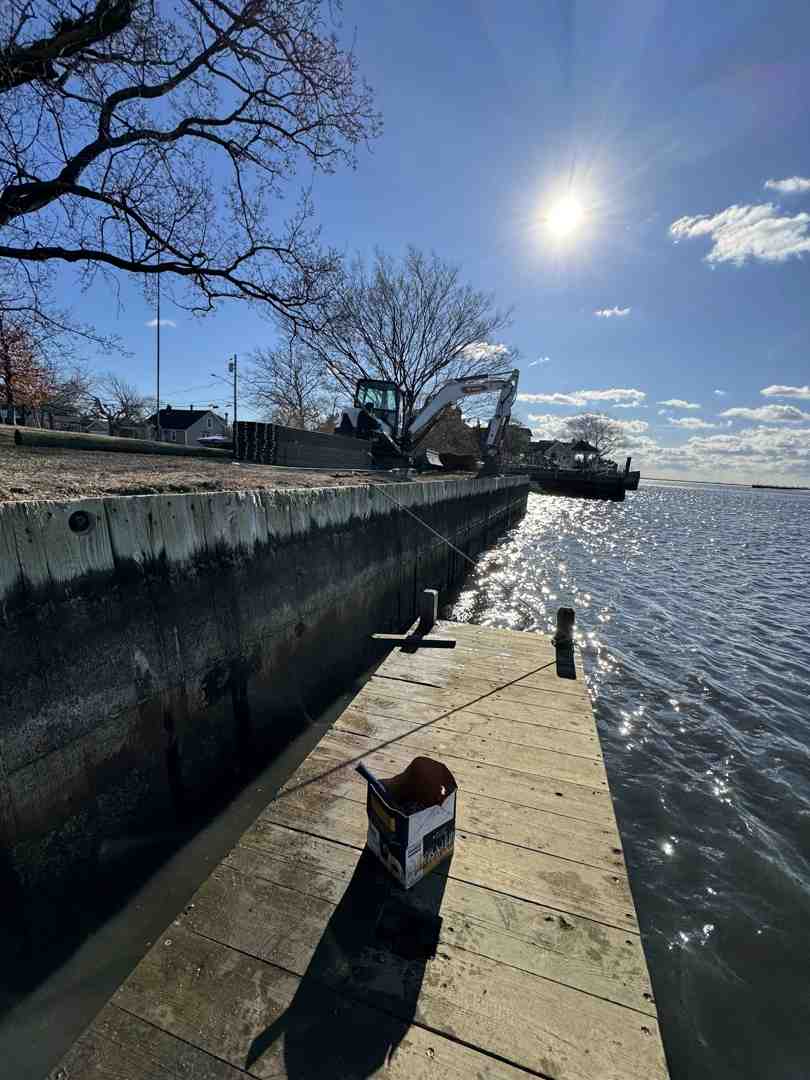
How Sea Wall Construction Design Handles Tides and Waves
Start with the water conditions, not the wall material. A sea wall construction design should account for wave height and timing, tides, storm surge, and future sea level rise. Those conditions guide the wall's height and shape. The design must also protect the base from scour and limit water washing over the top.
On shorelines in Nassau and Suffolk Counties on Long Island, NY, exposure can change from one property to the next. Pearce Marine Construction is a woman-owned marine construction company serving residential, commercial, and public clients in Nassau and Suffolk Counties on Long Island, NY. This guide explains what goes into a barrier built for its site.

Developing an effective shoreline barrier requires evaluating different types of seawalls, selecting site-appropriate seawall construction materials, and analyzing the overall cost of building a seawall based on site exposure.
Introduction: Hydrodynamic Forces and Coastal Boundary Conditions
Designing a marine barrier requires calculating the physical forces the ocean exerts against the shoreline. Water is heavy—weighing roughly 64 pounds per cubic foot in marine environments—and when propelled by high-energy winds, it produces dynamic impact pressures that can shatter under-engineered structures.
To determine the structural capacity required for a barrier, marine engineers analyze primary hydrodynamic design variables:
- Significant Wave Height and Peak Period: The average height of the highest one-third of waves and the time interval between wave crests.
- Astronomical Tides: The predictable rise and fall of coastal waters driven by gravitational cycles.
- Storm Surge: Wind-driven water piles pushed ashore during severe weather events.
- Local Bathymetry: The underwater depth profile that dictates shallow-water wave breaking mechanics.
- Projected Sea Level Trends: Water elevation allowances mapped over a 50-year economic structure life.
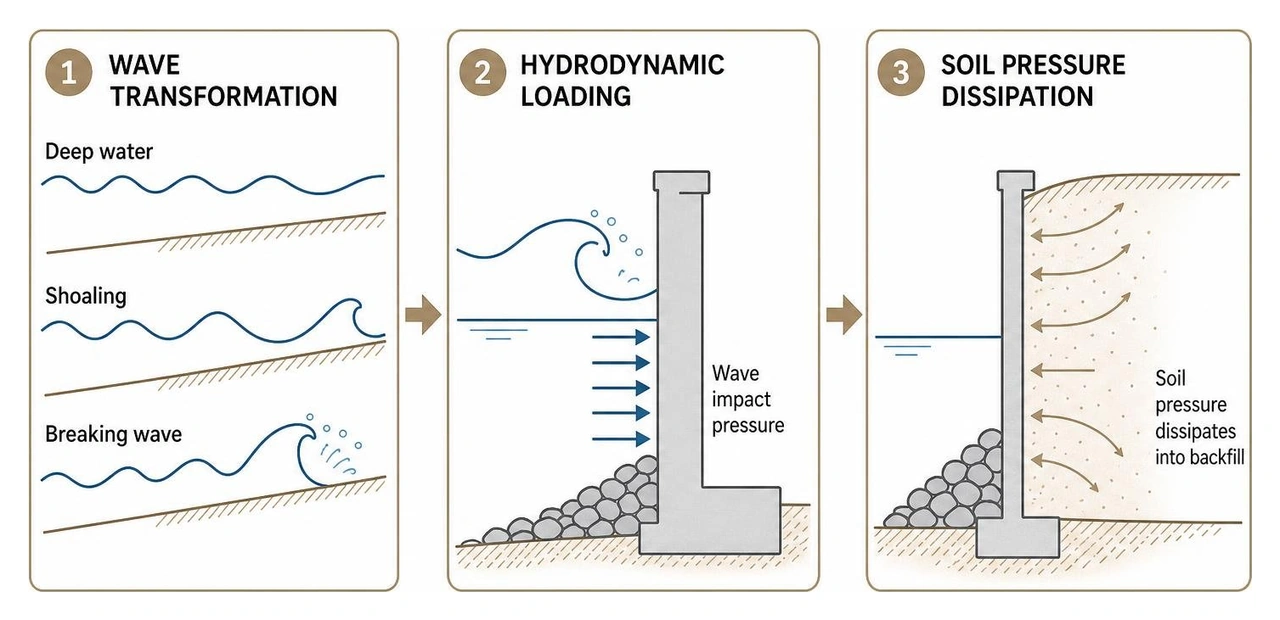
When waves transition from deep water into shallow coastal shelves, the seabed forces wave crests to steepen until they break. Cross-shore numerical modeling simulates these transformations, mapping how breaking waves convert kinetic energy into hydraulic loads against a structure.
Wave Runup, Overtopping Thresholds, and Crest Elevation
Wave runup describes the maximum vertical height water reaches as a wave rushes up the face of a marine barrier. If this runup exceeds the barrier's crest freeboard (the distance between the design water level and the top of the wall), overtopping occurs.
Engineers evaluate the surf similarity parameter—the relationship between the barrier slope and wave steepness—to select from various types of seawalls. A vertical, smooth barrier reflects incoming wave energy directly, resulting in significant vertical runup. Conversely, incorporating revetment slopes with rough armor stone introduces a roughness reduction factor and berm dissipation. This friction disrupts the incoming wave train, reducing overtopping discharge rates to manageable safety margins.
Joint Probability Analysis for Storm Surge and Sea Level Rise
High water levels rarely happen in isolation. A joint probability distribution calculates the statistical likelihood of peak astronomical high tides occurring simultaneously with maximum meteorological storm surge.
For long-term coastal stability, we evaluate 100-year return period water levels alongside Rayleigh distribution wave height limits. As detailed in the classic Seawalls, Bulkheads and Quaywalls Design Manual, evaluating hydrodynamic boundary scenarios prevents catastrophic wall failure by establishing the absolute minimum crest elevations and tieback anchor loads needed for storm resistance.
Core Principles of Sea Wall Construction Design and Armoring
Every marine barrier falls into a structural rigidity classification based on how it manages hydraulic energy, allowable structural displacement, and lateral soil pressures:
| Barrier Classification | Primary Structural Mechanics | Energy Dissipation Method | Typical Applications |
|---|---|---|---|
| Rigid Structures (Reinforced Concrete Gravity Walls) | Massive self-weight resists sliding and overturning moments | Direct reflection and vertical wave deflection | High-energy commercial ports and deep-water shorelines |
| Semi-Rigid Structures (Anchored Sheet-Pile Bulkheads) | Embedded toe depth and deadman tieback anchoring systems | Structural flexure and partial energy reflection | Residential canals, sheltered bays, and marinas |
| Flexible Structures (Rubble-Mound Revetments) | Interlocking heavy armor stone over engineered filter layers | Internal void friction and wave breaking dissipation | Open-water shorelines exposed to continuous wave action |

Selecting appropriate seawall construction materials dictates how the barrier handles failure mode mechanics like structural shear, rotational tipping, and foundation settlement.
Structural Classification and Sea Wall Construction Design Methods
Modern marine barriers use distinct structural methods to balance earth retention with water forces:
- Semi-Rigid Gravity and Cantilever Bulkheads: Vertical vinyl, composite, or steel sheet piling driven deep into the seabed. In residential seawall construction, these barriers rely on horizontal walers and steel tieback rods secured to buried concrete anchor blocks.
- Flexible Rubble Mounds: Sloped rock barriers that achieve dynamic equilibrium, allowing individual stones to settle naturally under heavy seas without structural collapse.
- Hybrid Composite Walls: Sheet-pile barriers paired with front-facing stone riprap aprons to reduce wave transmission coefficients and relieve hydrostatic tidal lag behind the wall.
Armor Sizing Equations and Hydrodynamic Stability Numbers
For sloped rock revetments and riprap toe protection, stone size cannot be left to guesswork. Coastal engineers use the Van der Meer and Hudson formulations to determine stable rock sizing based on critical wave height, stone density, and structural slope angles.
These calculations establish the stability number limit—the threshold where water velocity overcomes gravity and dislodges stone. Following standard seawall engineering sections, marine contractors place dense, angular quarry-graded stone in tightly interlocked, multi-layer configurations. The angular facets lock together, creating a stable surface that withstands high-velocity currents.
Engineering Resilient Shorelines Against Scour and Foundation Failure
More marine barriers fail from foundation undermining than direct wave impact. When a wave hits a vertical wall, the reflected downward wave energy drives high-velocity currents straight down to the base. This process, known as hydrodynamic toe shear, erodes the seabed and removes supporting soil.
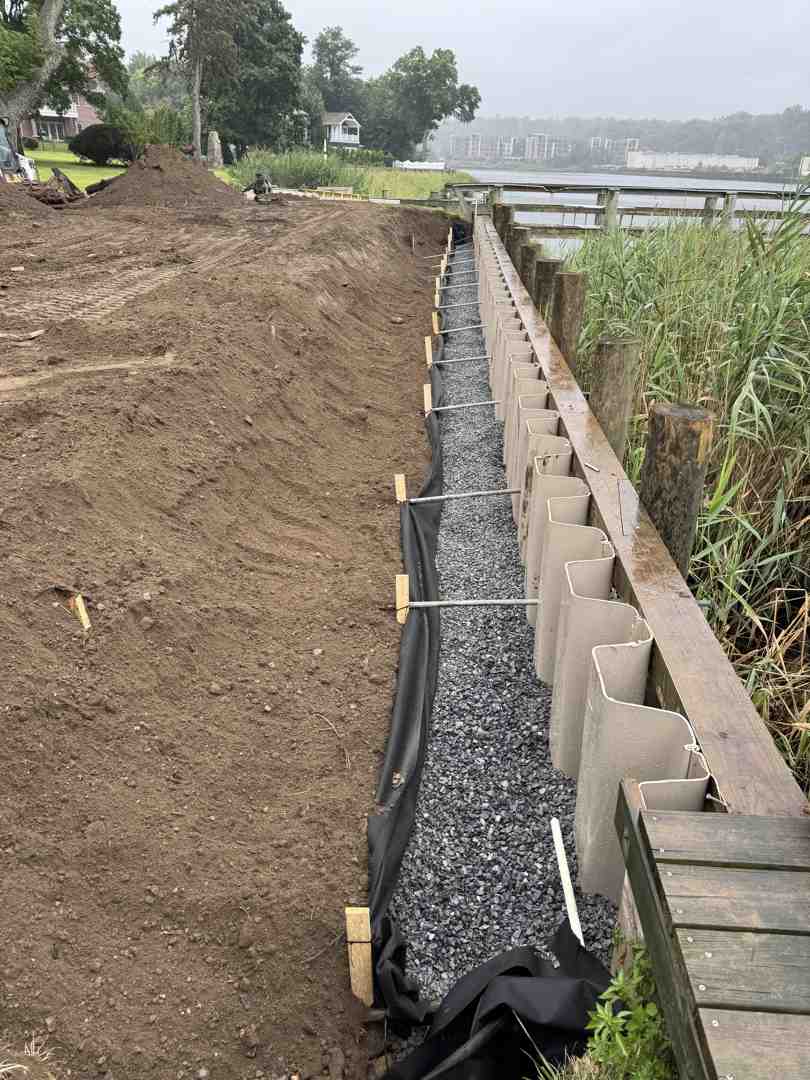
Without non-erodible foundation bedding, toe scour removes passive earth resistance at the base of sheet piling, causing the entire barrier to kick out at the bottom. Timely seawall erosion repair reinforces compromised bases before structural integrity is lost.
Implementing Sea Wall Construction Design for Toe Scour and Granular Filters
Preventing base erosion and sinkholes requires a two-part defense system:
- Engineered Toe Aprons: Placing heavy armor stone over a gravel bed at the mudline extends the scour footprint away from the barrier footing, breaking downward wave energy.
- Geotextile and Granular Filter Layers: Marine-grade woven geotextile fabric with high tensile strength is placed behind sheet piles and under riprap. This fabric provides hydraulic permeability to relieve hydrostatic pressure while blocking fine sand from washing out through joints and weep holes.
Engineering Waterfront Protection for Nassau and Suffolk County
Long Island’s shoreline features complex marine microclimates. Across Nassau and Suffolk Counties, waterfront installations face diverse environmental challenges:
- Open Ocean and Bay Exposure: Properties along Westhampton and Southampton experience open-water wave trains and significant tidal ranges that require heavy-gauge vinyl sheet piling, deep deadman anchoring systems, and heavy rock toe aprons.
- Tidal Canal Networks: Communities such as Massapequa, Merrick, Wantagh, Bellmore, West Islip, Brightwaters, Babylon, and Bayshore require durable bulkheads engineered to handle rapid hydrostatic tidal lag and vessel wakes.
- North Shore Bluffs and Harbors: Shorelines in Cold Spring Harbor, Huntington, and Lloyd Harbor contend with steep embankment pressures and fluctuating tidal currents demanding heavy-duty retaining systems.
Pearce Marine Construction is a woman-owned marine construction company serving residential, commercial, and public clients in Nassau and Suffolk Counties on Long Island, NY. With deep local expertise and superior craftsmanship, Pearce Marine delivers heavy-duty protection across every coastal build. Protect your shoreline investment with custom seawalls and bulkheads designed for multi-decade durability. Contact our team today to evaluate your waterfront infrastructure.



Bring Your Vision to Life
Whether you're planning a custom dock, seawall, or boat lift, our experienced team is ready to deliver high-quality marine construction tailored to your needs. Pearce Marine Construction brings craftsmanship, precision, and a deep understanding of Long Island's waterways to every project. Let us help you create a durable, beautiful solution that stands the test of time. Get in touch now for a personalized estimate!