
Don't Let Your Beach Wash Away: A Guide to Coastal Protection Engineering

Why Coastal Protection Engineering Is Critical for Long Island Property Owners
At Pearce Marine Construction, our professional coastal protection engineering services are designed to protect your waterfront property from severe erosion, wave damage, and tidal flooding. We specialize in the custom design, heavy-duty installation, and structural maintenance of marine infrastructure—including bulkheads, seawalls, and piers—across Nassau and Suffolk Counties.
If you are a Long Island property owner looking to secure your shoreline, our marine construction team provides the exact structural solutions you need:
| Your Shoreline Challenge | Pearce Marine Construction Engineering Solution |
|---|---|
| Severe shoreline erosion | Heavy-duty bulkhead and seawall construction |
| Compromised foundation stability | Deep pile driving and structural anchoring |
| Storm surge and wave impact | Heavy-duty wave-resistant marine structures |
| Damaged or failing infrastructure | Professional bulkhead repair and seawall restoration |
| Long-term shoreline stability | Custom-engineered solutions built to local site conditions |
With Nassau and Suffolk County properties sitting directly in the path of Atlantic storms and intense tidal forces, professional marine construction is essential. Wave action undermines foundations and buckles poorly built bulkheads, turning valuable waterfront properties into liabilities.
Pearce Marine Construction delivers engineered solutions to stop this damage. Our team utilizes advanced techniques and premium materials to build structures that withstand the harshest coastal environments.
This guide details our professional marine construction processes, the heavy-duty materials we install, and how our engineering solutions are tailored to Long Island's specific coastal conditions.
Our specialized marine construction services include:
- Coastal infrastructure development
- Managing the cost of building a seawall through efficient engineering
- Selecting high-performance seawall construction materials
The Science of Coastal Protection Engineering: Structural Solutions for Long Island Shorelines
Protecting a waterfront property requires advanced engineering and heavy-duty construction. Shorelines are highly dynamic systems governed by relentless hydrodynamic forces. To build marine structures that stand the test of time, Pearce Marine Construction utilizes established scientific principles and rigorous design methodologies, such as those detailed in the classic SHORE PROTECTION MANUAL.
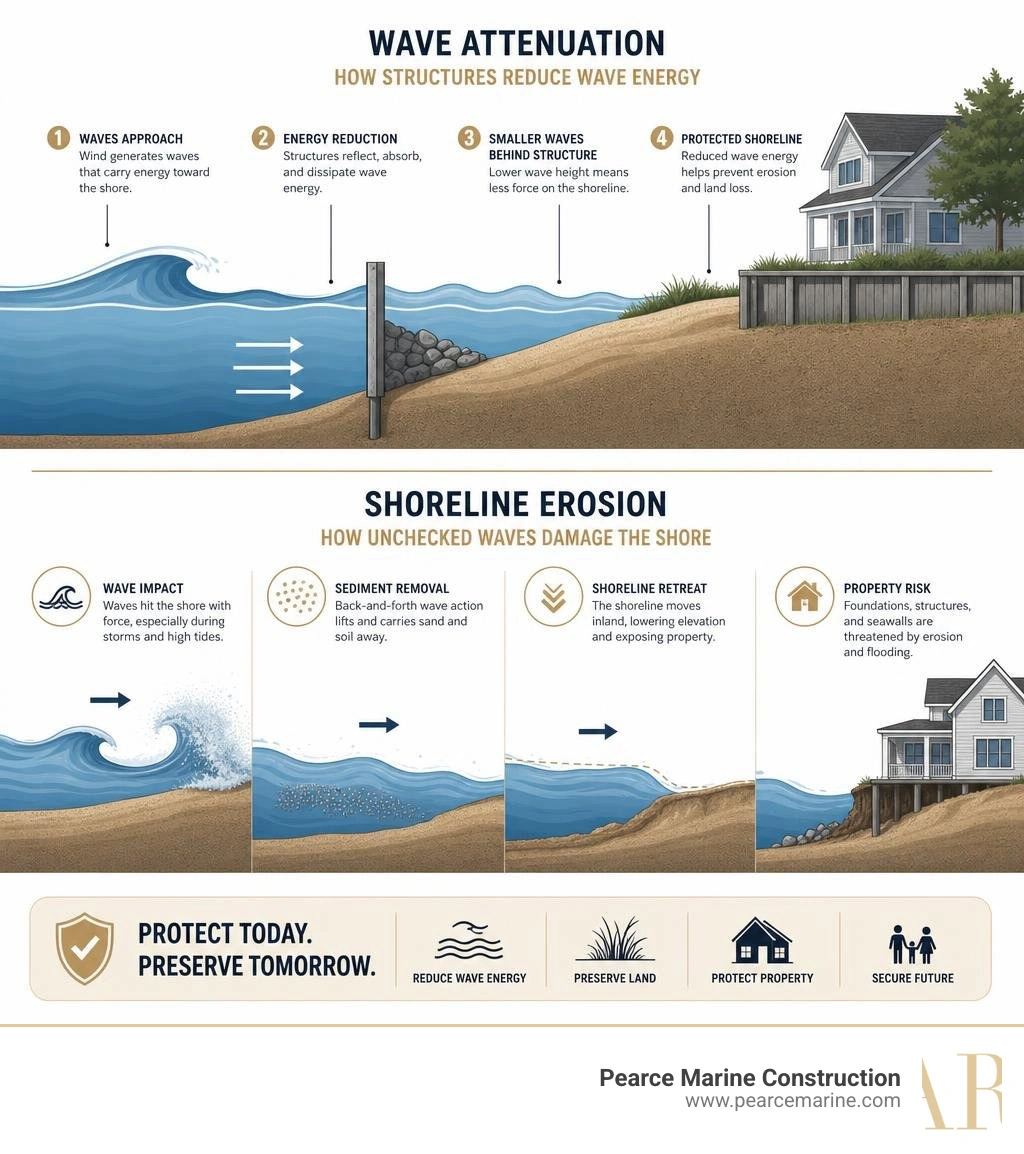
Our primary objective when delivering Coastal Engineering Solutions is wave attenuation—reducing the energy of incoming waves before they can damage your property. When a wave hits a solid barrier, its energy must be safely deflected. If a structure is poorly designed, that energy is directed downward, scouring the sand at the base of the wall, or upward, causing wave runup and overtopping.
To prevent overtopping and structural failure, our engineers calculate the maximum expected wave height, wind setup, and tidal ranges for specific Long Island shorelines. This ensures that the height, shape, and material thickness of your bulkhead or seawall are perfectly optimized to deflect forces safely back into the water.
Engineering Heavy-Duty Bulkheads and Seawalls
While people often use the terms interchangeably, bulkheads and seawalls serve different structural purposes. A bulkhead's primary job is soil retention—holding back the land and preventing it from sliding into the water. A seawall, on the other hand, is specifically designed to withstand the direct, pounding impact of waves.
For effective Coastal Erosion Control and Waterfront Erosion Control, choosing the right material is paramount to our construction process:
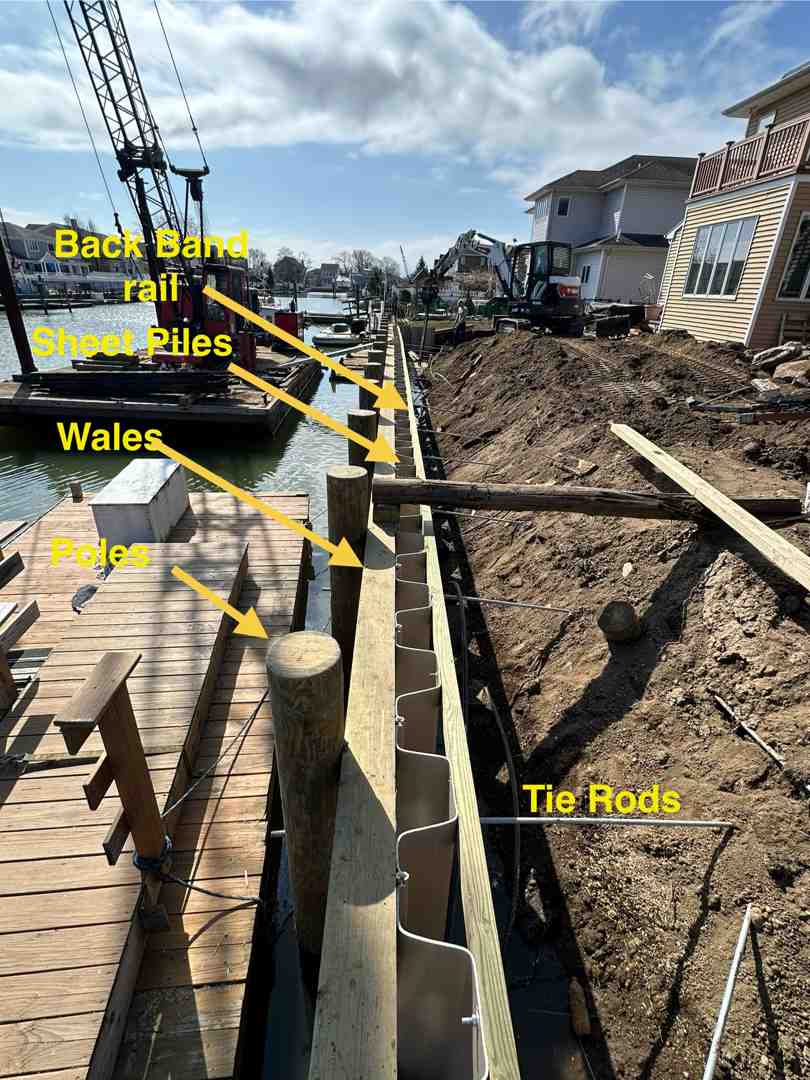
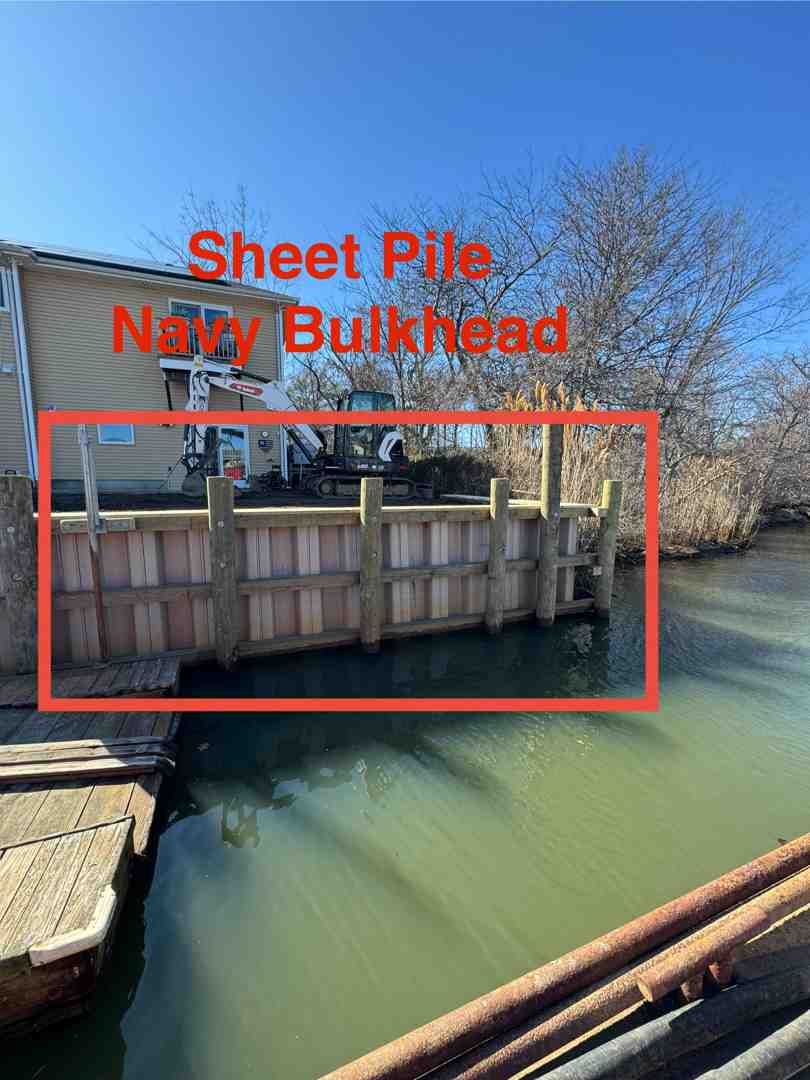
- Steel Sheet Piling: The gold standard for heavy-duty commercial and high-energy residential applications. Steel sheets interlock tightly and are driven deep into tough glacial soils by our specialized equipment, offering unmatched structural strength.
- Vinyl Barriers: Highly resistant to marine borers, UV damage, and corrosion, vinyl sheet piling is an excellent, long-lasting choice for residential canals and lower-energy bays across Nassau County.
- Timber Bulkheads: A classic, cost-effective option that utilizes heavy, pressure-treated wood. When built with modern hardware and proper tiebacks, timber structures offer a rugged, traditional aesthetic that blends beautifully with Long Island shorelines.
Regardless of the material, a major point of failure in bulkhead construction is hydrostatic pressure. When rain or high tides saturate the ground behind your bulkhead, water gets trapped. Without proper drainage solutions, such as weep holes and filter fabric, this trapped water exerts immense pressure, pushing the wall outward. Our engineering designs always incorporate heavy-duty drainage systems to relieve this pressure and keep your wall perfectly vertical.
The Role of Coastal Protection Engineering in Pile Driving and Foundation Stability

A marine structure is only as strong as its foundation. Because coastal soils on Long Island range from soft, organic marsh muds to dense glacial sands, standard shallow foundations simply will not work. That is why pile driving and specialized foundation engineering are core components of our marine construction services.
Piles are long, heavy columns driven deep into the ground until they reach a soil layer with sufficient load-bearing capacity. According to the structural guidelines in the Design of Coastal Project Elements, marine foundations must account for both vertical loads (the weight of docks, decks, and hoists) and lateral loads (the horizontal forces exerted by waves, wind, and shifting ice).
In areas with sensitive soils or tight access, we often utilize helical piles—steel shafts with screw-like plates that are rotated into the ground. This method minimizes vibration and protects neighboring structures.
Furthermore, we must design for scour protection. As waves flow around piles, they accelerate, washing away the surrounding sand. If scour is left unchecked, it can leave piles exposed and unstable. By calculating local water velocities, we install protective riprap or specialized geotextiles at the mudline to anchor the foundation permanently.
Comparing Structural Integrity: Conventional vs. Nature-Based Hybrid Systems
In recent years, the coastal engineering industry has explored Natural and Nature-Based Features (NNBF), such as emergent vegetation and living shorelines. While these green systems offer ecological benefits, they perform very differently compared to traditional gray infrastructure.
| Feature / Metric | Conventional Gray Infrastructure (Bulkheads, Seawalls) | Hybrid Nature-Based Features (NNBF) |
|---|---|---|
| Primary Materials | Steel, vinyl, pressure-treated timber, concrete | Emergent vegetation, rock sills, oyster reefs |
| Performance Predictability | High; calculated via standardized engineering formulas | Variable; depends on biological growth and seasons |
| Wave Energy Dissipation | Deflects energy (can cause localized scouring) | Absorbs and attenuates energy progressively |
| Initial Cost | Higher initial capital investment | Moderate, but highly site-specific |
| Maintenance Requirements | Low, periodic structural inspections | High in early years (vegetation establishment) |
| Lifespan | 30 to 50+ years with proper engineering | Dynamic; can self-repair but vulnerable to extreme storms |
According to research in Frontiers | State of the practice and engineering framework for using emergent vegetation in coastal infrastructure, one of the biggest challenges with relying solely on vegetation for wave energy dissipation is performance predictability. Plants grow, die back in the winter, and can be uprooted during severe winter storms.
For the high-energy environments typical of Long Island, we favor Sustainable Marine Construction practices that combine the two: hybrid shoreline stabilization. By placing a heavy-duty rock sill or low-profile bulkhead seaward of a planting zone, we provide the reliable structural protection your property needs while still allowing for the ecological benefits of natural vegetation.
Implementing Resilient Marine Infrastructure in Nassau and Suffolk Counties
Long Island’s coastal geology is incredibly diverse. The North Shore (bordering the Long Island Sound) features steep bluffs, rocky beaches, and deep harbors like Cold Spring Harbor and Lloyd Harbor. The South Shore is a highly dynamic system of sandy barrier islands, shallow bays, and open ocean exposures, stretching from Massapequa and Babylon to Southampton and West Hampton.
Because of these differences, Coastal Resilience Planning must be highly localized. Property owners on the open bays of West Islip or Brightwaters face severe wind-driven waves and heavy winter ice. Meanwhile, oceanfront estates in Southampton require heavy-duty Storm Surge Protection and robust Coastal Flood Protection to withstand direct Atlantic hurricane impacts.
Designing High-Performance Docks, Piers, and Anchoring Systems
A high-performance dock or pier must be engineered as an integrated system. From the custom decking underfoot to the deep-driven piles below, every component must distribute structural loads efficiently.
To keep your dock anchored firmly during extreme high-water events, we engineer robust anchoring systems using heavy-duty tiebacks and deadmen anchors. Deadmen are massive concrete blocks buried deep upland, connected to the bulkhead or pier by high-strength steel tieback rods. This system transfers lateral wave forces away from the wet shoreline and deep into stable upland soil.
We also use exclusively marine-grade fasteners, such as hot-dipped galvanized or grade 316 stainless steel, to prevent the rapid corrosion caused by Long Island's salty air and brackish waters.
Local Site Factors Influencing Coastal Protection Engineering on Long Island
When designing any marine structure in Nassau or Suffolk County, we must evaluate several critical, site-specific environmental factors:
- Tidal Range: The difference between high and low tide varies wildly across the island, directly affecting structural heights.
- Bathymetry & Wave Climate: Shallow bays attenuate wave energy naturally, whereas deep-water shorelines allow larger, more destructive waves to reach the shore.
- Longshore Sediment Transport: Sand is constantly moving along our coastlines. Poorly designed structures can block this flow, starving downdrift properties of sand and accelerating erosion elsewhere.
- Ice Forces: In sheltered bays like Bellmore, Wantagh, and Merrick, winter ice can freeze around piles. When the tide rises, this ice exerts a massive upward force (known as "ice jacking") that can pull piles straight out of the ground.
Our Shoreline Stabilization Guide 2026 emphasizes that ignoring these geotechnical conditions and seasonal profile variations is the fastest way to structural failure. Our local engineering expertise ensures your project is designed to withstand all of them.
Long-Term Maintenance and Structural Repair of Shoreline Infrastructure
Even the most robustly engineered structures require regular maintenance. Over time, storms, ice, and salt water take their toll. At Pearce Marine Construction, we bring generational expertise and meticulous craftsmanship to every project we undertake in Nassau and Suffolk Counties.
As a premier local marine contractor, we specialize in:
- Bulkhead Repair: Reinforcing older timber or steel walls, replacing corroded tiebacks, and installing advanced drainage systems to relieve hydrostatic pressure.
- Seawall Restoration: Repairing cracked concrete, adding protective riprap, and stabilizing undermined foundations.
- Structural Monitoring: Conducting routine inspections to catch small shifts, cracks, or soil loss before they turn into costly failures.
We perform all of our work with an uncompromising commitment to marine construction safety, ensuring your project is built safely, durably, and in complete compliance with local environmental standards.
If you want to secure your shoreline with a team that understands Long Island's unique coastal waters, explore our professional Seawalls and Bulkheads Services and let us build a defense system that lasts for generations.



Bring Your Vision to Life
Whether you're planning a custom dock, seawall, or boat lift, our experienced team is ready to deliver high-quality marine construction tailored to your needs. Pearce Marine Construction brings craftsmanship, precision, and a deep understanding of Florida’s waterways to every project. Let us help you create a durable, beautiful solution that stands the test of time. Get in touch now for a personalized estimate!