
The Ultimate Guide to Protecting Your Waterfront Property From Erosion

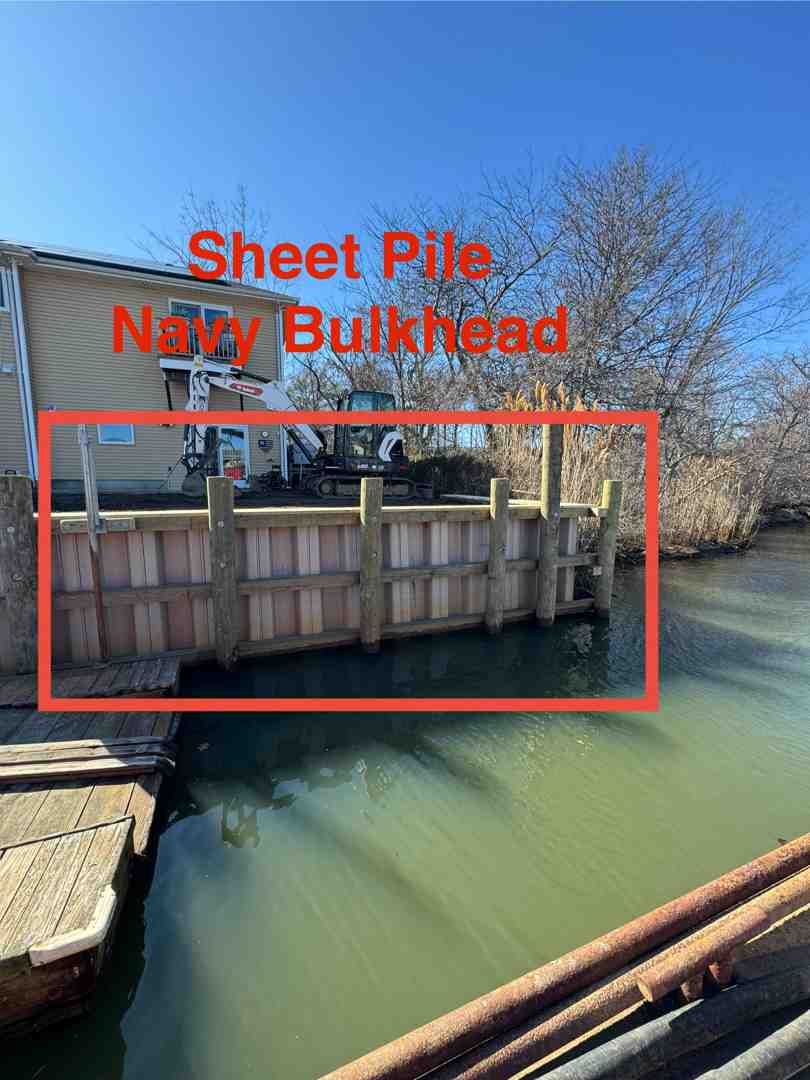
When the Shore Starts to Disappear: Professional Waterfront Erosion Control for Long Island
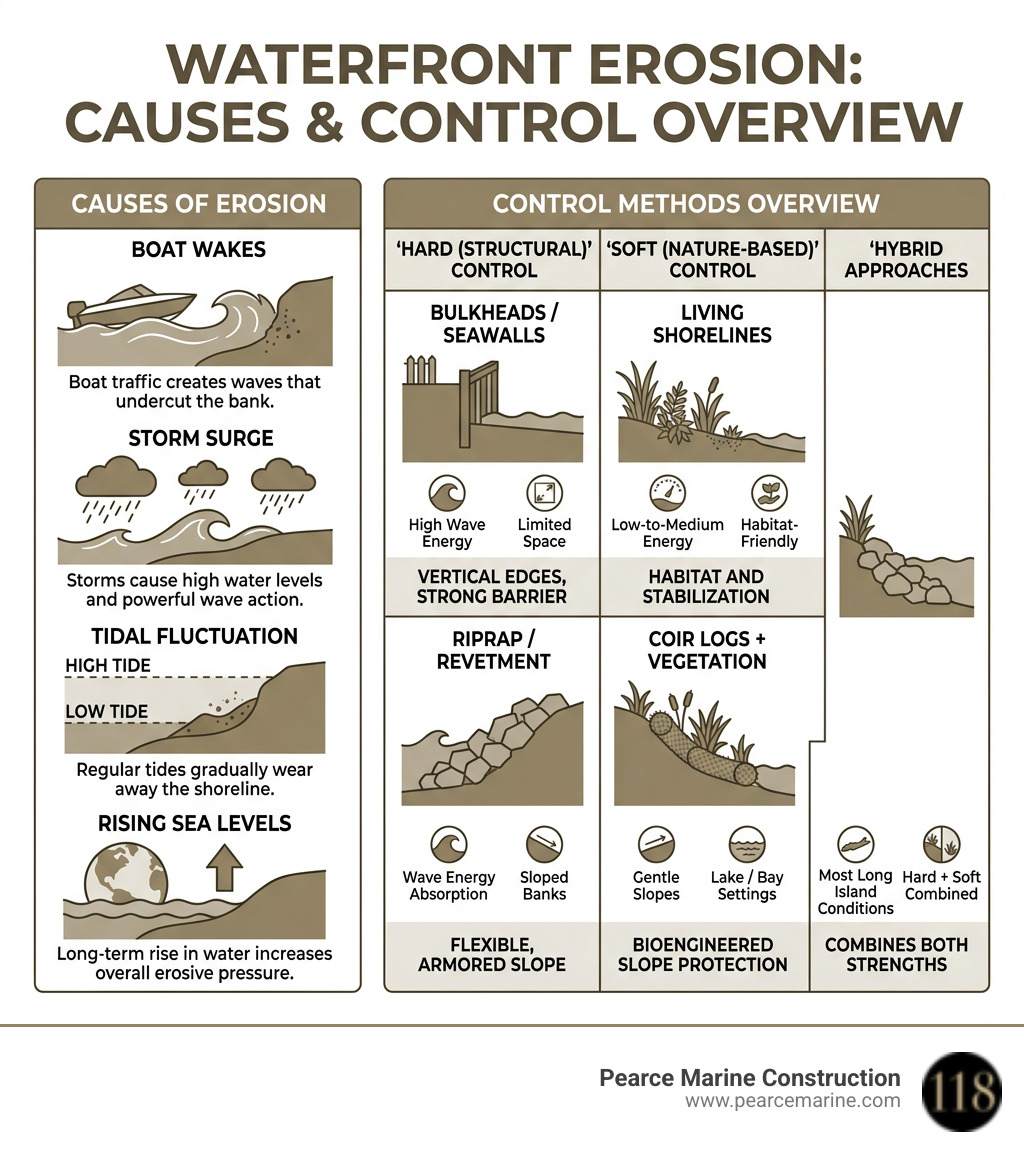
Waterfront erosion control is the use of engineered structures and marine-grade materials by Pearce Marine Construction to stop shoreline land loss caused by waves, tides, storms, and rising sea levels.
Our primary construction methods:
| Method | Type | Best For |
|---|---|---|
| Bulkheads / Seawalls | Hard (structural) | High wave energy, limited space, vertical edge needed |
| Riprap / Revetment | Hard (flexible) | Absorbing wave energy on sloped banks |
| Living Shorelines | Soft (nature-based) | Low-to-medium energy, habitat-friendly sites |
| Coir Logs + Vegetation | Soft (bioengineered) | Gentle slopes, lake or bay settings |
| Hybrid Approaches | Hard + Soft combined | Most Long Island waterfront conditions |
Coastlines don't stay still. Properties across Nassau and Suffolk Counties face a relentless combination of tidal erosion, storm surge from Nor'easters, boat wakes in busy canals, and the slow but steady pressure of rising sea levels. The result: banks undercut, soil washes away, and land that took decades to build simply disappears into the water. Even a single foot of recession on a 100-foot waterfront lot can translate to more than $9,000 in lost land value — before any structural damage is counted.
The good news? Erosion is not inevitable. With the right engineering, the right materials, and a specialized contractor like Pearce Marine Construction, your shoreline can be stabilized, reinforced, and protected for decades to come.
This guide details the professional marine construction solutions we utilize to secure Long Island properties.
Key Waterfront erosion control terms:
Waterfront Erosion Control: Engineering for Long Island’s Shorelines
When we look at a failing shoreline in Massapequa or a battered bluff in Montauk, we aren't just looking at dirt meeting water; we are looking at a complex battle of physics. Effective Waterfront erosion control requires a deep understanding of the forces at play.
The primary driver of land loss is wave energy. This energy is dictated largely by "fetch"—the distance of open water over which wind can blow to create waves. A property on a narrow canal in Merrick deals with boat wakes, but a property facing the Great South Bay deals with miles of fetch that can whip up significant swells during a Nor'easter.
Tidal range and soil composition also dictate our engineering choices. In Nassau and Suffolk, we often deal with sandy, porous soils that wash away easily if not properly contained. We also have to account for "scour," where wave energy hits a hard surface and reflects downward, potentially digging out the "toe" or bottom of a structure.

To help you understand the options, we use a "Green-to-Gray" continuum.
| Feature | Hard Engineering (Gray) | Soft Engineering (Green) |
|---|---|---|
| Structure | Vertical walls (Bulkheads, Seawalls) | Sloped, natural materials (Plants, Rock) |
| Durability | High; designed for 40-75+ years | Variable; requires natural establishment |
| Wave Energy | Reflects energy (high energy sites) | Absorbs/Dissipates energy (low/med energy) |
| Space Needed | Minimal; creates a sharp boundary | Significant; requires a gradual slope |
Hard Engineering: Bulkheads and Seawalls for Waterfront Erosion Control
For many Long Island homeowners, "hard" structures are the gold standard for protection. These are vertical barriers designed to withstand lateral earth pressure—the heavy weight of the soil pushing from the land side—and the constant pounding of waves from the water side.
Vinyl Bulkheads are incredibly popular in our region. Unlike old-fashioned timber, high-grade vinyl doesn't rot, and it's impervious to marine borers. It provides a clean, uniform look that lasts for decades. For high-load industrial sites or areas with extreme wave action, Steel Sheet Piling offers unmatched structural strength, though it requires specialized coatings to prevent corrosion in our saltwater environment. Timber walls are still used, particularly in lower-energy environments, but they generally have a shorter lifespan of 10–25 years.
A critical component of any bulkhead we build is hydrostatic drainage. Water builds up behind the wall from rain and receding tides. Without weep holes and proper filter fabric, that trapped water creates immense pressure that can cause a wall to lean or "blow out." By installing dedicated drainage systems, we ensure the wall only has to hold back the soil, not a mountain of trapped water.
Learn more about our bulkhead and seawall services to see how we secure Long Island properties.
Soft Engineering and Nature-Based Waterfront Erosion Control
In areas where the wave energy is lower, or where a more natural aesthetic is desired, we look toward "soft" or "hybrid" solutions. These methods focus on absorbing wave energy rather than reflecting it.
Rock Revetments and Riprap are among the most effective flexible solutions. By stacking specifically sized stone armor along a sloped bank, we create a porous barrier. When a wave hits riprap, the water flows into the gaps between the rocks, losing its energy before it can reach the soil. This prevents the "scouring" effect often seen with vertical walls.
Living Shorelines use native vegetation, coir logs (made of coconut fiber), and organic materials to stabilize the bank. These are excellent for bayside properties in Nassau County where we want to encourage local habitat while preventing "sheet erosion" from runoff. For more information on the science behind these changes, you can explore research on storm-induced coastal change.
If you are interested in how stone can protect your land, read more about rock revetment solutions for your property.
Site Assessment and Structural Design Factors
Before we drive a single pile, we conduct a rigorous site assessment. We look at slope stability to ensure the land won't slide toward the water, and we calculate toe scour to determine how deep our materials need to be embedded.
Foundation embedment is the "secret sauce" of marine construction. A bulkhead is only as strong as the portion of the pile that is buried in the subgrade. If the water is 6 feet deep, we don't just go 6 feet down; we may need to go 12 or 18 feet deep to reach stable strata and resist surcharge loads (the weight of things like decks or sheds on the land above).
We also consider regional sediment flow. Improperly designed structures can trap sand and starve neighboring properties, a phenomenon discussed in research on beach nourishment and shoreline protection. Our goal is always to protect your land without creating a headache for your neighbors.
Professional Construction and Long-Term Protection in Long Island
In towns like Southampton, West Islip, and Westhampton, the "standard" construction approach often isn't enough. The Atlantic doesn't care about "good enough." That’s why we focus on custom craftsmanship and marine-grade materials that exceed local building codes.
Whether we are working on a residential dock in Bayshore or a commercial bulkhead in Patchogue, the focus is on longevity. We use heavy-duty hardware—hot-dipped galvanized or stainless steel—to ensure that every bolt and tie-back can survive the salt air.
Structural Reinforcement and Anchoring Systems
The part of the bulkhead you see is only half the story. The real work happens underground through anchoring systems.
- Tie-backs and Deadmen: We run long steel rods from the bulkhead back into the yard, where they are bolted to "deadmen" (large concrete or timber anchors buried deep in the soil). This prevents the wall from tipping over under the weight of the land.
- Helical Piles: In areas with soft or "muck" soil, we use helical piles—essentially giant screws—that we drive deep into the earth to provide a rock-solid anchor point that won't budge.
- Pile Driving: Our heavy equipment ensures that every pile is driven to the exact design depth required for structural integrity.
If you are located in Nassau County, you can find more specific details on shoreline protection in Nassau here.
Addressing Climate Change and Increased Storm Intensity
We don't just build for today's tides; we build for tomorrow's storms. With sea level rise and the increasing frequency of intense Nor'easters, Waterfront erosion control must be resilient.
One of the biggest threats to Long Island shorelines is wave overtopping. During a major surge, water can crest over the top of a bulkhead, washing away the soil behind it and causing the wall to fail from the inside out. We address this through resilience engineering, which may involve increasing the structural height of the wall or installing "splash pads" and advanced drainage to handle the water that does make it over.
For a deeper look at how we adapt to these changing conditions, check out our shoreline protection in Long Island guide.
Selecting a Specialized Marine Contractor in Nassau and Suffolk
Choosing a contractor for your shoreline is a high-stakes decision. This isn't like hiring a house painter; if a bulkhead fails, it can take your yard and your home's foundation with it.
At Pearce Marine Construction, we bring generational expertise to every project. As a woman-owned business serving Nassau and Suffolk Counties, we pride ourselves on meticulous craftsmanship. We know the local soil in Wantagh, the tidal swings in Cold Spring Harbor, and the structural engineering requirements in the Hamptons.
We don't do "cookie-cutter" work. Every property from Huntington to West Islip is different, and we treat every project as a custom engineering challenge. From the initial site assessment to the final bolt, our focus is on keeping your land exactly where it belongs.
Explore our shoreline stabilization services and let us help you protect your investment for the next generation.



Bring Your Vision to Life
Whether you're planning a custom dock, seawall, or boat lift, our experienced team is ready to deliver high-quality marine construction tailored to your needs. Pearce Marine Construction brings craftsmanship, precision, and a deep understanding of Florida’s waterways to every project. Let us help you create a durable, beautiful solution that stands the test of time. Get in touch now for a personalized estimate!