
The Hard Truth About Concrete Bulkhead and Stair Costs

What Does a Concrete Bulkhead Cost? A Straight Answer for Long Island Property Owners
Concrete bulkhead cost ranges from $200 to $600 per linear foot for standard installations, but Long Island homeowners in Nassau and Suffolk Counties often see prices toward the higher end of that range — or beyond it — due to saltwater exposure, tidal conditions, and site access challenges.
Here's a quick breakdown before we go deeper:
| Cost Category | Typical Range |
|---|---|
| Concrete bulkhead installation | $200 - $600+ per linear foot |
| Bulkhead repair (injection sealing) | $1,800 - $2,500 |
| Full bulkhead replacement (100 LF) | $20,000 - $60,000+ |
| Marine engineering and structural design | $1,500 - $3,500 |
| Demolition and disposal | $75 - $250 per linear foot |
| Drainage systems | $15 - $55 per linear foot |
A 100-foot residential bulkhead replacement — a very common project scope — typically runs $20,000 to $60,000 fully installed, depending on conditions.
Concrete is one of the most durable shoreline protection materials available, with a lifespan of 30 to 50 years. But it's also the most complex to install, requiring excavation, formwork, rebar, pouring, and curing time — which means a 4 to 8 week installation timeline and a price tag that reflects that labor.
The hard truth? Most homeowners get sticker shock not from the base material cost, but from the extras — engineering, demolition, drainage, and site prep — that can add significantly to the final number. This guide breaks all of it down so you know exactly what you're paying for and why.
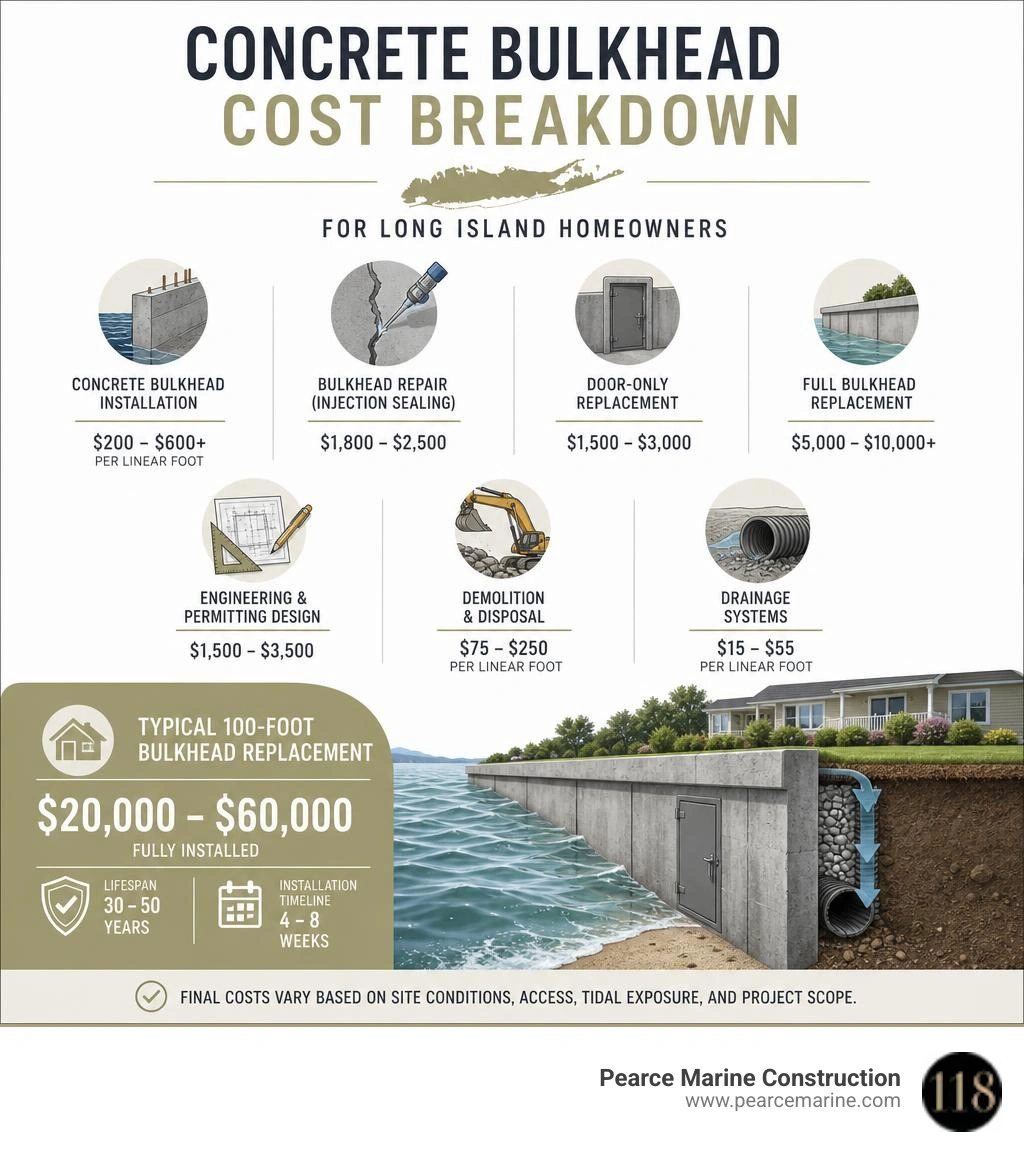
Simple concrete bulkhead cost word guide:
Understanding Your Concrete Bulkhead Cost in Nassau and Suffolk Counties
When you live on the water in places like West Islip, Babylon, or Wantagh, your shoreline is constantly under siege. Between the daily rise and fall of the tides and the aggressive nature of saltwater environments, a standard retaining wall simply won't cut it.
Building a concrete bulkhead is a serious engineering feat. Unlike lighter materials that can be quickly driven into the seabed, concrete requires heavy machinery, deep excavation, and precise structural reinforcement to handle the intense hydrostatic pressure from the land side and wave action from the water side.

Because every waterfront property on Long Island has a unique shoreline profile, pricing is highly dependent on the height of the wall required to secure your land. Taller walls require exponentially thicker concrete, heavier rebar grids, and deeper anchoring systems.
| Bulkhead Wall Height | Estimated Cost per Linear Foot (Labor & Materials) | Estimated Total Cost for a 100-LF Wall |
|---|---|---|
| Short (Under 4 Feet) | $200 - $350 | $20,000 - $35,000 |
| Standard Residential (5 to 8 Feet) | $350 - $550 | $35,000 - $55,000 |
| Deep-Water / Commercial (9+ Feet) | $600 - $1,200+ | $60,000 - $120,000+ |
Key Factors Driving Your Total Concrete Bulkhead Cost
If you ask two neighbors in West Hampton what they paid for their bulkheads, you might get two completely different answers. That is because the final concrete bulkhead cost is heavily dictated by your property's physical layout and environmental conditions.
- Site Accessibility: Can we get our heavy excavators, pile drivers, and concrete trucks directly to your shoreline? If your backyard in Southampton has a steep slope, tight easements, or mature landscaping that blocks land access, we may need to bring in marine barges to execute the installation from the water. Water-side installation can add 30% to 40% to your total project cost due to barge logistics and marine equipment rates.
- Soil Density and Shoreline Conditions: Hard clay or dense glacial till requires specialized drilling and driving equipment, while soft, saturated muck requires extra stabilization and deeper anchoring.
- Water Depth and Wave Energy: Properties facing open bays with high wave energy require robust, thick-walled concrete barriers compared to those along calm, sheltered canals. If you want to explore the full range of options we offer for these varying conditions, check out our Seawalls and Bulkheads Services.
Additional Construction Expenses: Engineering, Demolition, and Drainage
When budgeting for your shoreline protection, the concrete itself is only part of the equation. To ensure your investment stands up to the next major storm, several non-negotiable construction steps must be factored into your estimate, as detailed in our comprehensive Bulkhead Construction Cost Guide.
- Engineering and Design Fees ($1,500 - $3,500): Before a single spade of dirt is turned, a licensed marine engineer must design your bulkhead. This ensures the wall thickness, rebar schedule, and tie-back anchoring systems are perfectly matched to your soil type and local tidal loads.
- Demolition and Disposal ($75 - $250 per linear foot): If you are replacing a failing timber or steel bulkhead, the old material must be carefully excavated, extracted, and hauled away to a licensed disposal facility.
- Backfill and Compaction: Once the concrete wall is poured and cured, the void behind it must be filled with clean, well-compacted gravel. Proper compaction is critical; loose soil will settle over time, leading to sinkholes and structural instability.
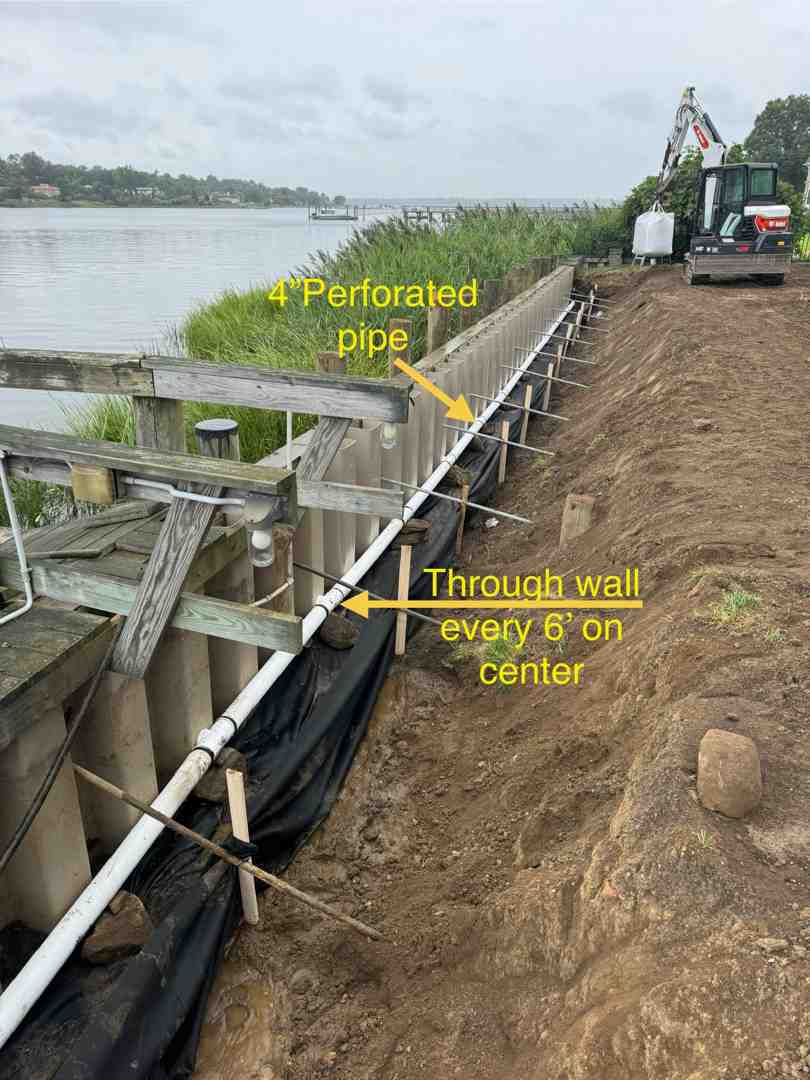
- Drainage Systems and Weep Holes ($15 - $55 per linear foot): Water is a bulkhead's worst enemy. When the tide goes out, water trapped behind the wall exerts immense hydrostatic pressure. We install dedicated drainage systems, including French drains and heavy-duty weep holes, to allow this water to escape safely without washing out your soil.
When to Choose Full Replacement vs. Injection Sealing
We always tell our clients in Massapequa and Bellmore that full replacement is not always the answer. If your concrete bulkhead is structurally sound but leaking water at the joints, you do not need to spend tens of thousands of dollars on a complete rebuild.
Most concrete bulkheads are constructed in panels, with joints sealed by a flexible gasket. Over decades of freeze-thaw cycles and tidal movement, these gaskets fail, allowing water to force its way through. This leads to soil loss and visible sinkholes behind your wall.
For localized joint leaks, we recommend professional polyurethane injection sealing. This process involves injecting a specialized, eco-friendly hydrophobic grout directly into the voids behind the joints. The grout expands to fill every hidden pocket, creating a watertight barrier.
This repair method typically costs $1,800 to $2,500 and comes with a lifetime guarantee, making it a highly cost-effective alternative to a $5,000 to $10,000+ partial replacement. However, if your concrete is crumbling, the internal rebar is rusted through, or the wall is bowing and leaning significantly, a full replacement is your only safe option. You can read more about diagnosing these structural issues in our Concrete Bulkhead Repair Ultimate Guide.
Long-Term Value: Concrete vs. Alternative Shoreline Materials
Choosing the right material for your shoreline barrier is a major financial decision. While some materials have a lower upfront cost, they often require frequent maintenance or have a significantly shorter lifespan.

When evaluating the long-term lifecycle cost of your bulkhead, concrete remains the gold standard for heavy-impact environments. In fact, the Federal Emergency Management Agency (FEMA) Coastal Construction Guidelines consistently highlight reinforced concrete as one of the most reliable methods for protecting coastal homes from severe storm surges and erosion.
Comparing the Lifetime Value and Concrete Bulkhead Cost to Vinyl and Steel
How does concrete stack up against other popular materials used on Long Island? Let's look at the numbers:
- Marine-Grade Vinyl: Vinyl sheet piling is highly popular because it does not rot, rust, or corrode in saltwater. It typically costs $200 to $550 per linear foot and boasts a lifespan of 50+ years. While vinyl offers incredible long-term value, it lacks the sheer mass and impact resistance of concrete, making it less suitable for high-energy shorelines with heavy wave action.
- Steel Sheet Piling: Steel is incredibly strong and excellent for deep-water commercial applications, costing $200 to $600+ per linear foot. However, even treated steel will eventually rust in Long Island's harsh saltwater bays, requiring sacrificial anodes and regular maintenance to reach its 30 to 50-year lifespan.
- CCA-Treated Timber: Wood bulkheads have the lowest initial cost ($150 to $500 per linear foot), but they are highly susceptible to marine borers, rot, and UV damage. They typically last only 15 to 30 years and require ongoing maintenance.
- Riprap Rock Armor: Placing large boulders along your shoreline costs $100 to $600 per linear foot and can last up to a century. However, riprap takes up a massive physical footprint, reducing your usable yard space, and does not provide a clean, vertical bulkhead line.
To see a detailed head-to-head breakdown of these materials, head over to our Ultimate Concrete Seawall Cost Guide.
Concrete Coping Cap and Tie-Back Installation Requirements
To ensure a marine concrete bulkhead does not bow or shift under intense lateral earth pressure, strict structural installation best practices must be followed during the Concrete Bulkhead Installation process:
- Heavy-Duty Coping Cap: A reinforced concrete coping cap must be poured along the top of the bulkhead to tie the vertical panels together and distribute wave impact loads uniformly.
- Tie-Back Rods: High-tensile steel tie-back rods, protected by corrosion-resistant sheathing, must extend from the wall face deep into the solid ground behind the failure plane.
- Deadman Anchors: Tie-backs must be securely anchored to poured-in-place concrete deadman blocks positioned at a calculated distance behind the bulkhead.
- Water Diversion & Drainage: A dedicated weep-hole system and clean, well-compacted gravel backfill must be installed directly behind the wall to prevent hydrostatic pressure from building up and cracking the concrete.
Selecting a Premier Long Island Marine Contractor
Your bulkhead is the only thing standing between your valuable property and the relentless power of the Atlantic tides. A cheap, poorly engineered installation might save you money upfront, but a single winter nor'easter can wash those savings away in a matter of hours.
At Pearce Marine Construction, we bring generational expertise, meticulous craftsmanship, and an uncompromising commitment to quality to every shoreline we protect. As a proud woman-owned business serving Nassau and Suffolk Counties — from the protected canals of Massapequa and Merrick to the exposed shorelines of Southampton and Lloyd Harbor — we understand the unique environmental demands of Long Island's waterways.
We do not believe in one-size-fits-all solutions or high-pressure sales tactics. We will thoroughly inspect your shoreline, explain your material options, and deliver an honest, itemized proposal engineered to protect your home for decades to come.
If you are ready to secure your property with a beautifully crafted, long-lasting marine structure, explore our Cost to Build Bulkhead Guide or contact our team today to schedule your professional shoreline assessment through our Seawalls and Bulkheads Services.



Bring Your Vision to Life
Whether you're planning a custom dock, seawall, or boat lift, our experienced team is ready to deliver high-quality marine construction tailored to your needs. Pearce Marine Construction brings craftsmanship, precision, and a deep understanding of Florida’s waterways to every project. Let us help you create a durable, beautiful solution that stands the test of time. Get in touch now for a personalized estimate!