
A Guide to Building Floating Concrete Docks That Last

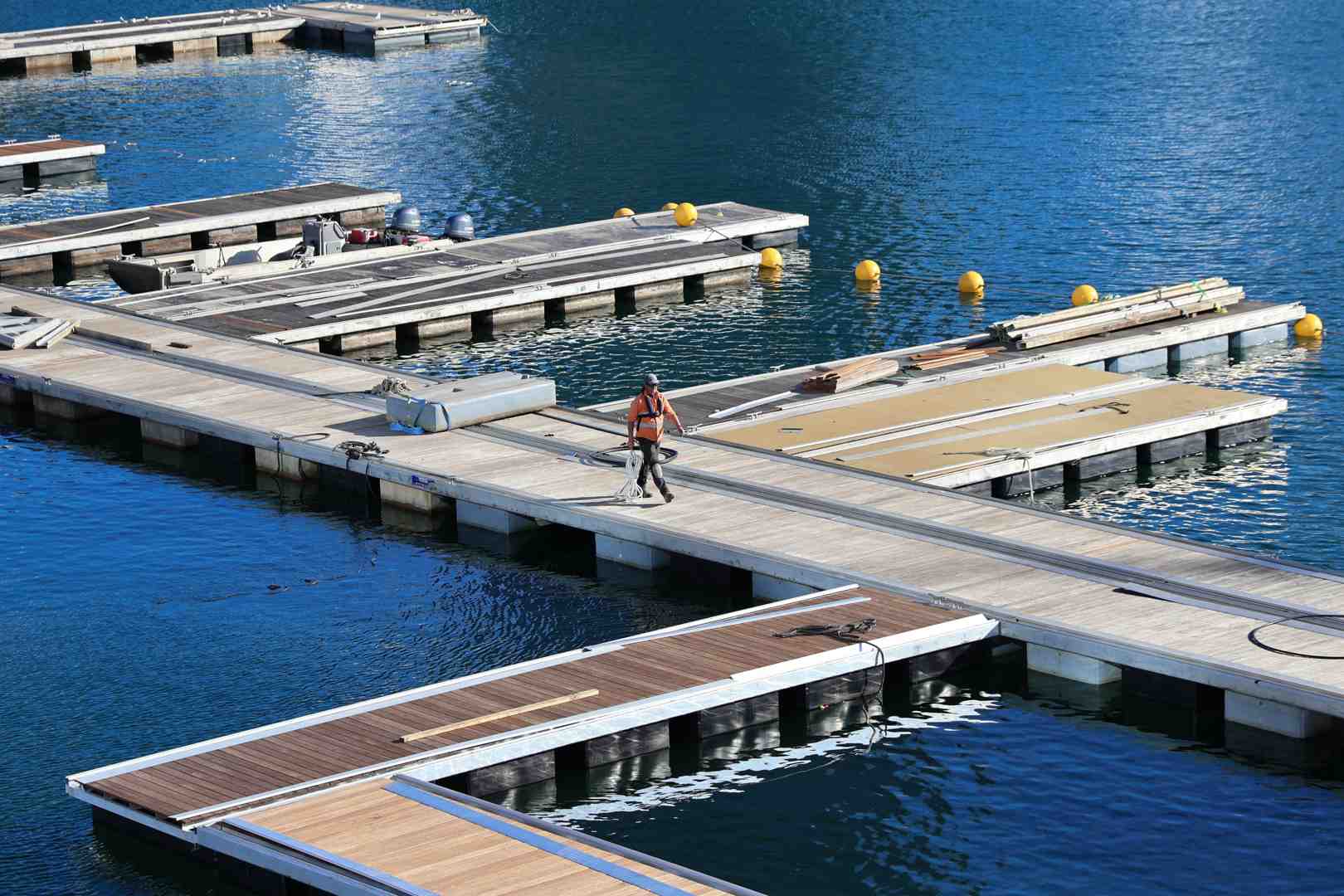
Why Concrete Floating Dock Construction Is the Smart Choice for Long Island Waterfronts
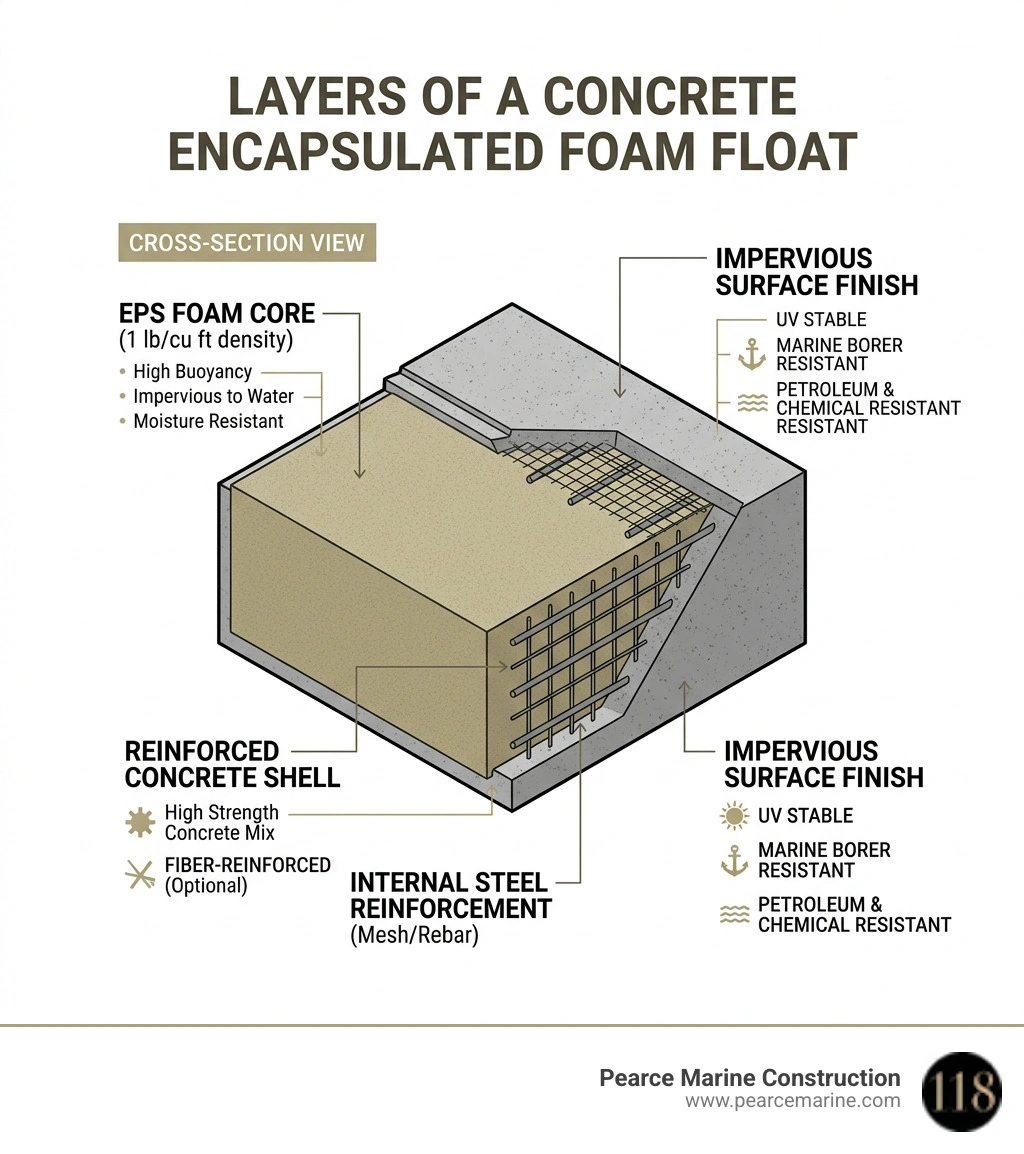
Concrete floating dock construction is the process of building buoyant dock sections using an expanded polystyrene (EPS) foam core encased in reinforced concrete, creating a structure that floats on water while delivering decades of low-maintenance service.
Here's what you need to know at a glance:
| Feature | Concrete Floating Dock |
|---|---|
| Lifespan | 50+ years with proper maintenance |
| Core material | Expanded polystyrene (EPS) foam, 1 lb/cu ft |
| Shell material | Reinforced concrete (sometimes fiberglass-reinforced) |
| Maintenance vs. wood | ~90% less maintenance required |
| Freeboard (min.) | 18 inches under dead load; 16 inches under combined loads |
| Storm performance | Survived Hurricane Sandy across NJ, NY, and CT coasts |
| Best for | Marinas, commercial facilities, residential waterfront properties |
Wood docks rot. Plastic docks degrade under UV exposure. Concrete floating docks, by contrast, are impervious to marine borers, petroleum products, and ultraviolet light. Docks installed in Baltimore Harbor back in 1975 are still functioning today — that's over 49 years of continuous service.
For property owners in Nassau and Suffolk Counties on Long Island, where saltwater exposure, tidal fluctuation, and storm surges are everyday realities, the material choice matters enormously. A concrete floating dock isn't just a platform on water — it's a long-term infrastructure investment engineered to outlast the alternatives.
At Pearce Marine Construction, we work with residential and commercial clients across Long Island to design and build concrete floating dock systems built to the highest engineering standards. This guide walks through everything you need to know — from materials and design specs to installation, anchoring, and long-term performance.
Important concrete floating dock construction terms:
Engineering Excellence in Concrete Floating Dock Construction
The sheer mass of a concrete dock is its greatest asset. Unlike lightweight alternatives that "bounce" with every ripple, a concrete system provides a sense of stability often described as "walking on land." Achieving this requires a sophisticated marriage of buoyancy and structural reinforcement. In April 2026, as we look at the evolving needs of Long Island's coastlines from Babylon to South Hampton, the engineering behind these structures has never been more critical.
Materials and Structural Integrity
The "heart" of any modern concrete dock is high-density expanded polystyrene (EPS). We utilize virgin EPS foam with a density of 1 lb/cu ft, which provides roughly 60 pounds of buoyancy per cubic foot. This foam is encased in a protective shell of high-strength concrete.
To combat the corrosive nature of the Great South Bay and the Atlantic, the concrete is often enhanced with fiberglass fibers and rust-free engineered fabrics. One of the most significant innovations in concrete floating dock construction is the use of post-tensioning. By running 3/8" steel strands through the modules and tensioning them to a minimum of 8,000 lbs, we create a monolithic structure with incredible tensile strength. This prevents the concrete from cracking under the constant stress of wave action.
For more detailed technical insights, you can explore our resources on boat dock construction.
| Material Type | Estimated Lifespan | Maintenance Level |
|---|---|---|
| Reinforced Concrete | 50+ Years | Very Low |
| Pressure-Treated Wood | 10–20 Years | High |
| Composite/Plastic | 15–25 Years | Moderate |
Design Standards for Concrete Floating Dock Construction
We don't just "pour and hope." Professional construction follows rigorous standards, specifically those outlined in ASCE Report No. 50. These standards dictate that a floating pier must maintain a minimum freeboard (the distance from the water to the deck) of 18 inches under a full dead load. When you add a live load—such as people or equipment—the dock must still maintain at least 16 inches of freeboard while supporting a 30 psf (pounds per square foot) live load.
Furthermore, these docks are engineered to withstand wind loads of 15 psf against berthed vessels and impact loads of 5,000 lbs of perpendicular thrust. This level of precision ensures that whether you are in a sheltered canal in Merrick or an exposed harbor in Huntington, your dock remains level and safe. You can read more about the scientific research on floating concrete dock sections and methods to understand the evolution of these standards.
Stability and Performance in Harsh Marine Environments
Long Island's history with major weather events is well-documented. During Hurricane Sandy, concrete floating docks performed remarkably better than almost any other dock type along the NY and CT coasts. Their weight allows them to act as a wave attenuator, absorbing energy rather than being tossed by it.
In areas like West Islip and Brightwaters, where winter ice can be a concern, concrete's density provides a natural defense. Unlike wood, which can be crushed or splintered by ice pressure, high-strength concrete is an inert material that resists freeze-thaw cycles and UV degradation. It is also impervious to petroleum products and marine pests that typically destroy foam-only or wooden systems. For those seeking the most durable builds, our team of dock builders in Long Island specializes in these high-performance installations.
Professional Installation and Anchoring Systems
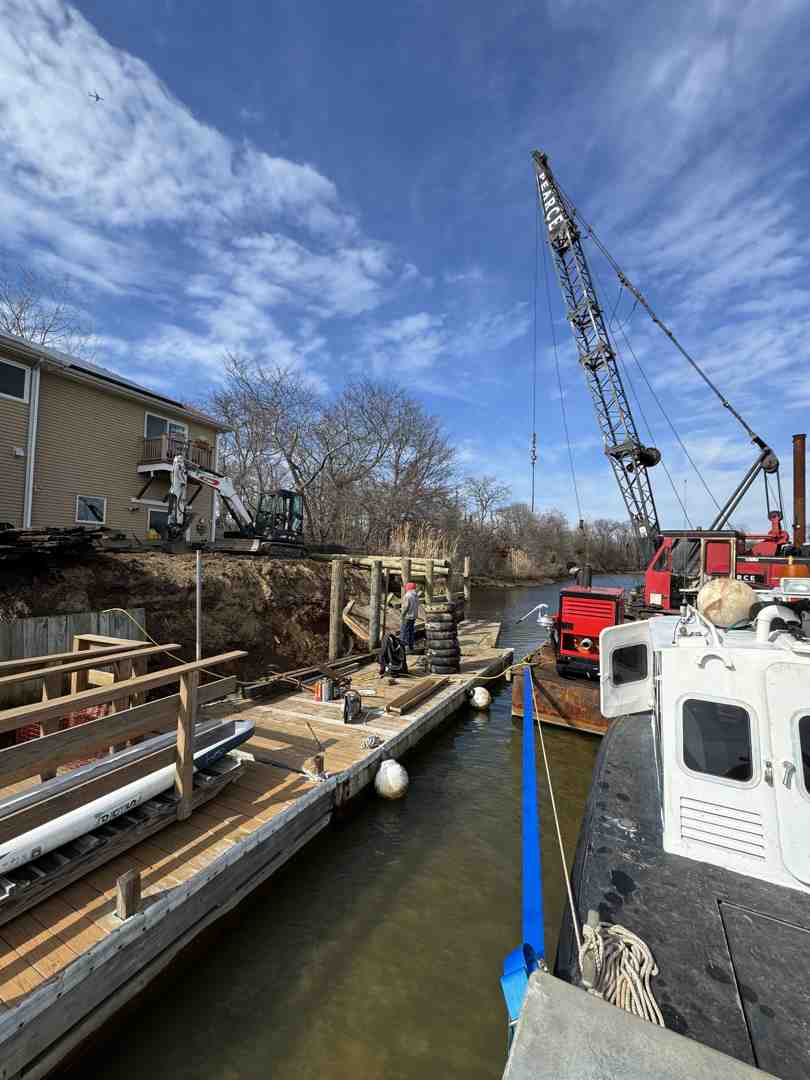
Building the modules is only half the battle; the installation process requires heavy machinery and precision diving. Because a single NordiDock P-50 section can weigh 34,000 lbs, the logistics of transport and placement are a feat of marine engineering.
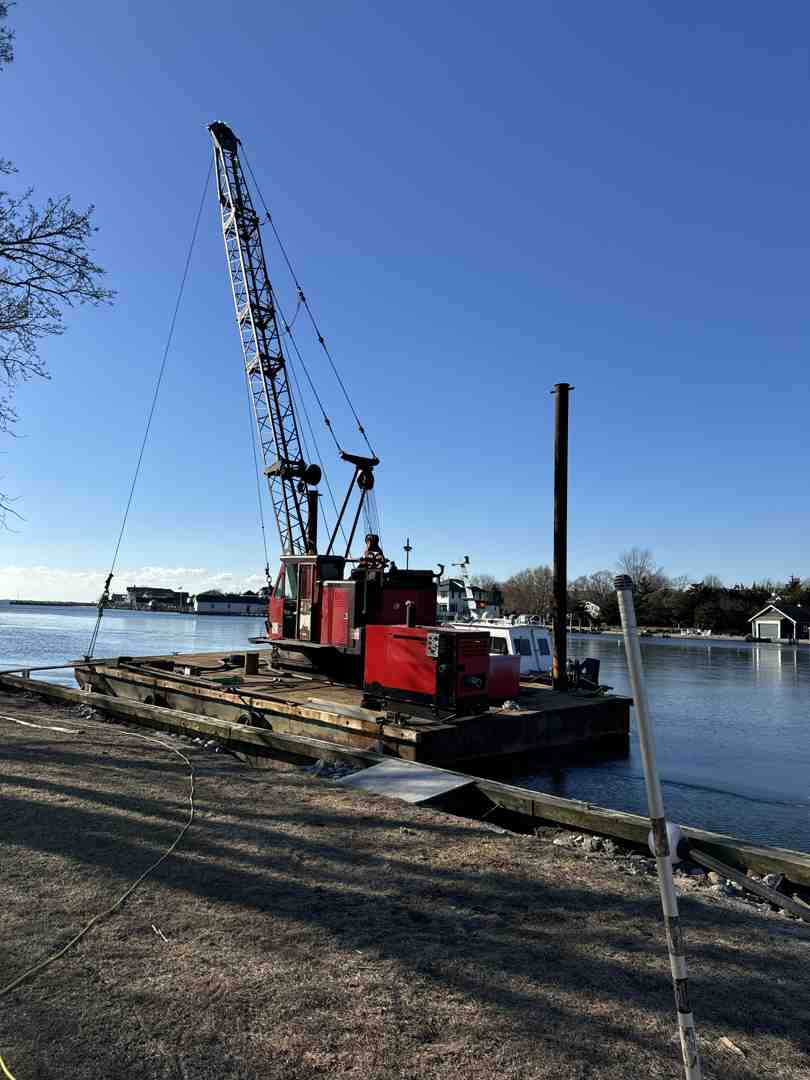
The Concrete Floating Dock Construction Process
The process begins with prefabrication in a controlled environment. We use monolithic pouring techniques to ensure there are no cold joints in the concrete shell. The concrete thickness is strategically varied: typically 3" for the deck, 2" for the sides, and 1.5" for the bottom. This keeps the center of gravity low, enhancing stability.
Once the modules arrive at a waterfront in West Hampton or Bayshore, they are interconnected using specialized hardware. We often employ waler-connected systems or bolted hinges with 1/2" thick neoprene pads (79 durometer) to allow for slight movement while dampening noise and vibration. We also integrate utility conduits directly into the core, allowing for seamless installation of electricity, water, and fuel lines without unsightly pipes cluttering the deck. Detailed steps can be found in our floating dock construction guide.
Advanced Anchoring and Mooring Solutions
A floating dock is only as good as its anchoring system. In the tidal waters of Nassau and Suffolk County, the dock must be able to move vertically with the tide while remaining horizontally fixed.
- Piling Guides: These are the gold standard for Long Island. Internal or external pile hoops with rollers allow the dock to slide up and down fixed pilings.
- Deadweight Anchors: In deeper water or where pilings aren't feasible, we use concrete anchors weighing 400+ lbs, connected by heavy-duty galvanized chains or cables.
- Seafloor Evaluation: Before installation, we evaluate the seabed—whether it's soft mud in Bellmore or hard sand in Lloyd Harbor—to determine the required weight and holding power.
Proper tensioning is key; we often use "criss-cross" patterns to prevent the dock from drifting or swaying. For a deeper dive into these mechanics, see our guide on floating dock anchoring systems.
Long-Term Maintenance and Lifespan Economics
While the initial investment in concrete floating dock construction is higher than wood, the lifecycle economics are undeniable. A concrete dock requires approximately 90% less maintenance than a wooden one. There are no boards to sand, no splinters to worry about, and no need for annual staining.
Routine inspections should still be performed. We recommend checking the hardware every spring—tightening bolts and inspecting the neoprene pads for wear. However, the concrete itself is designed for a 50+ year service life. When you calculate the cost of replacing a wooden dock three times over that same period, concrete becomes the most cost-effective choice for serious waterfront property owners.
At Pearce Marine Construction, we bring generational expertise to every project, ensuring your investment is protected by meticulous craftsmanship. Whether you are looking for a residential slip in Massapequa or a commercial marina expansion in Cold Spring Harbor, we are here to help. Contact our experts for boat docks and floating docks today to begin your project.



Bring Your Vision to Life
Whether you're planning a custom dock, seawall, or boat lift, our experienced team is ready to deliver high-quality marine construction tailored to your needs. Pearce Marine Construction brings craftsmanship, precision, and a deep understanding of Florida’s waterways to every project. Let us help you create a durable, beautiful solution that stands the test of time. Get in touch now for a personalized estimate!