
Whip It Good: A Practical Setup Walkthrough for Boat Dock Whips

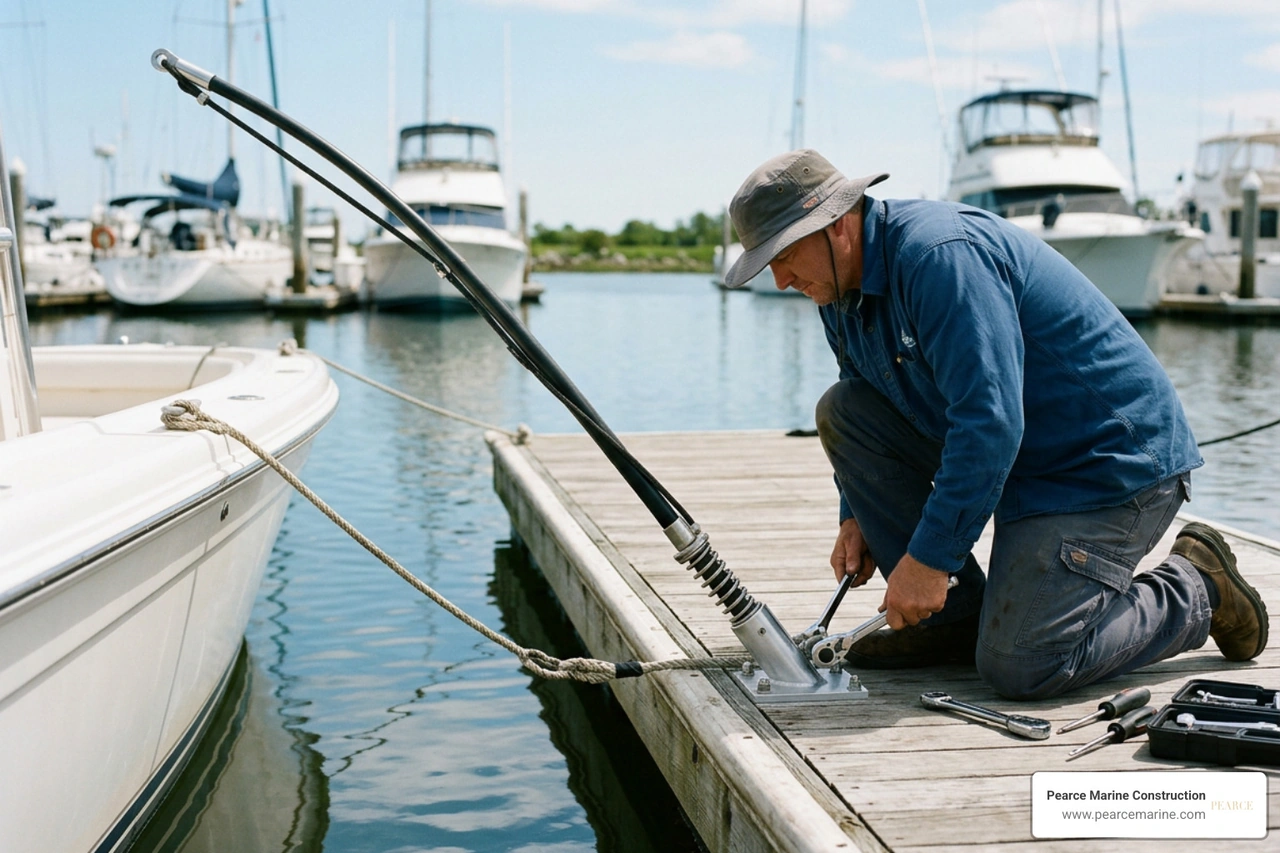
Dock Whips Installation: Marine Construction Anchoring Systems for Long Island Shorelines
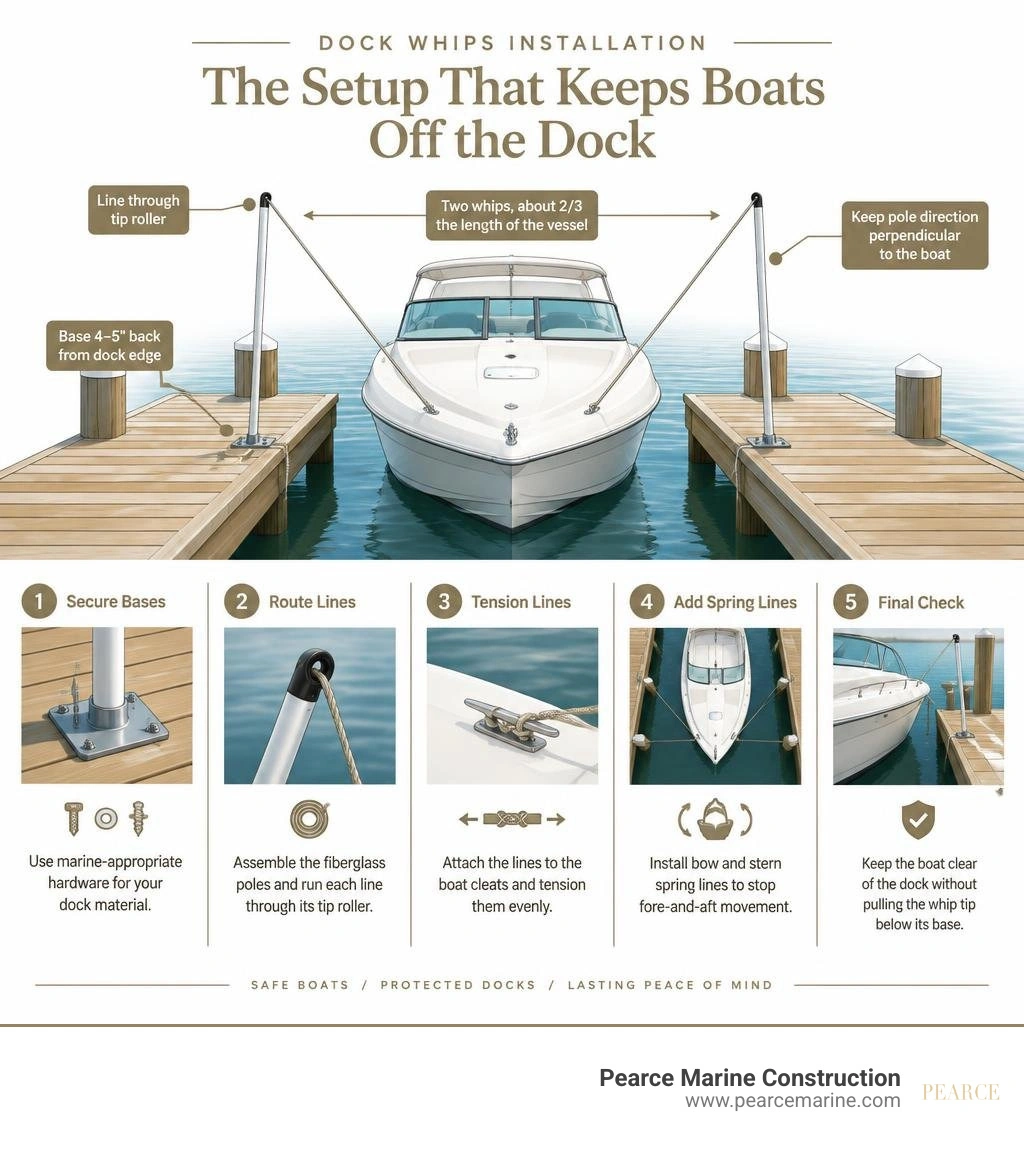
A proper dock whips installation starts with solid dock framing, correctly placed bases, and balanced lines engineered as part of a marine anchoring system. Marine contractors mount each base about 4-5 inches back from the dock edge, align it perpendicular to the vessel cleats, and space the two whips roughly two-thirds of the vessel's overall length apart.
Structural marine contractors execute this installation through precision construction steps:
- Securing mounting bases into underlying framing with marine-grade 316 stainless steel hardware.
- Assembling heavy-duty fiberglass poles and running lines through low-friction tip rollers.
- Attaching lines to vessel cleats and setting calibrated tension.
- Integrating bow and stern spring lines to arrest fore-and-aft movement.
- Calibrating dynamic standoff clearance so the vessel stays clear of the pier across tidal cycles.
When waterfront property owners hire specialists to install mooring whips, the system delivers continuous spring-loaded standoff force that prevents structural dock damage. Combined with structural boat cleat installation, these systems protect both the pier framing and moored vessels from severe wake fatigue.
For waterfront properties in Nassau and Suffolk Counties, including Southampton, West Islip, West Hampton, and nearby Long Island shoreline communities, details such as tidal movement, wake exposure, saltwater corrosion, and dock framing integrity all dictate installation parameters. Pearce Marine Construction is a woman-owned marine construction company serving residential, commercial, and public clients in Nassau and Suffolk Counties on Long Island, NY with durable dock, pier, bulkhead, seawall, pile driving, and shoreline infrastructure built for local conditions.
Contractor-Built Mooring Whips for Dockside Structural Protection
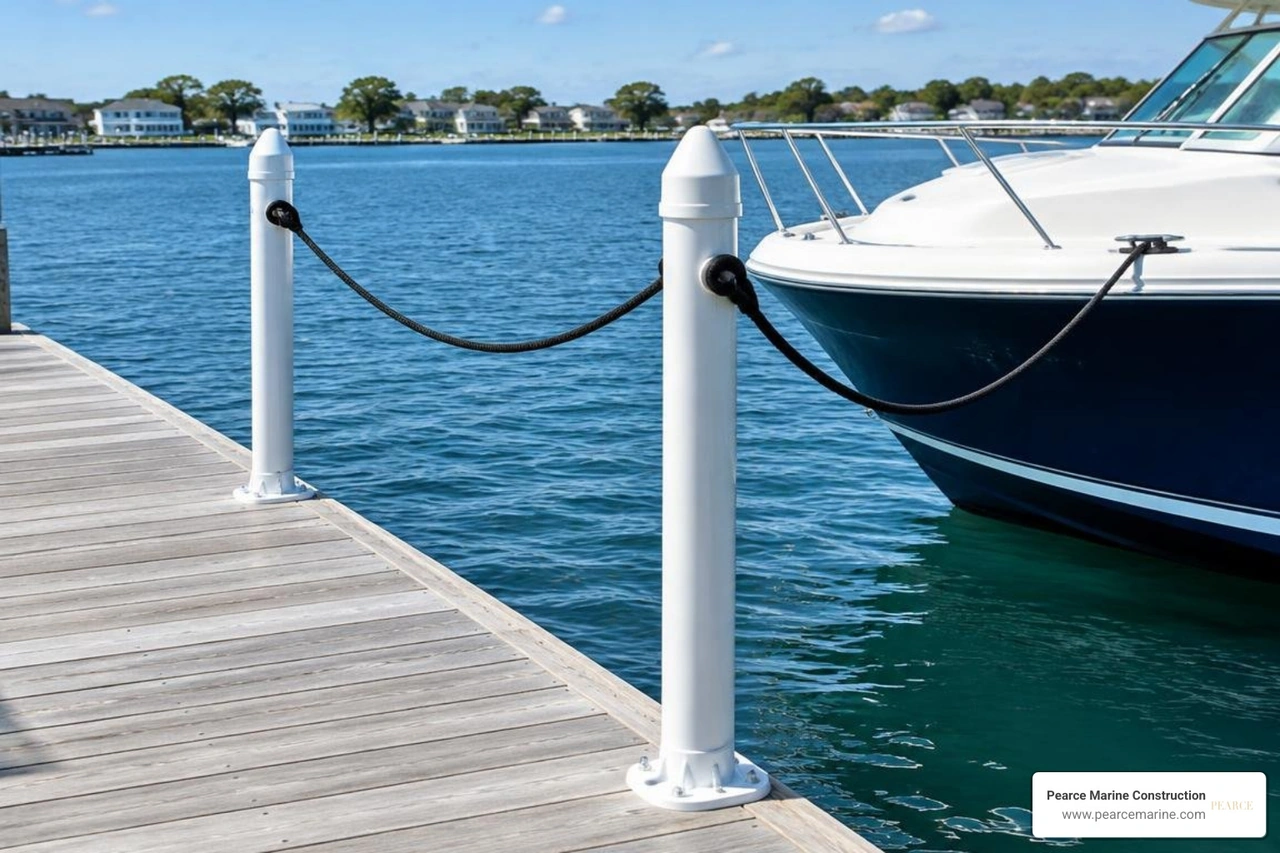
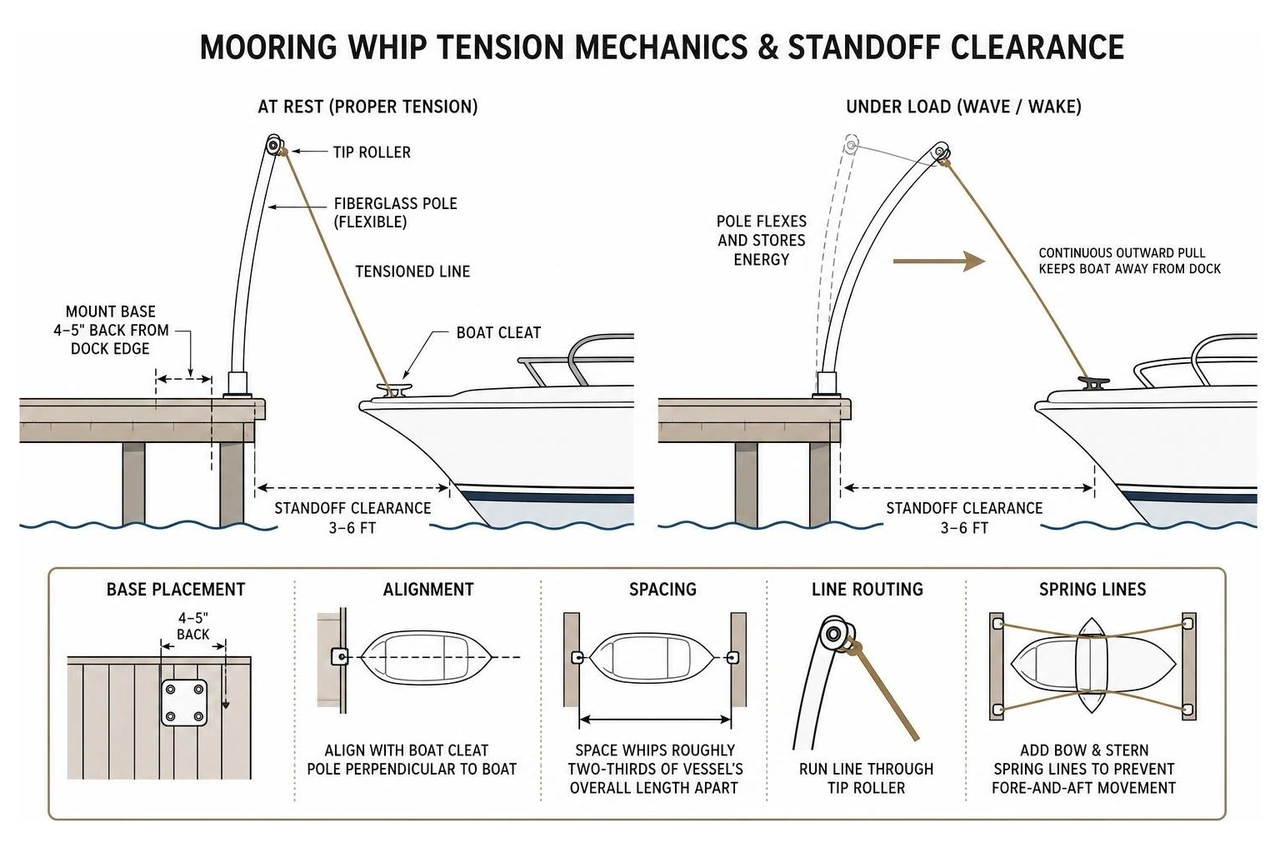
Mooring whips function as continuous spring-loaded cantilevers designed to pull a vessel away from the pier, distributing dynamic wave energy and wake loads away from the dock framing. Unlike standard bumpers that merely cushion direct contact, flexible fiberglass whips act as engineered anchoring systems, absorbing kinetic energy from incoming wakes and tidal currents to prevent structural fatigue along dock edges.
In high-energy coastal environments across Nassau and Suffolk Counties, including Great South Bay, Shinnecock Bay, Huntington Harbor, Southampton, and West Islip, heavy wake action imposes severe cyclic prying forces on dock stringers and deck boards. Marine contractors integrate heavy-duty boat dock accessories and dedicated whip anchoring systems directly into reinforced dock substructures to maintain a safe 3-to-6-foot standoff barrier, shielding both the pier framing and pilings from structural impact damage.
Professional Dock Whips Installation and Mounting Methods
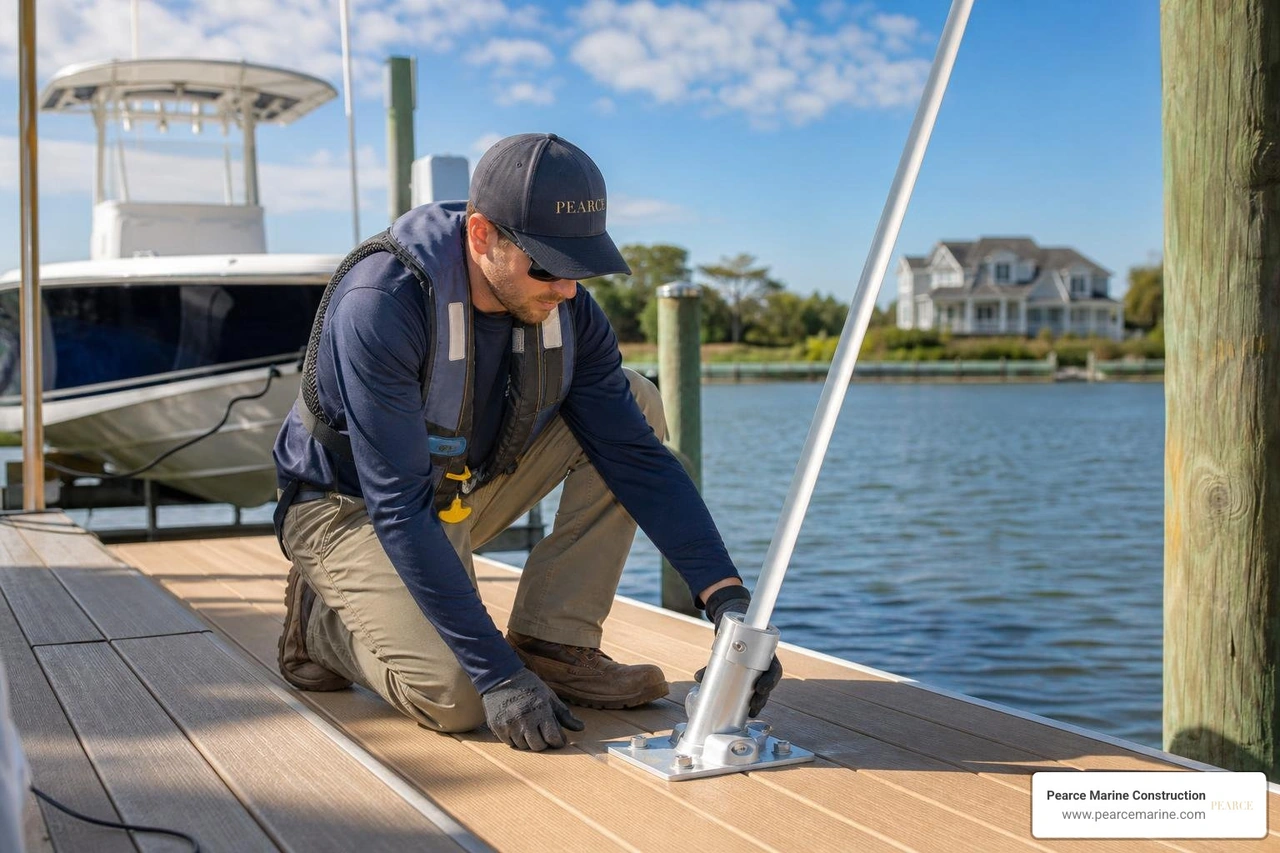
Professional marine contractors execute a secure dock whips installation by evaluating dock geometry, prevailing exposure, framing capacity, and tension loads. Mounting bases on the leeward side of the pier ensures that natural wind and wave forces work in tandem with the whips rather than placing continuous extreme strain on the dock fasteners.
High-tensile fiberglass whips exert significant upward prying torque on dock edge decking. To ensure structural longevity, marine builders tie mounting hardware directly into underlying structural stringers, joists, or reinforced sub-deck blocking rather than surface decking alone.
Preparing the Dock and Aligning Bases for Dock Whips Installation
- Engineering Base Spacing: Marine contractors calculate mounting locations based on vessel dimensions, placing bases at approximately two-thirds of the overall vessel length to balance dynamic load distribution.
- Perpendicular Alignment: Base sockets are aligned perpendicular to the vessel tie-off points at a precise 90-degree angle, eliminating dangerous lateral torque and uneven loading across the dock structure.
- Dock Edge Setback: Bases are set back 4 to 5 inches from the dock edge to preserve timber integrity and ensure adequate edge distance for structural fasteners.
- Framing Reinforcement: Prior to drilling, marine builders inspect the dock frame. Weathered framing requires sistered structural members or heavy backing plates, which contractors address through comprehensive dock repair before adding high-load hardware.
- Structural Fastener Installation:
- Timber Docks: Builders through-bolt bases into framing timbers using 3/8-inch 316 stainless steel carriage bolts, heavy-gauge washers, and locking nuts beneath the substructure.
- Concrete Piers: Locations are precision-drilled with masonry tooling and anchored using marine-grade 316 stainless steel wedge anchors or epoxy capsule systems.
Assembling Poles and Securing Whip Bases on Fixed and Floating Docks
Mooring whip systems utilize heavy pultruded fiberglass rods engineered to withstand heavy cyclic deflection. Professional installation practices include:
- Pole Assembly: Marine epoxy is applied inside structural ferrule sleeves on multi-piece systems to prevent water intrusion and joint failure under high dynamic flex.
- Base Socket Securing: Poles are seated into cast aluminum base sockets, aligning the roller tips perpendicular to the dock face, and secured to the manufacturer's specified torque limits to avoid crushing composite fibers.
- Corrosion Isolation: To prevent galvanic corrosion between 316 stainless steel hardware and cast aluminum bases in saltwater environments, non-conductive isolation washers are installed.
On floating docks in Nassau and Suffolk County waterways, whip installations are paired with robust floating dock anchoring infrastructure to absorb combined wave and tidal movement.
| Feature / Metric | Fixed-Base System | Rocker-Arm (Pivoting) Base |
|---|---|---|
| Typical Vessel Size Range | 18 to 33 ft (Up to 20,000 lbs) | 33 to 56 ft (Up to 48,000 lbs) |
| Fixed Angle Setting | Rigid 60-degree elevation | Pivoting / Retracts toward vertical |
| Tidal Suitability | Stable water or < 2 ft tidal change | High-tide zones (> 2 ft swings) |
| Primary Base Material | Cast Aluminum-Magnesium alloy | Cast Aluminum with heavy pivot pin |
| Adjustment Mechanism | Manual line tensioning at dock cleat | Integral free-play adjustment bolt |
Rigging Lines and Setting Proper Tension in Dock Whips Installation
Marine contractors run high-tensile braided lines through roller tip pulleys, ensuring smooth operation that minimizes friction and wear. Dockside control lines are integrated into structural configurations using proven dock cleat installation standards.
Tension is calibrated using the standard inch-per-foot deflection rule, tensioning the whip tip downward by one inch per foot of total pole length to establish balanced restorative force without exceeding fiber yield limits, adhering strictly to technical specifications in the English Whip Instructions.
Contractor Maintenance, Line Tuning, and Seasonal Removal
Routine contractor inspections ensure that dynamic anchoring hardware and dock framing remain structurally sound. Marine professionals evaluate dock connections for fastener loosening, inspect composite poles for stress fatigue, and check pivot hardware on rocker-arm mechanisms to ensure continuous performance under heavy marine exposure.
Integrating Spring Lines and Adapting for Long Island Tidal Swings
Mooring whips provide outward lateral standoff force and rely on complementary dock mooring lines to resist fore-and-aft drift. Marine contractors design comprehensive mooring configurations that combine whip bases with reinforced dock cleats.
Crossed spring lines distribute longitudinal tidal currents across multiple structural dock pilings while allowing the whips to maintain an uninterrupted standoff distance. In Nassau and Suffolk County waterways with tidal fluctuations of 2 to 4 feet or more, including waterfront sites near Southampton, Brightwaters, Cold Spring Harbor, and West Islip, contractors install rocker-arm pivoting bases. Adjusting the integral free-play bolt balances pivot tension against internal dampening cushions, allowing hardware to adapt to rising and falling water levels without over-stressing mounting bolts, as detailed in the Premium & Ultimate MOORING WHIP engineering documentation.
Contractor Inspection, Troubleshooting, and Winter Removal Practices
To preserve structural dock integrity and equipment longevity, marine builders design setups that avoid common engineering failures:
- Over-deflection prevention: Preventing line tension that pulls the whip tip below the base mounting plane to protect structural pole integrity.
- Eliminating lateral shear: Maintaining strict 90-degree perpendicular alignment between whip bases and tie points to avoid destructive side-loading on dock framing.
- Storm-rated anchoring design: Mooring whips are engineered for moderate conditions; contractors design heavy-duty storm mooring and piling tie-offs for extreme coastal surges and northeasters.
In Long Island communities such as Southampton, Brightwaters, West Islip, and Cold Spring Harbor, severe winter freeze-thaw cycles and ice floes place extreme loads on waterfront structures. Marine contractors ensure whip bases are permanently through-bolted into underlying framing while allowing pole elements to be unseated for winter storage, keeping the structural marine infrastructure protected year-round.
Expert Marine Construction Across Nassau and Suffolk Counties
Proper dock equipment installation requires a solid foundation. At Pearce Marine Construction, we bring generational expertise, meticulous engineering, and superior craftsmanship to every waterfront project across Nassau and Suffolk Counties. Pearce Marine stands apart from competitors such as Bayview Dockbuilders and Kevel through specialized engineering, precision dock substructure reinforcement, and unmatched local knowledge of Long Island waterways. Whether you need custom timber dock building in Babylon, heavy-duty piling driving in Massapequa, structural shoreline protection in West Islip, or dock anchoring systems in Southampton, our team delivers resilient marine infrastructure built to withstand coastal elements.
Contact us today to discuss custom boat docks and floating docks, structural dock framing, pile driving, bulkhead repair, seawall construction, or specialized hardware installations for your waterfront property.



Bring Your Vision to Life
Whether you're planning a custom dock, seawall, or boat lift, our experienced team is ready to deliver high-quality marine construction tailored to your needs. Pearce Marine Construction brings craftsmanship, precision, and a deep understanding of Florida’s waterways to every project. Let us help you create a durable, beautiful solution that stands the test of time. Get in touch now for a personalized estimate!