
The Ultimate Guide to Versatile Floating Platform Construction


Floating Platform Construction That Fits the Job
Start with the job the platform must do. Measure the needed deck space and load, then check water depth, tides, waves, and access. Choose pontoons or other buoyant supports that can carry the full load with room to spare. Plan how the platform will be anchored before selecting its shape or materials. For temporary work, modular sections can make transport, assembly, and later changes easier.
A floating platform can provide access for dock repairs, support equipment, or create a flexible waterfront workspace. Pearce Marine Construction is a woman-owned marine construction company serving residential, commercial, and public clients in Nassau and Suffolk Counties on Long Island, NY.

Know your Floating platform construction terms:
- Floating docks for lakes
- concrete floating dock construction
- floating dock construction techniques
- Buoyancy
Engineering Fundamentals for Modern Floating Platform Construction

Engineering a durable water-based structure requires understanding hydrodynamics, structural mechanics, and material science. Floating platform construction must address environmental loads—such as dynamic wave action, high winds, and continuous tidal changes—while maintaining horizontal stability and structural rigidity.
To prevent structural failure, the deck framing must distribute point loads across multiple buoyancy modules. Wave dampening is achieved through strategic hull shaping, pontoon spacing, and draft depth. The right material foundation determines how the structure behaves in rough coastal waters.
| Feature / Criteria | Steel Pontoon Assembly | High-Density Polyethylene (HDPE) | Engineered Concrete Floatation |
|---|---|---|---|
| Primary Strength | Extreme structural rigidity and point-load capacity | High impact resistance and chemical inertness | Exceptional mass, durability, and natural wave dampening |
| Corrosion Defense | Sacrificial zinc anodes and marine epoxy coatings | Immune to saltwater corrosion and marine growth | Marine-grade rebar with low-permeability concrete |
| Typical Application | Heavy machinery staging and industrial work decks | Modular work platforms and adaptable commercial docks | Permanent marina berths, deepwater platforms, and heavy piers |
| Maintenance Profile | Periodic hull coating and anode replacement | Low routine maintenance; UV-stabilized | Minimal maintenance; decades of service life |
Floating Platform Construction Materials and Buoyancy Systems
Buoyancy calculations dictate the baseline design: total displaced water mass must exceed the dead weight of the structure plus its maximum operating payload, with a safety factor usually of 1.5 to 2.0. In historical specifications such as the N55 research framework, an 8.4-meter triangular platform utilizing 189 low-density polyethylene tanks provides 7,500 kg of total buoyancy, delivering 2,000 kg of net payload capacity after structural framing.
Modern commercial installations rely on rotomolded HDPE hulls filled with expanded closed-cell EPS foam or engineered concrete floating docks. When building in the coastal waters of Massapequa, Babylon, or Merrick, hardware selection is critical. We use marine-grade 316 stainless steel fasteners and hot-dipped galvanized structural brackets. To counteract galvanic corrosion from salt spray and submerged electrical potentials, sacrificial zinc anodes are bolted across metal structural elements to protect submerged assemblies.

Modular vs. Monolithic Designs in Floating Platform Construction
Modular floating construction uses interlocking pontoon cells assembled into customized geometric layouts. For example, six standardized 2.5m × 10m × 0.9m steel or poly pontoons can be pinned together on-site into a 10m × 15m industrial platform equipped with an integrated crane.
Modular designs allow transport via standard flatbed trucks through congested coastal corridors in Nassau and Suffolk County, bypassing wide-load freight permits. When project scopes expand, crews connect additional pontoon cells without redesigning the core structure. Conversely, monolithic designs, such as massive concrete caissons or hexagonal structures up to 50 meters in diameter, offer lower natural wave resonance, unmatched deck rigidity, and long service lives for permanent commercial installations, as detailed in our custom dock construction guide.
Ballasting, Stability, and Load-Bearing Configurations
Maintaining positive metacentric height ($GM$) prevents listing or capsizing when shifting equipment across the deck. When placing asymmetrical live loads—such as an excavator or material pallet—on a floating platform, internal ballasting systems counteract uneven heel angles.
Techniques derived from patented large-scale marine fabrication methods show the effectiveness of controlled ballasting. Compartmentalized pontoon cells are partially flooded with water ballast to lower the center of gravity and submerge foundation columns for precision alignment, then de-ballasted using compressed air to regain full freeboard. This approach ensures deck deflection limits stay within tolerances, keeping the platform level during heavy industrial operations.
Contractor-Led Design Review for Long Island Floating Platforms
For a commercial, municipal, or residential waterfront project, a floating platform should be designed around the site rather than a standard layout. An experienced marine contractor reviews the working purpose of the deck, equipment access, shoreline connection points, water movement, anticipated live loads, and the condition of adjacent bulkheads or piers. That review helps determine whether the platform needs a modular arrangement, a heavier pontoon system, reinforced framing, or a more robust pile-guide or stiff-arm anchoring approach.
Local conditions shape those decisions. South Shore work sites can face open-bay exposure, wind-driven chop, and changing tidal conditions, while North Shore locations may require different approaches to shoreline geometry, deeper water, or protected harbor access. A sound construction plan accounts for the forces acting on the platform and the structure it connects to, including dock framing, pile capacity, bulkhead attachment points, and access ramps or gangways. Addressing these components together reduces the risk of premature movement, uneven loading, or connection failures after installation.
Pearce Marine Construction brings generational craftsmanship and specialized marine-construction experience to waterfront work throughout Nassau and Suffolk Counties. The team evaluates each project as a complete waterfront system, coordinating floating deck construction with the anchoring, pile driving, dock and pier building, custom decking, bulkhead, and shoreline-protection work that supports long-term performance. This contractor-led approach keeps material selection, structural framing, and site conditions aligned before construction begins.
Construction Sequence and Quality-Control Priorities
A durable floating platform installation depends on disciplined sequencing in the field. Crews first confirm the deck footprint, access route, connection locations, and anchoring layout. They then prepare the buoyancy modules and structural frame, set pile guides or other mooring components, and make the final deck and shoreline connections. Each stage should be checked for alignment, fastening integrity, load distribution, and clearance for expected water-level movement.
Quality control also extends to marine-grade hardware and finish details. Connections exposed to saltwater must be selected and installed to limit corrosion and unnecessary wear. Deck transitions, guardrail bases, access points, and utility penetrations require particular attention because they are common locations for movement and water intrusion. A professional installation team verifies that the assembled platform remains level under anticipated working loads and that anchoring components allow controlled vertical travel without excessive lateral play.
For Long Island waterfront properties and work sites, this attention to construction detail matters as much as the pontoon selection itself. A platform that is properly framed, anchored, and connected is better positioned to provide stable access for dock repairs, shoreline construction, equipment staging, and other marine infrastructure work.
Advanced Applications, Anchoring, and Installation Strategies
Installing floating infrastructure along Long Island’s South Shore or North Shore requires analyzing coastal bathymetry, sub-bottom soil profiles, and local tidal ranges. From Great South Bay to Huntington Harbor, tidal shifts of up to nine feet demand responsive anchoring hardware. Managing these engineering demands is central to our full-scope marine construction services.
Anchoring and Mooring Solutions for Coastal Tidal Waters
A floating platform is only as dependable as its mooring system. The dynamic interaction between wind shear, tidal currents, and wake turbulence requires purpose-built anchoring:
- Heavy-Duty Pile Guides: Heavy-gauge steel or UHMW-lined collars slide smoothly over driven timber, steel, or composite pilings. This design keeps the platform in horizontal alignment while allowing free vertical rise during severe storm surges.
- Telescoping Stiff Arms: When pilings cannot be driven due to restrictive waterfront boundaries or hard seabed strata, heavy structural steel stiff arms anchored into reinforced concrete seawalls provide rigid lateral control.
- Helical Moorings and Deadweight Anchors: In deeper waters or environmentally sensitive zones, helical pile installation provides exceptional uplift and lateral holding power directly into the substrate. This eliminates dragging risks associated with concrete deadweight blocks.
For challenging open-bay exposures, engineering a comprehensive layout based on floating dock anchoring systems protects the platform and adjacent waterfront bulkheads from shock loads.
Specialized Heavy-Equipment and Industrial Use Cases
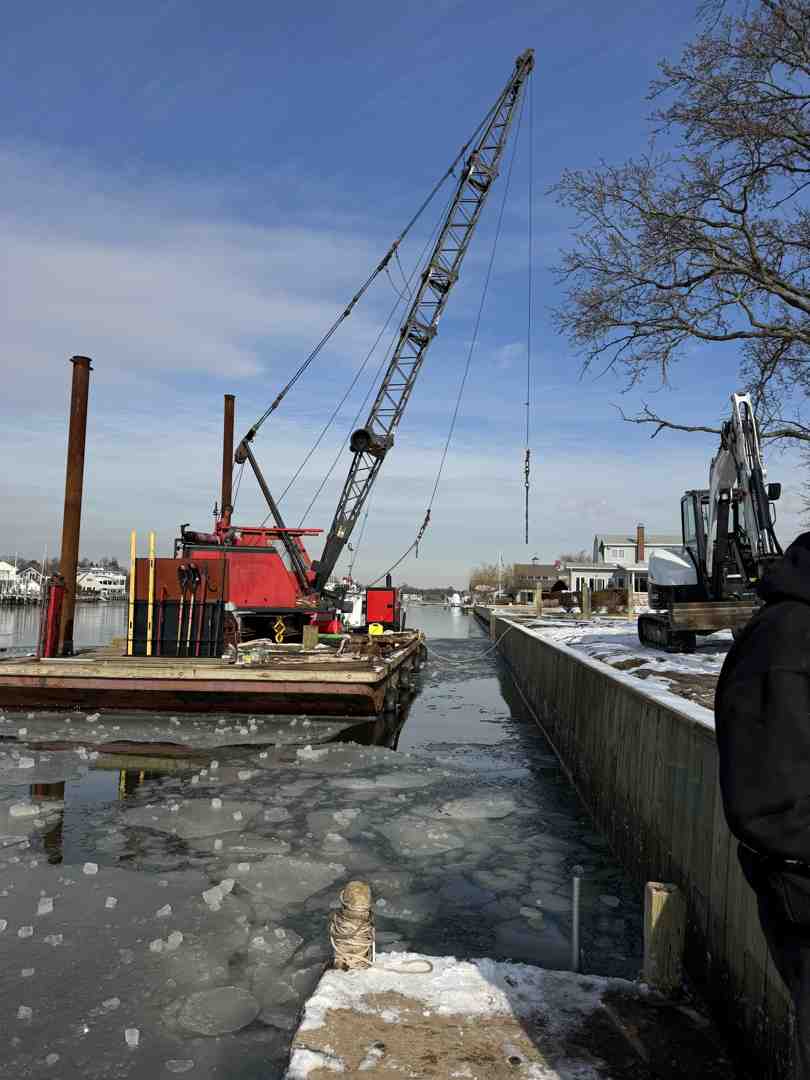
Industrial marine construction requires robust on-water equipment support. Custom modular platforms can be configured to support a 5-ton knuckle boom crane with a 7-meter working radius for marine pile driving, material transfer, and bulkhead repairs.
Designing platforms for heavy equipment requires:
- Reinforced Deck Substructures: Under-deck steel trusses and load-spreading plates that distribute crane outrigger pressures directly across the structural frame.
- Perimeter Tie-Down Rings: Forged steel D-rings rated for multi-ton tension loads to secure generators, excavators, and sheet pile packs.
- Removable Safety Guardrails: Heavy-gauge, bolt-fixed railings that can be disassembled during crane swing operations, combining crew safety with functional clearance.
Managing these technical requirements demands the precision planning covered in professional marine project management.
When to Specify a Custom Floating Work Platform
Custom floating platforms are most appropriate when a standard dock configuration cannot safely support the planned construction activity. Examples include projects that require temporary material staging, equipment access beside a bulkhead or seawall, pile-driving support, or a stable work surface during dock and pier construction. In these situations, the platform must be matched to the anticipated load path, operating area, and anchoring constraints instead of being treated as a general-purpose floating deck.
A contractor should also assess how the platform will interact with the existing waterfront structure. A deteriorated bulkhead, undersized piling, limited shoreline access, or narrow canal can change the recommended construction method. Pearce Marine Construction evaluates those conditions across Nassau and Suffolk Counties to determine practical attachment, anchoring, and access solutions that support safe marine construction operations while protecting the surrounding shoreline infrastructure.
Emerging Innovations in Sustainable and Unmanned Platforms
The marine construction sector continues to evolve through advancements in modular engineering and material sustainability:
- ESSA Design Principles (Eliminate, Simplify, Standardize, Automate): Modern platforms are engineered with standardized, modular components that reduce maintenance requirements. Unmanned platforms can eliminate non-essential topside elements, focusing exclusively on operational stability and remote structural health monitoring.
- Eco-Conscious Concrete & Low-Carbon Composites: New platform designs incorporate low-carbon pozzolanic concrete formulations that resist sulfate attacks in saltwater environments. Non-reactive deck surfaces prevent toxic leaching into protected coastal estuaries.
- Deepwater Energy Support Foundations: Scaled modular concepts are now used to support offshore power links, modular generation platforms, and coastal grid-connection hubs positioned offshore in depths exceeding 100 meters.
Build Your Waterfront Infrastructure with Long Island's Marine Experts
Whether you need a heavy-duty industrial work deck, a specialized commercial pier, or a durable shoreline workspace, Pearce Marine Construction delivers reliable engineering and long-lasting durability. As a woman-owned marine construction contractor rooted in Long Island, NY, we bring generational craftsmanship, specialized equipment, and deep local regulatory expertise to every project.
Our team builds marine structures for residential, commercial, and municipal clients across Nassau and Suffolk Counties, including Massapequa, Merrick, Bellmore, Wantagh, Brightwaters, West Islip, Babylon, Bayshore, Huntington, Cold Spring Harbor, Lloyd Harbor, Southampton, and Westhampton.
Pearce Marine Construction applies generational craftsmanship, specialized equipment, and a construction-first approach to custom marine engineering and enduring shoreline protection across Long Island. For floating platform construction, that means evaluating the platform, anchoring system, connecting structures, and site conditions as one coordinated waterfront project.
Connect with our engineering team today to review your site plans, evaluate anchoring needs, and explore custom floating platform solutions by Pearce Marine Construction.



Bring Your Vision to Life
Whether you're planning a custom dock, seawall, or boat lift, our experienced team is ready to deliver high-quality marine construction tailored to your needs. Pearce Marine Construction brings craftsmanship, precision, and a deep understanding of Florida’s waterways to every project. Let us help you create a durable, beautiful solution that stands the test of time. Get in touch now for a personalized estimate!