
How Much Do Helical Piers Cost to Install?


What Do Helical Pile Installation Costs Actually Look Like?
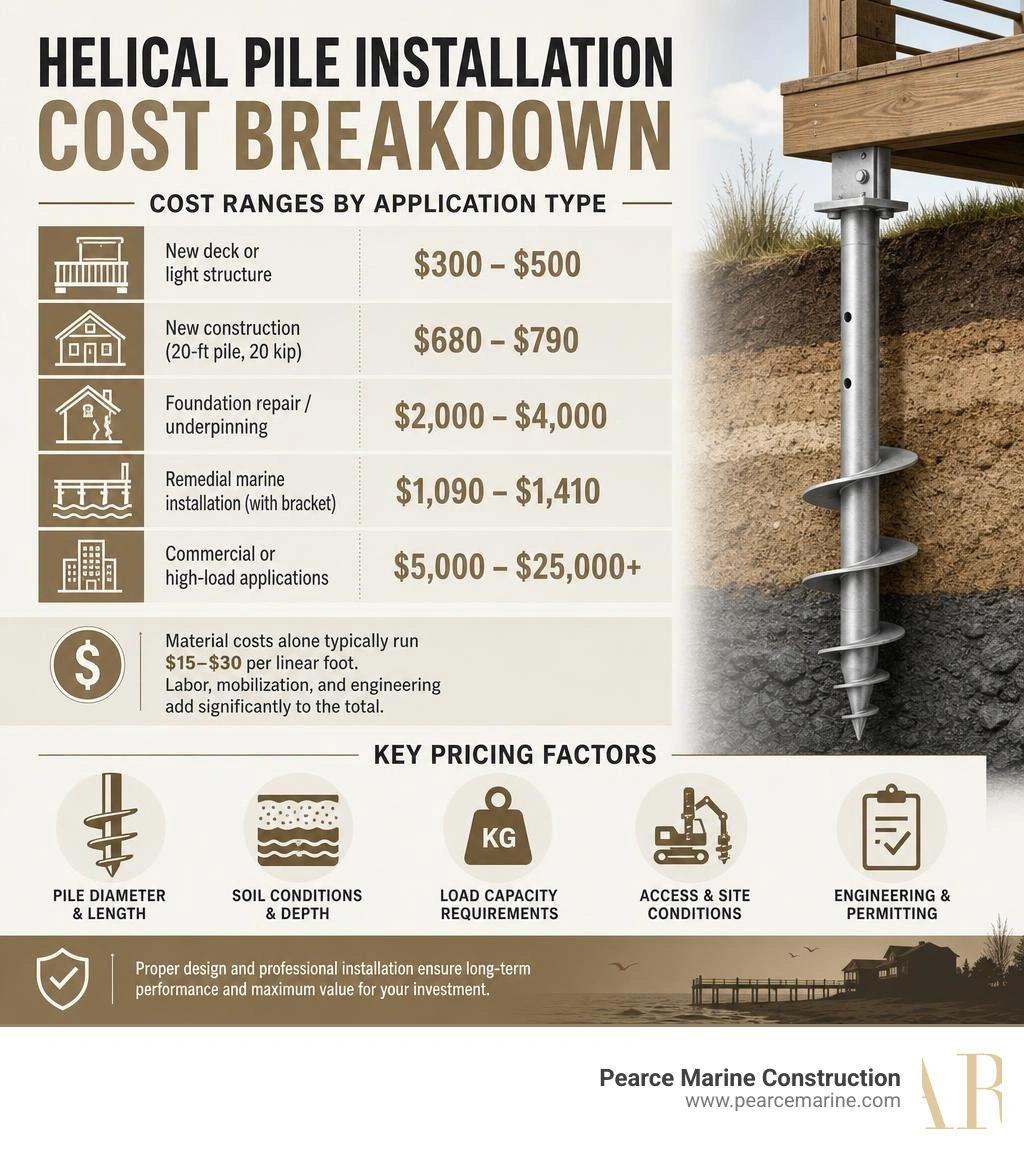
Helical pile installation costs vary widely depending on your marine project type, soil conditions, and pile specifications — but here's a quick breakdown to give you an immediate sense of what to budget for professional marine construction services:
| Marine Application | Typical Cost Per Pile |
|---|---|
| Waterfront deck or light marine structure | $300 – $500 |
| New marine construction (20-ft pile, 20-kip) | $680 – $790 |
| Bulkhead / shoreline underpinning | $2,000 – $4,000 |
| Remedial marine installation (with bracket) | $1,090 – $1,410 |
| Commercial marine or high-load shoreline applications | $5,000 – $25,000+ |
Material costs alone typically run $15–$30 per linear foot. Labor, mobilization, and engineering add significantly to the total.
If you own waterfront property in Nassau or Suffolk County, you already know that foundations don't get easier near the water. Shifting sands, tidal erosion, organic silt layers — Long Island's shoreline soils can swallow a poorly designed foundation fast.
Helical piles have become the go-to deep foundation solution for marine construction along Long Island's south shore, from West Hampton to Southampton to West Islip. They screw deep past unstable surface soils into load-bearing strata, delivering immediate structural capacity without excavation or concrete curing time.
But what does it actually cost to have them installed? The honest answer is: it depends on more variables than most contractors will tell you upfront.
This guide breaks down every cost factor clearly — from pile diameter and soil depth to regional pricing and long-term value — so you can go into any contractor conversation fully informed.
Helical pile installation costs further reading:
Helical Pile Installation Costs: Key Pricing Factors

When calculating helical pile installation costs, we look at several interconnected factors. A helical pile is not a one-size-fits-all commodity; it is a custom-engineered deep foundation component. The physical properties of the pile itself dictate a large portion of the material costs, while site accessibility and engineering requirements dictate the labor and machinery costs.
To understand where your money goes, let's break down the primary structural drivers of the final price:
- Pile Shaft Diameter and Thickness: Larger marine structures require thicker steel. Standard waterfront piles typically use 2 7/8-inch to 3 1/2-inch round shafts or comparable square shafts. High-load commercial marine applications require heavy-duty shafts that increase raw material costs by 50% or more.
- Helix Configuration: The helices are the circular plates welded to the shaft that provide the bearing capacity. A pile can have a single, double, or triple helix configuration. More plates mean more surface area, higher load ratings, and higher manufacturing costs.
- Steel Grade and Corrosion Protection: Marine environments on Long Island are incredibly corrosive. Using standard black steel is a recipe for early structural failure. We always recommend hot-dip galvanization to EN ISO 1461 standards, which shields the steel against aggressive saltwater and extends the foundation's lifespan to 100 years. This treatment typically adds 15% to 25% to the material cost but is non-negotiable for waterfront durability.
- Mobilization and Equipment Setup: Getting heavy hydraulic machinery onto a tight waterfront lot in Babylon or Bayshore requires specialized logistical planning. Mobilization fees cover the transport of excavators, drive heads, and torque-monitoring equipment to the jobsite.
For a comprehensive breakdown of pile engineering, check out our Helical Piles Complete Guide.
Average Helical Pile Installation Costs for New Construction
For new waterfront and marine construction projects across Nassau and Suffolk County, installing helical piles before the structural framing begins is highly efficient. In a clean-slate environment, there are no existing structures to work around, allowing crews to drive piles rapidly using excavator-mounted hydraulic drive heads.
For a standard 20-foot helical pile with a double-helix configuration and a 20-kip (20,000 lbs) allowable capacity, the average installed cost ranges from $680 to $790 per pile. These installations typically terminate with a grade beam cap, which is integrated directly into the concrete grade beam or custom timber marine framing.
Because setup and mobilization costs are distributed across multiple foundation points, the cost per pile drops significantly as the project scale increases. This makes helical piles highly competitive for new waterfront foundations, docks, and shoreline boardwalks. You can explore more detailed pricing tables in our Helical Piles Cost Guide 2026 or reference national residential benchmarks via How Much Do Helical Piers Cost? (2026).
Remedial Helical Pile Installation Costs for Marine Foundations
Remedial marine underpinning is a completely different beast. If you are dealing with a settling bulkhead, a listing dock, or a boat lift foundation that is actively sinking into the canal mud in Massapequa or Merrick, the installation process is more complex.
Remedial installations require excavating down to the existing foundation footings, preparing the connection points, and using heavy-duty underpinning brackets to transfer the structural weight to the newly installed steel piles. Because of the manual labor, excavation, and specialized bracket hardware required, remedial marine helical pile installations average $1,090 to $1,410 per pile.
When a bulkhead or dock foundation requires stabilization, stabilizing the structure prevents catastrophic failure. For detailed engineering steps on remedial underpinning, read our guide on the Cost to Install Helical Piers.
How Soil Conditions and Depth Impact Pricing
Long Island's coastal geology is notoriously variable. While the north shore (such as Cold Spring Harbor, Huntington, and Lloyd Harbor) features clay and rocky glacial till, the south shore is dominated by shifting sandy soils and deep layers of soft, organic muck.
Helical piles achieve their load-bearing capacity by being screwed down until the installation torque reaches a target value specified by structural engineers. This torque-to-capacity ratio guarantees that the pile has reached a stable, load-bearing soil stratum.
If your property sits on a deep layer of organic silt, a standard 10-foot or 20-foot pile will not suffice. We must add shaft extensions until the pile bites into solid load-bearing sand or till. Because material costs average approximately $30 per linear foot, extending a pile from 20 feet to 40 feet will add roughly $600 in material and labor per pile.
For a deeper dive into how Long Island's unique coastal soils dictate deep foundation designs, consult our Helical Piles Long Island Guide.
Comparing Deep Foundation Methods: Helical Piers vs. Driven Timber Piles

When building waterfront structures like custom marine decks, docks, and shoreline walkways on Long Island, choosing the right deep foundation is a critical decision. Traditionally, driven timber piles have been the standard, but modern engineering favors steel screw piles for their precision, speed, and minimal environmental footprint.
| Feature | Helical Steel Piers | Driven Timber Piles |
|---|---|---|
| Primary Material | Hot-dip galvanized structural steel | Pressure-treated wood |
| Installation Method | Screwed hydraulically (vibration-free) | Hammered via impact pile driver |
| Average Depth | Adjustable (using extensions to reach solid strata) | Fixed length (limited by pile size) |
| Load Verification | Real-time torque monitoring during install | Rough blow-count estimation |
| Environmental Impact | Zero soil displacement, minimal disturbance | Significant shoreline disruption |
| Curing / Waiting Time | None — immediate load transfer | None |
| Lifespan in Marine Soil | 50 to 100+ years | 20 to 30 years (subject to marine borers) |
To understand how these systems compare structurally, read our Helical Pile Foundation Complete Guide.
Cost-Performance Analysis: Helical Piers vs. Driven Timber Piles
At first glance, a single pressure-treated timber pile appears cheaper than a steel helical pier. A typical timber pile can cost between $450 and $850 to install. In comparison, a marine-grade helical pier ranges from $1,500 to $2,000 for high-load waterfront applications.
However, looking only at the per-pile cost is a common mistake. Driven timber piles require heavy, specialized pile-driving rigs that cause massive soil vibration and require wide site access, often tearing up lawns, seawalls, and existing shoreline structures. The mobilization of these massive rigs can add thousands of dollars to your project.
In contrast, helical piles are installed using compact, low-impact excavators fitted with hydraulic drive heads. They screw into the ground with virtually zero vibration, making them perfect for tight waterfront lots in Brightwaters, West Islip, or Wantagh where heavy equipment cannot easily pass. When you factor in the reduced site preparation, faster installation speeds (often completing a residential marine project in 1 to 2 days), and zero restoration costs, the total project cost of helical piles is highly competitive.
For a complete breakdown of total project economics, see the How Much Do Screw Piles Cost Complete Price Guide and our Screw Pier Installation Guide 2026.
Long-Term Financial Benefits of Steel Screw Piles
Coastal foundations face constant environmental stress. From tidal cycles to winter freeze-thaw cycles, the upper layers of soil are constantly moving. Timber piles are susceptible to frost heave, where freezing surface water grabs the wooden shaft and lifts it, destabilizing the entire deck or dock. Furthermore, timber is vulnerable to marine borers and rot over time.
Steel helical piles are engineered to resist these forces:
- Frost Heave Resistance: Because the helical bearing plates are anchored deep below the active frost line (and well into stable marine soils), the pile remains completely stationary. The smooth, narrow steel shaft minimizes the surface area that freezing surface soils can grip.
- Zero Maintenance: Once installed, hot-dip galvanized steel piles require zero ongoing maintenance. They do not rot, warp, or degrade in saltwater.
- 100-Year Durability: High-quality steel screw piles deliver a 50 to 100-year service life, safeguarding the structural integrity of your shoreline assets for generations.
To learn more about how helical piles protect waterfront decks, view our guide on Helical Piles for Decks.
Selecting a Certified Marine Piling Contractor on Long Island
When investing in a deep foundation for your waterfront home foundation, dock, or bulkhead, the quality of the installation is just as important as the quality of the steel. Because helical pile capacity is directly tied to the torque applied during installation, you need a contractor who utilizes calibrated torque-monitoring equipment and works hand-in-hand with structural engineers.
At Pearce Marine Construction, we bring generational marine construction expertise and meticulous craftsmanship to every project across Nassau and Suffolk Counties. As a premier woman-owned marine contracting firm, we understand the unique environmental and geological challenges of Long Island's shoreline. Whether we are stabilizing a bulkhead in West Hampton, building a custom dock in Southampton, or underpinning a waterfront home foundation in West Islip, we do not believe in shortcuts.
While general contractors or less specialized outfits may offer generic piling services, they often lack the specialized marine engineering partnerships and high-torque machinery required to guarantee long-term performance in shifting coastal soils. We provide fully engineered, turn-key deep foundation solutions tailored specifically to your site's soil profile and load requirements.
Don't leave the future of your waterfront structure to guesswork. Partner with Long Island's trusted marine piling experts.
- Verify our credentials: Certified Helical Pile Installers
- Explore our process: Marine Piling Installation Complete Guide
- Ready to build? Explore our professional marine construction services and request your custom shoreline foundation consultation today.



Bring Your Vision to Life
Whether you're planning a custom dock, seawall, or boat lift, our experienced team is ready to deliver high-quality marine construction tailored to your needs. Pearce Marine Construction brings craftsmanship, precision, and a deep understanding of Florida’s waterways to every project. Let us help you create a durable, beautiful solution that stands the test of time. Get in touch now for a personalized estimate!