
Helix Pile vs Concrete Footings: Which Foundation Holds Up Best?


Engineering Mechanics and Selection of Helix Pile Systems
When Pearce Marine Construction evaluates site conditions across Nassau County and Suffolk County — including coastal properties in Southampton, West Islip, Massapequa, and Babylon — engineering precision is non-negotiable. Soft silt, shifting sand, and deep organic peat layers mean surface soil rarely offers the bearing capacity needed for durable marine structures. This is where a custom helix pile foundation installed by our specialized marine foundation crews excels.
By utilizing specialized computational tools like HelixPile Analysis Software — relied upon by over 3,000 professional engineering firms globally — marine engineers and our construction team accurately simulate complex soil profiles and load requirements down to exact depths. The structural efficiency of a helix pile relies on transferring structural weight past weak topsoil directly into dense subsoils via welded helical plates. For a deep dive into foundation engineering concepts, explore our helical pile foundation complete guide.
Types of Round, Square, and Combo Helix Pile Shafts
Choosing the right central shaft shape depends entirely on the types of forces your coastal structure will encounter during installation by Pearce Marine Construction:
- Square Shaft (SS) Piles: Solid round-cornered square steel shafts (typically 1.25 to 2.25 inches) offer high tensile strength and penetrate hard, dense soil strata easily. They feature the highest torque correlation factor ($K_t = 10$), delivering exceptional efficiency for axial compression and tension loads up to 50–200 kips. However, because they are slender, they have limited bending resistance under lateral forces unless encased.
- Round Pipe Shaft (RS) Piles: Hollow structural steel pipe shafts (ranging from 2.875 to 8.625 inches in outer diameter) provide superior cross-sectional area and high bending stiffness. This mechanical profile allows round shafts to effectively resist columnar buckling in soft upper soils and withstand strong lateral loads from waves and tides.
- Combo Piles: A hybrid design that joins a solid square shaft lead section (for deep soil penetration through tough strata) to a hollow round pipe shaft extension near the surface using cast transition couplers. This gives marine structures the best of both worlds without changing drive tools mid-installation.
- Displacement Piles: Designed with displacement plates that expand the hole during insertion, allowing an encapsulating grout column to fill the surrounding void. This generates extra axial capacity via skin friction while completely protecting steel components against severe subterranean corrosion.
For light-duty residential walk-outs or heavy-duty pier applications, referring to manufacturer technical charts helps determine precise plate and pipe dimensions. You can also review our detailed helical pile installation complete guide.
Determining Load Capacity with Helix Pile Installation Torque
One of the greatest engineering advantages of a helix pile installation by Pearce Marine Construction is that its ultimate load capacity is verified in real time during installation. As our heavy hydraulic machinery drives the screw pile into the ground, torque resistance increases proportionally with soil strength.
The empirical relationship governing ultimate axial capacity is calculated using the torque-to-capacity formula:
$$Qu = Kt \times T$$
Where:
- $Q_u$ = Ultimate geotechnical axial load capacity (lbs or kips)
- $Kt$ = Empirical torque correlation factor (ft⁻¹), varying based on shaft geometry ($Kt = 10$ for square shafts, $K_t = 6\text{--}9$ for round pipes)
- $T$ = Final installation torque measured in ft-lbs
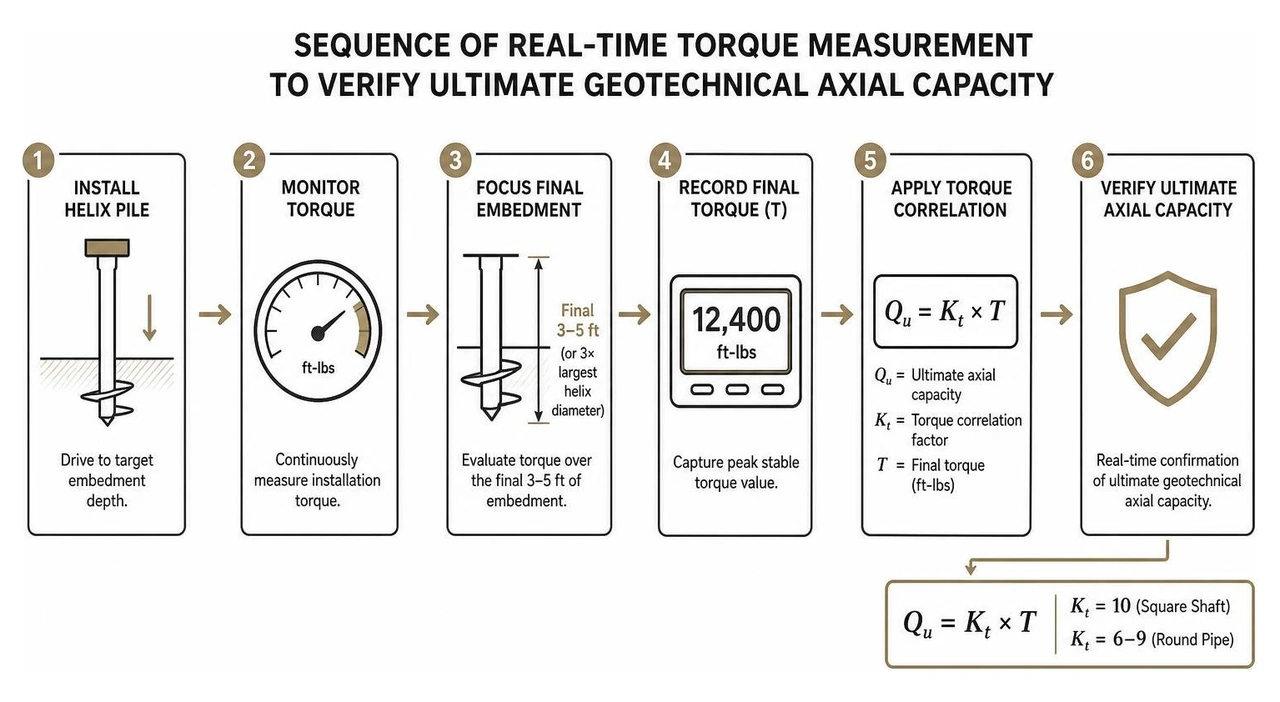
By monitoring hydraulic drive pressure over the final 3 to 5 feet of embedment (or three times the diameter of the largest helix plate), our field crews confirm exact soil bearing resistance without waiting for external laboratory tests. For engineering design codes and field guidelines, consult the Simplified Design and Inspection Guide.
Key Structural Design Factors for Coastal Marine Foundations
Designing long-lasting coastal foundations across Nassau County and Suffolk County communities like Southampton and West Islip demands careful attention to specific environmental hazards:
- Bending Stiffness & Lateral Resistance: Tidal surges, wind loads, and wave impacts generate strong horizontal shear forces on dock pilings and bulkhead tiebacks. Utilizing larger round HSS pipe shafts provides the cross-sectional moment of inertia required to prevent displacement.
- Columnar Buckling in Soft Soil Strata: Saturated organic peat and soft salt marsh soils offer little lateral restraint. In these soft layers, slender solid shafts risk buckling under heavy downward compressive loads. Choosing thick-walled pipe shafts or grouted displacement shafts eliminates this risk.
- Corrosion Resistance in Saltwater: Coastal environments accelerate steel degradation. To guarantee a 75 to 100-year design life, high-grade carbon steel (such as ASTM A500 Grade C with 51 ksi minimum yield strength) is hot-dip galvanized according to ASTM A123 standards or coated with specialized polymer coatings under ICC AC228 standards.
- Expansive and Shifting Marine Clay: Helical plates must be anchored deep below active soil movement layers and frost lines (typically anchored 5 to 6 feet deep minimum in our region) to ensure total structural stability.
Learn more about adapting deep footings for residential elevated marine structures in our guide on helical piles for decks.
Deep Foundation Performance in Long Island Marine Applications
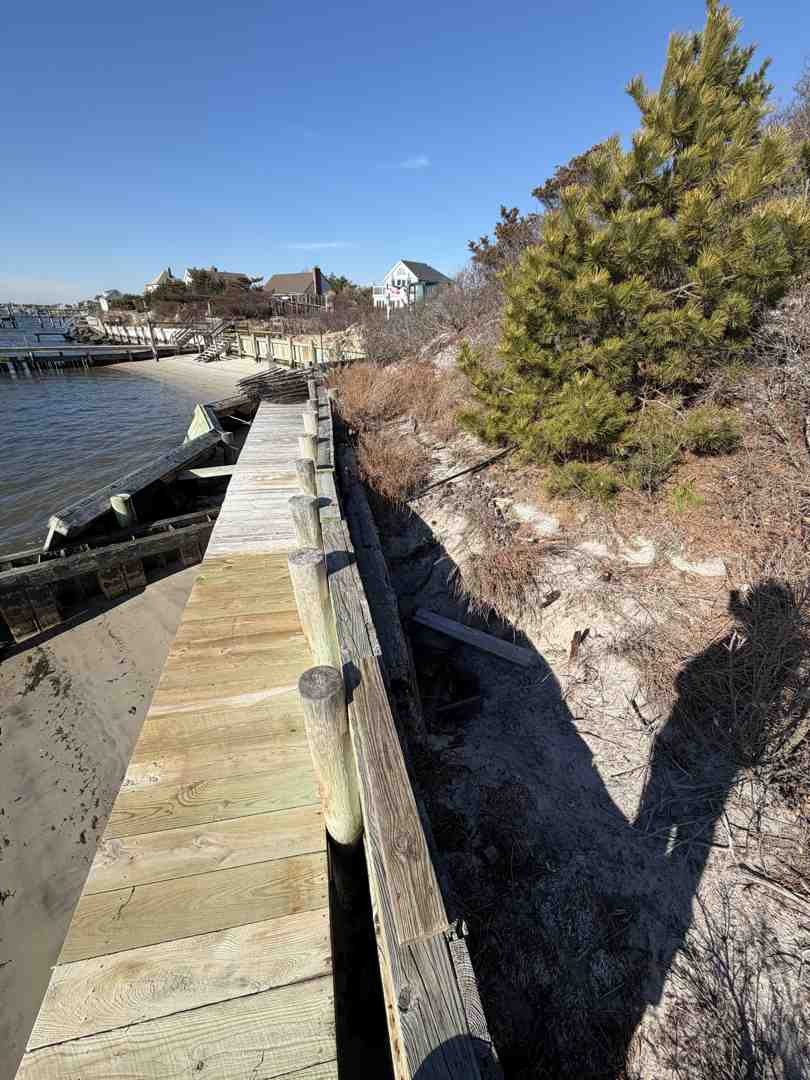
From Southampton to West Islip, building marine infrastructure on Long Island presents unique challenges. The proximity to marshlands and open bay waters makes traditional poured concrete footings vulnerable to severe cracking, settling, and tidal erosion. A helix pile system circumvents these environmental vulnerabilities by driving deep through weak surface soils down into stable, dense sand or hardpan layers.
Performance Comparison: Deep Screw Foundations vs Poured Concrete
To understand why custom marine builders rely heavily on steel screw foundations over traditional concrete, consider how they stack up side by side in coastal construction settings:
| Engineering Parameter | Modern Helix Pile System | Traditional Poured Concrete Footing |
|---|---|---|
| Installation Footprint | Low impact; compact hydraulic machinery used | Heavy excavation; large earthmoving equipment required |
| Soil Spoils Generated | Near zero; soil is compacted, not excavated | Massive volume of wet soil spoils requiring offsite disposal |
| Curing Time Delay | Zero wait time; immediate full load bearing capacity | Requires 28 days to achieve full design compressive strength |
| Tidal & Sub-Zero Impact | Unaffected by water table; anti-friction sleeves stop frost heave | Water dilution weakens concrete mix; high risk of freeze crack |
| Erosion & Scour Vulnerability | High; deep steel shaft stays firmly anchored below scour zone | High risk; surface water washes soil out from beneath shallow footings |
| Target Lifespan | 75 to 100 years with hot-dip galvanized steel | 15 to 30 years in harsh saltwater freeze-thaw conditions |
Because screw piles require zero curing time and generate zero soil spoils, construction on upper structures like piers, bulkheads, and custom timber decks can begin the exact moment the drive head disengages. To read further on coastal foundation selection across the South Shore and North Shore, view our complete helical piles long island guide.
Quality Control, Torque Inspection, and Engineering Compliance
Ensuring long-term structural integrity requires rigorous field quality control during every step of insertion:
- Uniform Helix Pitch: All helical plates must maintain a precise, uniform 3-inch pitch. This allows multi-helix plates to follow the exact same helical track into the soil without churning or agitating the surrounding earth.
- Inter-Helix Spacing: Multi-helix configurations space plates along the shaft at a distance equal to at least three times the diameter of the lower helix plate. This guarantees each helix bears load on undisturbed soil strata.
- Continuous Torque Logging: Hydraulic pressure gauges continuously monitor rotational resistance. Reaching the engineered target torque over the final embedment depth confirms the pile meets design load requirements under a standard Safety Factor of 2.
- Code Compliance: Commercial-grade helical systems strictly comply with ICC-ES AC358 building criteria and carry evaluation listings like IAPMO UES ER-481 to guarantee performance under maximum building code standards.
Selecting the Best Marine Foundation System for Nassau and Suffolk Counties
At Pearce Marine Construction, we bring generational craftsmanship and deep local expertise to every marine project we build. As a woman-owned business serving residential, commercial, and municipal clients across Massapequa, Merrick, Wantagh, Bellmore, Brightwaters, West Islip, Babylon, Westhampton, Southampton, Bayshore, Cold Spring Harbor, Huntington, and Lloyd Harbor, we understand the distinct soil mechanics of Long Island shorelines better than anyone.
Whether anchoring high-capacity bulkhead tiebacks, supporting deep pier footings, or building custom waterfront decking, we engineer foundation systems built to withstand decades of harsh coastal weather. When compared to traditional driven timber or poured concrete piers, galvanized helix piles offer superior speed, precision, and longevity.
Ready to secure your waterfront property with an engineered deep foundation system built for Long Island waters? Explore our specialized Pearce Marine Construction Services or check out our complete line of helical piles marine solutions today to schedule a site evaluation with our engineering specialists!



Bring Your Vision to Life
Whether you're planning a custom dock, seawall, or boat lift, our experienced team is ready to deliver high-quality marine construction tailored to your needs. Pearce Marine Construction brings craftsmanship, precision, and a deep understanding of Florida’s waterways to every project. Let us help you create a durable, beautiful solution that stands the test of time. Get in touch now for a personalized estimate!