
Floating or Fixed? Your Long Beach Dock Installation Roadmap


Choosing a Dock for Your Long Beach Waterfront
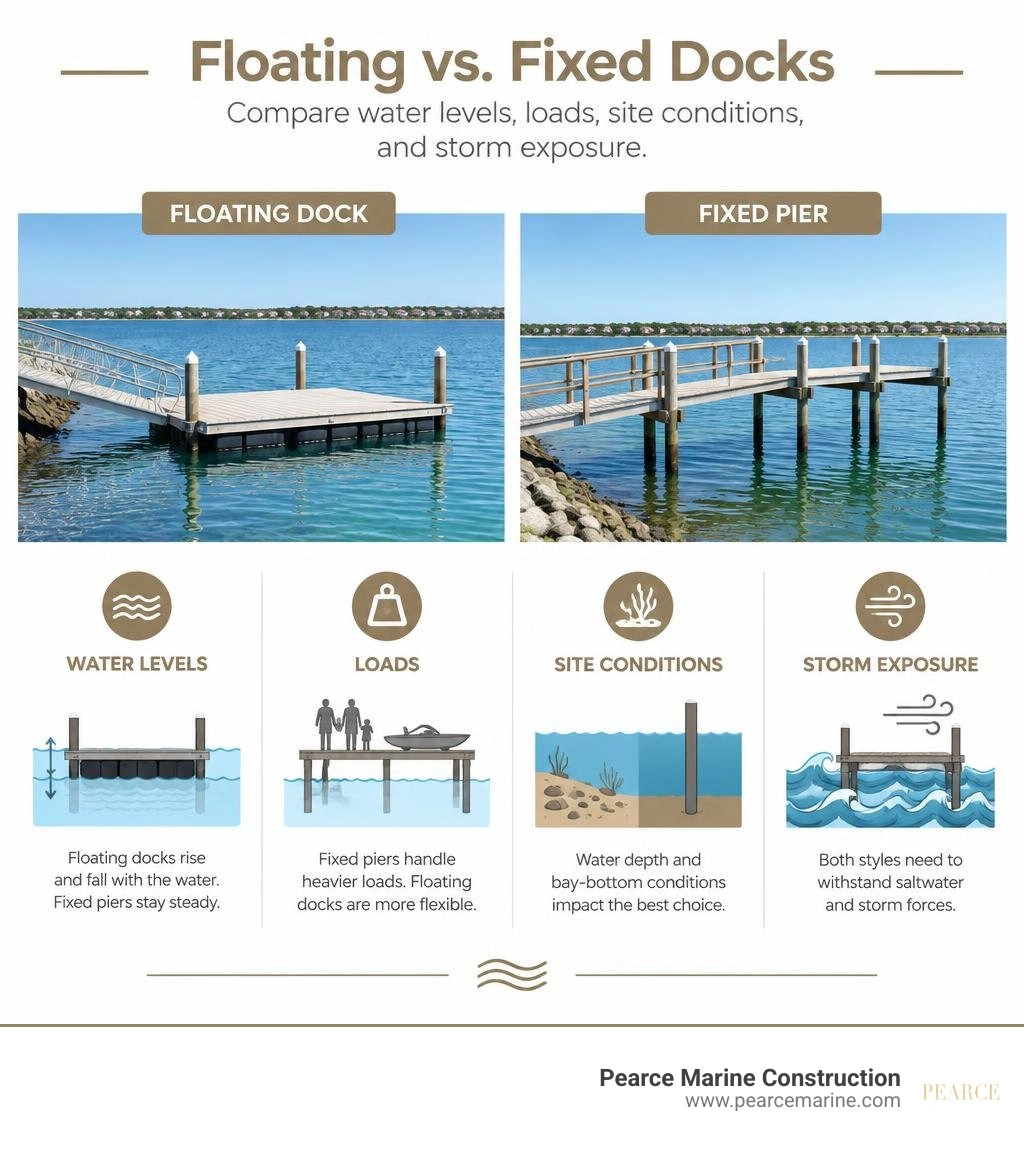
Choose a floating dock if changing water levels make access your main concern. Consider a fixed pier if you need a steady walkway or plan to support heavier loads. Neither is the safer choice by default: water depth, bay-bottom conditions, saltwater exposure, and storm forces should shape the design.
Start a Long Beach dock installation with a site assessment, then confirm engineering requirements before ordering materials. As a woman-owned company delivering specialized long island marine construction services, Pearce Marine Construction serves residential, commercial, and public clients across Nassau and Suffolk Counties, ranging from Huntington marine services on the North Shore to heavy-duty patchogue marine infrastructure on the South Shore.
Navigating Coastal Waterfront Systems in Long Beach

Long Beach occupies a dynamic barrier island setting along the South Shore of Long Island, framed by Reynolds Channel to the north and the Atlantic Ocean to the south. Waterfront properties in this region face consistent tidal swings between four and six feet, corrosive saltwater chemistry, and recurring coastal storm surges. Engineering a resilient marine structure requires careful evaluation of tidal dynamics, channel currents, and the property's specific shoreline geometry.
Designing a waterfront system in Nassau County is never a one-size-fits-all endeavor. The bay-bottom topography ranges from dense sandy silt to soft organic mud, each dictating how support structures transfer mechanical loads. The decision framework below highlights how distinct coastal site conditions dictate dock configurations.
Comparing Floating and Stationary Systems for Long Beach Dock Installation
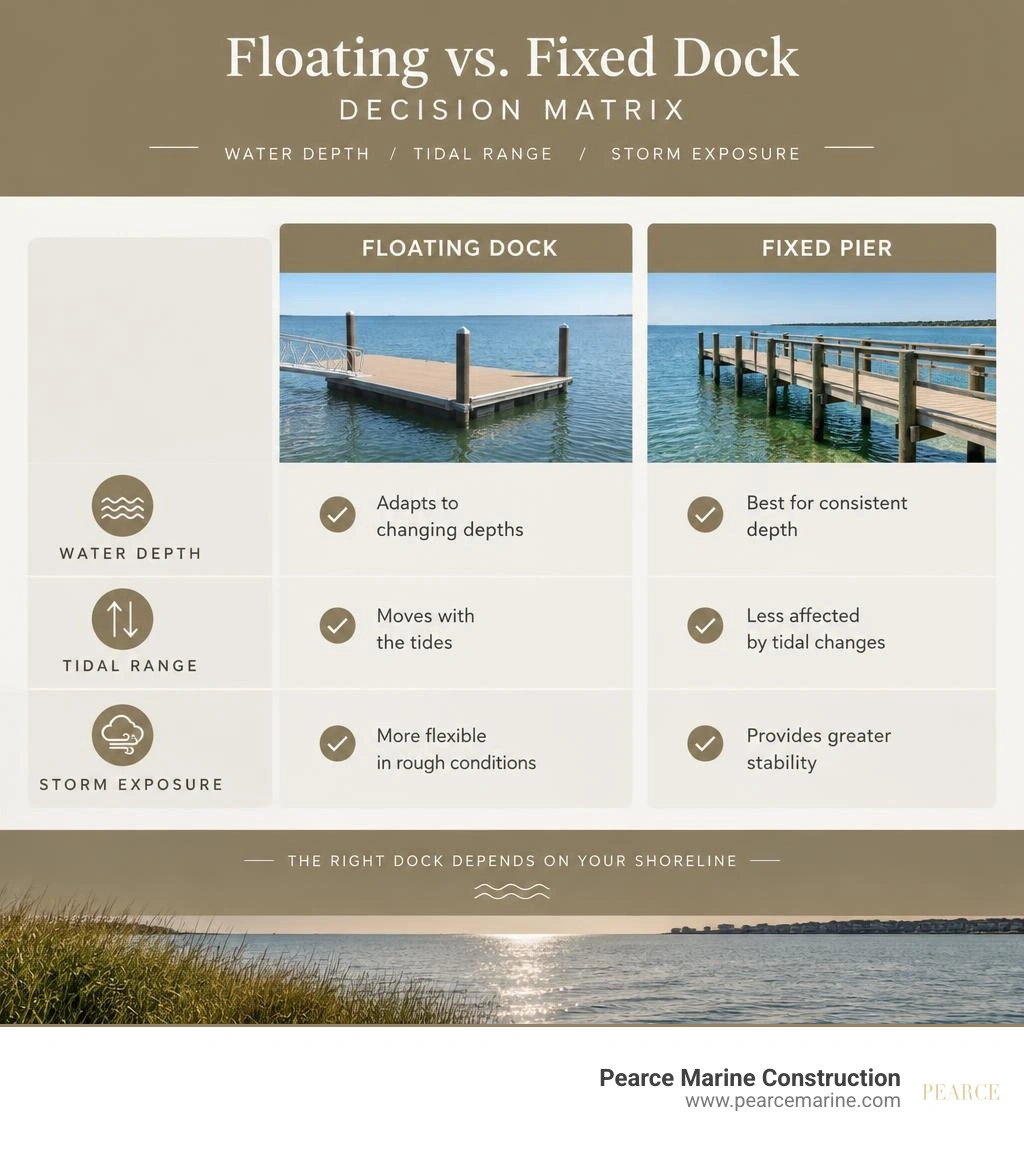
Selecting between a floating dock and a fixed stationary pier involves analyzing mean low water (MLW) depth, hydrodynamic loads, seasonal ice movement, and boat lift configurations.
| Feature / Condition | Floating Dock System | Stationary Fixed Pier |
|---|---|---|
| Tidal Adaptation | Self-adjusts continuously with 4–6 ft tides | Fixed elevation; requires ladders or ramps at low water |
| Minimum Water Depth | Requires adequate depth at MLW to avoid grounding | Operates effectively across shallow flats and deep channels |
| Winter Ice Performance | Susceptible to surface crushing; can be detached | Rigid pilings resist lateral crushing and vertical ice jacking |
| Heavy Load Support | Limited by pontoon displacement capacity | Exceptional; ideal for heavy gear, hoists, and lifts |
| Hydrodynamic Wave Action | Articulates with surface chop to reduce strain | Absorbs energy directly through pilings and stringers |
| Bed Impact | Minimal footprint when using tension anchoring | Piling displacement into the sub-benthic strata |
Floating Dock Systems and Dynamic Water Applications

Floating docks excel in areas with significant tidal fluctuation where maintaining a consistent freeboard is critical. Modern floating installations utilize heavy-duty polyethylene pontoons, marine-grade aluminum framing, or post-tensioned concrete modules that track water levels seamlessly.
For properties along Reynolds Channel canals, a floating system ensures your deck remains level relative to the waterline at all times. Transitioning from the upland bulkhead or fixed walkway to the floating dock is accomplished through engineered, ADA-compliant aluminum ramps and gangways outfitted with non-skid decking and transition plates. Homeowners and commercial facility operators across Nassau and Suffolk County frequently select our high-performance custom floating docks on Long Island to overcome variable water elevations without sacrificing structural longevity.
Fixed Pier Engineering for Long Beach Dock Installation Sites
Stationary timber and composite piers are rigid structures supported by timber, steel, or composite foundation pilings driven deep into the bay floor. A fixed pier provides an unyielding, rigid platform capable of bearing heavy structural loads, accommodating overhead canopies, and integrating directly with heavy-duty boat lift cradles.
In exposed areas prone to high-velocity currents, stationary piers resist lateral deflection through cross-bracing and deep embedment. Understanding proper dock piling installation methods is essential for fixed pier success; piles must be driven past loose sediment into dense load-bearing strata to withstand winter ice heave and storm-driven uplift forces throughout South Shore bays.
Structural Materials, Wave Dynamics, and Saltwater Resilience
The aggressive marine environment of the South Shore demands materials engineered to resist wood-boring organisms, UV degradation, and saltwater corrosion.
- Marine Timber Framing: Heavy structural timbers must be pressure-treated with marine-grade preservatives (such as CCA or ACQ rated for salt immersion) to repel marine borers and prevent fungal decay.
- Engineered Composite Decking: Capped polymer and composite deck boards eliminate splintering, resist moisture absorption, and withstand intense summer thermal expansion.
- Corrosion-Proof Fasteners: All through-bolts, tie rods, lag screws, and framing brackets must be manufactured from 316 stainless steel or heavy hot-dipped galvanized steel to prevent galvanic corrosion.
- Piling Protection: Heavy-duty vinyl wraps and high-density polyethylene (HDPE) pile sleeves shield wood pilings from marine organisms and mechanical wave abrasion.
- Wave Attenuation: In higher-energy waterways, integrated baffle walls and floating wave attenuators dissipate wake energy before it reaches the primary dock structure.
Applying specialized custom dock construction methods ensures that framing, hardware, and structural elements remain resilient against severe coastal wear.
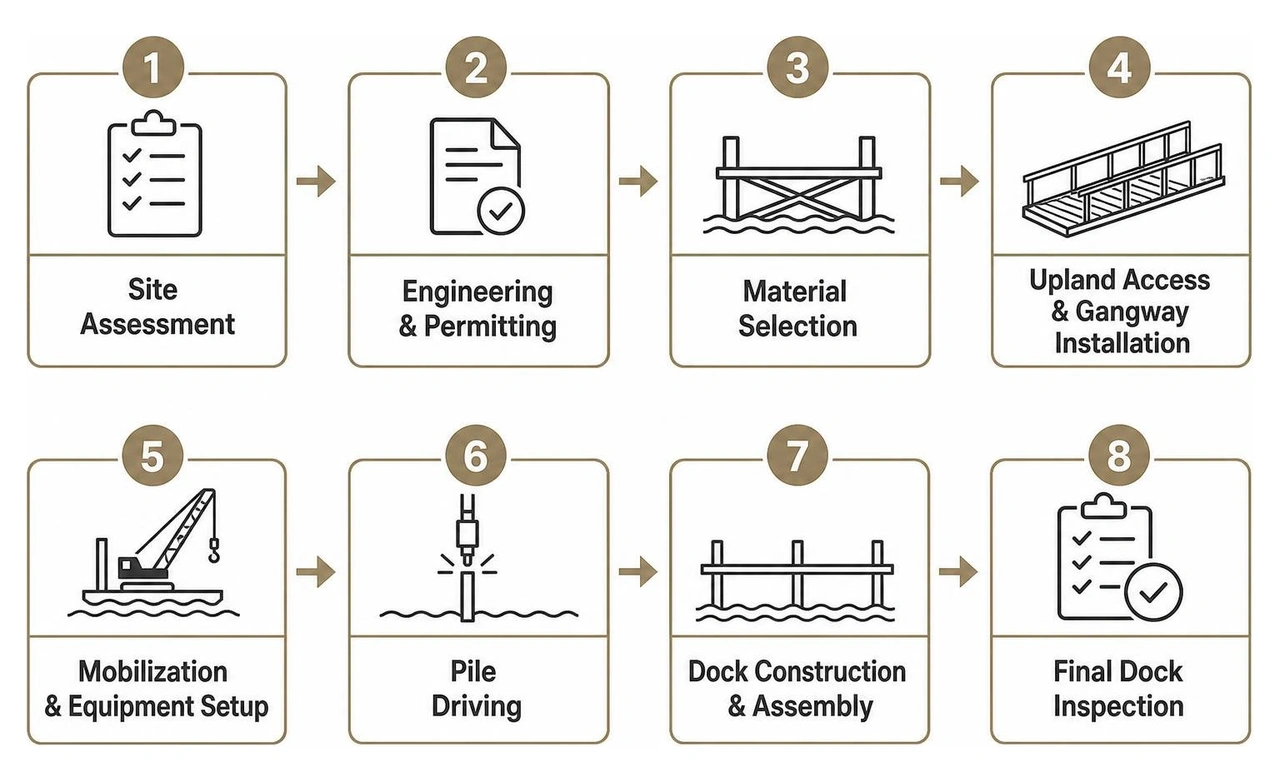
Site Engineering and Marine Construction Steps
Executing a successful dock installation requires a meticulous sequence of geotechnical analysis, structural engineering, and marine construction techniques.
Foundation Anchoring, Pilings, and Environmental Compliance
The integrity of any dock installation hinges on its anchoring system. Marine contractors employ heavy-duty pile driving barges outfitted with drop hammers or vibratory drivers to embed round timber or composite piles to engineering refusal.
Where pile driving is restricted by soft benthic habitats or site-specific engineering parameters, specialized anchoring technologies provide alternative stability:
- Seaflex Helical Screw Anchors: Low-impact helical earth screws are driven into the seabed, connected to self-tensioning elastomeric hawsers that secure floating docks without disturbing soft-bottom mud.
- Sediment and Turbidity Controls: Marine contractors deploy full-depth turbidity curtains and containment booms around the active work zone to prevent suspended sediment from migrating into adjacent channels.
- Sub-Benthic Habitat Preservation: Careful pile placement minimizes disturbance to benthic organisms, ensuring the dock foundation remains structurally sound while respecting coastal ecological requirements.
Our engineered boat dock and floating dock installations provide durable waterfront access while maintaining structural stability and environmental compliance across sensitive coastal areas.
Project Timelines, Budgeting, and Professional Contractor Selection
A custom dock installation typically spans several phases:
- Site Feasibility & Bathymetric Survey: 1 to 2 weeks
- Engineering Design & Structural Planning: 4 to 8 weeks
- Material Sourcing & Staging: 2 to 4 weeks
- Marine Construction & Pile Driving: 1 to 3 weeks
Project costs depend on linear footage, soil density, structural capacity, and the choice between stationary pilings or floating modules. Because marine environments place immense physical stress on structures, selecting an experienced, fully licensed marine contractor is critical.
Pearce Marine Construction provides the specialized marine equipment and deep regional knowledge required for every phase of the dock installation process across Long Island.
Partner with Long Island's Marine Construction Experts
Building a dock along Long Beach requires an uncompromising focus on structural engineering, high-grade marine materials, and coastal durability. Pearce Marine Construction delivers superior craftsmanship, advanced pile-driving capabilities, and deep local South Shore engineering expertise. As a woman-owned marine construction company serving residential, commercial, and public clients throughout Nassau and Suffolk Counties—including communities like Southampton, West Islip, West Hampton, Massapequa, and Merrick—our dedicated crews ensure structurally resilient dock and pier installations engineered to endure for decades. Contact our marine engineering team today to schedule an on-site shoreline evaluation.


Bring Your Vision to Life
Whether you're planning a custom dock, seawall, or boat lift, our experienced team is ready to deliver high-quality marine construction tailored to your needs. Pearce Marine Construction brings craftsmanship, precision, and a deep understanding of Long Island's waterways to every project. Let us help you create a durable, beautiful solution that stands the test of time. Get in touch now for a personalized estimate!