
Get Your Shoreline Back in Shape with Professional Seawall Repairs


Why Timely Seawall Repairs Are Critical for Long Island Shorelines
Seawall repairs are the process of restoring a damaged or deteriorating seawall to full structural integrity — sealing leaks, stabilizing soil, filling voids, and reinforcing the wall against future wave action, tidal pressure, and storm surge.
Here's what you need to know at a glance:
- Repair vs. replace: Repair is appropriate when damage is localized and the wall is structurally sound. Replacement is needed when material failure is widespread.
- Common repair methods: Polyurethane injection, epoxy grouting, helical tieback anchoring, concrete patching, and soil stabilization.
- Typical cost savings: Professional repair costs roughly 20–40% of full replacement, which can exceed $1,000 per linear foot.
- How long repairs last: Surface repairs may last a few years. Structural repairs, done right, can extend a seawall's life by 10–20+ years.
- Warning signs: Cracks, rust stains, leaning panels, soil sinkholes behind the wall, or water seeping through the base.
Long Island's shorelines face some of the harshest conditions on the East Coast. In Nassau and Suffolk Counties, seawalls endure daily tidal cycles, wave impact, saltwater corrosion, and freeze-thaw stress — year after year. Over time, even a well-built wall begins to show the strain.
The problem is that most damage starts underground. Water seeps through hairline cracks, soil washes out behind the wall, voids form, and pressure builds — all before anything looks wrong from the surface. By the time panels are visibly leaning or sinkholes appear in the yard, the damage is already serious.
Waiting makes it worse. And patching surface symptoms without fixing the root cause — poor drainage, eroded backfill, hydrostatic pressure — can actually accelerate failure rather than stop it.
At Pearce Marine Construction, we work with residential and commercial property owners across Long Island to assess seawall conditions honestly and deliver repairs built to last in real marine environments.
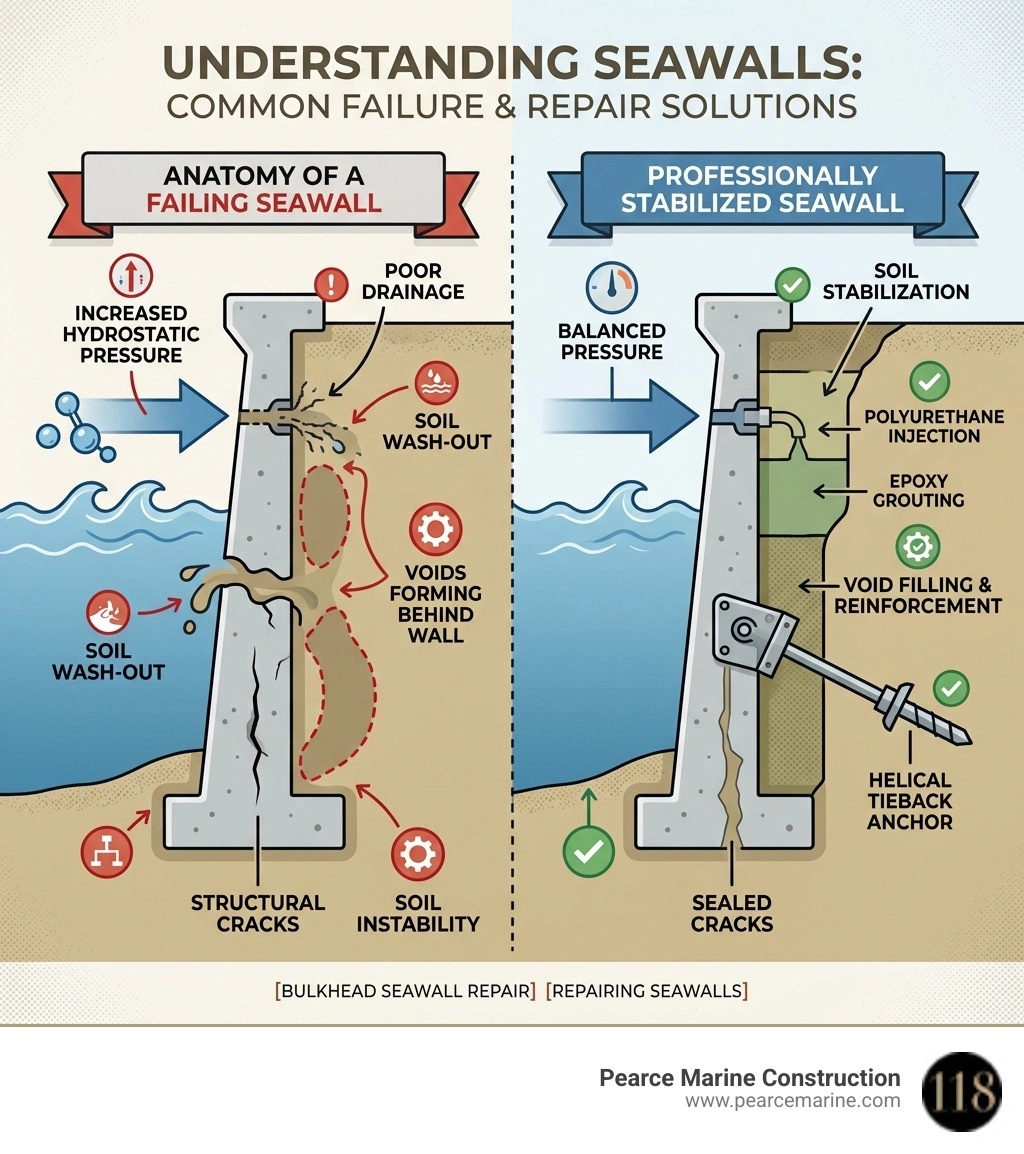
Simple guide to seawall repairs terms:
Essential Techniques for Long-Lasting Seawall Repairs
When we talk about seawall repairs in April 2026, we aren't just talking about slapping some cement over a crack. Modern marine engineering has evolved to address the "invisible" forces that destroy shorelines. The primary antagonist for any bulkhead in Nassau or Suffolk County is hydrostatic pressure. This occurs when water gets trapped behind the wall and cannot drain back into the bay or canal as the tide goes out. The weight of that trapped water pushes against the structure, leading to bowing, cracking, and eventual collapse.
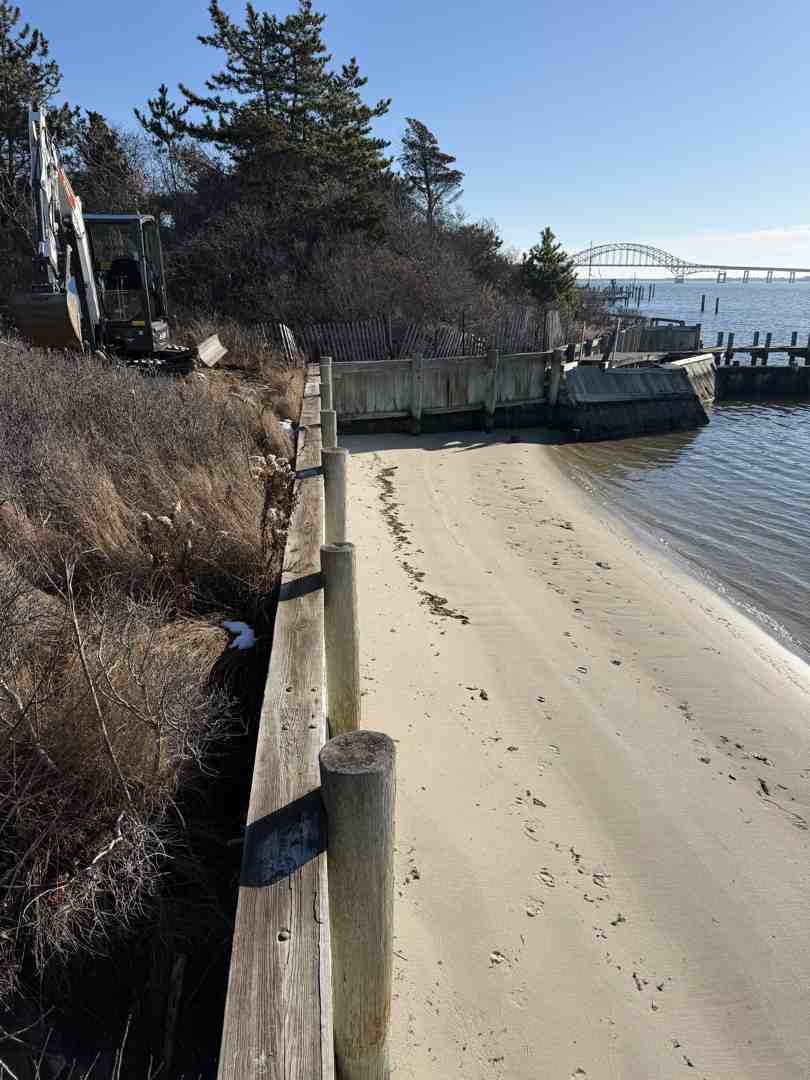
To combat this, we utilize a combination of soil stabilization, void filling, and pressure relief. If the soil behind your wall has washed away, it creates a vacuum that invites more water and more pressure. By filling these voids with specialized materials, we restore the "backbone" of your shoreline.
For property owners, understanding the differences between these methods is key to making an informed investment. You can find more info about seawall repair services to see how these apply to your specific shoreline.
Comparison of Seawall Repair Methods
| Method | Primary Use | Pros | Estimated Life Extension |
|---|---|---|---|
| Chemical Grouting | Filling voids & sealing leaks | Minimally invasive, eco-friendly, fast | 10–20 Years |
| Helical Anchoring | Structural stabilization | High load capacity, stops leaning | 20+ Years |
| Concrete Patching | Surface cracks & spalling | Low cost, improves aesthetics | 2–5 Years |
| Pressure Relief | Hydrostatic balance | Prevents future damage, low cost | Permanent with maintenance |
Advanced Chemical Grouting and Polyurethane Seawall Repairs
One of the most effective "game-changers" in our toolkit is chemical grouting. Instead of bringing in heavy excavators that tear up your beautiful landscaping in Merrick or West Islip, we use precision resin injection.
We use high-strength, hydro-active polyurethanes (like SW-RP1) that are injected directly into the soil or through cracks in the wall. These resins react with moisture to expand and form a watertight, bedrock-like mass. This process does three things at once: it fills the hidden voids, seals active leaks, and stabilizes the loose soil. Because these materials are often NSF-certified for contact with drinking water, they are environmentally safe for our sensitive South Shore ecosystems.
If you are noticing small cracks or sinkholes, more info about seawall crack repair can help you understand if this non-invasive method is right for you. You can also explore specialized Sea Wall Repair | Nassau County - Concrete Lifting solutions for settling slabs near the water.
Structural Stabilization with Helical Tiebacks and Anchoring
Sometimes, the issue isn't just a leak; it's a lack of strength. Many older cantilevered walls in places like Southampton or Babylon were not designed for the increased storm frequency we see today. If your seawall is leaning toward the water (panel deflection), it means the original anchoring system has failed.
We solve this by installing helical tiebacks. These are large, screw-like steel anchors that are driven deep into stable soil behind the wall. Once they reach the required torque, they are bolted to the seawall cap or face. This provides immediate lateral support, pulling the wall back into alignment and preventing it from tipping over. This is often the best way to handle bulkhead repair when the structure is still in good condition but lacks the muscle to hold back the land. You can also see how similar structural challenges are addressed in other coastal regions like Seawall Repair in Washington.
Material-Specific Seawall Repairs for Concrete and Steel
The material of your wall dictates the repair strategy.
- Concrete: The biggest threat here is "spalling." Saltwater penetrates the concrete, causing the internal steel rebar to rust. As the rust expands, it cracks the concrete from the inside out. We treat this by removing the damaged concrete, treating the steel with corrosion inhibitors, and applying marine-grade epoxy patches.
- Steel: In the "splash zone" of West Hampton, steel bulkheads face aggressive corrosion. We use specialized coatings and sometimes weld reinforcement plates to restore the thickness and strength of the steel piles.
- Vinyl: While vinyl doesn't rust or rot, it can "unzip" at the seams if the soil pressure becomes too great. Repairing these involves stabilizing the soil behind the sheets to take the load off the joints.
For more technical insights, you can look at large-scale municipal projects like the Seawall - Waterfront | seattle.gov to see how high-durability materials are used to reach a 75-year lifespan, or check out more info about repairing seawalls for residential applications.
Choosing Between Professional Repair and Full Replacement
As a property owner, the most stressful question is: "Do I need a few seawall repairs, or do I need to spend $100,000 on a new wall?"
Around 40% of the world’s population lives near the coast, and 24% of sandy beaches are eroding. This means the demand for marine construction is high, and the costs reflect that. A full replacement in Suffolk County can range from $200 to over $1,000 per linear foot.
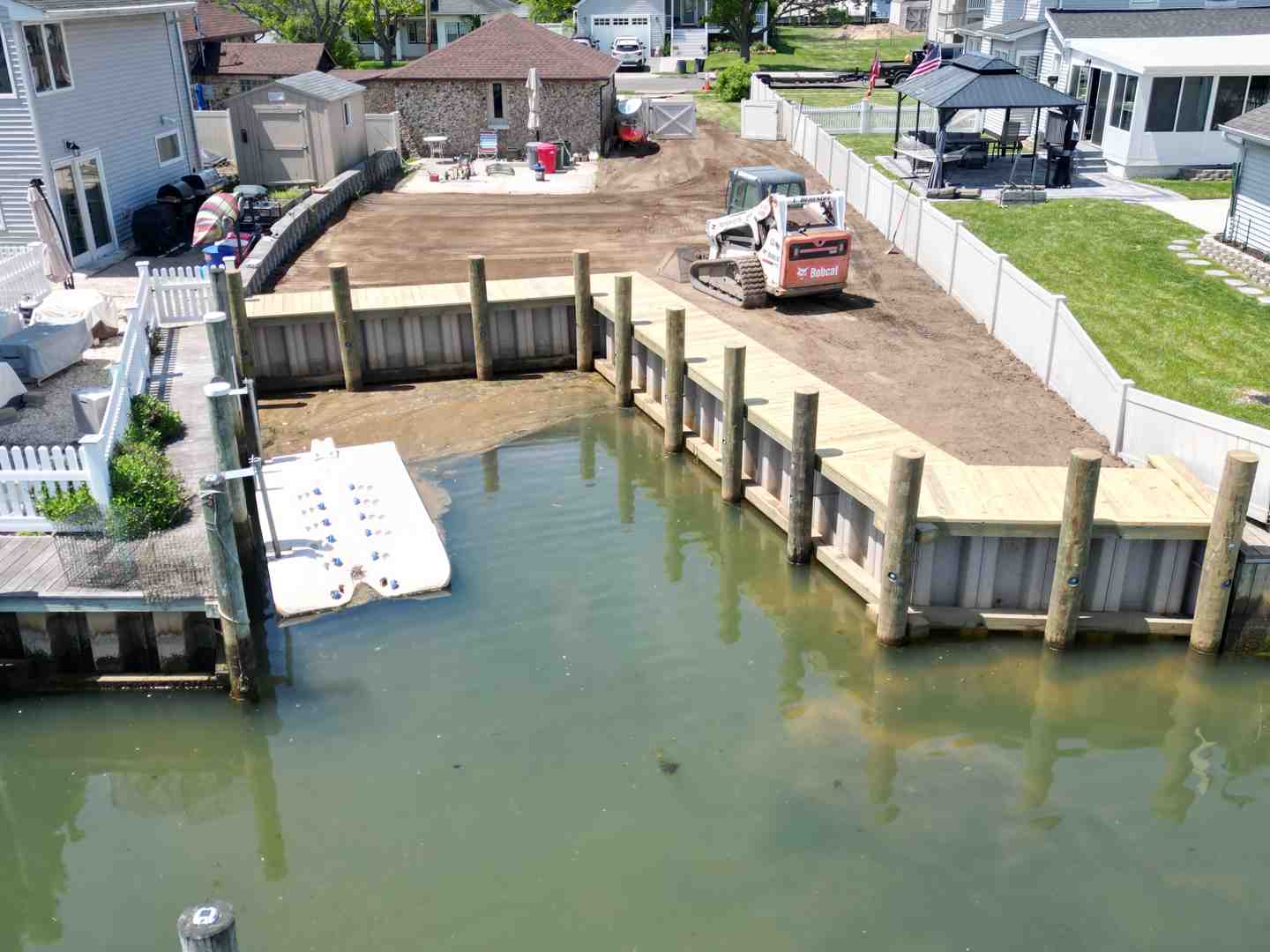
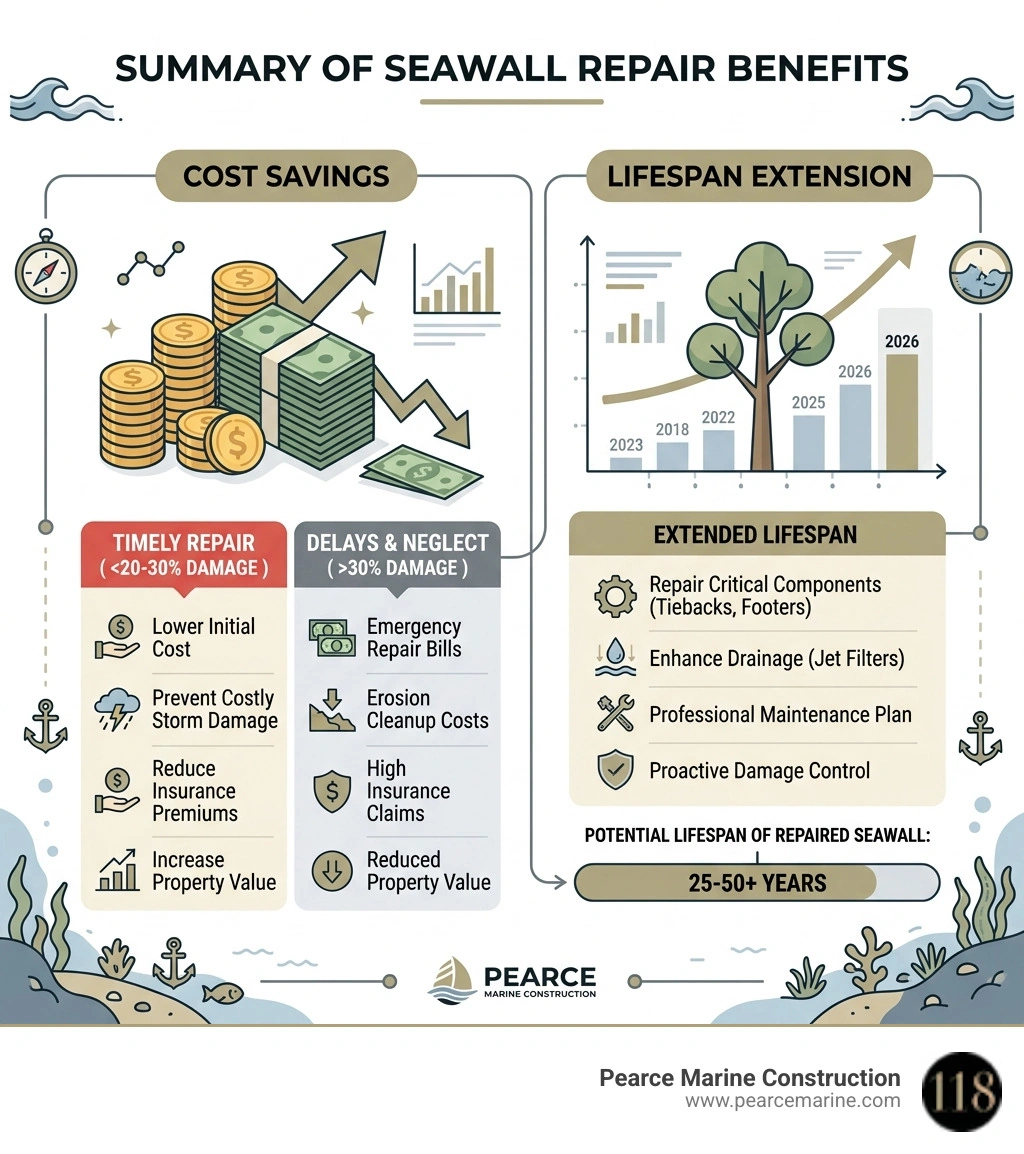
We generally recommend repair if the damage is localized to less than 20–30% of the wall and the main structural components (like the tiebacks and footer) are still functional. If the material itself has reached the end of its 25–50 year lifespan and is crumbling everywhere, a seawall bulkhead repair complete guide can help you weigh the long-term benefits of a full rebuild versus a short-term patch.
Identifying Early Warning Signs of Failure
Don't wait for a storm to tell you your wall is failing. We recommend regular seawall inspection services to catch "whispers" of failure before they become shouts.
Look for these signs:
- Sinkholes: Small depressions in the grass or sand behind the wall indicate that soil is being sucked out through a gap during low tide.
- Rust Streaks: Orange stains on a concrete wall mean your internal rebar is failing.
- Cracked Caps: If the concrete beam along the top of the wall is cracking or showing exposed aggregate, the wall is likely shifting.
- Panel Gaps: If you can see daylight between the vertical sheets of your bulkhead, you are losing shoreline every single day.
Long-Term Maintenance and Drainage Solutions
The secret to a seawall that lasts 50 years isn't just the material; it's the drainage. Every professional repair should include an evaluation of your weep holes. These are the small pipes that allow water to escape from behind the wall. If they are clogged with mud or shells, the pressure builds up.
We often install advanced pressure relief systems and jet filters that allow water to flow out while keeping the soil in place. This creates a "hydrostatic balance" that protects your investment. Even major cities realize this; for instance, the Low Battery Seawall Repair | Charleston, SC project focuses heavily on managing water flow to preserve historic infrastructure. You can learn more about how these systems work together at seawalls and bulkheads.
Partnering with Expert Marine Contractors for Seawall Repairs
Shoreline construction is no place for amateurs. In Nassau and Suffolk Counties, you need a team that understands the specific soil types of the South Shore and the regulatory environment of the NYS DEC.
Pearce Marine Construction is a woman-owned company with generational expertise. We don't just build walls; we build defenses for your home. From the initial inspection to the final injection of stabilizing resin, we treat every foot of your shoreline with meticulous craftsmanship.
When you're ready to protect your property, make sure you're talking to the right seawall repair contractors. Whether you are in Massapequa, Bayshore, or the Hamptons, we are here to ensure your seawall stands strong against the next 50 years of tides.
Ready to get your shoreline back in shape?Contact Pearce Marine Construction for a professional seawall evaluation today.



Bring Your Vision to Life
Whether you're planning a custom dock, seawall, or boat lift, our experienced team is ready to deliver high-quality marine construction tailored to your needs. Pearce Marine Construction brings craftsmanship, precision, and a deep understanding of Florida’s waterways to every project. Let us help you create a durable, beautiful solution that stands the test of time. Get in touch now for a personalized estimate!