
The Best Slope Stabilization Contractors for Landslide Repair


When Slopes Fail, Property Is at Risk — Here's What to Know
Slope stabilization contractors are specialists who reinforce unstable ground to prevent landslides, erosion, and structural collapse. If you need one fast, here's what to look for:
What the best slope stabilization contractors offer:
- Geotechnical assessment — soil testing and stability analysis before any work begins
- Design-build capability — one team handles engineering and construction
- Emergency response — rapid mobilization for active landslides or slope failures
- Proven methods — soil nailing, shotcrete, retaining walls, micropiles, and drainage systems
- Local expertise — knowledge of regional geology, soil types, and shoreline conditions
Slopes fail quietly — then suddenly. A few cracks in the ground, shifting shoreline structures, water seeping from the base of a hillside. By the time most property owners notice, the problem is already advanced.
On Long Island, shoreline slopes in Nassau and Suffolk Counties face constant pressure. Heavy rainfall, tidal fluctuation, freeze-thaw cycles, and the saturated soils common to coastal areas all push slopes toward failure. When a slope gives way, it threatens bulkheads, seawalls, and the structural integrity of the entire marine installation.
Choosing the right contractor matters enormously. The difference between a stabilized slope and a recurring failure often comes down to whether the team understood the root cause — not just the visible damage.
This guide covers the key techniques, what to look for in a qualified contractor, and how Pearce Marine Construction approaches shoreline slope work across Long Island.
Essential Techniques Used by slope stabilization contractors
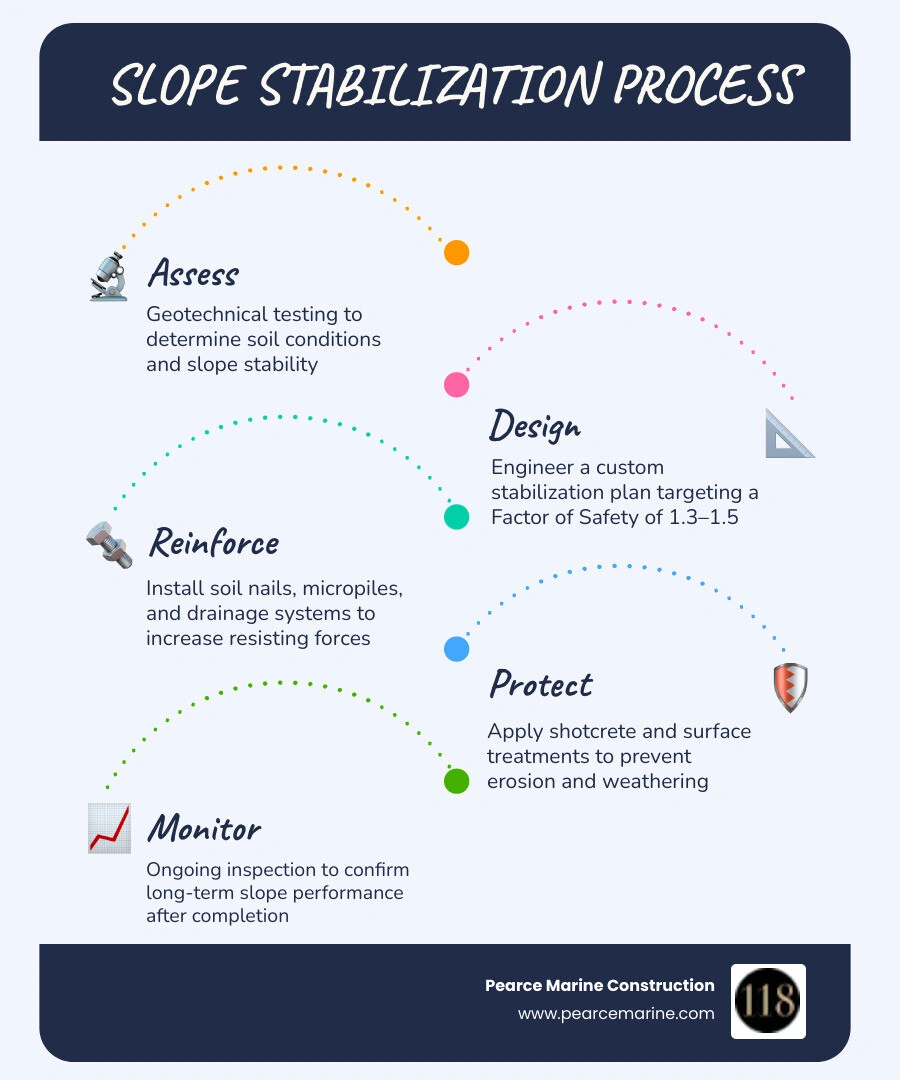
To successfully secure a hillside or coastal bluff, professional slope stabilization contractors use a combination of structural reinforcement and surface protection. The goal is to increase the "Factor of Safety" (FOS). In technical terms, the FOS is the ratio of resisting forces to driving forces. To prevent movement, we aim for a static FOS of 1.3 to 1.5. If it's below 1.0, the slope is actively failing.
Modern stabilization relies on several heavy-duty engineering methods:
- Soil Nailing: This involves inserting long, steel reinforcement bars (nails) into the ground at a slight downward angle. These nails are then grouted into place to tie the soil mass together.
- Shotcrete: This is concrete projected at high velocity onto a surface. It creates a hard, structural "skin" that prevents surface erosion and works in tandem with soil nails.
- Micropiles: These are small-diameter, high-capacity piles used when the ground is too weak to support traditional foundations. They are often used to underpin existing structures threatened by slope movement.
- Geotextiles: Specialized fabrics and mats provide immediate erosion control and can be integrated with precision anchoring systems.
For a deeper look at how we protect the interface between land and water, see our Shoreline Stabilization Guide 2026. You can also explore more about general slope stabilization techniques to see how these methods vary by terrain.
Structural Reinforcement with Soil Nailing and Shotcrete
When a slope is too steep for simple grading, we turn to internal support. Soil nailing acts like a series of "staples" that pin the unstable soil to more competent ground deeper in the hillside. This is often the preferred method for slope stabilization contractors working in tight residential areas like Merrick or Bellmore, where heavy excavation isn't possible.
Once the nails are installed, we apply a structural facing—usually shotcrete. This prevents the soil between the nails from sloughing off. It’s a permanent, high-strength solution that can even be sculpted and stained to look like natural rock, blending into the Long Island coastline. For projects requiring vertical support, we often integrate these techniques when Building Retaining Walls to ensure the earth behind the wall stays put.
Advanced Drainage Solutions for slope stabilization contractors
Water is the primary enemy of slope stability. Excess water increases "pore-pressure," which essentially lubricates the soil and makes it heavy, leading to slides. Professional contractors don't just "hold the dirt back"; they manage the water.
We implement subsurface drainage systems, such as horizontal drains and weep holes in retaining structures, to allow water to escape without carrying soil with it. Effective Waterfront Erosion Control is impossible without a dedicated plan to manage hydrostatic pressure.
The Role of Retaining Walls in Long Island Shoreline Protection
In areas like Huntington and Lloyd Harbor, where the land meets the Sound, retaining walls are the front line of defense. These are heavy-duty engineered structures designed to withstand the massive weight of saturated earth and the relentless force of the tide.
- Bulkheads: Essential for many Suffolk County properties, these vertical walls prevent the toe of the slope from being washed away by wave action.
- Seawalls: Heavier structures designed to break the force of waves.
- Tiered Systems: Using multiple levels of walls to break up a steep grade into manageable sections.
If you’re in the eastern part of the island, our Retaining Walls Suffolk County Guide provides specific insights into local requirements. For more on high-stakes geohazard work, you can review Rock Slope Stabilization methods used in the most challenging terrains.
Selecting Professional Slope Stabilization Contractors in Nassau and Suffolk County
Choosing a contractor for slope work is different than hiring a general builder. You need a team that understands the intersection of soil mechanics and marine engineering. On Long Island, the geology is primarily glacial till—a mix of sand, gravel, and clay that behaves very differently than the bedrock found elsewhere.
A qualified contractor should always begin with a geotechnical assessment. This involves testing the soil composition and steepness to determine why the failure is happening. We use a design-build approach, which means we handle both the engineering analysis and the actual construction. This ensures that the person turning the wrench (or driving the pile) understands exactly what the engineer intended.
For homeowners in Southampton or West Islip, it’s vital to look for a contractor who provides verified performance data. You can find more Coastal Erosion Protection Tips 2026 to help evaluate your site's needs, or see how Geotechnical Solutions are applied to complex infrastructure projects.
Emergency Landslide Repair and Rapid Response
When a slope fails after a major storm in West Hampton or Brightwaters, time is your biggest enemy. An active landslide can move several feet in a matter of hours, potentially taking out bulkheads, seawalls, or the primary shoreline foundation.
The best slope stabilization contractors maintain a rapid response capability. This includes:
- 24/48 Hour Proposals: Getting an engineer on-site immediately to assess the risk.
- Rapid Mobilization: Having the specialized drilling and grouting equipment ready to move.
- Temporary Shoring: Installing immediate measures to stop movement while the permanent solution is finalized.
In emergency scenarios, we focus on arresting the movement first. We often use "launched soil nails"—a technology that allows us to stabilize a slope with minimal site disturbance and no excavation. Explore our Erosion Control Solutions to see how we handle these high-pressure situations.
Why Local Expertise Matters for slope stabilization contractors
At Pearce Marine Construction, we know that Long Island isn't a monolith. The soil conditions in Massapequa are vastly different from the bluffs in Cold Spring Harbor. Using the wrong materials or failing to account for local tidal surges is a recipe for a multi-thousand-dollar failure.
As a woman-owned business with generational expertise, we prioritize meticulous craftsmanship and marine-grade materials. We don't just build for today; we build for the 75-year design life that these structures require. Whether it's a bulkhead in Babylon or a complex soil-nailing project in Wantagh, our local knowledge ensures the job is done right the first time.
For a comprehensive look at how we defend Long Island properties, check out our Shoreline Protection Long Island Guide.
CTA: Professional Seawall and Bulkhead ConstructionDon't wait for the next big storm to test your property's stability. If you've noticed cracks in your soil or movement near your shoreline, contact Pearce Marine Construction today. We serve Nassau and Suffolk Counties with the expert engineering and construction services needed to keep your land exactly where it belongs.



Bring Your Vision to Life
Whether you're planning a custom dock, seawall, or boat lift, our experienced team is ready to deliver high-quality marine construction tailored to your needs. Pearce Marine Construction brings craftsmanship, precision, and a deep understanding of Florida’s waterways to every project. Let us help you create a durable, beautiful solution that stands the test of time. Get in touch now for a personalized estimate!