
How Much Does It Cost to Repair or Replace a Bulkhead


What Does Bulkhead Repair Cost on Long Island?
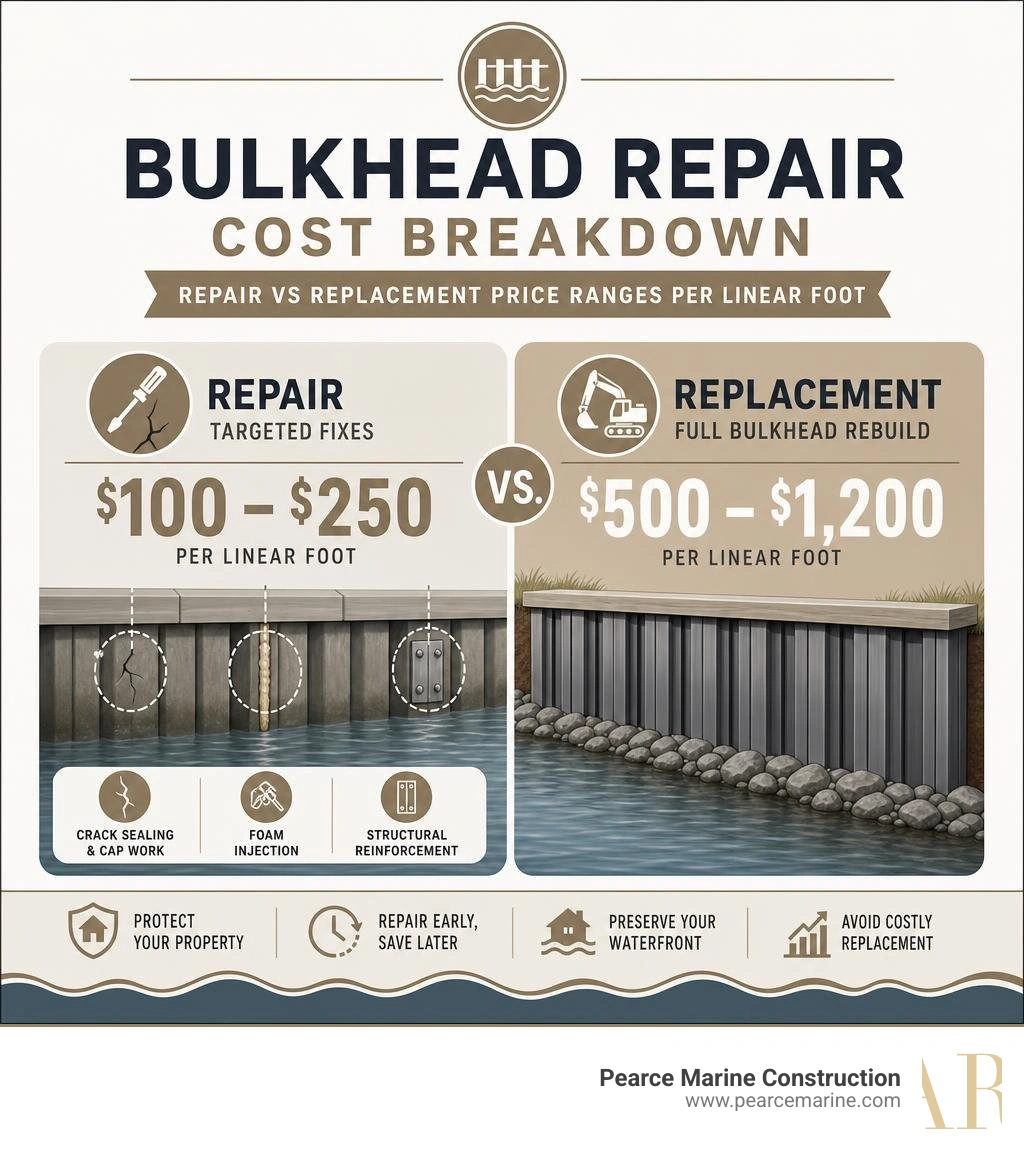
At Pearce Marine Construction, we provide professional diagnostic, repair, and replacement services for failing shorelines across Nassau and Suffolk Counties. Bulkhead repair cost on Long Island typically ranges from $100 to $250 per linear foot for targeted repairs, while full replacement runs $500 to $1,200 per linear foot. Most residential repair projects we execute fall between $3,000 and $8,000 total.
Here's a quick breakdown of our professional services:
| Repair Type | Typical Cost Range |
|---|---|
| Minor repairs (crack sealing, cap work) | $100 - $250 per linear foot |
| Polyurethane foam injection | $2,000 - $5,000 per project |
| Structural reinforcement | $5,000 - $15,000 per project |
| Full bulkhead replacement | $500 - $1,200 per linear foot |
| Average residential repair project | $3,000 - $8,000 total |
Your bulkhead is doing heavy, invisible work every single day — holding back tidal pressure, preventing soil loss, and protecting your property from storm surge. Most Long Island waterfront homeowners don't think about it until something goes wrong.
And when something goes wrong, the cost difference between acting early and waiting can be enormous. A small crack or minor washout can stay a $3,000 repair. Left alone, the same problem can become a $50,000+ full replacement. Pearce Marine Construction offers the specialized engineering and heavy equipment required to address these issues before catastrophic failure occurs.
This guide walks you through exactly what drives bulkhead repair costs, which warning signs to watch for, and how our team decides whether repair or replacement is the smarter investment for your waterfront property in Nassau or Suffolk County.
Easy bulkhead repair cost word list:
Introduction
When you own a waterfront home in places like West Islip, Southampton, or Huntington, your bulkhead is your properties' ultimate line of defense. Pearce Marine Construction provides critical shoreline protection, structural erosion control, and soil retention against the aggressive tides of the Great South Bay and the Long Island Sound. Without a structurally sound barrier, the daily ebb and flow of saltwater will slowly but surely wash away your lawn, destabilize your custom decking, and threaten your home's foundation.
Maintaining this infrastructure is not just about aesthetics; it is about storm surge defense. To understand how these structures function and where they typically fail, it helps to look at the anatomy of a professional marine bulkhead.
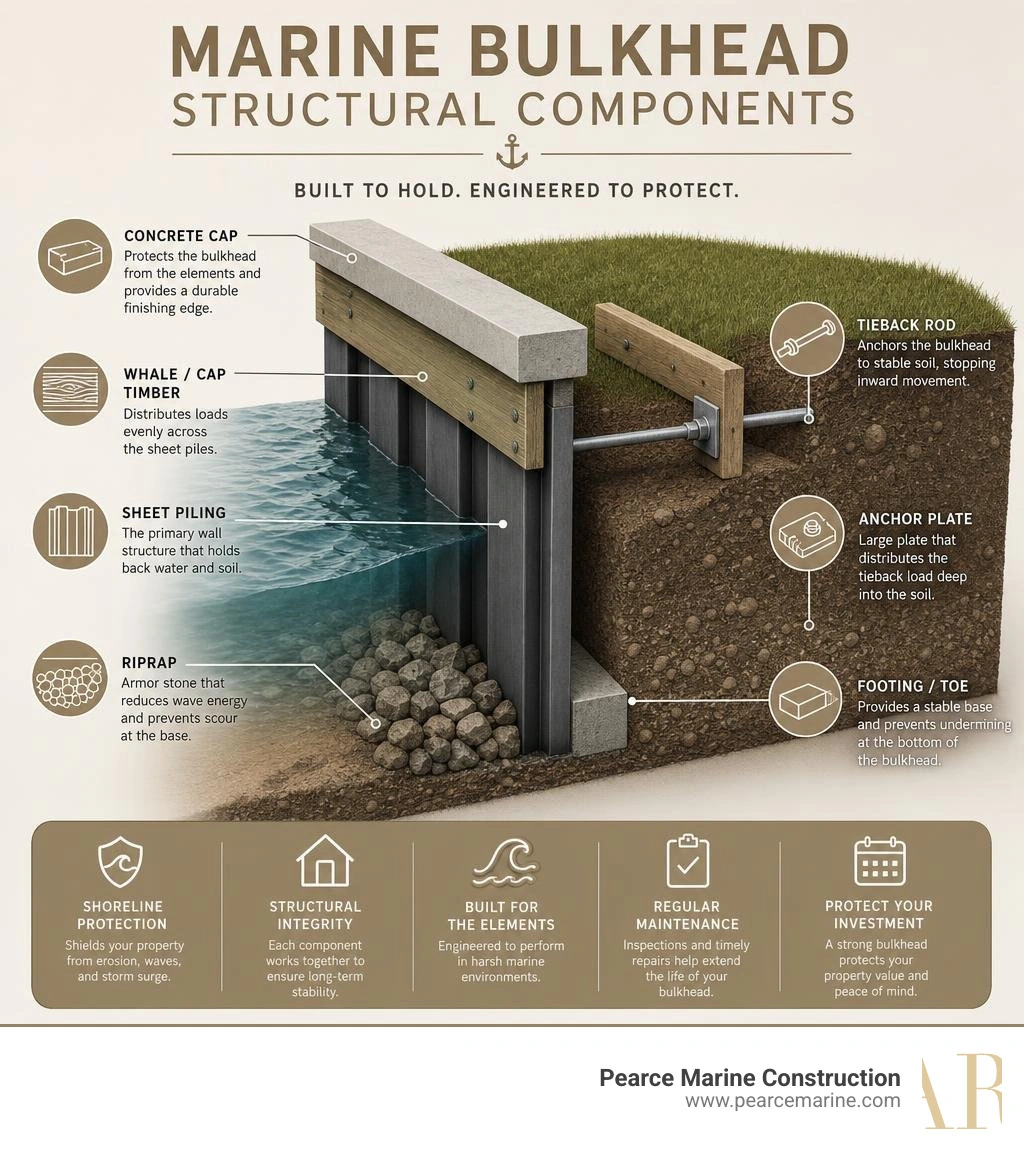
Understanding these components—from the deep-driven sheet piling to the tieback rods anchored back in your yard—is essential when calculating potential repair fees.
Marine Bulkhead Repair Cost and Price Factors
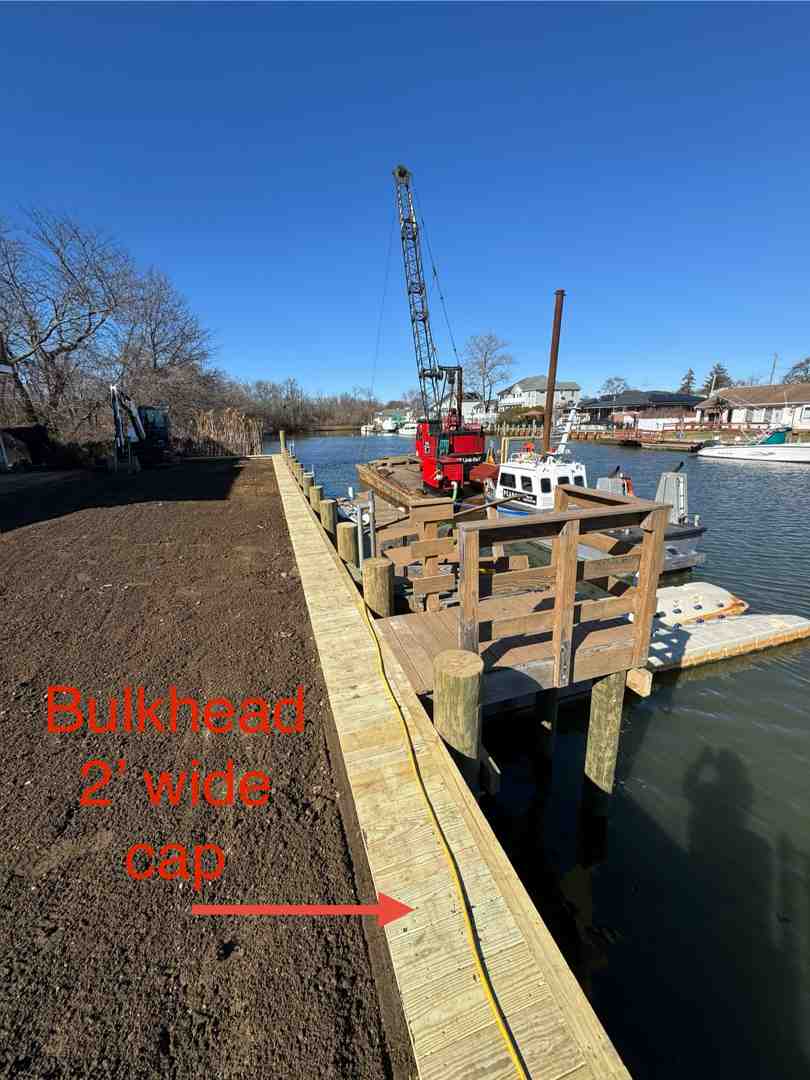
Estimating the exact bulkhead repair cost for a coastal property in Nassau or Suffolk County requires analyzing several physical and logistical variables. At Pearce Marine Construction, our marine engineering team evaluates these key factors to provide highly accurate estimates for your shoreline project:
- Linear Footage: Because professional marine engineering is priced by the foot, the total length of your waterfront frontage in communities like West Islip or Southampton is the primary cost driver.
- Mobilization Fees: Transporting heavy marine equipment, such as pile drivers, barges, and excavators, to a coastal property requires specialized logistics. Mobilization is a key component of our professional service pricing.
- Coastal Access Challenges: If land access is restricted by narrow easements or mature trees in waterfront neighborhoods like Merrick or Wantagh, our crews utilize specialized marine barges to complete the installation and repair work from the water side.
- Labor Scarcity: Marine construction requires highly skilled commercial divers and heavy equipment operators. Pearce Marine Construction employs certified professionals to ensure structural integrity and safety.
- Seasonal Timing: Scheduling your project during the off-season (late autumn through early spring) allows our team to optimize scheduling and provide highly competitive pricing.
To get a broader sense of overall project budgeting, you can explore our comprehensive Cost to Build a Bulkhead Guide and our detailed Bulkhead Construction Cost Guide.
Average Marine Bulkhead Repair Cost per Linear Foot
For targeted structural repairs that do not require pulling the existing sheets, professional repair pricing typically runs between $100 and $250 per linear foot. On the other hand, if the structural integrity of the wall is completely compromised, a full replacement utilizing modern materials will range from $500 to $1,200 per linear foot.
The average residential repair project we tackle in coastal communities like Bellmore, Babylon, and Bayshore typically ranges from $3,000 to $8,000. To help you visualize the financial differences, look at this cost comparison table:
| Project Scope | Average Cost (60-Foot Wall) | Average Cost (100-Foot Wall) | Expected Lifespan |
|---|---|---|---|
| Targeted Repair (Sealing & Reinforcement) | $6,000 - $15,000 | $10,000 - $25,000 | Adds 15 - 20 years |
| Full Vinyl Replacement (All-In Project) | $50,000 - $75,000 | $100,000+ | 50 - 60+ years |
To read more about baseline pricing structures for complete installations, check out our guide on the Cost of a Bulkhead.
Material Lifespans and Their Impact on Bulkhead Repair Cost
The material of your existing bulkhead heavily dictates both its current repair needs and its ultimate replacement cost. Pearce Marine Construction specializes in high-performance marine materials:
- Vinyl Sheet Piling (Lifespan: 50–60+ Years): The absolute default choice for residential shorelines on Long Island. Marine-grade vinyl PVC resists rot, UV degradation, marine borers, and saltwater corrosion. It requires almost zero maintenance and is highly cost-effective over its long lifecycle.
- Pressure-Treated Timber (Lifespan: 10–25 Years): Historically popular, but wood bulkheads are highly susceptible to marine wood-boring organisms and rot. Since environmental regulations banned certain chemical treatments for residential marine sheet piling, wood has become less practical and shorter-lived.
- Steel Sheet Piling (Lifespan: 30–50 Years): Incredibly strong and ideal for high-energy shorelines or deep-water channels, but highly prone to saltwater corrosion. Steel requires specialized protective coatings and sacrificial anodes, driving up maintenance and repair costs.
- Concrete Seawalls (Lifespan: 30–50 Years): Extremely durable but vulnerable to freeze-thaw cycles. Over time, saltwater can seep into tiny cracks, rusting the internal rebar and causing the concrete to spall or crack.
While some regional regulations and historical exemptions vary across different coastal areas—as detailed in The LBI Bulkhead Question: When to Repair, When to Replace, and ... —the core engineering reality remains the same: investing in premium vinyl or composite materials up front prevents frequent, costly repair cycles down the road.
Advanced Engineering: Polyurethane Foam Injection vs. Structural Reinforcement
Modern marine engineering has introduced highly effective, non-invasive repair methods that can save homeowners tens of thousands of dollars compared to full excavation.
- Polyurethane Foam Injection ($2,000 - $5,000): This modern technique targets underground voids and sinkholes behind your bulkhead. We inject specialized, eco-friendly, high-density closed-cell polyurethane foam directly into the soil. The foam expands rapidly, filling hidden voids, sealing joints, and stabilizing the soil without requiring disruptive excavation.
- Structural Reinforcement ($5,000 - $15,000): If your wall is leaning slightly but the panels are still in good condition, we can install supplemental helical tiebacks or replace failed tie-rods. This anchors the bulkhead back into stable inland soil, reversing cap rotation and bowing.
If your concrete or timber cap is rotting or cracking, we also offer targeted cap repairs. Learn more in our Bulkhead Cap Repair Guide or visit our dedicated Bulkhead Repair Services page to see how we restore structural integrity.
Shoreline Restoration: When to Repair vs. Replace
Deciding whether to repair your existing wall or pull the trigger on a full replacement comes down to a simple engineering rule of thumb: the 60-70% rule. If the cost of targeted repairs exceeds 60% to 70% of a full replacement, investing in a brand-new vinyl bulkhead is always the smarter long-term financial decision.
Furthermore, you must look at the overall structural integrity of the barrier. If your bulkhead has suffered lateral failure propagation—meaning the failure of one section is actively dragging down adjacent panels—isolated repairs will only act as temporary bandages. If severe soil loss has undermined the toe (the bottom) of the sheet piling, the wall is at risk of sudden catastrophic collapse, making a full replacement mandatory. For an in-depth look at this decision-making process, read our Seawall and Bulkhead Repair Complete Guide.
Early Warning Signs of Shoreline Infrastructure Failure
Catching bulkhead issues early can literally save you $50,000. Keep a close eye on your shoreline for these critical red flags:
- Bowing Panels: If the vertical sheets are curving outward toward the water, the soil pressure behind the wall is overpowering the structural capacity of the sheets.
- Cap Rotation: If the top cap of the bulkhead is tilting forward, your anchoring tiebacks have likely snapped or slipped.
- Sinkholes and Soil Washouts: If you notice sudden depressions or holes forming in your lawn within 10 to 15 feet of the bulkhead, soil is actively escaping through failed joints or weep holes below the waterline.
- Rusted Tie-Rods or Rotting Timber: Visible rust bleeding through concrete or soft, spongy wood that a screwdriver can easily penetrate indicates advanced material decay.
If you notice any of these signs, don't wait for the next major coastal storm to worsen the damage. Read our Bulkhead Repair Complete Guide to learn how we diagnose and address these early warning signs.
Marine Construction Excellence in Nassau and Suffolk Counties
Protecting your waterfront investment requires specialized local expertise. Unlike general contractors who work primarily on dry land, marine construction demands a deep understanding of local tidal patterns, soil saturation levels, and the harsh marine environments of Long Island.
At Pearce Marine Construction, we bring generational expertise and meticulous craftsmanship to every shoreline project we touch. As a proud woman-owned marine construction company, we serve residential, commercial, and public clients across Nassau and Suffolk Counties. Whether you need a heavy-duty vinyl bulkhead installed in Brightwaters, pile driving for a custom dock in Cold Spring Harbor, or targeted structural repairs in Lloyd Harbor, our team delivers unmatched quality.
While other regional builders may offer standard services, Pearce Marine Construction prides itself on custom-engineered solutions tailored specifically to your property's unique wave energy and soil conditions. From Southampton and West Hampton to Massapequa and West Islip, we build waterfront structures designed to stand the test of time.
Ready to secure your shoreline? Contact us today to schedule a professional marine assessment, or visit our Pearce Marine Bulkhead Repair Services page to learn more about how we can safeguard your piece of paradise.



Bring Your Vision to Life
Whether you're planning a custom dock, seawall, or boat lift, our experienced team is ready to deliver high-quality marine construction tailored to your needs. Pearce Marine Construction brings craftsmanship, precision, and a deep understanding of Florida’s waterways to every project. Let us help you create a durable, beautiful solution that stands the test of time. Get in touch now for a personalized estimate!