
The Ultimate Guide to Helical Pile Installation Equipment Packages


Why Choosing the Right Helical Pile Installation Equipment Matters for Marine Construction
Helical pile installation equipment is the core of any successful marine deep foundation project — and choosing the wrong setup can compromise the structural integrity of your waterfront assets.
Here's a quick overview of the main equipment types used to install marine helical piles:
| Equipment Type | Best For | Torque Range |
|---|---|---|
| Handheld / Portable Units | Tight spaces, low headroom, under-dock retrofits | Up to 6,000 ft-lbs |
| Mini Skid Steer Attachments | Restricted access, coastal residential sites | Up to 10,000 ft-lbs |
| Skid Steer Packages | Light commercial, residential marine foundations | Up to 7,000 ft-lbs |
| Mini Excavator Attachments | Standard residential docks and light commercial bulkheads | Up to 15,000 ft-lbs |
| Standard Excavator Drive Heads | Heavy commercial, deep marine foundations | 20,000–360,000 ft-lbs |
For marine construction specifically — think docks, bulkheads, and seawalls along Long Island's coastline — the stakes are even higher. Saltwater environments, sandy coastal soils, and tidal forces demand equipment that's precisely matched to the job.
Helical piles can support over 50 tons each and reach depths exceeding 150 feet. But that capacity only holds if the installation equipment delivers the right torque, monitors it accurately, and places every pile with precision.
This guide breaks down every major equipment category, explains what to look for in drive heads and torque motors, and helps Long Island property owners and contractors understand what professional marine pile installation actually requires.
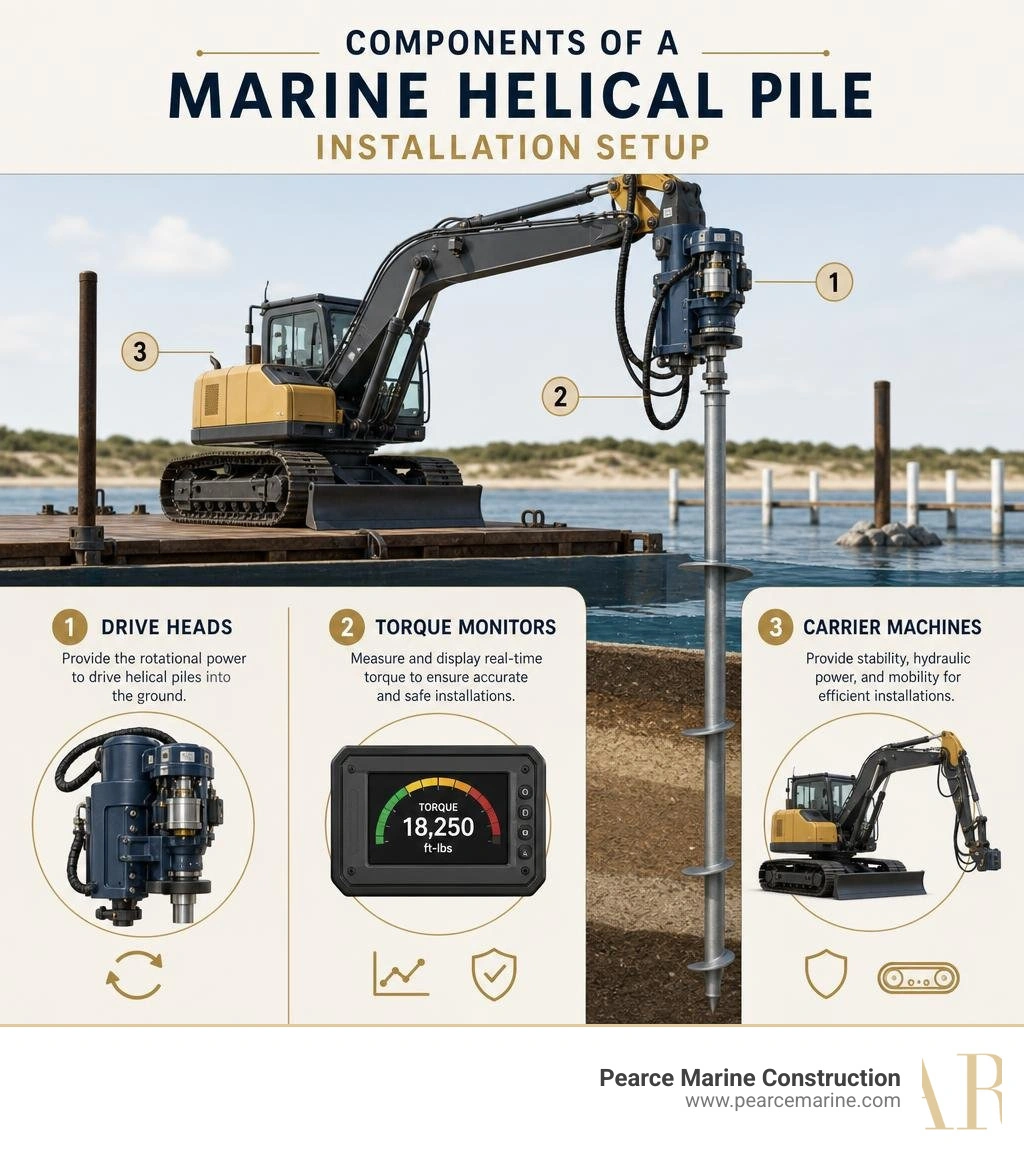
Simple guide to helical pile installation equipment terms:
Key Components of Professional Helical Pile Installation Equipment
To achieve the massive load-bearing capacities required for coastal infrastructure, a professional pile-driving setup relies on a synchronized system of mechanical and hydraulic components. When we construct bulkheads or docks in Nassau County and Suffolk County, we use heavy-duty attachments specifically engineered to handle high torsional stresses.
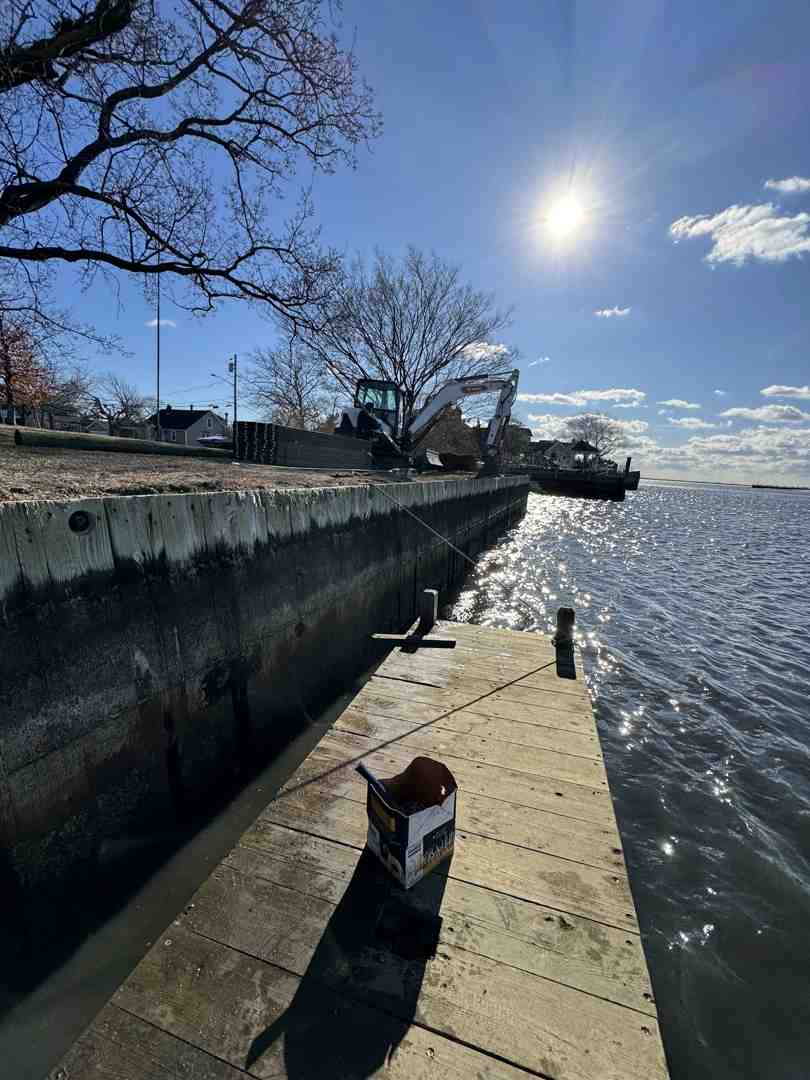
At the center of any professional system is the hydraulic drive head (or torque motor). This specialized attachment converts the carrier machine's hydraulic flow and pressure into the rotational force needed to screw the steel pile deep into the earth. Choosing the right drive head from specialized suppliers—such as those detailed in the Helical Pile Installation Equipment | Hydraulic Drive Systems guide—is crucial to matching the target soil resistance.
Other vital components in a complete engineering kit include:
- Adapter Flanges and Hex Kelly Adapters: These heavy steel connectors connect the drive head output shaft to the pile itself, ensuring a secure fit that prevents slippage or wobble during rotation.
- Shear Pin Limiters: These safety devices act as mechanical fuses. If the torque head hits an unexpected underground obstruction (like a large boulder), the shear pin snaps, instantly disconnecting the drive train to protect both the pile and the equipment from catastrophic failure.
- Gimbal Mounts: These multi-directional swivels allow the drive head to hang plumb even when the carrier machine is parked on uneven, sloping shoreline terrain.
- In-Line Relief Valves: These valves regulate hydraulic pressure to protect the host machine's hydraulic pumps from extreme pressure spikes when driving piles through dense soil layers.
Understanding how these components interface is the first step toward a successful foundation. For a deeper dive into how these elements work together, read our helical pile foundation complete guide.
Handheld and Portable Helical Pile Installation Equipment
When heavy equipment cannot access a site due to tight clearance or sensitive coastal vegetation, portable options save the day. Handheld and portable helical pile drivers are highly compact systems powered by portable hydraulic power packs. These units are ideal for low-headroom marine environments, such as retrofitting foundations beneath existing docks, piers, or boardwalks in tight waterfront properties in Huntington or West Islip.
According to the manufacturer Operating Instructions, a standard handheld hydraulic installer has a torque capacity limit of 2,500 ft-lb (3,390 Nm) at 1,550 psi. Because a human crew cannot physically hold back 2,500 ft-lbs of turning force, these systems utilize a physical yoke and torque bar (which must be at least 8 feet long).
This torque bar must be braced against a solid object—such as a concrete wall or heavy anchor—capable of withstanding a lateral resistance force of up to 1,000 lbs (4.5 kN). A remote foot pedal allows the operator to control the rotation safely and hands-free. While portable units are highly versatile for tight spots, they are limited to smaller shaft diameters. To learn more about when to deploy these compact solutions, consult our helical piles complete guide.
Excavator and Skid Steer Helical Pile Installation Equipment Packages
For standard waterfront residential and commercial piling projects, contractors rely on modular attachment packages designed to convert standard fleet machinery into high-performance foundation drivers. Pre-engineered packages, such as those offered by Piertech, allow operators to turn excavators and skid steers into dedicated piling rigs.
A typical skid steer package includes a high-torque drive head (such as the MM10K drive head, which delivers up to 10,000 ft-lbs of torque), a telescopic skid steer attachment arm, a drive tool with a hex adapter, and in-line pressure relief valves with integrated gauges. Excavator packages feature heavy-duty mounting systems, link arms, and size-specific 45mm pins rated for the immense torsional loads of deep foundation driving.
When adapting standard rental or fleet machinery for helical piling, mechanical compatibility is a common hurdle:
- Bi-Directional Auxiliary Circuits: Standard digging attachments only require one-way hydraulic flow. However, helical pile installation requires a bi-directional auxiliary hydraulic circuit so the operator can reverse the rotation to adjust pile alignment or retrieve a pile.
- Pressure Regulators: Many standard excavators have their factory pressure regulators set for standard digging (typically around 2,500 psi). If the regulator is not adjusted to match the torque motor's maximum rated capacity (often 3,000 to 3,500 psi), the drive head will stall long before reaching its target installation torque.
To understand the mechanical requirements for these mid-to-large attachment packages, read our helical pile installation complete guide.
Real-Time Torque Monitoring and Calibration Systems
How do engineers know that a helical pile can support its rated load of 50+ tons without waiting days for concrete to cure? The answer lies in the torque-to-capacity ratio. In helical piling, the mechanical torque required to turn the pile into the ground directly correlates to the ultimate load-bearing capacity of the soil.

Modern helical pile installation equipment features advanced digital monitoring systems. Wireless data transmitters mounted directly on the drive head measure actual torque, shaft speed, and installation angle. This data is transmitted in real-time to an in-cab monitor, allowing the operator to verify that every single pile meets engineering specifications.
Key benefits of digital monitoring systems include:
- Dual-Axis Tilt Monitoring: Measures verticality within a tight 0.1° margin of accuracy, ensuring piles are driven perfectly straight.
- Engineering Compliance: Generates a digital log of the installation torque at every foot of depth, providing solid proof of structural capacity for local building inspectors in Nassau and Suffolk Counties.
- Load Verification: Eliminates guesswork by confirming when a pile has transitioned from soft coastal silt into a load-bearing sand or clay layer.
For more information on high-capacity pile parameters and technical specifications, refer to Helical Pile - YC Attachments. Working with certified helical pile installers ensures your project is backed by accurate, calibrated data.
Selecting the Right Carrier Machine for Marine Piling on Long Island
Operating on the coast of Long Island—whether in the tidal zones of Southampton, the sandy shorelines of West Hampton, or the canal properties of West Islip—requires a careful match between the carrier machine and the local soil conditions.
| Carrier Machine Type | Operating Weight | Max Torque Capacity | Coastal Soil Performance | Mobilization Cost |
|---|---|---|---|---|
| Mini-Excavator | 3 to 8 Tons | Under 15,000 ft-lbs | Excellent for tight residential shorelines; low ground pressure | Low |
| Tracked Skid Steer | 3 to 5 Tons | Under 7,000 ft-lbs | Great on soft sand; limited by low boom height (piles <7 ft) | Low |
| Standard Excavator | 12 to 35+ Tons | 20,000 to 360,000+ ft-lbs | Essential for high-capacity bulkheads and heavy commercial docks | High |
In sandy coastal soils and high-water-table areas, machine weight and footprint are critical. A machine that is too heavy can sink into saturated shoreline mud, while a machine that is too light won't provide enough downward force (crowd pressure) to keep the helical pile advancing, causing the pile to simply spin and disturb the soil.
For projects requiring deep penetrations through dense glacial till or hard sand layers, standard excavators are unmatched. Their high hydraulic flow and pressure enable them to run massive torque heads, driving heavy-duty piles to depths of over 100 feet to reach stable load-bearing strata. To learn more about selecting the right equipment for Suffolk County's unique geology, check out our guide on pile driving suffolk and our local helical piles long island guide.
Marine Piling Best Practices in Nassau and Suffolk Counties
At Pearce Marine Construction, a woman-owned marine construction company serving Nassau and Suffolk Counties, we bring generational expertise and meticulous craftsmanship to every shoreline project. From custom bulkheads and heavy-duty docks to beautiful custom decking and shoreline protection in Brightwaters, Massapequa, and South Hampton, we know that a marine structure is only as strong as its foundation.

When executing marine pile driving in sensitive tidal zones, we follow strict best practices:
- Precision Alignment: We utilize dual-axis tilt sensors and high-accuracy alignment guides to ensure verticality, which is critical for supporting heavy dock structures and resisting lateral wave forces.
- Corrosion Protection: All helical piles we install are hot-dip galvanized to withstand the harsh, corrosive saltwater environments of Long Island's Great South Bay and Atlantic shorelines.
- Low Environmental Impact: By choosing tracked mini-excavators and specialized helical pile drive heads, we minimize ground disturbance, preserving delicate coastal vegetation and avoiding the need for heavy excavation or messy concrete.
Don't leave your shoreline protection or waterfront foundation to chance. For professional, code-compliant marine piling services in Babylon, Merrick, Wantagh, and beyond, trust the local experts. Explore our full range of services on our Pearce Marine Construction Services page, read our guide on dock piling installation, or view our dedicated page on helical piles to get started on your next marine project.

_compressed.avif)

Bring Your Vision to Life
Whether you're planning a custom dock, seawall, or boat lift, our experienced team is ready to deliver high-quality marine construction tailored to your needs. Pearce Marine Construction brings craftsmanship, precision, and a deep understanding of Florida’s waterways to every project. Let us help you create a durable, beautiful solution that stands the test of time. Get in touch now for a personalized estimate!