
Making Waves: A Comprehensive Look at Marine Pile Driving Techniques


What Is Marine Pile Driving — and Why Does It Matter for Long Island Waterfront Structures?
Marine pile driving is the process of forcing long, load-bearing columns — made of steel, concrete, or timber — deep into the seabed to create stable foundations for waterfront structures.
Quick answer for Long Island property owners:
| Question | Answer |
|---|---|
| What is it? | Driving piles into the seabed to support docks, piers, bulkheads, and seawalls |
| Common materials | Steel pipe piles, treated timber, pre-stressed concrete, composite |
| Key methods | Impact driving, vibrodriving, pressing/jacking |
| Typical cost | $500–$1,500 per linear foot |
| Depth needed | 4–6 ft (sandy bottom), 6–8 ft (boat lifts), 4–5 ft into rock |
| Who needs it? | Residential and commercial waterfront property owners |
Without properly installed pilings, no dock, pier, bulkhead, or seawall can stand up to the forces that Long Island's waterways throw at them — tidal shifts, wave action, soft or variable seabeds, and long-term scour.
The challenge is that marine environments are unforgiving. Soil conditions can shift dramatically over just a few feet. Saltwater accelerates corrosion. Tidal windows limit working time. And a poorly placed pile — even one that's just slightly out of alignment — can compromise an entire structure.
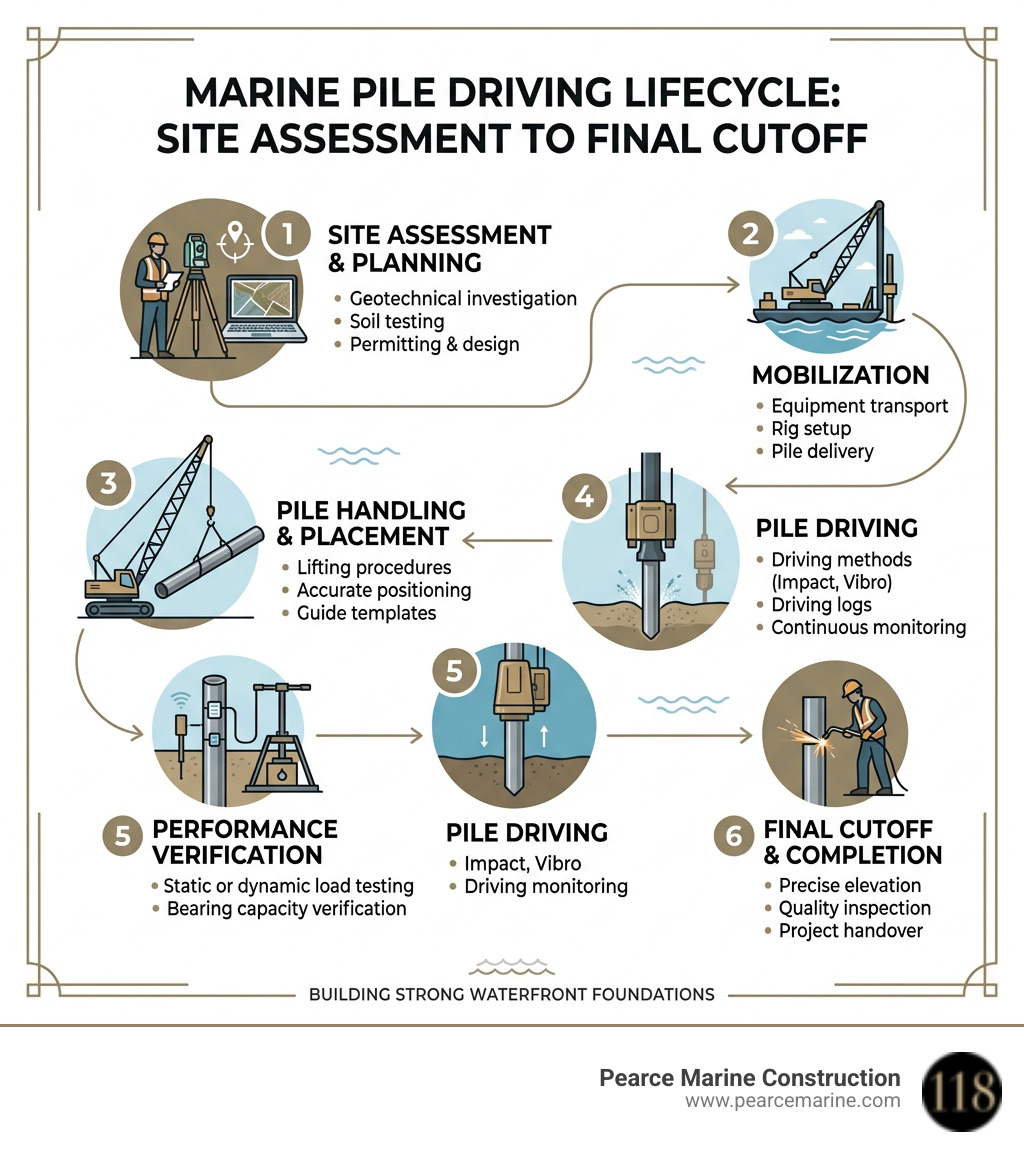
That's why marine pile driving is as much a craft as it is an engineering task. From initial site assessment in Nassau County bays to final cutoff elevation on a Suffolk County shoreline, every decision matters.
Marine pile driving helpful reading:
The Mechanics and Methods of Marine Pile Driving
At its core, marine pile installation is about transferring the weight of a structure through weak, surface-level sediments down to stable, load-bearing soil layers or bedrock. On Long Island, where we deal with everything from the fine sands of the South Shore to the rocky glacial till of the North Shore, choosing the right method is the difference between a dock that lasts forty years and one that settles after the first major storm.
There are three primary marine pile installation techniques we use to get the job done:
- Impact Driving: This is the most traditional method. It involves a heavy weight (the ram) being lifted and dropped onto the head of the pile. Modern versions use hydraulic hammers that offer high precision and adjustable energy levels. It is incredibly effective for driving piles through dense sand or into rocky strata.
- Vibrodriving (Vibratory Driving): Instead of vertical blows, a vibratory hammer clamps onto the pile and uses counter-rotating weights to create high-frequency vertical vibrations. This temporarily "liquefies" the soil around the pile, reducing friction and allowing the pile to sink under its own weight and the weight of the hammer. It’s significantly faster in the sandy conditions often found in West Islip or Babylon.
- Pressing/Jacking: This method uses hydraulic rams to literally push the pile into the ground. It often relies on the reaction force of previously installed piles. Because it involves no hammering or vibration, it is the quietest method and is ideal for noise-sensitive residential areas in Cold Spring Harbor or Lloyd Harbor.
Comparing Pile Driving Methods
| Method | Noise Level | Soil Suitability | Vibration |
|---|---|---|---|
| Impact | High | Dense sand, gravel, rock | High |
| Vibratory | Medium | Silt, clay, loose sand | Medium |
| Pressing | Low | Soft clays, silts | Very Low |
For those looking for professional pile driving services, understanding these methods helps in planning for site-specific constraints like local noise ordinances or proximity to existing fragile structures.
Primary Equipment for Marine Pile Driving
To execute these methods effectively in Nassau and Suffolk Counties, we utilize specialized commercial marine construction equipment. The "star of the show" is usually the pile driving barge. Because many waterfront properties in areas like Massapequa or Wantagh have limited land access, we often approach the site from the water.
- Shallow Draft Barges: These are essential for navigating the shallow bays of Long Island’s South Shore. They allow us to get heavy machinery into tight canals and tidal areas where deeper vessels would run aground.
- Fixed and Swinging Leads: These are the vertical rails that hold the hammer and the pile in perfect alignment. Fixed leads provide the highest level of accuracy for plumb (vertical) or battered (angled) piles.
- Jetting Pumps: In very dense sand, we use high-pressure water jets to loosen the soil at the pile tip. This "jetting" assistance reduces the resistance, making it easier to drive the pile to the required depth without damaging the material.
- Predrilling Rigs: If we encounter "pile refusal" (where the pile simply won't go deeper) due to boulders or glacial till, we may use predrilling to create a pilot hole before driving the pile home.
Material Selection for Durable Shoreline Structures
Choosing the right material is a balance of load requirements, environmental conditions, and budget. For support for lighter structures like residential walkways, timber is a classic choice, but heavier commercial piers in Huntington Harbor may require steel or concrete.
- Treated Timber: The most common choice for residential dock piling installation. It is cost-effective and, when treated according to timber marine pile specifications, can resist rot and marine borers for decades.
- Steel H-Piles and Pipe Piles: These are incredibly strong and can be driven to great depths. They are often used for bulkheads or heavy-duty piers. To combat the corrosive saltwater of the Atlantic and our local sounds, steel piles are typically galvanized or coated with marine-grade epoxy.
- Pre-stressed Concrete: Highly resistant to corrosion and capable of supporting immense vertical loads. These are common in large-scale bridge work or commercial port facilities.
- Composite/Synthetic Pilings: Made from materials like fiberglass or recycled plastic, these will never rot or rust. While the upfront cost is higher, their lifespan makes them a smart long-term investment for shoreline protection.
Overcoming Geotechnical Challenges in Marine Pile Driving
The ground beneath Long Island's waters is anything but uniform. Geotechnical variability is one of the biggest hurdles in pile driving in Suffolk County.
- Seabed Composition: We might start driving a pile in soft silt only to hit a dense layer of "hardpan" or a stray glacial boulder three feet down. This requires real-time adjustments to hammer energy or the use of predrilling.
- Scour Management: Moving water (currents and tides) can wash away the sediment around the base of a pile over time. This is called "scour." We must account for this by driving the pile deeper than the initial load-bearing requirements to ensure it remains stable even if several feet of seabed are lost to erosion.
- Tidal Ranges and Currents: In places like the Shinnecock Inlet or the Great South Bay, the impact of natural elements on installation is significant. We have to time our driving operations with the tides to ensure the barge remains stable and the pile stays plumb.
Installation Standards, Costs, and Long Island Expertise
When we talk about marine pile driving, precision is non-negotiable. A pile that is "close enough" isn't good enough for a structure that needs to withstand a Nor'easter. On Long Island, we adhere to strict engineering tolerances to ensure safety and longevity.
Installation Costs: Generally, you can expect to pay between $500 and $1,500 per linear foot for marine piling installation. This price fluctuates based on the material (timber vs. steel), the depth of the drive, and the accessibility of the site. A barge-mounted project in a remote part of the Hamptons or Oyster Bay will naturally cost more than a land-accessible project in Merrick or Hempstead.
Standard Depths and Tolerances:
- Sandy Bottoms: Piles typically need to be driven 4–6 feet deep for standard docks.
- Boat Lifts: Because of the heavy weight and lateral torque, 6–8 feet of penetration is often required.
- Rocky Conditions: Piles should reach at least 4–5 feet into the rock (often requiring pre-drilling) to ensure they don't "walk" or shift.
- Lateral Tolerance: The top of the pile (the butt) must be within 4 inches of the specified location.
- Plumbness: For vertical piles, the deviation cannot exceed 0.25 inches per foot. If your pile is 20 feet tall, it can't be more than 5 inches out of vertical at the top.
If an existing structure is leaning or sinking, it may require marine piling repair and maintenance, which can include "sistering" new piles alongside old ones or using pile jackets to restore structural integrity.
Quality Assurance and Environmental Standards
Every project we undertake in Nassau and Suffolk involves more than just "hitting a post into the mud." We follow a rigorous quality assurance process.
- Test Piles and Load Testing: On larger projects, we drive "test piles" to determine exactly how much resistance the soil provides. We then perform load tests (often holding a maximum load for 24 hours) to verify that the pile won't settle under the weight of the finished structure.
- Environmental Protection: We are committed to protecting our local ecosystems. This includes using "Best Management Practices" (BMPs) for treated wood. For example, all field-cut ends of timber piles are treated with copper naphthenate (per AWPA M4 standards) to prevent preservatives from leaching into the water.
Innovative Alternatives: Helical Piles and Caissons
Sometimes, traditional marine pile driving isn't the best fit—perhaps due to extremely tight quarters, sensitive marine habitats, or the need for massive load capacities. In these cases, we look toward innovative foundation solutions.
- Helical Piles: These are steel shafts with helical "plates" (like a giant screw). Instead of being hammered, they are twisted into the seabed. This offers minimal vibration, making it perfect for working near older, fragile bulkheads. You can learn more in our helical pile foundation complete guide or check our helical piles Long Island guide for local specifics.
- Drilled Caissons: These are large-diameter, hollow tubes that are drilled into the ground and then filled with reinforced concrete. They offer the highest load capacity and are often used for massive waterfront structures or bridge supports.
While the cost to install helical piers can differ from traditional driving, the speed of installation and reduced environmental footprint often make them a competitive choice for modern Long Island construction.
Conclusion: Partnering with Long Island’s Marine Experts
At Pearce Marine Construction, we understand that your waterfront property is more than just an investment—it’s a legacy. Whether we are driving timber piles for a private dock in Westhampton or installing a heavy-duty steel bulkhead in Bayshore, we bring generational expertise and meticulous craftsmanship to every blow of the hammer.
As a woman-owned business serving both Nassau and Suffolk Counties, we pride ourselves on our deep knowledge of local soil conditions, tidal patterns, and engineering standards. We don't just build structures; we build foundations that stand the test of time against the Atlantic’s toughest seasons.
From the initial site assessment to the final cutoff, our team is dedicated to providing the highest quality shoreline protection and marine infrastructure. If you are planning a project in Southampton, West Islip, or anywhere in between, trust the experts who know these waters best.
Explore our comprehensive marine construction services and let us help you build a foundation that lasts for generations.

Bring Your Vision to Life
Whether you're planning a custom dock, seawall, or boat lift, our experienced team is ready to deliver high-quality marine construction tailored to your needs. Pearce Marine Construction brings craftsmanship, precision, and a deep understanding of Florida’s waterways to every project. Let us help you create a durable, beautiful solution that stands the test of time. Get in touch now for a personalized estimate!