
Screw Pile Footings vs Concrete: Why Your Deck Deserves Better

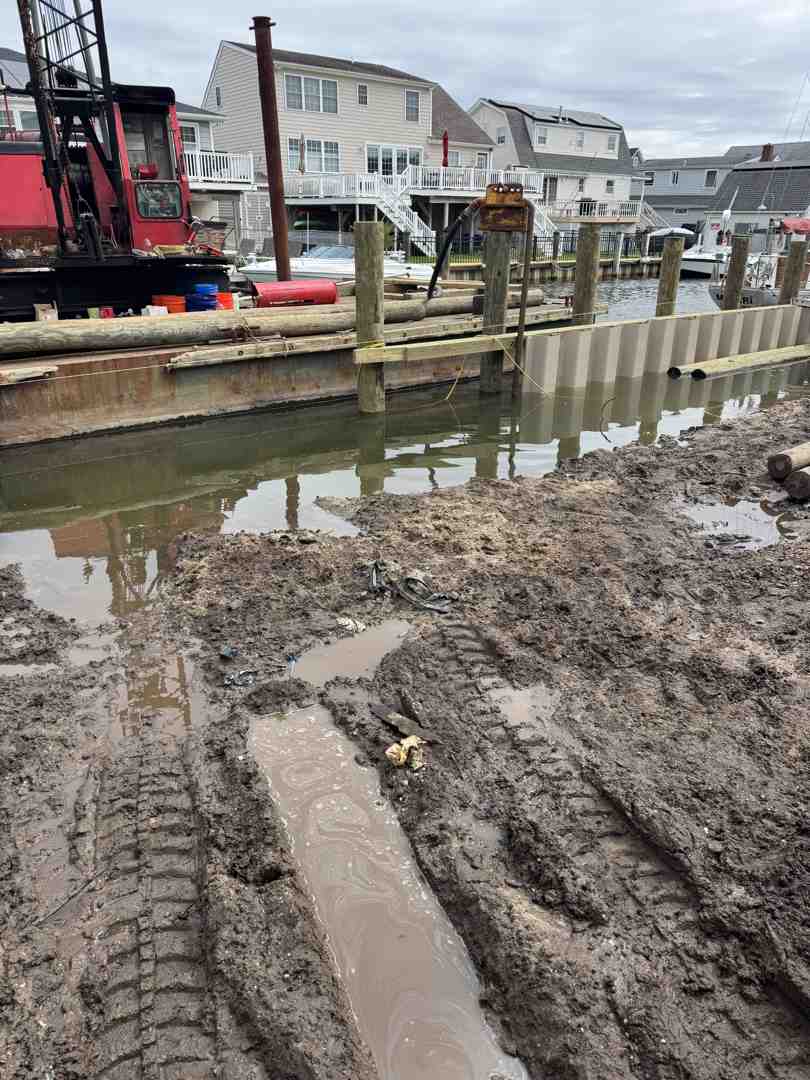
The Fastest Way to Build a Solid Foundation Without Digging
Screw pile footings are steel shafts with helical plates that are mechanically screwed into the ground to create an instant, load-bearing foundation — no digging, no concrete, no curing time required.
Quick answer: What are screw pile footings?
| Feature | Screw Pile Footings |
|---|---|
| Material | Galvanized high-strength steel shaft with welded helical plates |
| Installation | Hydraulically screwed into the ground using an excavator or torque motor |
| Load capacity | Up to 300 kN axial, 200 kN uplift (small-diameter); 2,500+ kN for large-diameter |
| Installation time | 3–5 minutes per pile — no curing wait |
| Best for | Coastal decks, docks, piers, retaining walls, marine structures |
| Design life | 30+ years (galvanized steel in normal soil conditions) |
| Reusable? | Yes — can be unscrewed and reinstalled elsewhere |
For waterfront property owners on Long Island, the foundation under a dock, deck, or seawall is everything. Soft sandy soils, high water tables, and saltwater exposure make traditional concrete footings a real challenge — they shift, crack, and heave over time.
Screw pile footings solve that problem directly.
The technology isn't new. Irish civil engineer Alexander Mitchell first described screw piles in 1848, and more than 100 screw-pile lighthouses were built along the U.S. east coast between the 1850s and 1890s. Those structures needed to hold firm in tidal waters and unstable ground — exactly the conditions found along Nassau and Suffolk County shorelines today.
Modern helical screw piles take that same proven principle and pair it with high-strength galvanized steel, precision torque monitoring, and engineered load ratings — making them the go-to foundation choice for marine construction professionals.

Related content about screw pile footings:
Engineering Coastal Foundations with Screw Pile Footings
When we build along the coast, we are fighting a constant battle against shifting sands, high tides, and seasonal storms. Traditional concrete footings require massive excavation, which disrupts the shoreline and weakens the surrounding soil structure before the concrete is even poured.
Screw piles—also known as helical piles or helical anchors—take an entirely different approach. Instead of removing soil, they displace it minimally as they are driven deep into the earth. The structural design of a screw pile consists of a central steel shaft with one or more helix-shaped plates welded to the bottom. These plates act like a wood screw, pulling the pile down into the ground as rotational force is applied.
The true genius of this design lies in how it transfers weight. While traditional driven piles rely heavily on skin friction along the length of the shaft, screw piles derive the vast majority of their load-bearing capacity from the bearing resistance of the helical plates resting against deep, stable soil layers. By bypassing the weak, saturated upper soils of Nassau and Suffolk County shorelines, we can anchor custom decks and docks directly into dense load-bearing strata.
To understand how these systems are calculated and configured to meet the rigorous demands of coastal engineering, you can read our helical pile foundation complete guide.
High-Capacity Round Shaft Screw Pile Footings
For heavy downward forces—known as compression loads—round shaft screw piles are the industry standard. These piles feature circular hollow sections that provide exceptional resistance to bending and buckling. When we construct large coastal decks or heavy dock platforms in communities like Brightwaters and West Islip, we rely on round shafts to distribute these massive vertical loads safely.
The circular geometry of a round shaft provides uniform strength in all directions. This is vital when dealing with the lateral forces of waves, wind, and soil movement. During a professional helical piles installation, the hollow core of the round shaft also allows us to achieve deep penetration without excessive soil displacement. According to the Helical Foundation Systems Engineering Reference Manual, round shafts are the premier choice for transferring high axial compression loads down to competent load-bearing soils, ensuring that your waterfront structure remains perfectly level for decades to come.
Square Shaft Screw Pile Footings for Tension Anchoring
While round shafts excel at supporting heavy downward weight, square shaft screw piles are the undisputed champions of tension applications. Tension occurs when forces try to pull a pile out of the ground—such as wind uplift on a deck roof, the buoyant forces of high tides on a dock, or the lateral pull on a retaining wall or bulkhead.
Square shafts feature a solid steel core, which provides incredibly high torsional strength. This allows them to be screwed into extremely dense soils or rocky ground without twisting or breaking. Because of their slim profile, they cause almost zero soil displacement during installation. This preserves the natural shear strength of the surrounding soil, which is critical when we install tieback anchors to secure bulkheads and seawalls. When we perform a professional dock piling installation in high-energy wave zones, integrating square shaft anchors ensures that the entire system remains securely tied back into the shoreline, resisting the constant tug of the tides.
Marine Grade Galvanized Steel Footings
In the harsh saltwater environments of Long Island’s South Shore, untreated steel is quickly destroyed by rust. That is why we use exclusively marine-grade, hot-dip galvanized steel for all our screw pile footings. Galvanization coats the high-strength steel in a protective layer of zinc, preventing oxygen and saltwater from reaching the structural metal beneath.
Our galvanized screw piles conform strictly to ASTM A252 standards, guaranteeing the structural integrity of the steel. This hot-dip process gives our foundations an engineered design life of 30 to over 150 years, depending on local soil chemistry.
| Durability Metric | Hot-Dip Galvanized Steel | Untreated Carbon Steel |
|---|---|---|
| Saltwater Corrosion Resistance | Extremely High (Self-healing zinc oxide barrier) | Extremely Low (Rapid oxidation and flaking) |
| Estimated Design Life (Coastal) | 30 to 75+ Years | Under 5 to 10 Years |
| Structural Integrity Over Time | Maintains full load capacity | Suffers severe section loss and failure |
| Environmental Impact | Safe, inert coating | Leaches rust flakes into marine ecosystems |
Professional Marine Piling Installation on Long Island

Installing screw pile footings along the water requires heavy-duty hydraulic machinery, precise torque-monitoring equipment, and a deep understanding of local coastal geology. At Pearce Marine Construction, we utilize specialized compact excavators equipped with high-torque, low-speed hydraulic drive heads to install these deep foundations with surgical precision.
Whether we are working on a tight waterfront lot in Massapequa, a sweeping estate in Southampton, or a residential shoreline in West Hampton, our professional marine piling installation process ensures that every single pile is driven to the exact depth and torque required by structural engineers. This vibration-free installation method protects nearby bulkheads, homes, and neighboring structures from the damaging ground shaking associated with traditional pile driving.
Geotechnical Considerations for Nassau and Suffolk Counties
Long Island’s coastal geology is incredibly diverse and highly challenging. In areas like Merrick, Wantagh, and Bellmore, we frequently encounter soft, organic clays and marshy peat layers. Further east in West Islip, Bayshore, and Babylon, the soil transitions to highly permeable, shifting sands. In the North Shore areas of Cold Spring Harbor, Huntington, and Lloyd Harbor, we must contend with glacial till and high water tables.
Before we install a single screw pile, we review local soil boring logs to locate the exact depth of the load-bearing strata. Saturated, sandy soils are highly susceptible to shifting, while organic clays offer virtually zero bearing capacity. Our crew uses these geotechnical insights to determine the correct pile length and helix configuration, ensuring that the helical plates bypass these unstable upper layers and seat firmly into dense, compact sand or gravel.
Load Testing and Quality Assurance for Coastal Decks
One of the greatest engineering advantages of screw pile footings is our ability to verify their load capacity in real time during installation. As the hydraulic drive head turns the pile into the ground, we monitor the rotational torque.
There is a direct, mathematically proven correlation between installation torque and ultimate load-bearing capacity. By measuring the torque during the final three to five feet of the drive, we can instantly verify that the pile has reached the capacity specified by the structural design. This immediate quality control allows us to apply a strict safety factor of 2 for permanent structures, ensuring that your custom coastal deck or walkway will withstand extreme weather events without settling or shifting.
Why Pearce Marine Construction Outperforms the Competition
When it comes to protecting your waterfront property, experience and craftsmanship are irreplaceable. Pearce Marine Construction is a proud, woman-owned marine construction contractor serving residential and commercial clients across Nassau and Suffolk Counties.
We do not cut corners by using recycled oilfield pipes or ungalvanized materials. We bring generational expertise, meticulous craftsmanship, and a deep respect for Long Island's delicate coastal ecosystems to every single project. From custom decking and dock building to robust bulkhead installations and anchoring systems, we build foundations designed to stand the test of time.
Ready to secure your coastal property with the ultimate foundation technology? Contact us today to learn more about our professional marine construction services and schedule a site assessment with our expert team.



Bring Your Vision to Life
Whether you're planning a custom dock, seawall, or boat lift, our experienced team is ready to deliver high-quality marine construction tailored to your needs. Pearce Marine Construction brings craftsmanship, precision, and a deep understanding of Florida’s waterways to every project. Let us help you create a durable, beautiful solution that stands the test of time. Get in touch now for a personalized estimate!