
Fortify Your Bulkhead with High-Performance Seawall Repair Materials

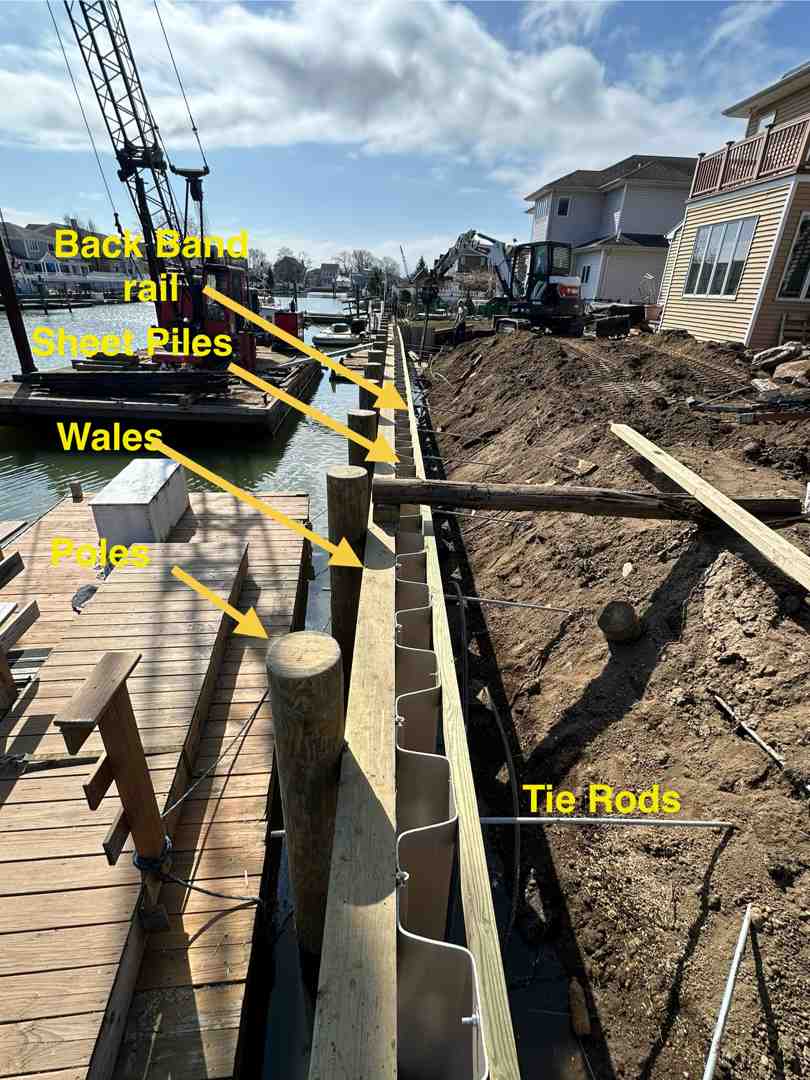
Professional Seawall Repair Materials for Long Island Marine Infrastructure
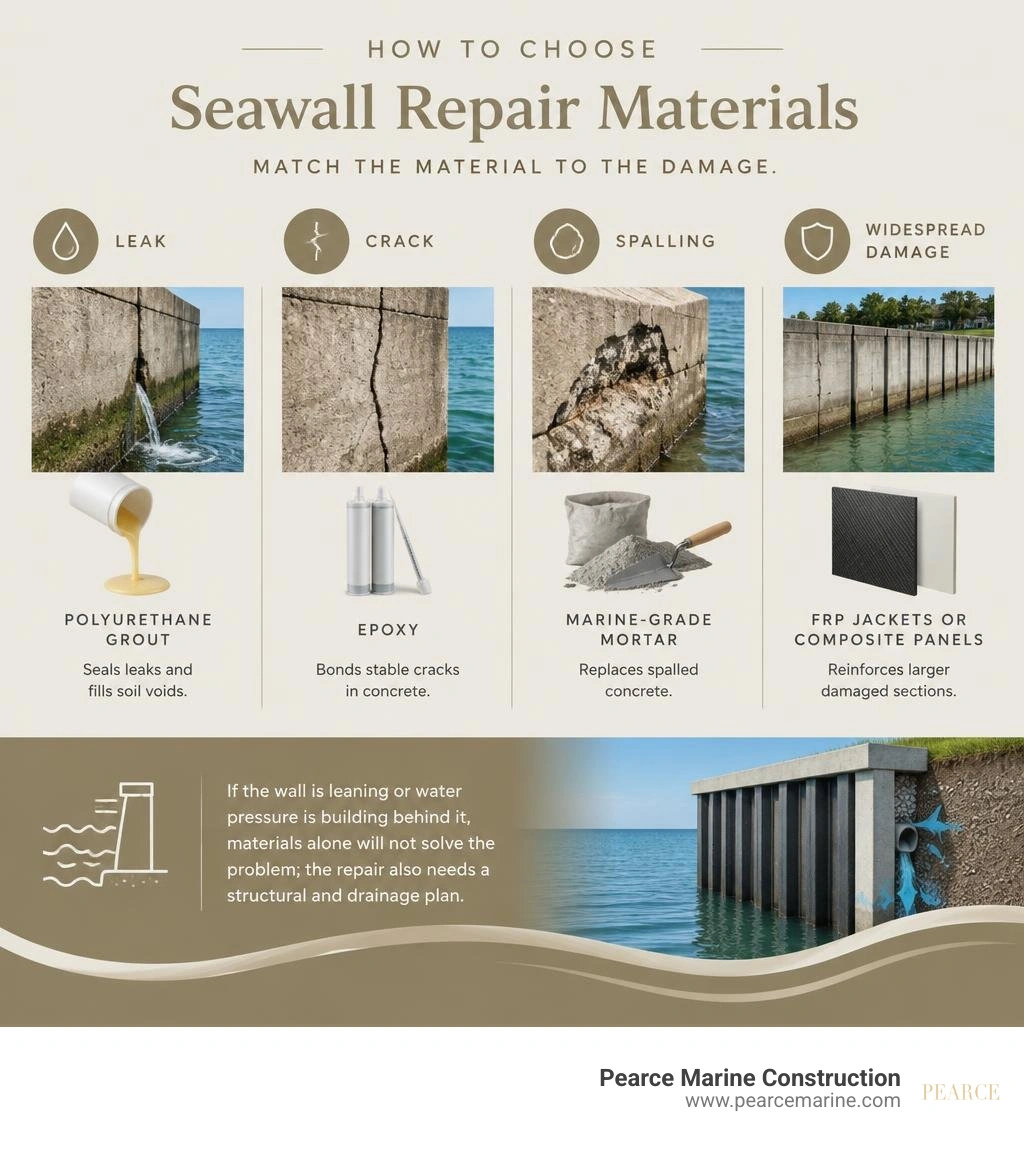
Match the repair material to the site condition during a contractor assessment. Polyurethane grout seals leaks and fills soil voids. Epoxy bonds stable cracks in concrete. Marine-grade mortar replaces spalled concrete. FRP jackets or composite panels can reinforce larger damaged sections. If the wall is leaning or water pressure is building behind it, materials alone will not solve the problem; the repair also needs a structural, drainage, and anchoring plan from an experienced marine contractor.
Pearce Marine Construction is a woman-owned marine construction company serving residential, commercial, and public clients in Nassau and Suffolk Counties on Long Island, NY, including waterfront communities such as Southampton, West Islip, West Hampton, and Massapequa.
Related Pearce Marine contractor resources:
- Compare wall systems in our seawall construction materials overview.
- Review structural options for different types of seawalls.
- Plan project scope with our cost of building a seawall resource.
Understanding Shoreline Deterioration and Failure Mechanisms
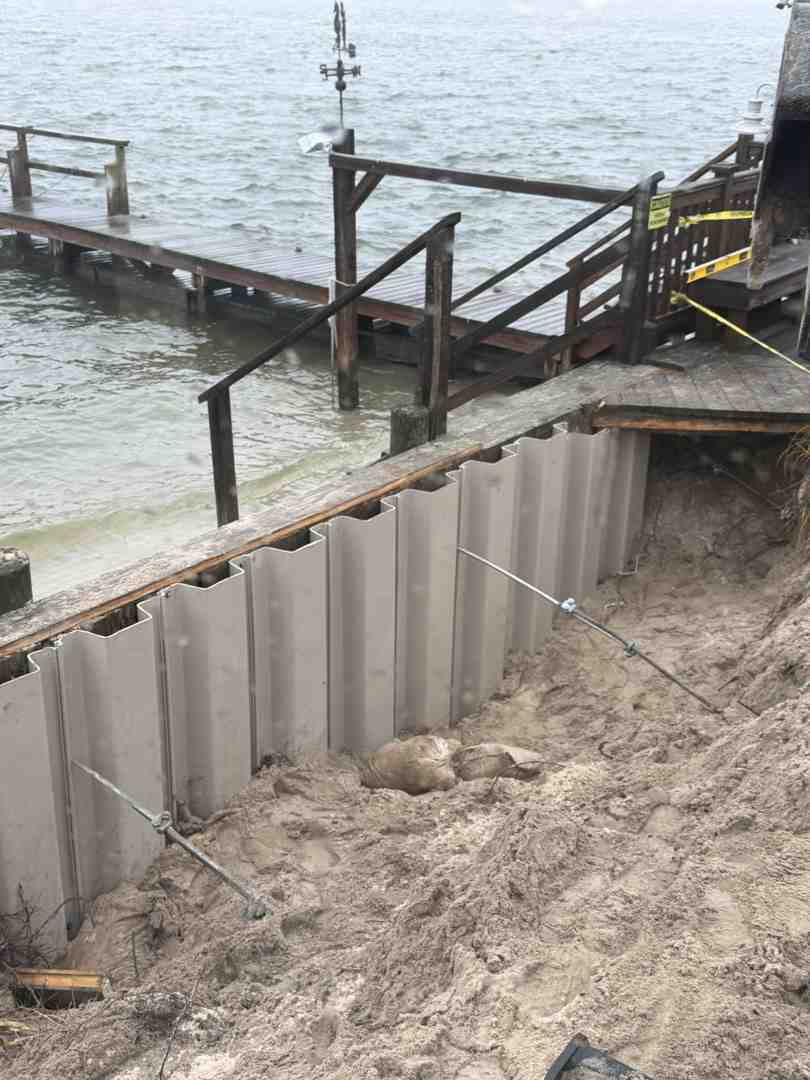
Seawalls and bulkheads across Nassau and Suffolk Counties operate under relentless marine conditions. These structures face heavy tidal action, shifting currents, constant chloride exposure, and aggressive freeze-thaw cycles every winter. Unchecked marine elements inevitably turn microscopic defects into structural threats.
Deterioration typically begins beneath the surface. When seawater penetrates concrete through micro-cracks, chloride ions attack the passive protective layer on internal steel rebar. This causes oxidation, rust expansion, and severe concrete spalling. Simultaneously, tidal fluctuation creates significant hydrostatic pressure differentials behind the structure. When receding tides pull water outward, backfill soil washes through unsealed joints or cracks. This leads to hidden subterranean voids, soil washouts, and sinkholes along waterfront properties in Nassau County and canal networks throughout Suffolk County.

Our forensic assessments routinely evaluate these mechanisms across coastal communities like Massapequa, West Islip, and Southampton to ensure repair strategies directly resolve the underlying root cause.
Top High-Performance Seawall Repair Materials for Marine Bulkheads
Selecting appropriate repair compounds requires matching engineering characteristics to exposure zones on Nassau and Suffolk County waterfronts. Shoreline structures demand proven seawall construction materials that deliver rapid early compressive strength, total impermeability to salt and water, and non-shrink bonding capability under saturated conditions.
Expanding Polyurethane Chemical Grouts as Deep Seawall Repair Materials
Polyurethane grouting is an advanced, non-destructive method for sealing underwater joints, consolidating compromised soils, and filling large underground voids without heavy excavation. These moisture-activated polymers react rapidly upon contact with groundwater.
- Hydrophobic Polyurethanes: Repel water during reaction, maintaining chemical stability in high-flow marine environments. Form rigid, closed-cell foams with up to 50x expansion to drive out trapped water and bridge large voids.
- Hydrophilic Polyurethanes: Absorb water during reaction, creating flexible, elastomeric gaskets ideal for tight joints and fine cracks subjected to tidal movement.
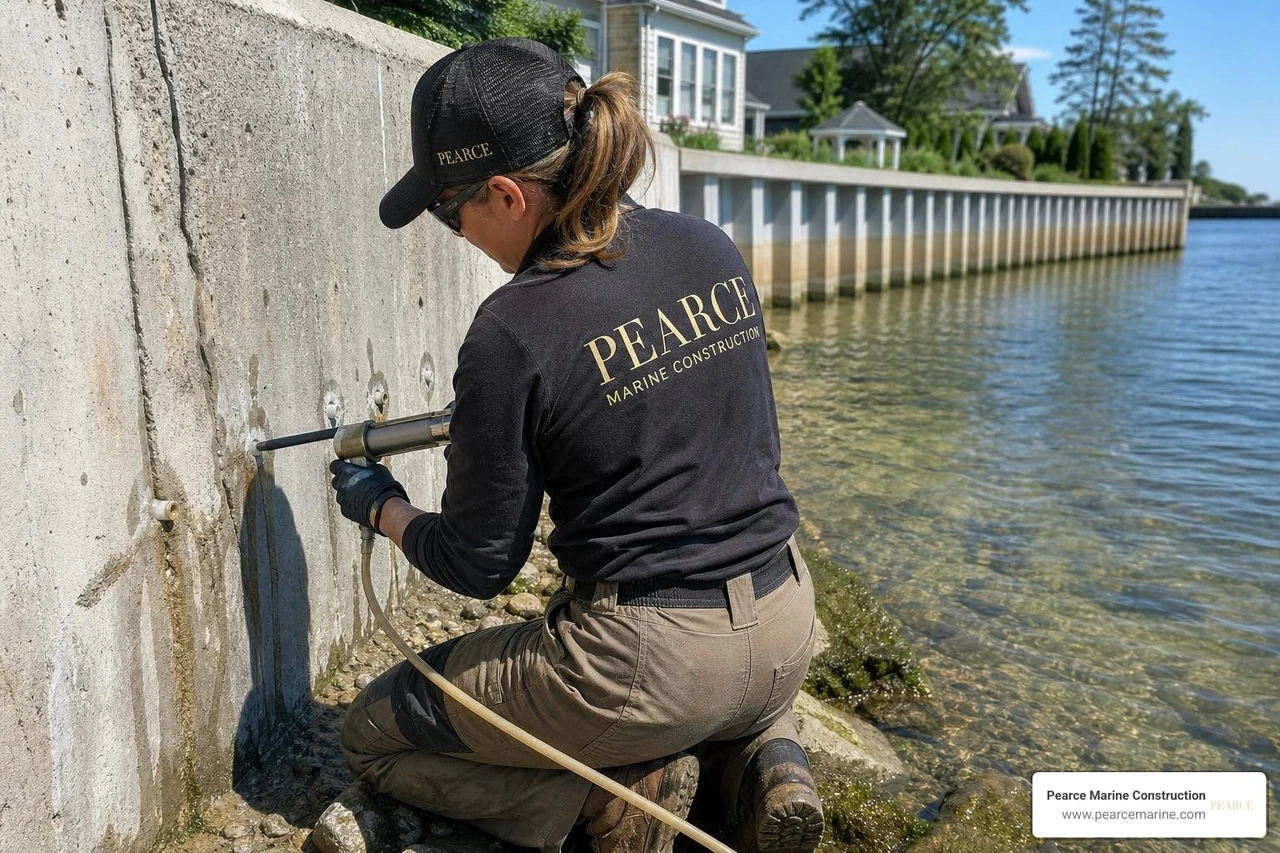
With low initial viscosities (~100 cps), these resins travel 10 to 15 feet under controlled pressure to penetrate deep soil paths. Our polyurethane seawall repair services stabilize compromised substrate and seal failing joints without destructive surface excavation.
| Material Property / Characteristic | Hydrophobic Polyurethane | Hydrophilic Polyurethane | Traditional Flowable Fill |
|---|---|---|---|
| Expansion Ratio | Up to 50x liquid volume | Minimal (1.5x–2x) | 0% (Shrinkage prone) |
| Reaction Mechanism | Moisture-activated, repels water | Water-reactive, absorbs water | Cementitious hydration |
| Cured Structure | Rigid, closed-cell foam | Flexible elastomeric gel/foam | Dense cement matrix |
| Soil Permeation | High (penetrates fine sands) | Medium (joints/cracks) | Poor (requires large voids) |
| Washout Resistance | Excellent in moving water | Good in low-flow water | Extremely vulnerable before set |
| Added Backfill Weight | Negligible (~3–5 lbs/cu.ft) | Low | Heavy (~100–120 lbs/cu.ft) |
High-Strength Structural Epoxy Injections and Underwater Resins
For structural restoration of unmoving, cracked concrete caps and marine piles, epoxy injection provides monolithic bonding. Low-viscosity epoxy penetrates hairline openings as narrow as 0.002 inches, welding fractured concrete faces together with tensile strengths exceeding the original concrete.
Specialized formulations such as Sikadur®-6000 UW cure underwater, developing compressive strengths of 10,000 psi within 7 days and linear shrinkage under 0.06%. This allows structural encapsulation of submerged concrete without dewatering. Our seawall crack repair solutions address crack sealing, bonding, and water intrusion in active marine environments.
Thixotropic Cementitious Mortars and Calcium Aluminate Mixes
Vertical and overhead concrete spalls require high-build, non-sag cementitious mortars that resist early wave washout:
- Polymer-Modified Marine Mortars: Materials like Marine Mortar S incorporate microsilica and fiber reinforcement, achieving 15–20 MPa compressive strength within 24 hours and 50–60 MPa at 28 days with an elastic modulus of 26 GPa.
- Calcium Aluminate Cements: Formulations such as STRONG-SEAL High Performance Mix provide total resistance to microbial-induced corrosion (MIC) and deliver compressive strengths over 7,000 to 9,000 psi alongside zero drying shrinkage.
Advanced Fiber-Reinforced Polymer (FRP) and Composite Panel Systems
When seawalls suffer severe section loss or corrosion across large expanses, installing heavy exterior structural faces provides a reliable alternative to complete demolition.
Pultruded composite assemblies, such as SPiRe Plus - QuakeWrap Inc. panels, utilize vinyl ester resins that are immune to chloride corrosion. Mechanically anchored to aging concrete or timber bulkheads and back-grouted with marine cement, these lightweight panels act as stay-in-place formwork and external structural reinforcement. Our resources on steel seawall repair and fiberglass seawall panels outline complementary rehabilitation methodologies.
Repair Assessment, Drainage Management, and Long-Term Lifespan
A contractor-evaluated seawall carries an expected operational lifespan of 25 to 50 years. When localized structural issues are addressed early, restoration costs approximately 20% to 40% of full replacement while extending service life by 10 to 20+ years. Targeted seawall repair and vinyl seawall panel retrofits provide long-term protection against continuous marine exposure.
Essential Engineering Criteria and Hydrostatic Relief for Seawall Repair Materials
Applying high-performance compounds without addressing trapped water behind the wall often leads to premature failure. Water trapped behind a bulkhead exerts tremendous lateral loads during low tide cycles.
To ensure long-term stability, repair systems must integrate:
- Gravity Weep Holes & Drainage: Installing filtered, one-way check valves relieves hydrostatic pressure while preventing backfill soil washout.
- Geotextile Filter Backing: High-flow, non-woven geotextiles prevent fines from escaping through joints.
- Tieback Anchoring: When alignment shifts occur, high-capacity helical tieback anchors pull walls back into structural plumb.
Key Performance Criteria for Marine Repair Compounds:
- Chloride Impermeability: Low electrical flux (<1000 Coulombs) to protect internal rebar.
- Rapid Early Strength: High initial set within 1 to 4 hours to withstand incoming tides.
- Bond Strength: Greater than 2.0 MPa against damp or submerged substrates.
- Washout Resistance: High cohesion during initial placement in tidal splash zones.
Cost Analysis: Localized Restoration versus Full Bulkhead Replacement
Full seawall replacement across Long Island typically costs $1,000+ per linear foot. Where deterioration remains localized, the foundation is stable, and the anchoring tiebacks are intact, engineered repair delivers superior economic return.

Pearce Marine Construction provides forensic evaluations and turnkey marine restorations across Nassau and Suffolk County waterfronts, including Southampton, West Islip, West Hampton, Babylon, Merrick, and Huntington. Waterfront property owners choose Pearce Marine for deep local Long Island expertise, disciplined engineering execution, and superior craftsmanship on seawalls, bulkheads, drainage systems, and anchoring repairs.
Schedule an engineering evaluation with our team for your next waterfront restoration via our marine seawalls and bulkheads division.



Bring Your Vision to Life
Whether you're planning a custom dock, seawall, or boat lift, our experienced team is ready to deliver high-quality marine construction tailored to your needs. Pearce Marine Construction brings craftsmanship, precision, and a deep understanding of Long Island's waterways to every project. Let us help you create a durable, beautiful solution that stands the test of time. Get in touch now for a personalized estimate!