
In Depth Guide to Steel Seawall Panels for Sale

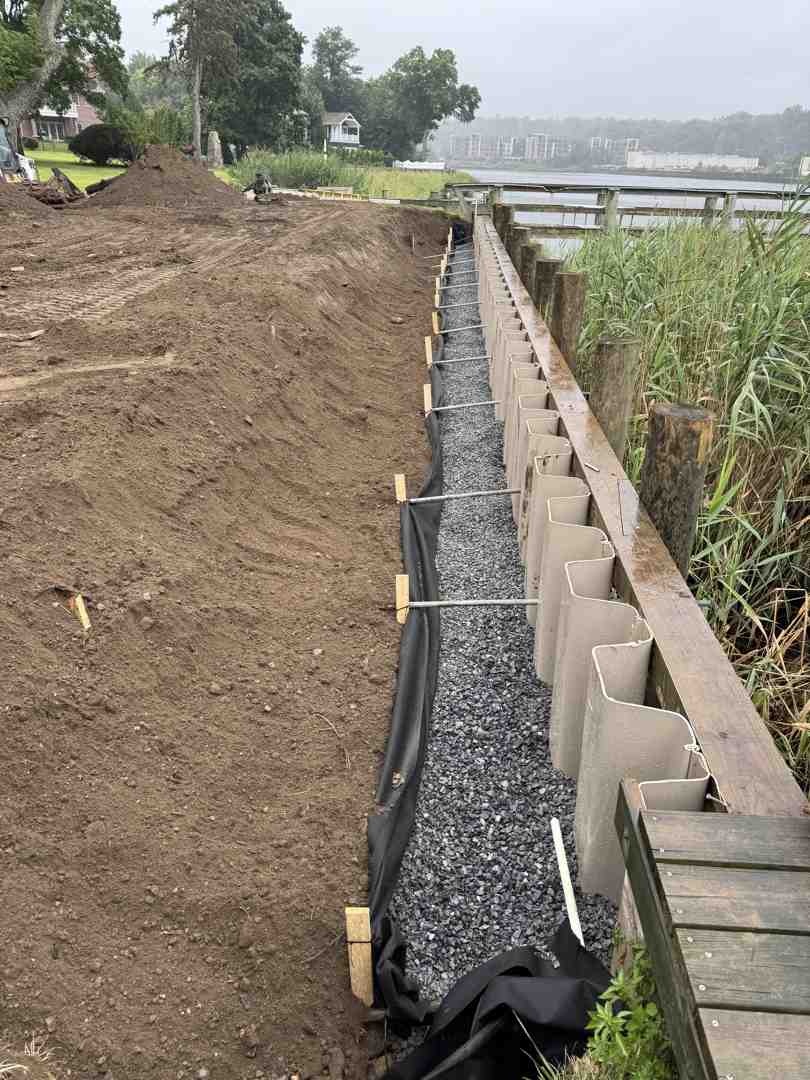
Steel Seawall Panels for Sale: Engineering and Marine Construction
For waterfront properties in Nassau and Suffolk Counties, steel seawall panels for sale must be selected as part of a complete, professionally engineered bulkhead and retaining wall system. Sourcing heavy-gauge steel piling requires pairing an interlocking pile profile sized for severe lateral earth and hydrostatic loads with the exact embedment depth, corrosion protection suited to saltwater exposure, and compatible tiebacks, wales, caps, and filter drainage systems.
Steel sheet piling is the premier structural choice where severe erosion, heavy tidal surges, wake action, or high soil retention demand a rigid marine barrier. Standard structural configurations include PZ, AZ, NZ, Z-type, and U-type profiles engineered to withstand intense coastal pressures.
For Long Island shorelines, selecting and installing steel sheet piling requires detailed analysis of water depth, benthic soil stratigraphy, wave dynamics, and barge or land-based crane access. Pearce Marine Construction is a woman-owned marine construction company serving residential, commercial, and public clients in Nassau and Suffolk Counties on Long Island, NY with heavy-duty seawall, bulkhead, and pile driving solutions.

Steel seawall panels for sale terms to know:
Evaluating Steel Seawall Panels for Sale: Profiles and Sourcing
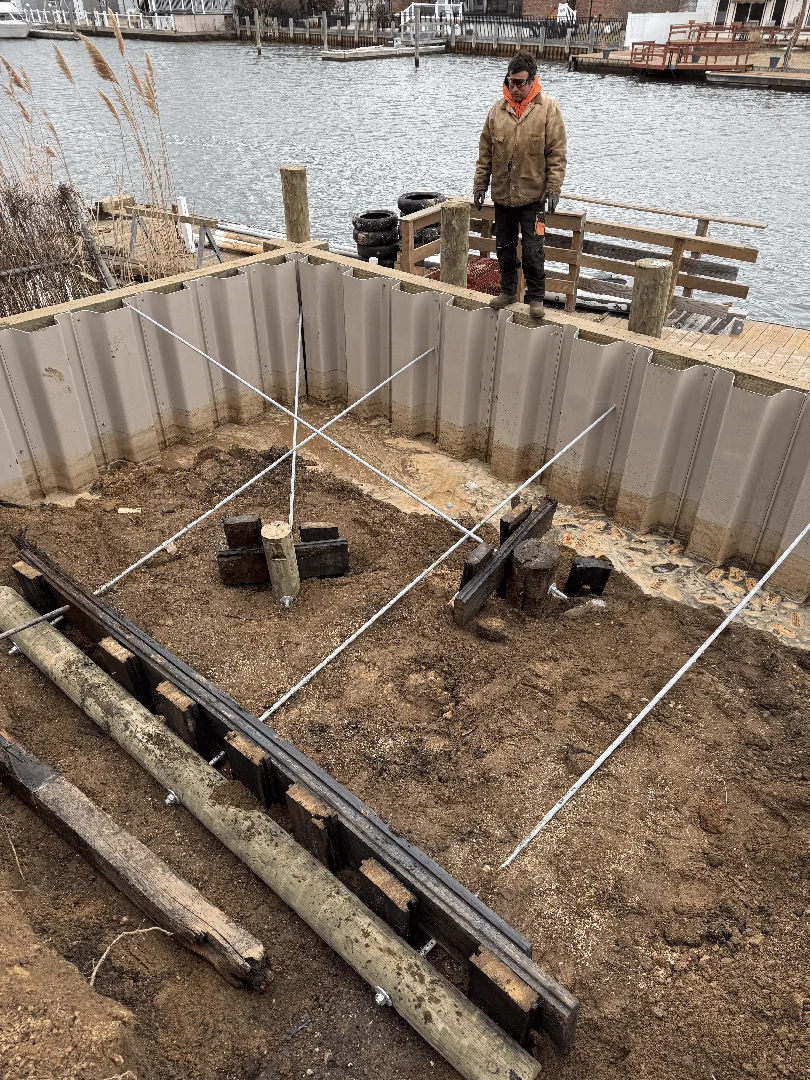
Selecting the right steel sheet pile sections requires understanding structural demands, steel grades, and manufacturing standards. When navigating our Seawall Construction Materials Guide, you will find that steel provides unmatched structural strength against severe storm surges and shifting tides. Marine structures must meet strict structural standards, frequently specifying international and domestic structural steel grades such as ASTM A572 Grade 50, S355, or Q345B.
Steel sheet piles are designed to interlock continuously, forming an impervious, rigid vertical barrier. Choosing between hot-rolled and cold-formed sections, determining the exact profile geometry, and evaluating steel specifications are the fundamental engineering choices that dictate the longevity of your coastal bulkhead.
Hot-Rolled vs. Cold-Formed Steel Seawall Panels for Sale
The primary distinction in steel sheet piling manufacturing lies between hot-rolled and cold-formed sections:
- Hot-Rolled Sheet Piling: Formed at high temperatures during the milling process, hot-rolled piles feature dense, traditional Larssen or Ball-and-Socket interlocks. These interlocks provide superior structural stiffness, higher resistance to driving stress in hard, compacted soils, and enhanced water-tightness. They are the benchmark for high-load commercial ports, ocean-facing bulkheads, and deep-draft waterfronts.
- Cold-Formed Sheet Piling: Manufactured by roll-forming flat structural steel coils at ambient temperatures, cold-formed structural steel specifications offer wide profile flexibility and tight section modulus customizability. Cold-formed Z- and U-profiles deliver exceptional strength-to-weight ratios, offering a cost-effective solution for residential canals and medium-energy shorelines.
While alternative synthetic options like Fiberglass Seawall Panels excel in specific chemical and low-impact environments, steel sheet piling remains the structural gold standard where heavy retained soil heights and punishing wave forces require immense bending resistance.
Selecting Profiles: PZ, AZ, NZ, and U-Type Sheet Piles
The cross-sectional shape of the steel sheet determines its section modulus and moment of inertia—the core structural values governing how much soil and water pressure the wall can withstand without deflecting.
- Z-Type Profiles (PZ, AZ, NZ): Z-shaped piles place the interlocking joints on the outer flanges, away from the neutral axis. This design optimizes the moment of inertia and maximizes structural efficiency, making profiles such as PZ-27, PZ-35, and AZ38-700 ideal for deep embedment and high lateral loads.
- U-Type Profiles: Interlocks sit along the neutral structural axis in U-type sheets. Defined by hot-rolled U-type profile standards, these profiles offer compact shipping dimensions, ease of handling, and wide use in retaining walls, riverbank defense, and cofferdams.
To understand how steel stacks up against alternative configurations across various coastal settings, review our analysis of different Types of Seawalls.
| Profile Type | Typical Section Modulus Range ($cm^3/m$) | Interlock Location | Primary Marine Application | Structural Benefit |
|---|---|---|---|---|
| PZ Series | $1,500 - 3,500+$ | Outer Flange | Deepwater Bulkheads, High Surge Zones | Maximum bending resistance under severe load |
| AZ Series | $1,200 - 4,600+$ | Outer Flange | Coastal Shorelines, Exposed Harbors | High strength-to-weight ratio, wide coverage |
| NZ Series | $1,000 - 2,800+$ | Outer Flange | Residential & Commercial Shorelines | Optimized profile width for faster driving |
| U-Type | $600 - 2,000+$ | Neutral Axis | Canals, Retaining Walls, Cofferdams | Compact footprint, versatile handling |
Material Verification and Quality Standards for Steel Panels
Ensuring structural integrity requires thorough inspection and quality control of steel sheet piling before driving:
- Structural Dimensioning: Profiles must meet exact cross-sectional and flange dimensions to deliver specified section modulus and moment of inertia under design loads.
- Interlock Integrity: Sheets must undergo rigorous quality inspections. Any deformation, tears, or crimps in the interlocks can halt pile driving operations and compromise the continuous soil and water barrier.
- Corrosion Assessment: Ultrasonic thickness testing verifies that structural steel members have not experienced section loss, ensuring wall thickness meets engineering tolerances.
- Mill Certifications: Steel lots should be accompanied by certified mill test reports verifying yield strength (such as 50 ksi) and metallurgical composition.
Our team at Pearce Marine Construction carefully evaluates Steel Sheet Piling stock to verify that all structural members meet our rigorous construction and safety criteria before installation.
Professional Installation, Cost Factors, and Long Island Shoreline Engineering

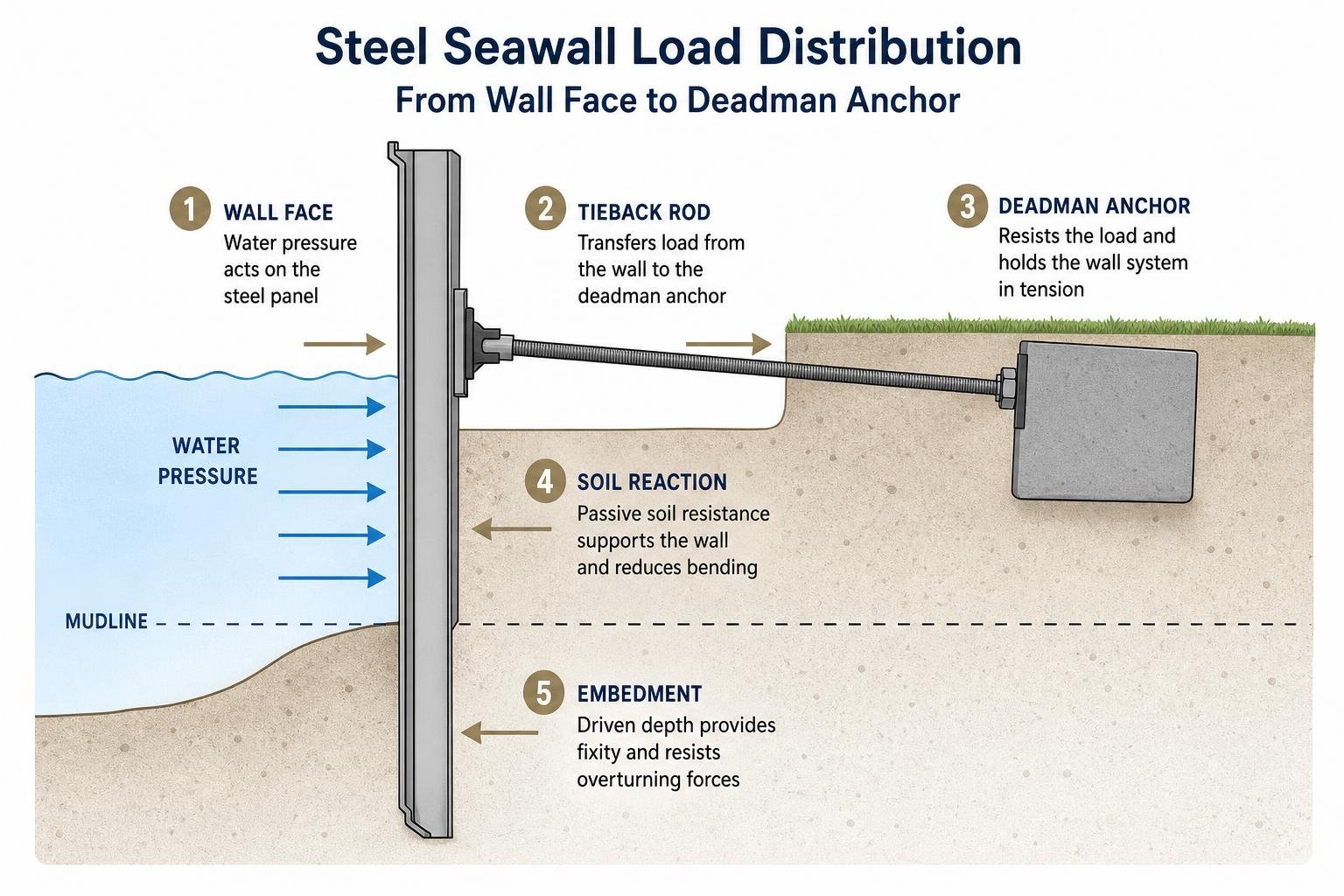
A steel seawall is only as reliable as its foundation engineering and installation execution. Driven sheet piling requires heavy-duty marine plant equipment, specialized vibratory pile drivers, or hydraulic impact hammers mounted on barge rigs or shoreline crane tracks. Soil boring data dictates the necessary penetration depth—often requiring a 1:1 or 2:1 embedment ratio (driving just as much or twice as much steel below the mudline as remains exposed above).
For an extensive breakdown of installation budgets, equipment staging, and material expenses, see our Seawall Building Cost Complete Guide.
Essential Hardware: Tiebacks, Wales, Caps, and Geotextiles
A free-standing cantilever steel wall can only support moderate retained heights. For larger exposures, a complete anchored bulkhead assembly is required:
- Tieback Anchor Rods: Heavy-duty, all-thread tieback rods (typically 5/8-inch to 1-1/4-inch diameter or larger) fabricated from high-strength galvanized steel connect the seawall face to subterranean deadman anchors installed safely inland.
- Structural Steel Wales: Double steel channel wales distribute the lateral earth loads horizontally across all adjacent sheet pile panels into the tiebacks.
- Heavy-Duty Seawall Caps: Concrete or structural steel cap channels lock the top edge of the panels into alignment, protecting the sheet heads and establishing a clean grade elevation.
- Marine Geotextile Fabric: Heavy non-woven filter fabric placed directly behind the wall allows water to weep through weep holes and drainage joints without permitting fine sands and soils to wash out into the bay.
Marine Durability, Corrosion Coatings, and Lifespan
Untreated steel in harsh marine splash zones corrodes over time due to oxygen, salt mist, and biological growth. To ensure a 35-to-50+ year service life, structural engineering incorporates multiple protection tiers:
- Coal Tar Epoxy & Polyurethane Barrier Coatings: High-build marine epoxies applied to the splash and atmospheric zones shield bare steel from saltwater contact.
- Hot-Dip Galvanizing: Metallurgical zinc bonding protects steel components and tieback hardware against oxidation.
- Sacrificial Steel Allowances: Structural engineers specify heavier flange and web thicknesses (such as increasing plate thickness by 2 mm to 3 mm) to account for nominal annual corrosion rates without loss of structural rating.
- Cathodic Protection: Sacrificial zinc or aluminum anodes mounted underwater protect submerged steel surfaces through galvanic action.
Long Island Waterfront Engineering and Professional Construction
Building marine infrastructure along Long Island requires precision execution tailored to local coastal geology. From the heavy wave exposure of Southampton and Westhampton ocean reaches to the tidal canal networks of West Islip, Babylon, Massapequa, Merrick, Wantagh, Bellmore, Brightwaters, Bayshore, Huntington, Lloyd Harbor, and Cold Spring Harbor, proper site engineering is paramount.
Pearce Marine Construction stands out as the superior choice over contractors like Bayview Dockbuilders and Kevel by delivering unparalleled local expertise, precision pile driving capabilities, and superior craftsmanship. When you need heavy-gauge shoreline defense built to withstand severe coastal storms, trust our team for expert seawalls and bulkheads installation that protects your waterfront property for generations to come.

%20(2)%20(1)%20(1).avif)


Bring Your Vision to Life
Whether you're planning a custom dock, seawall, or boat lift, our experienced team is ready to deliver high-quality marine construction tailored to your needs. Pearce Marine Construction brings craftsmanship, precision, and a deep understanding of Florida’s waterways to every project. Let us help you create a durable, beautiful solution that stands the test of time. Get in touch now for a personalized estimate!