
From Gray to Green: Enhancing Coastal Resilience Through Smart Infrastructure

Why Coastal Infrastructure Development Matters for Long Island Waterfront Properties
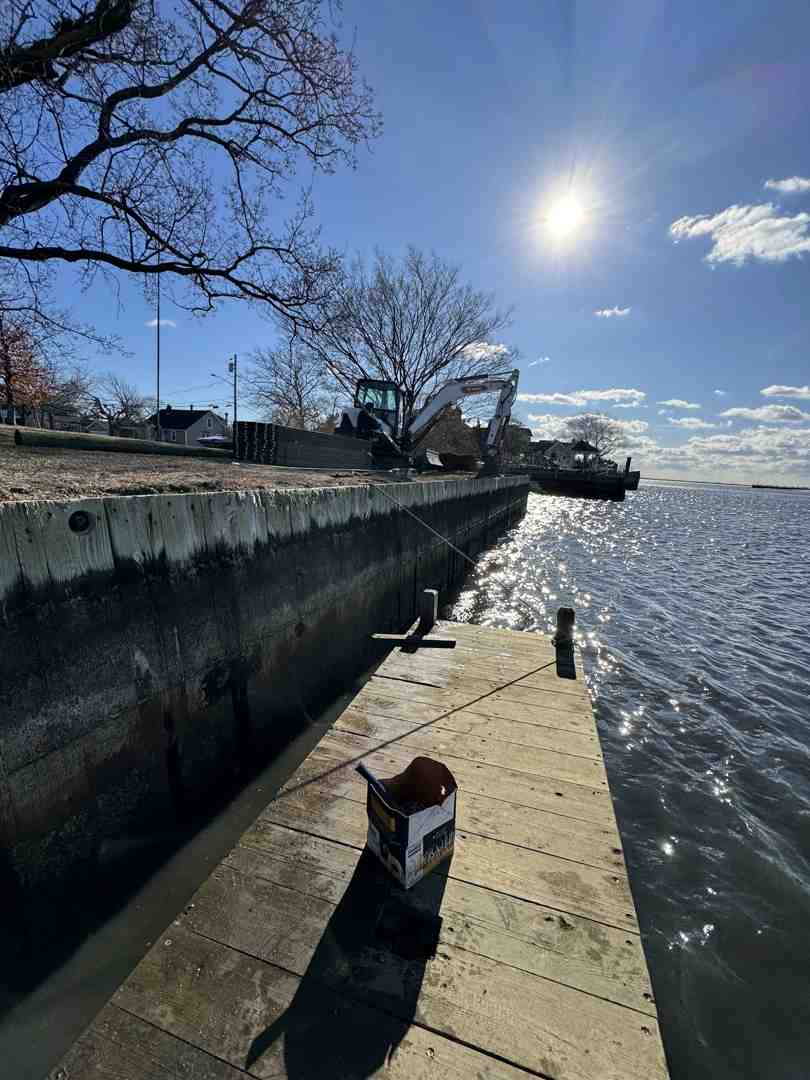
Coastal infrastructure development is the planning, design, and construction of engineered structures that protect shoreline properties from erosion, flooding, and storm damage. For Nassau and Suffolk County property owners, these structures—bulkheads, seawalls, docks, and piers—are essential investments that safeguard valuable waterfront assets against rising sea levels and increasingly severe weather events.
What You Need to Know About Coastal Infrastructure:
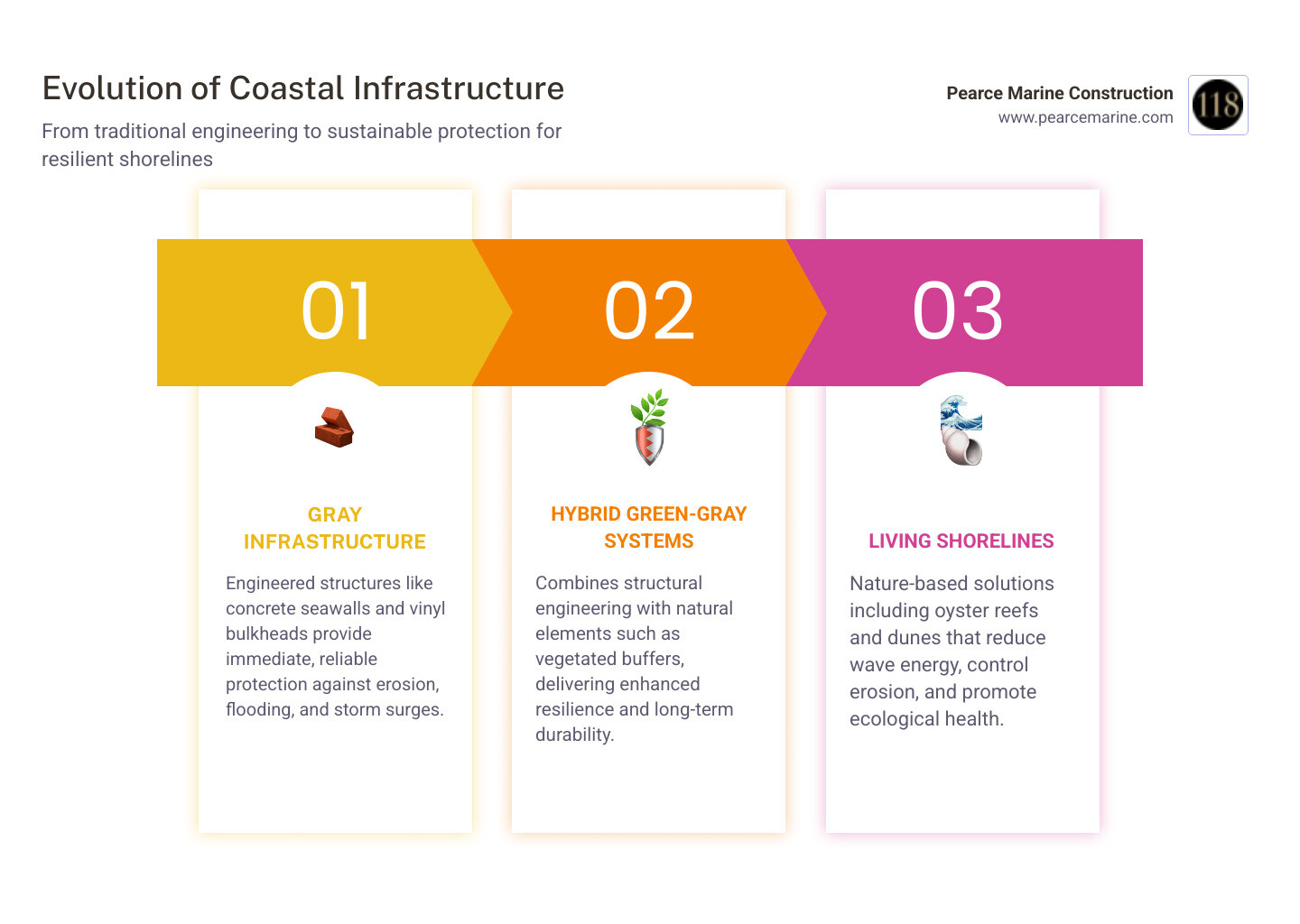
- Gray Infrastructure — Traditional engineered structures like concrete seawalls, vinyl bulkheads, and steel pile systems that provide immediate, reliable shoreline protection
- Hybrid Solutions — Combined approaches that integrate structural engineering with natural elements for improved resilience
- Local Requirements — Nassau and Suffolk Counties have specific regulations governing marine construction projects
- Professional Installation — Proper construction techniques and materials selection determine long-term performance and durability
Long Island's coastline faces unprecedented challenges. Over the last 40 years, global coastal areas have lost 14,000 km² of permanent land to erosion and sea-level rise, with more than 50% occurring along developed coastlines. For Long Island homeowners and commercial property owners, this translates to real threats: accelerating shoreline erosion in West Hampton, increased flooding in West Islip, and storm surge risks throughout Nassau and Suffolk Counties.
The good news? Properly engineered coastal structures work. When designed and built to withstand local conditions—wave action, tidal patterns, soil composition, and storm intensity—marine infrastructure provides decades of reliable protection. The key is partnering with experienced contractors who understand Long Island's unique coastal environment and can deliver the meticulous craftsmanship these critical structures demand.
This guide explains how modern coastal infrastructure development combines proven engineering principles with innovative approaches to protect your waterfront investment. Whether you need a new bulkhead in Southampton, seawall repair in Babylon, or custom dock construction anywhere in Nassau or Suffolk County, understanding these fundamentals helps you make informed decisions about your property's protection.
Engineering Resilient Coastal Infrastructure Development in Nassau and Suffolk Counties
When we talk about coastal infrastructure development on Long Island, we aren’t just talking about putting up a fence in the water. We are talking about high-stakes engineering designed to hold back the Atlantic Ocean and the Long Island Sound. In places like West Islip and Merrick, the demand for resilient structures has never been higher. Global mean sea levels have risen from 1.38 mm/year in the early 20th century to 3.16 mm/year recently, and projections suggest a rise of up to 0.32 meters by 2050. That’s not a "future problem"—that’s a "now" problem for anyone with a backyard on the canal.
To build for the next fifty years, we look at Scientific research on coastal development resilience to understand how to balance structural rigidity with environmental reality. On Long Island, this often means a shift toward more robust materials and smarter designs that can handle "coastal squeeze"—where rising tides push against fixed human structures.
| Infrastructure Type | Primary Components | Performance in High Surge | Durability | Environmental Impact |
|---|---|---|---|---|
| Gray | Concrete, Steel, Vinyl | Superior | 30-50+ Years | High Alteration |
| Green | Dunes, Saltmarshes | Moderate | Variable (Regenerative) | Low/Positive |
| Hybrid | Engineered Core + Vegetation | High | 40+ Years | Balanced |
The Role of Gray Infrastructure in Coastal Infrastructure Development
Gray infrastructure remains the backbone of shoreline protection in densely populated areas like Nassau County. When a storm surge hits Massapequa or Bellmore, you want the uncompromising strength of a seawall-construction-ultimate-guide or a professionally driven pile system.
Gray infrastructure refers to "hardened" structures. This means:
- Bulkheads: Vertical walls (often vinyl or timber) designed to retain soil and prevent sliding into the water. If your current wall is leaning or showing "sinkholes" behind it, you likely need a bulkhead-repair to restore structural integrity.
- Seawalls: Massive concrete or stone barriers designed to break the energy of incoming waves.
- Pile Driving: The literal foundation of everything we build. We use high-tonnage equipment to drive timber or steel piles deep into the substrate, ensuring your dock or bulkhead doesn't budge when the ice moves in the winter.
In Suffolk County, where many properties face more open water, the engineering must account for "scour"—the process where waves wash away the sand at the base of a wall. Proper gray infrastructure design includes deep toe protection and robust retaining-wall-builders techniques to ensure the structure doesn't get undermined from below.
Hybrid Approaches and Nature-Based Solutions for Shoreline Protection
While gray infrastructure provides the "muscle," we are increasingly seeing the benefits of hybrid systems. These projects combine the reliability of engineered structures with the energy-absorbing qualities of nature-based solutions. Think of it as a "living bulkhead."
In areas like the Great South Bay, we might implement shoreline-stabilization-services that include a structural bulkhead backed by a graded, vegetated buffer. This doesn't just look better; it helps manage drainage and reduces the "reflected wave energy" that can erode your neighbor's property.
Key hybrid elements we consider include:
- Dynamic Revetments: Using stone or cobble that can move slightly with wave energy, acting as a natural shock absorber.
- Vegetated Slopes: Using native Long Island plantings to bind the soil behind a waterfront-retaining-walls system.
- Living Breakwaters: Submerged or partially submerged structures that reduce wave height before they reach your dock. You can find More info about the Living Breakwaters model to see how these are being used on a larger scale in New York.
For coastal-erosion-control, these hybrid models offer a way to comply with increasingly strict environmental regulations while still providing the level of protection that Long Island's extreme weather demands.
Advanced Modeling and Data-Driven Coastal Infrastructure Development
We don't guess where to put a pile or how high to build a wall. Modern coastal infrastructure development relies on sophisticated data. While we rely on our generational expertise, we also look at the same tools used by major ports and government agencies.
Discover more TUFLOW software, which is the industry standard for hydraulic and coastal modeling. This type of modeling allows engineers to simulate:
- Hydrodynamics: How water moves through your specific canal or bay during a Nor'easter.
- Sediment Transport: Where the sand will go after we install a new groin or jetty.
- Storm Surge Scenarios: Predicting exactly how high the water will rise based on different hurricane categories.
By using data-driven simulations, we can ensure that a new marine-bulkhead-construction project in Huntington or Bayshore is built to the correct elevation to handle the "100-year storm" that seems to happen every ten years lately.
Future-Proofing Long Island: Construction Standards for the Next Generation
The structures we build today in places like Southampton and West Hampton must be tougher than the ones built by our grandfathers. The materials have changed, and the standards have evolved. When we talk about "future-proofing," we are talking about high-performance materials like heavy-duty vinyl sheets, fiber-reinforced polymers, and marine-grade concrete.
Our marine-construction-guide-2026 outlines the shift toward "Climate-Ready Coasts." This involves building with higher "freeboard" (the distance between the water and the top of the structure) and using commercial-concrete-construction-companies techniques that prevent saltwater from corroding the internal steel reinforcement of seawalls.
Protecting Critical Assets with Resilient Bulkheads and Seawalls
A bulkhead is your property’s first and last line of defense. In Nassau and Suffolk Counties, a failure doesn't just mean a messy yard—it can mean the loss of land and damage to your home’s foundation.
When we handle seawalls-and-bulkheads, we focus on the "tie-back" system. This is the anchoring system that holds the wall upright against the massive pressure of the wet soil behind it. In Long Island's sandy conditions, we often use "deadmen" (large anchors buried deep inland) and galvanized steel rods.
For bulkhead-construction-long-island-ny, we prioritize:
- Material Selection: Vinyl is often preferred for its resistance to marine borers and rot, while steel or concrete may be necessary for high-energy shorelines.
- Permit Compliance: We ensure every build meets the rigorous standards of the NYS Department of Environmental Conservation (DEC) and local town codes in places like Babylon or Oyster Bay.
- Meticulous Craftsmanship: Every joint, cap, and fastener is a potential point of failure. Our team treats every bolt like it’s the most important one in the wall.
Custom Dock and Pier Construction for Commercial and Residential Resilience
Docks and piers are more than just a place to stand; they are complex marine structures that must withstand vertical lift from tides and horizontal sheer from moving ice. In Cold Spring Harbor and Lloyd Harbor, the rocky bottom and steep slopes require specialized underwater-construction expertise.
We are long-island-custom-pier-builders who specialize in both residential and commercial-dock-construction. The difference is in the details:
- Pile Depth: We drive piles until we hit "refusal" or the required load-bearing capacity, ensuring your dock doesn't "jack" out of the ground during a winter freeze.
- Decking Materials: We offer everything from traditional pressure-treated timber to high-end composites and tropical hardwoods that can handle the salt spray of the Atlantic.
- Hardware: We exclusively use 316 stainless steel or hot-dipped galvanized hardware to prevent the "bleeding" and rust that weakens cheaper builds.
Whether you are looking for boat-docks-and-floating-docks or a fixed timber pier, the goal is the same: durability that lasts a generation.
Conclusion: The Pearce Marine Standard of Craftsmanship
Coastal infrastructure development is a serious business on Long Island. With over 1,000 miles of shoreline in New York alone, the pressure on our coastal assets is immense. From the quiet canals of Wantagh to the exposed bluffs of the North Shore, every property requires a custom approach.
At Pearce Marine Construction, we take pride in being a woman-owned business that brings a different level of attention to detail to the job site. We don't just "bang in some wood" and head to the next job. We bring generational expertise and a commitment to meticulous craftsmanship that ensures our marine-structures stand the test of time.
If you are a property owner in Nassau or Suffolk County—from Massapequa to Southampton—and you are concerned about the integrity of your shoreline, don't wait for the next storm to test your defenses. Whether you need a concrete-bulkhead-repair-ultimate-guide or a completely new marine-bulkhead-construction project, we are here to help you build the future you want to see for your waterfront home.
Ready to protect your investment?Contact us today to discuss your project and experience the Pearce Marine difference. From the first pile driven to the final deck screw, we build for Long Island.



Bring Your Vision to Life
Whether you're planning a custom dock, seawall, or boat lift, our experienced team is ready to deliver high-quality marine construction tailored to your needs. Pearce Marine Construction brings craftsmanship, precision, and a deep understanding of Florida’s waterways to every project. Let us help you create a durable, beautiful solution that stands the test of time. Get in touch now for a personalized estimate!