
Building Resilient Marinas with High-Performance Floating Dock Systems


How to Build a Floating Dock Marina That Lasts
Floating dock marina construction starts with the site, not the dock. Measure water-level changes, waves, currents, and seabed conditions. Then plan slips and access for the vessels the marina will serve. Engineers can use those findings to size the floats, frames, guide piles or anchors, and gangways.
The key difference from a fixed pier is how the dock carries weight: floats support people and equipment as the dock rises and falls with the water. Piles or anchors hold it in place against wind, waves, and vessel forces. Getting both jobs right helps protect access, limit wear, and avoid costly repairs.
Pearce Marine Construction is a woman-owned marine construction company serving residential, commercial, and public clients in Nassau and Suffolk Counties on Long Island, NY.

Floating dock marina construction glossary:
Engineering Principles of Floating Dock Marina Construction
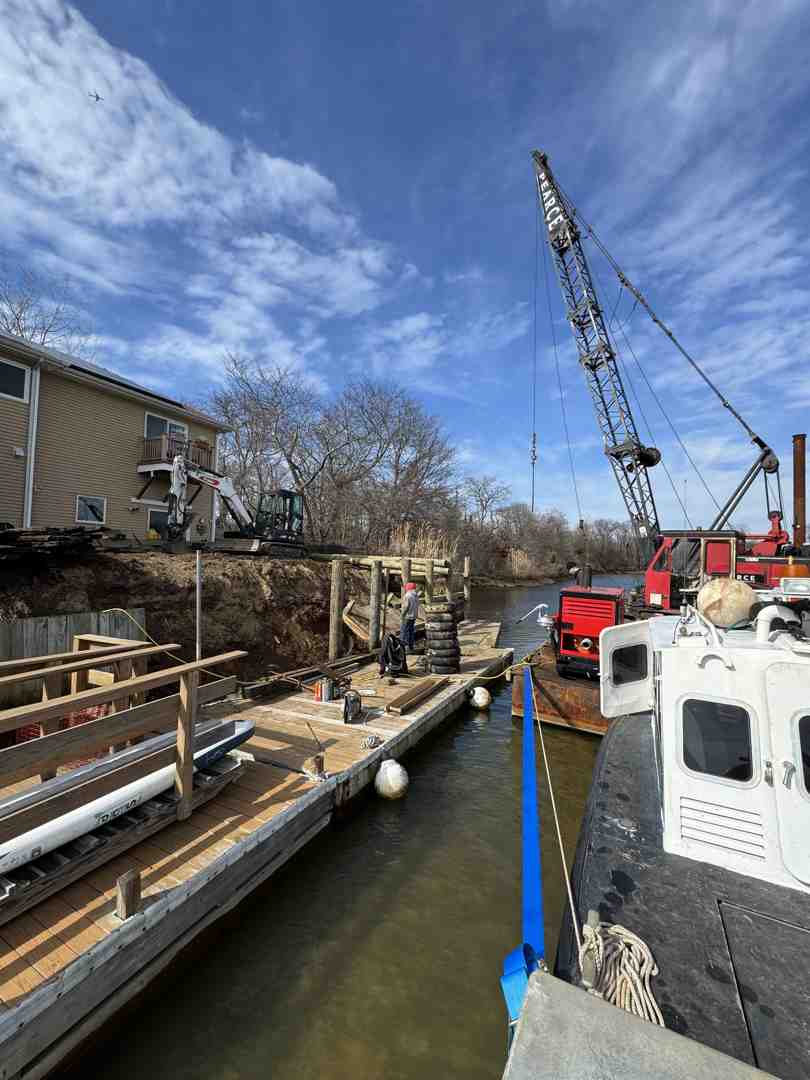
Engineering a resilient floating marina requires a deep understanding of dynamic equilibrium. Unlike land-based structures that transfer static dead and live loads downward into rigid footings, floating dock systems operate within a constantly shifting hydrodynamic field. Every wave crest, tidal surge, and gust of wind introduces simultaneous multi-axis forces that the marina structure must absorb, distribute, and dissipate.
The primary engineering objective is balancing buoyancy distribution with structural frame stiffness. Flotation modules—typically expanded polystyrene (EPS) cores encased in seamless, rotomolded high-density polyethylene (HDPE) shells—must be spaced precisely to support both distributed live loads (pedestrian traffic, utility chases, service equipment) and concentrated point loads (gangway landing hinge reactions and pile guide brackets).
Simultaneously, the structural framework must possess enough torsional rigidity to resist twisting across wave troughs while incorporating dynamic joint flexibility at module connections. If a multi-slip dock system is engineered too rigidly without semi-flexible hinge points, cyclic wave action introduces severe bending moments that fatigue welds and shear connection bolts. Conversely, excessive flexibility leads to excessive deck deflection and early mechanical failure of internal utility conduits.

Structural Foundations and Pile Anchoring in Floating Dock Marina Construction
The foundation of a floating marina does not support gravity loads; instead, it provides lateral restraint while permitting unrestricted vertical travel throughout the tidal cycle. Guide piles must be engineered to resist significant bending moments caused by wind shear on berthed vessels, current drag against submerged hulls, and kinetic impact forces during berthing maneuvers.
In modern coastal engineering across Long Island's South Shore bays and North Shore harbors, pile material selection is critical:
- HDPE-Sleeved Steel Piles: Heavy-wall structural steel pipe piles driven deep into underlying sand strata provide immense shear and lateral load resistance. Encasing these piles in heavy-duty HDPE sleeves eliminates direct saltwater contact, prevents galvanic oxidation, and drastically reduces friction against floating pile guides.
- Driven Prestressed Concrete Piles: Frequently specified for heavy-commercial applications, solid concrete piles deliver exceptional long-term durability in high-energy marine environments without the risk of biological decay or rust.
- Timber Pile Retrofit Strategies: While legacy facilities often relied on treated timber pilings, modern commercial redevelopments frequently upgrade to steel or concrete piles. In active projects like the $7.9 million rehabilitation underway at New York marina facilities, aging timber pilings are systematically replaced with heavy steel piles to enhance lateral load capacity and structural longevity.
Engineers must also calculate pile penetration depth based on local geotechnical soil shear capacity. In soft silts and organic clays common to marsh estuaries, piles require deeper embedment or larger diameters to prevent lateral deflection. Furthermore, pile height must extend well above the projected 100-year storm surge elevation to prevent the docks from floating off the tops of the pilings during extreme weather events.
To explore detailed engineering layouts for specific berth designs, review our comprehensive floating dock construction guide.
Material Selection: Aluminum, Concrete, and Wood Performance
Selecting the right framing and decking materials dictates the structural integrity, maintenance schedule, and total operational lifespan of the marina facility.
| Performance Metric | Marine-Grade Aluminum (6061-T6 / 6005A-T6) | Heavy Fiber-Reinforced Concrete | Pressure-Treated Timber |
|---|---|---|---|
| Strength-to-Weight Ratio | Extremely High (60–70% lighter than concrete) | Low (relies on massive dead weight for ballast) | Moderate |
| Structural Lifespan | 30 to 50+ Years | 40 to 70 Years | 15 to 25 Years (treated) |
| Corrosion Resistance | Superior (natural oxide film; requires dielectric isolation) | High (vulnerable to chloride ion intrusion in rebar) | Poor (subject to marine borers, rot, and splintering) |
| Maintenance Profile | Low (routine inspection and fastener torque checks) | Very Low (periodic joint and bumper maintenance) | High (frequent fastener tightening, sealing, deck replacement) |
| Buoyancy Requirements | Low (lightweight superstructure minimizes draft) | High (requires large, heavily buoyant displacement pontoons) | Moderate |
Marine-grade aluminum extrusions, particularly 6061-T6 and 6005A-T6 structural alloys, have become the gold standard for high-performance marina framing. Aluminum weighs roughly one-third as much as structural steel and eliminates the dead-weight penalties associated with heavy timber. Extruded structural channels often incorporate integrated T-slot tracks, allowing cleats, finger pier brackets, and utility hangers to be repositioned without drilling field holes that could compromise structural coatings. When pairing aluminum frames with 316L stainless steel fasteners or steel pile guides, isolation bushings and dielectric barriers must be installed to prevent galvanic corrosion.
For heavy, open-water commercial basins requiring exceptional roll dampening, concrete floating dock solutions provide massive ballast that naturally attenuates short-period chop. For walking surfaces, modified woods such as Kebony or premium composite materials provide dimensional stability, high slip resistance, and resistance to UV degradation without leaching harmful chemical preservatives into sensitive marine estuaries.
Innovative Mooring Solutions and Wave Attenuation in Floating Dock Marina Construction
When water depth, geotechnical constraints, or environmental regulations make vertical guide piles impractical, engineered elastic mooring systems and specialized anchoring strategies offer proven performance.

In deep basins or sites with restrictive seabed penetration limits, elastic mooring systems like Seaflex combined with helical screw anchors offer stable lateral support. These systems utilize progressive-resistance elastomeric hawser assemblies that elongate predictably under storm surges while maintaining continuous pretension. This prevents the abrupt shock loads associated with slack anchor chains, keeping floating piers securely aligned.
For severe open-water conditions or unique bathymetric profiles where traditional piling cannot reach stable soil, advanced marine engineering can implement specialized suspended mooring designs. Along Long Island's North Shore, where steep underwater slopes and deep harbor basins present challenging anchoring conditions, suspended frameworks anchored to stable sub-bottom strata secure floating docks over depths that would make conventional pile driving impractical.
To mitigate lateral kinetic impacts along traditional guide piles, energy-dissipating pile guides such as ShockGUARD replace standard ultra-high-molecular-weight polyethylene (UHMW-PE) rollers. By incorporating heavy elastomeric dampening elements between the pile collar and the dock frame, these systems absorb vessel berthing impacts and cyclic wave energy, drastically reducing structural fatigue across the entire dock assembly.
Lifecycle Economics and Long-Term Marina Planning
A commercially successful marina balances structural resilience with optimized slip density, seamless utility delivery, and long-term asset value. For commercial operators, our commercial dock installation guide provides in-depth technical walk-throughs of the complete project lifecycle from site survey to final commissioning.
Basin Layout Engineering, Fairway Sizing, and ADA Compliance
Master planning a floating marina basin requires balancing vessel geometry against hydrodynamic clearance. Fairway widths between dock fingers must be engineered based on the design vessel length overall (LOA):
- Interior Fairway Widths: Standard commercial guidelines dictate a minimum fairway clearance of 1.5 times the LOA of the longest vessel utilizing the slip fairway. In high-current or wind-exposed basins, this ratio should be expanded to 1.75 times LOA to ensure safe vessel maneuvering.
- Finger Pier Proportions: Finger piers should match 100% of the berthed vessel length to provide full mooring line control and reduce bow or stern overhang into active navigation channels. For detailed structural dimensioning, refer to our finger pier floating dock construction planning guide.
- ADA Accessibility and Gangway Slopes: Gangways connecting fixed upland bulkheads to floating piers must be engineered to comply with the Americans with Disabilities Act (ADA). The maximum allowable gangway slope is 1:12 (an 8.33% grade) under typical operational water levels. In regions with substantial tidal swings, gangway spans must be lengthened and fitted with bottom transition roller plates to maintain safe slope thresholds across the full astronomical tidal range.
Integrated utility chases should be factored into structural framing from the outset. Internal conduits house single-phase and three-phase power pedestals, potable water feeds, fire suppression standpipes, and in-slip vacuum pump-out lines, protecting critical infrastructure beneath the walking deck. For heavy-duty industrial or commercial waterfronts, see our overview of commercial dock construction.
Coastal Engineering Considerations Across Long Island Waters
Floating dock systems across Nassau and Suffolk Counties must be engineered for distinctly different hydrodynamic environments. South Shore bay installations—including those in Massapequa, Babylon, West Islip, and Brightwaters—require designs that account for shallow draft constraints, soft silty seabeds, and long-fetch wind chop across open bay waters. North Shore harbor installations—including Cold Spring Harbor, Huntington, and Lloyd Harbor—demand deeper pile embedment strategies and robust lateral restraint systems to handle steep underwater slopes and higher-energy tidal currents.
Structural engineering for these environments focuses on pile sizing, flotation module placement, and frame reinforcement rather than administrative processes. For practical insights into local site conditions and structural solutions, review our case study on Massapequa marina development.
Capital Costs vs. Lifecycle Maintenance Strategies
Evaluating a floating dock marina solely on initial capital expenditure (CapEx) often leads to high operational expenditures (OpEx) later on. While treated timber systems carry a lower upfront price tag, their shorter 15-to-25-year structural service life, susceptibility to marine borer damage, and high ongoing maintenance costs make them significantly more expensive over time compared to aluminum or concrete systems.
Over a typical 50-year asset design life, the probability of a marina experiencing a statistical 100-year storm event exceeds 39%. Engineering structural margins to withstand these peak hydrodynamic events protects against catastrophic structural failure and total loss of revenue. Investing in marine-grade 6061-T6 aluminum truss frames with closed-cell EPS flotation provides a verified structural service life of 30 to 50+ years with only routine cleaning, fastener torque checks, and sacrificial anode replacement.
When investing in waterfront infrastructure across Nassau and Suffolk Counties, partnering with an experienced, high-precision marine contractor ensures your facility is engineered to withstand harsh coastal conditions. Pearce Marine Construction delivers superior craftsmanship and generational local knowledge across Long Island.
Whether developing a new multi-slip commercial harbor, retrofitting aging piles, or constructing shoreline bulkheads and piers in Southampton, West Islip, or Wantagh, our team provides turn-key engineering and construction excellence. Learn more about our custom solutions by visiting our boat docks and floating docks services page.



Bring Your Vision to Life
Whether you're planning a custom dock, seawall, or boat lift, our experienced team is ready to deliver high-quality marine construction tailored to your needs. Pearce Marine Construction brings craftsmanship, precision, and a deep understanding of Long Island's waterways to every project. Let us help you create a durable, beautiful solution that stands the test of time. Get in touch now for a personalized estimate!