
Why Gabion Basket Retaining Walls Are Rocking the Landscaping World


The Real Deal on Gabion Basket Retaining Walls for Long Island Properties
At Pearce Marine Construction, we engineer and install heavy-duty gabion basket retaining walls to provide robust shoreline stabilization, slope protection, and erosion control for waterfront properties across Long Island.
Our professional marine construction services deliver engineered solutions designed to withstand coastal forces:
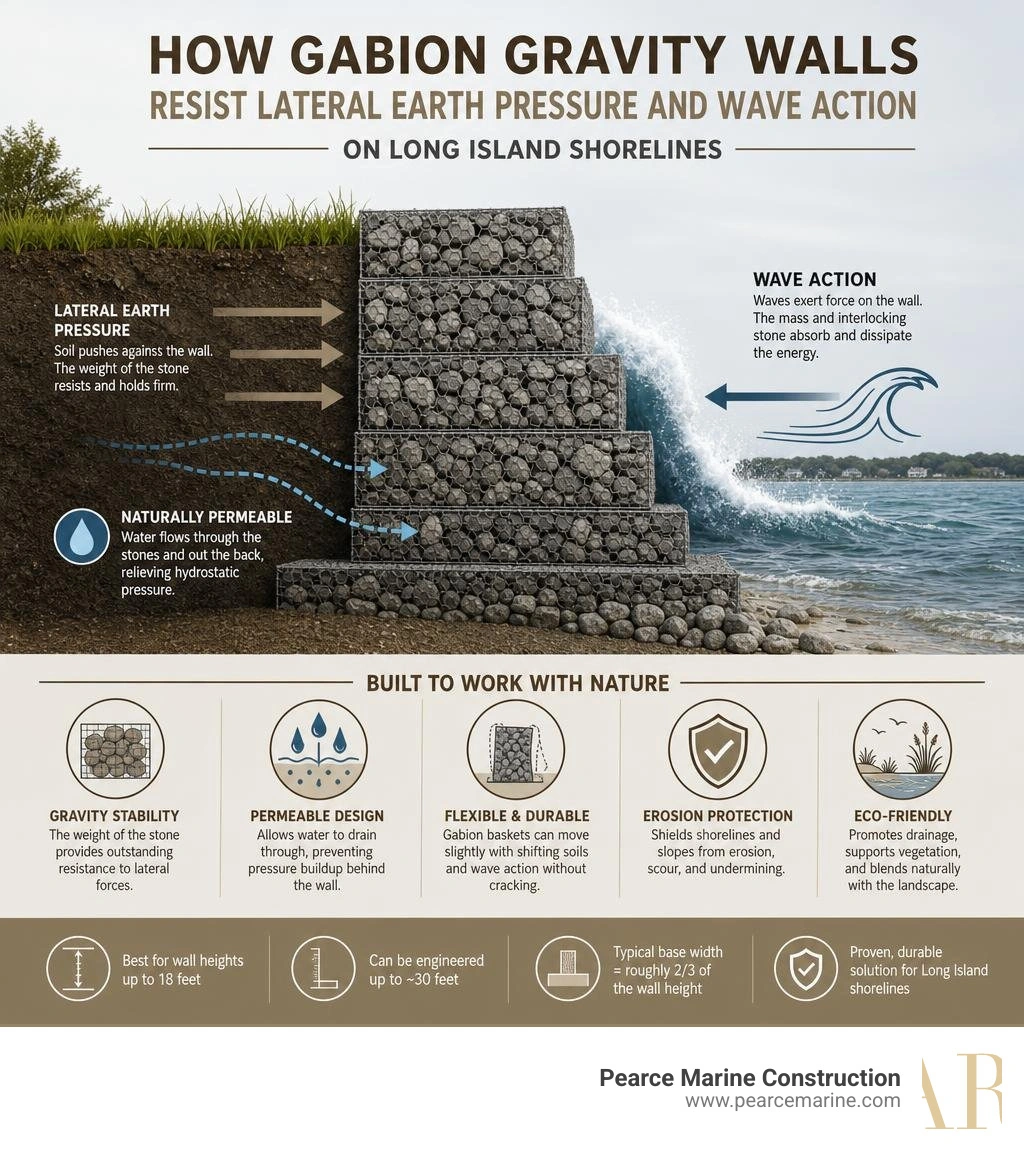
- Mass Gravity Structures: We construct walls using heavy-gauge wire mesh baskets filled with dense, angular rock (such as granite or basalt) to resist lateral soil and wave pressures.
- Natural Hydrostatic Relief: The inherent permeability of our gabion systems allows water to drain freely, preventing dangerous pressure buildup behind the wall.
- Structural Flexibility: Unlike rigid concrete, our gabion walls flex and settle naturally with ground movement without cracking or structural failure.
- Custom Engineering: We design walls optimized for heights up to 18 feet, and can engineer specialized structures up to 30 feet for severe slope stabilization.
- Optimal Footprints: We calculate precise base widths—typically 2/3 of the wall height—to ensure absolute structural stability against sliding and overturning.
For homeowners in Nassau and Suffolk Counties—from Southampton and West Hampton to West Islip—coastal erosion, wave action, and unstable bluffs require professional-grade intervention. Our marine construction team addresses these threats with heavy-duty gabion systems built to last.
Gabions have a proven track record in marine civil engineering. Today, Pearce Marine Construction utilizes these systems as a premier choice for waterfront slope stabilization and shoreline protection along Long Island's bays, canals, and inlets.
This guide outlines the professional engineering principles, material specifications, and heavy construction techniques we use to secure your waterfront property.
Glossary for gabion basket retaining wall:
Engineering and Benefits of a Gabion Basket Retaining Wall
When we design shoreline infrastructure in challenging marine environments, we have to account for immense physical forces. Traditional rigid structures, like poured concrete or concrete masonry units (CMU), attempt to resist these forces through sheer, unyielding mass. However, when the ground shifts, or during severe freeze-thaw cycles on Long Island, rigid walls are highly prone to cracking and catastrophic failure.
A gabion basket retaining wall functions as a monolithic gravity retaining wall. Its structural stability is derived from its massive self-weight, friction, and the mechanical interlock of the stone fill.
The single greatest engineering advantage of a gabion wall is its structural flexibility. Because the wire baskets can deform slightly without losing their structural integrity, the wall easily accommodates differential ground settlement and minor soil movements. Instead of cracking, a gabion wall simply settles and conforms to the changing contours of the earth.
To understand how gabions compare to other popular marine options, consider this comparison:
| Feature | Gabion Basket Retaining Wall | Traditional Timber Bulkhead |
|---|---|---|
| Primary Mechanism | Mass gravity and stone interlock | Soil anchors and structural sheeting |
| Permeability | Extremely high (30% to 40% porosity) | Impermeable (requires separate weep holes) |
| Flexibility | Highly flexible; absorbs ground movement | Semi-rigid; susceptible to bowing or snapping |
| Wave Energy | Dissipates wave energy through rock voids | Deflects wave energy, potentially scouring the toe |
| Lifespan | 50 to 60+ years (with PVC/Galfan coating) | 20 to 30 years (subject to marine borers) |
Through careful Gabion Retaining Wall Design, we can customize these gravity structures to match the specific soil bearing capacities and wave conditions of your waterfront property.
Structural Design of a Gabion Basket Retaining Wall for Slopes
Designing a retaining wall for a steep waterfront slope requires precise mathematical ratios. A conservative, industry-standard rule of thumb is that the base width of the wall must equal approximately 2/3 of its total height. For example, a 12-foot-tall wall requires a base basket depth of at least 8 feet to safely resist sliding and overturning forces.
Additionally, we design these walls with a "wall batter"—a deliberate backward tilt of approximately 6 degrees (or a 1:10 to 1:6 slope ratio) leaning into the soil being retained. This angle shifts the center of gravity backward, significantly increasing the wall's resistance to lateral earth pressures.
While gabion gravity walls can be engineered up to 30 feet in height under specific conditions, they are most efficient and stable at heights of 18 feet or less. For taller or highly loaded slopes, a professional marine contractor must perform a comprehensive global stability analysis. If you are dealing with a failing bluff or sliding shoreline, you can read more about our professional solutions for a retaining wall for slope or contact experienced slope stabilization contractors to evaluate your site.
Durability, Coatings, and Rock Fill Specifications
The longevity of a gabion basket retaining wall in brackish or saltwater environments depends entirely on wire metallurgy and coating technology. Standard galvanized wire will quickly corrode when exposed to the harsh, salty air of West Islip or West Hampton.
To prevent this, we utilize two primary wire specifications:
- Galfan Coating: A high-performance zinc-aluminum alloy coating that provides up to three times the service life of standard galvanizing.
- PVC Coating: A thick, protective polyvinyl chloride sleeve extruded over Galfan-coated steel wire. This is the gold standard for marine and coastal applications, projecting a service life of 60+ years.
For primary structural retaining walls, we specify double-twisted hexagonal woven wire mesh compliant with ASTM A975 standards. Woven mesh is self-locking; if a single wire breaks, the double-twist prevents the mesh from unravelling. For architectural elements or lower, highly aligned walls, heavy-duty welded mesh (utilizing thick vertical rods and structural C-profiles) offers superior rigidity to prevent face bulging.
The rock fill inside the baskets must also meet strict engineering criteria. We use hard, durable, non-friable angular stones—such as granite, basalt, or dense limestone—with a specific gravity of no less than 2.5. The stone size must range between 4 and 8 inches (roughly 1.5 to 2 times the mesh opening size) to ensure the rocks cannot escape the baskets. Angular stones are critical because they lock together under pressure, creating a dense, stable mass with a high unit weight (often between 138 and 180 lbs/cubic foot depending on the stone type).
Permeability and Hydrostatic Pressure Relief
Hydrostatic pressure—the pressure exerted by water trapped behind a retaining wall—is the leading cause of retaining wall failures globally. When heavy rains saturate the soil behind a solid concrete wall, the weight of the water pushes outward with immense force.

Gabion walls inherently solve this problem. Because they are filled with large, angular stones, they have a natural porosity of 30% to 40%. This massive void ratio allows water to flow freely through the structure. Rainwater, tides, and seasonal runoff pass right through the wall face, completely eliminating hydrostatic pressure buildup.
To keep the soil behind the wall from washing out through the rock voids, we install a heavy-duty, non-woven geotextile filter fabric directly between the rear face of the gabion baskets and the backfill soil. This fabric acts as a high-performance filter: it allows water to drain freely while holding back even the finest silt and sand particles. Understanding How Gabion Retaining Walls Work highlights why they are so superior for marine environments, especially when compared to traditional, impermeable waterfront retaining walls.
Professional Installation and Shoreline Stabilization Services
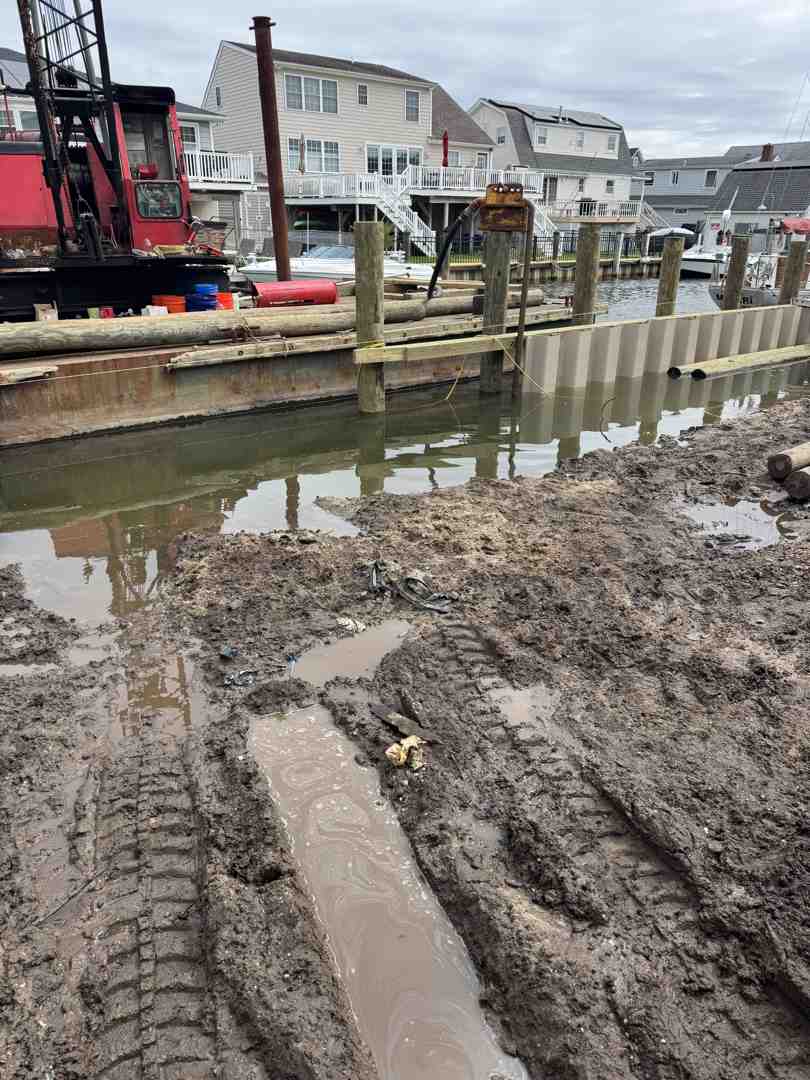
Building a marine-grade gabion wall is not a manual-labor project for a weekend warrior. It requires heavy machinery, precise grading, and professional execution to ensure the structure survives the brutal coastal storms of Long Island.
Marine Applications of a Gabion Basket Retaining Wall on Long Island
On the waterfronts of Nassau and Suffolk Counties, gabion walls serve as highly effective bulkheads, seawalls, and revetments. Unlike vertical concrete walls that abruptly reflect wave energy—which causes severe erosion and "scouring" at the base of the wall—gabion walls absorb and dissipate wave energy. As a wave hits the porous face of a gabion basket, the water rushes into the rock voids, losing its destructive force before it can damage your property.
Whether you are protecting a low-lying lawn in Babylon or stabilizing a steep bluff in Cold Spring Harbor, gabion systems offer a highly durable, environmentally friendly alternative to traditional steel or vinyl sheeting. To learn more about how we design these systems for coastal properties, explore our comprehensive shoreline stabilization guide 2026 or view our dedicated seawalls and bulkheads services.
Professional Foundation Preparation and Construction Steps
The longevity of any gravity structure depends entirely on its foundation. Our professional installation process follows a strict sequence:
- Excavation and Subgrade Preparation: We excavate the footprint of the wall, removing all organic matter, loose topsoil, and soft clay. The subgrade is compacted thoroughly to support the massive weight of the stone-filled baskets.
- Base Construction: We place a 4-to-8-inch level base of compacted crushed aggregate. This creates a stable, well-draining foundation that resists frost-heaving during freezing winter temperatures.
- Geotextile Installation: The non-woven geotextile filter fabric is laid along the back of the excavation trench and up the slope to prevent soil migration.
- Basket Assembly and Alignment: Empty PVC- or Galfan-coated baskets are assembled on-site. We join the baskets using heavy-duty lacing wire or stainless steel hog rings. Baskets are placed with their length dimension running from the back to the front of the wall to maximize structural stability.
- Layered Filling and Internal Bracing: Baskets are filled in 12-inch lifts. To prevent the wire mesh from bulging outward, we install internal connecting wires (bracing wires) across the cells at every 1-foot height interval.
- Hand-Packing the Face: While the core of the baskets can be mechanical-filled, our crews hand-pack the visible front face with select angular stones. This ensures a tight, interlocking, and visually striking stone facade.
- Lid Lacing: Once filled, the lids are tightly laced to the sides and diaphragms of the baskets, creating a single, monolithic mass.
For a deeper dive into structural specifications, read our retaining wall construction guide.
Why Choose Pearce Marine Construction
At Pearce Marine Construction, we are a woman-owned marine construction company with generational expertise in safeguarding Long Island’s coastlines. Our meticulous craftsmanship and deep engineering knowledge allow us to consistently outperform other marine contractors through superior engineering and local coastal expertise. We don't believe in one-size-fits-all solutions; we engineer every project to match the precise soil conditions, wave heights, and tidal ranges of Nassau and Suffolk Counties.
From the estate bluffs of Southampton to the canal properties of West Islip and the beachfronts of West Hampton, we build waterfront structures designed to stand the test of time.
Ready to secure your shoreline with a professionally engineered gabion basket retaining wall? Contact the experts at Pearce Marine Construction today to schedule a site evaluation.



Bring Your Vision to Life
Whether you're planning a custom dock, seawall, or boat lift, our experienced team is ready to deliver high-quality marine construction tailored to your needs. Pearce Marine Construction brings craftsmanship, precision, and a deep understanding of Florida’s waterways to every project. Let us help you create a durable, beautiful solution that stands the test of time. Get in touch now for a personalized estimate!