
Shoreline Erosion Control Solutions: Making Waves Without Losing Ground

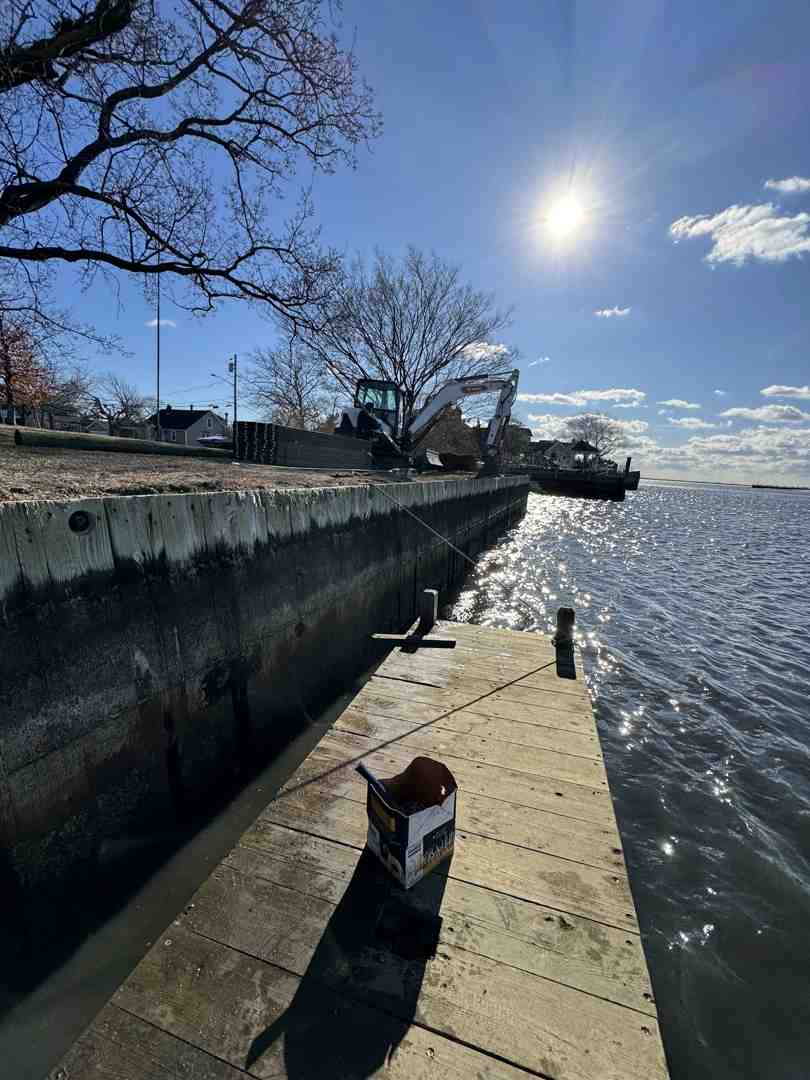
Professional Shoreline Erosion Control Solutions for Long Island Property Owners
Shoreline erosion control solutions installed by Pearce Marine Construction are the most important investment a waterfront property owner can make to protect their land, structures, and long-term property value.
Here is a quick overview of the most effective professional options:
| Solution Type | Best For | Key Benefit |
|---|---|---|
| Bulkheads & Seawalls | High wave energy zones | Strong vertical barrier; stops land loss fast |
| Rock Revetment (Riprap) | Moderate to high energy | Absorbs and dissipates wave force |
| Living Shorelines | Calmer, sheltered areas | Eco-friendly; stabilizes naturally over time |
| Bioengineered Systems | Ponds, streams, canal banks | Vegetation-integrated; low maintenance |
| Concrete Block Mats | Slopes, spillways, levees | Permeable, flexible, and durable |
Long Island has over 1,180 miles of shoreline. That means an enormous amount of waterfront property — in Nassau County, Suffolk County, Southampton, West Islip, West Hampton, and beyond — requires professional stabilization to withstand constant hydraulic pressure.
Tidal action, storm surges from Nor'easters and hurricanes, boat wakes in busy canals, and steadily rising sea levels all chip away at the land beneath your feet. The result is lost land, damaged foundations, and reduced property values.
Modern shoreline erosion control has advanced significantly. From traditional hard armoring like vinyl bulkheads and riprap to bioengineered living shorelines, Pearce Marine Construction provides proven, durable solutions matched to every site condition and energy level. This guide details the professional construction methods we utilize to protect your property.
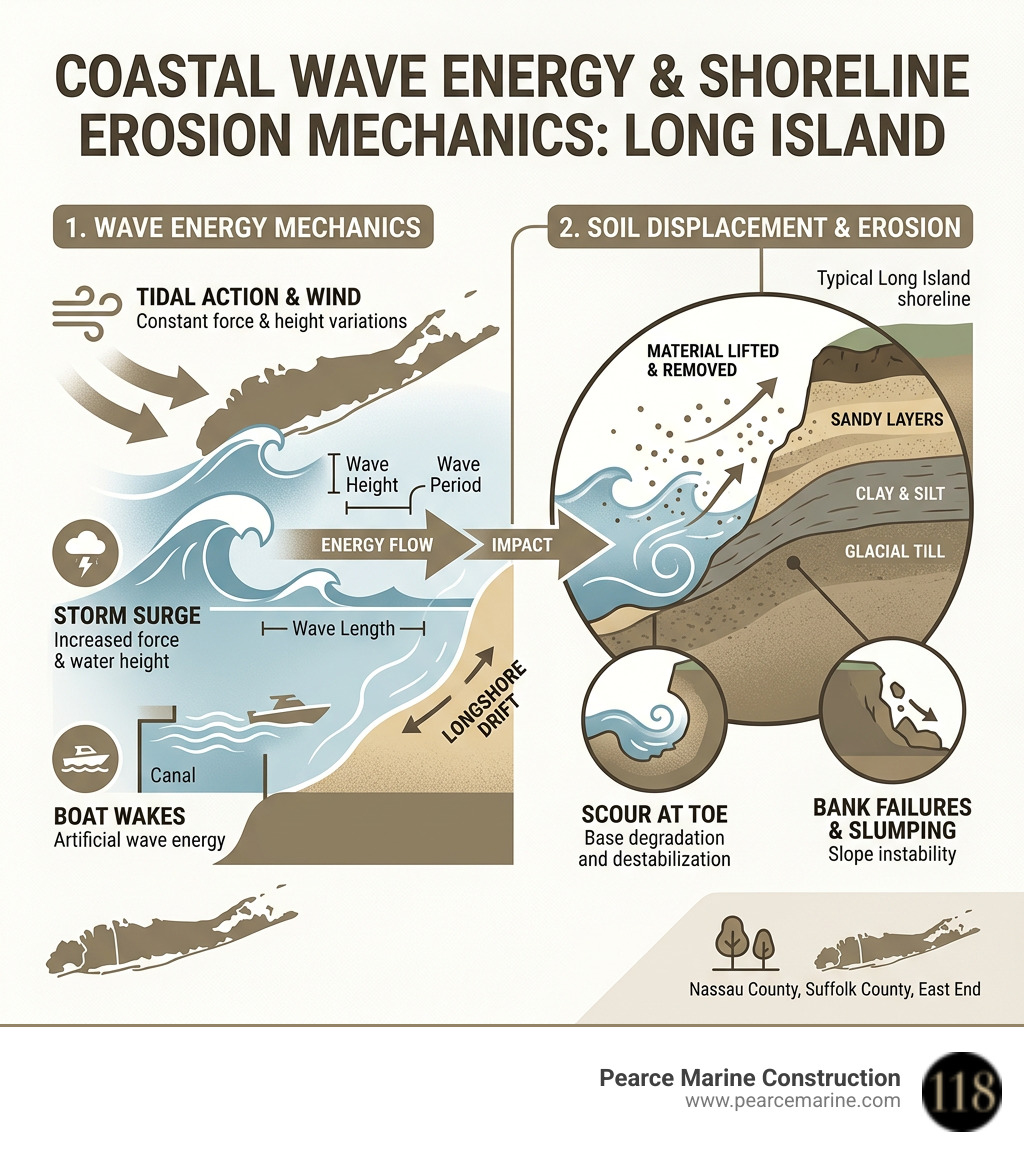
Engineering Effective Shoreline Erosion Control Solutions
When we talk about engineering shoreline erosion control solutions, we aren’t just throwing rocks at a problem and hoping they stay put. Effective coastal engineering requires a deep understanding of the unique geology found across Long Island. From the sandy reaches of Southampton to the more varied strata of the North Shore, the soil composition (or "strata") dictates which construction methods will hold firm and which will wash away during the next big blow.
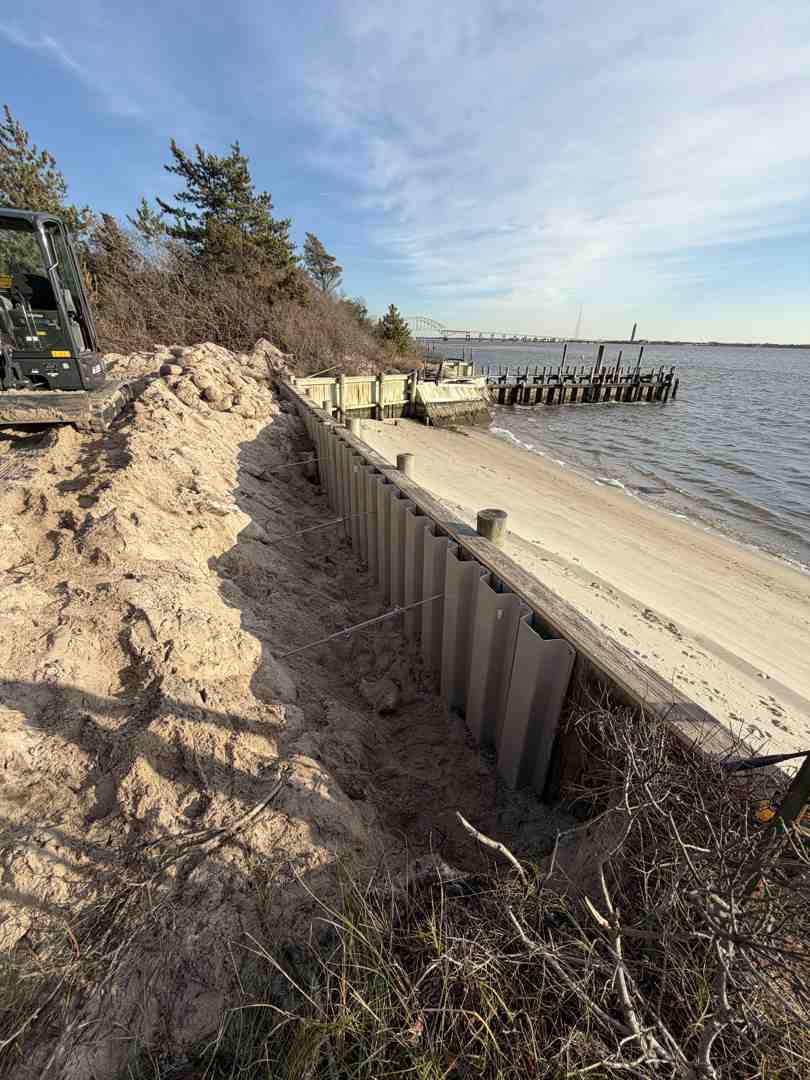
Engineering a solution involves calculating wave energy—the force with which water strikes your property. In high-energy zones, such as properties facing the open Atlantic or wide bays like the Great South Bay, the engineering must prioritize structural rigidity and energy deflection. In more sheltered canals in Massapequa or Merrick, the focus shifts toward managing boat wakes and maintaining vertical stability.
Structural Durability vs. Wave Energy Tolerance
| Method | Durability Rating | Wave Energy Tolerance | Maintenance Level |
|---|---|---|---|
| Vinyl Bulkhead | High (30+ years) | High | Low |
| Timber Bulkhead | Moderate (20 years) | Moderate | Moderate |
| Rock Revetment | Very High | Very High | Low |
| Bioengineered Mesh | Moderate | Low to Moderate | Moderate |
| Articulated Concrete | High | Moderate to High | Low |
Successful engineering also accounts for hydrostatic pressure. This is the pressure exerted by water trapped in the soil behind a structure. Without proper drainage, this pressure can push a bulkhead outward or cause a seawall to fail. We utilize modern materials and drainage techniques to ensure that the land stays on your side of the wall while the water stays on the other.
Hard Armoring: Bulkheads and Seawalls for High-Energy Zones
For many Long Island homeowners, "hard armoring" is the gold standard of protection. These are vertical or near-vertical structures designed to provide a definitive line of defense against the sea.
Vinyl Sheathing and Timber Piles
Modern bulkheads often utilize high-grade vinyl sheathing, such as C-Loc systems. Unlike old-fashioned wood that can rot or be attacked by marine borers, vinyl is impervious to the elements and maintains its structural integrity for decades. We drive these sheets deep into the bay floor, supported by heavy timber piles that provide the "skeleton" of the structure.
Composite Capping and Batter Piles
To finish a bulkhead with both strength and style, we often use composite capping (like Timber Tech) or aluminum grating. This protects the top of the structure from UV damage and foot traffic. For added stability in areas with soft soil or high storm vulnerability, we install batter piles—piles driven at an angle to provide extra resistance against the "push" of the land and the "pull" of the tide.
If you are considering a new installation or a repair, you can find More info about bulkhead services on our specialized service page. For a deeper dive into the regional challenges we face, check out our Shoreline Protection Long Island Guide.
Rock Revetments and Riprap Shoreline Erosion Control Solutions
If a bulkhead is a shield, a rock revetment is a sponge. Also known as riprap, these solutions consist of strategically placed stones and boulders that absorb and dissipate wave energy rather than reflecting it.
How It Works
When a wave hits a flat, vertical wall, the energy has nowhere to go but up and down (often scouring the bottom and weakening the foundation). When a wave hits a Rock Revetment, the energy is broken up as the water flows into the gaps between the stones. This makes it one of the most effective Coastal Erosion Control methods for properties with enough space to accommodate a sloped barrier.
Strategic Stone Placement
We don't just dump rocks; we engineer them. We use various sizes of stone, starting with a core of smaller "filter" stone and finishing with massive "armor" stones that can weigh several tons each. This layering prevents the underlying soil from washing out through the rocks (a process called piping) while providing a heavy, interlocking exterior that even a hurricane struggles to move.
Bioengineered and Living Shoreline Erosion Control Solutions
For properties in more sheltered areas—like the canals of Bellmore or the inner harbors of Huntington—a "soft" approach is often preferred. A living shoreline is a nature-based method for stabilizing a shoreline using natural materials like plants, sand, and organic fiber.
Coir Logs and Native Plantings
One of the most common bioengineered tools is the coir log—a dense roll of coconut fiber. We anchor these at the water's edge to provide immediate stabilization. Over time, native wetland plants are tucked into the logs. As the plants grow, their root systems weave through the fiber and into the soil, creating a permanent, "living" wall that actually gets stronger as it matures.
Innovative Bioengineered Products
Several high-tech products have revolutionized this space:
- ShoreSOX®: This is a high-density polyethylene mesh system filled with local sediment or dredged material. It creates an immediate, weight-bearing slope that can be fully vegetated, making it nearly invisible once the grass grows in.
- Flexamat®: A permanent erosion control mat that consists of concrete blocks locked together with high-strength geogrid. It allows vegetation to grow through it while providing the "teeth" needed to stop erosion from waves and ice.
- Shoreblock®: These articulated concrete blocks offer up to 20% open area for vegetation and hydrostatic pressure relief. Research shows that once revegetated, the force needed to remove a single block can be 20 times its own weight!
For those looking for a blend of aesthetics and function, our Shoreline Stabilization Services can help design a custom hybrid approach.
Professional Installation and Long-Term Shoreline Protection
You could have the best materials in the world, but if they aren't installed correctly, the Atlantic Ocean will find the weakness. Professional installation is the difference between a bulkhead that stands for 40 years and one that leans after the first Nor'easter.
The Importance of Site Analysis
Before we drive a single pile, we conduct a thorough site analysis. This includes evaluating the bank erosion rate, elevation, and prevailing wind direction. We also look at adjacent shorelines; if your neighbor has a hard bulkhead and you have a soft bank, your property might experience "end-around" erosion as waves deflect off their wall and into your land.
Precision Pile Driving
In places like West Hampton and Bayshore, the depth of the "firm" soil layer can vary. We use professional pile-driving equipment to ensure every support post reaches the required "refusal" point or depth. This ensures the structure can handle the massive weight of the backfill and the relentless pressure of the tides.
Scientific evidence on living shoreline storm performance shows that well-designed, professionally installed shorelines—especially those incorporating natural elements—often perform better during major storms than poorly planned hardened structures.
Structural Reinforcement and Anchoring Systems
A bulkhead is only as strong as what’s holding it back. Most people only see the front of the wall, but the real magic happens underground.
Tiebacks and Deadmen Anchors
To prevent a bulkhead from tipping toward the water, we use a system of tiebacks and deadmen. A "deadman" is a heavy anchor (usually a large timber or concrete block) buried deep in the yard, far behind the wall. A steel or composite rod connects the bulkhead to this anchor, essentially "tying" the wall to the stable earth of your property.
Helical Piles
In some cases, traditional deadmen aren't feasible due to existing structures or pool decks. In these scenarios, we use helical piles—large steel screws that are bored deep into the earth at an angle. These provide incredible tension resistance and are a staple of modern Coastal Engineering Solutions.
To learn more about the technical side of keeping your property in place, see our guide on Erosion Control Solutions.
Maintenance and Repair of Coastal Shoreline Erosion Control Solutions
Even the toughest shoreline erosion control solutions require a check-up now and then. The dynamic environment of Long Island means that sand is always moving.
Backfilling and Grading
One of the most common maintenance tasks is backfilling. Over time, soil can settle or small amounts can escape through tiny gaps. If you notice "sinkholes" appearing behind your bulkhead, it’s time to call us. We use specialized equipment to add fresh fill and regrade the area to ensure water flows away from the shoreline.
Structural Audits
We recommend a structural audit every few years, especially after a major storm season. We check for:
- Loose or rusted hardware (bolts and washers).
- Cracks in vinyl or rot in older timber.
- Scouring at the base of the structure (where the water has dug a hole).
- Integrity of the capping and decking.
By following Shoreline Erosion Best Practices, you can extend the life of your investment by decades. If you’re already seeing signs of trouble, don't wait—explore our Shoreline Erosion Solutions for repair options.
Choosing a Long Island Marine Contractor for Shoreline Erosion Control Solutions
When it comes to protecting your slice of Long Island, experience in marine construction isn't just a bonus—it's a requirement. Pearce Marine Construction is a woman-owned company with generational expertise in the unique conditions of Nassau and Suffolk Counties.
Whether you are in West Islip, Southampton, Cold Spring Harbor, or Lloyd Harbor, we understand the local tides and the local soil. We don't believe in "one size fits all" solutions. Every property is different, and every client deserves a shoreline that is as beautiful as it is durable.
We take pride in our meticulous craftsmanship. From the first pile driven to the final screw in your custom deck, we treat your property like it’s our own. We’ve seen what the ocean can do to the unprepared, and we’ve made it our mission to ensure our clients aren't among them.
If you’re ready to stop losing ground and start making waves with a professional, custom-engineered solution, contact us today. We are proud to be among the top Shoreline Protection Contractors on the island, and we’re ready to get to work for you.
Frequently Asked Questions
How much do these solutions cost?Costs vary based on the length of the shoreline and the energy level of the site. However, systems like Shoreblock® can often be 20-50% more cost-effective than traditional poured concrete, while vinyl bulkheads offer the best long-term ROI due to their 30+ year lifespan.
How long does installation take?A typical residential bulkhead or rock revetment can take anywhere from one to three weeks once the equipment is on-site, depending on the weather and the complexity of the anchoring systems.
Is a living shoreline as strong as a bulkhead?In the right environment (low to moderate energy), yes! In fact, living shorelines can be more resilient because they grow and adapt, whereas a bulkhead only gets older and weaker over time. However, for high-energy Atlantic-facing properties, a hard or hybrid solution is usually necessary.
Pearce Marine Construction serves Nassau and Suffolk Counties, including Massapequa, Merrick, Wantagh, Bellmore, Brightwaters, West Islip, Babylon, West Hampton, South Hampton, Bayshore, Cold Spring Harbor, Huntington, and Lloyd Harbor.



Bring Your Vision to Life
Whether you're planning a custom dock, seawall, or boat lift, our experienced team is ready to deliver high-quality marine construction tailored to your needs. Pearce Marine Construction brings craftsmanship, precision, and a deep understanding of Florida’s waterways to every project. Let us help you create a durable, beautiful solution that stands the test of time. Get in touch now for a personalized estimate!